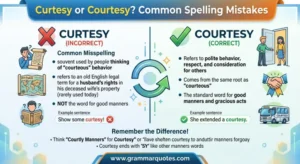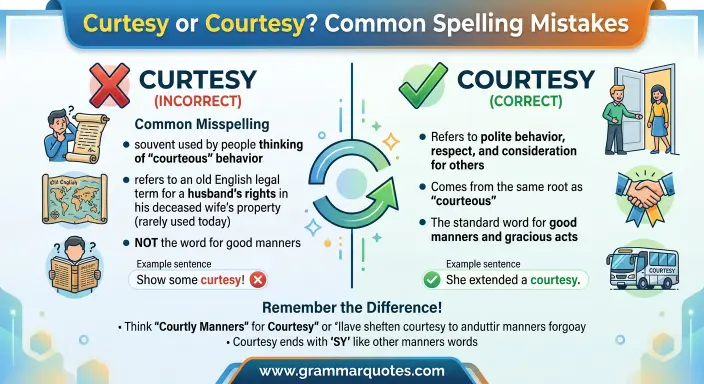
Courtesy is the correct word when you mean politeness, good manners, or respectful behavior. Curtesy is a rare legal and historical term that traditionally refers to a husband’s life interest in certain property belonging to his deceased wife. Although these words look and sound similar, their meanings are very different.
For example, you might say, “Thank you for your courtesy,” when thanking someone for being polite. In a historical legal text, however, curtesy may refer to a specific property right.
Choosing the correct spelling is important because using one word in place of the other can change the meaning of your sentence. Most everyday writing requires courtesy, especially when discussing manners, respect, customer service, or professional communication.
In this guide, you will learn the meanings of both words, their differences, common mistakes, and how to use them correctly. You will also find practical examples, related expressions, and answers to frequently asked questions.
Quick Answer: Curtesy vs Courtesy
- Courtesy: Politeness, good manners, or considerate behavior.
- Curtesy: A rare historical legal term concerning a husband’s interest in certain property of his deceased wife.
Examples:
- Thank you for your courtesy.
- The legal historian explained the old property right known as curtesy.
Easy rule: Use courtesy when talking about politeness or respect. Use curtesy only when discussing its specific historical legal meaning.
What Does Courtesy Mean?
Courtesy is a noun that means polite, respectful, and considerate behavior toward other people. It can also refer to a polite act or a service provided without charge.
Courtesy helps people communicate respectfully at home, at school, at work, and in public places.
Definition and Meaning of Courtesy
- Part of speech: Noun
- Pronunciation: KUR tuh see
- Plural: Courtesies
Examples:
- She treated every guest with courtesy.
- Thank you for your courtesy and support.
- Basic courtesy makes conversations more pleasant.
- The company provides a courtesy shuttle to the airport.
- He showed courtesy by holding the door open.
In these sentences, courtesy refers to good manners, respectful actions, or a helpful service.
Common Uses of Courtesy
1. Polite behavior
Courtesy means treating others with respect and consideration.
Example: “Please show courtesy to your classmates.”
2. A polite act
It can describe a small action that demonstrates good manners.
Example: “As a courtesy, she informed her neighbor about the noise.”
3. A free service
Businesses sometimes use courtesy to describe a service offered without an additional charge.
Example: “Guests can use the courtesy bus to reach the hotel.”
4. Attribution or acknowledgment
The expression courtesy of identifies the person or organization that provided something.
Example: “The photographs are courtesy of the local museum.”
What Does Curtesy Mean?
Curtesy is a rare legal and historical noun. Traditionally, it refers to a husband’s right, under certain historical legal systems, to receive a life interest in qualifying property of his deceased wife, subject to specific conditions.
The details depended on the applicable law. The term is mainly encountered in historical legal documents and discussions of property law.
Definition and Meaning of Curtesy
- Part of speech: Noun
- Usage: Historical and legal
- Context: Traditional property rights
Examples:
- The historian discussed the doctrine of curtesy in old property law.
- The legal text explained the conditions attached to curtesy.
- Students examined how historical rules concerning curtesy differed from modern property laws.
These examples illustrate the specialized meaning of the term. It is not the correct spelling when you want to express politeness.
Is Curtesy a Misspelling of Courtesy?
Not always. Curtesy is a recognized historical legal term. However, if you are writing about manners, respect, or polite behavior, it is almost certainly a spelling mistake.
For example:
- Incorrect for the intended meaning: “Thank you for your curtesy.”
- Correct: “Thank you for your courtesy.”
The correct choice depends on the meaning you want to communicate.
Curtesy vs Courtesy: Key Differences
| Feature | Curtesy | Courtesy |
| Meaning | A historical property law right | Politeness or considerate behavior |
| Part of speech | Noun | Noun |
| Common usage | Rare and specialized | Very common |
| Typical context | Historical legal writing | Everyday and professional communication |
| Example | The text discussed curtesy. | She showed courtesy to everyone. |
| Everyday choice | Rarely needed | Correct for manners and respect |
The main difference is the meaning. Courtesy is the word you normally need in everyday English, while curtesy belongs to a narrow historical legal context.
When Should You Use Curtesy or Courtesy?
The easiest way to choose the correct word is to identify the subject of your sentence.
Use Courtesy for Politeness
Use courtesy when discussing manners, respectful communication, considerate actions, or certain complimentary services.
Examples:
- Please treat everyone with courtesy.
- He answered the question with courtesy.
- The hotel offers a courtesy shuttle.
- Thank you for your courtesy during the meeting.
- Good customer service begins with courtesy.
If the sentence is about kindness, respect, or good manners, courtesy is generally the correct choice.
Use Curtesy for Historical Legal Contexts
Use curtesy only when the specific historical property law meaning is intended.
Example:
- The researcher studied curtesy as part of the history of inheritance law.
This term is uncommon in modern everyday English. If you encounter it in a legal document, consult the relevant historical context because its legal implications depend on the applicable rules.
Common Mistakes with Curtesy and Courtesy
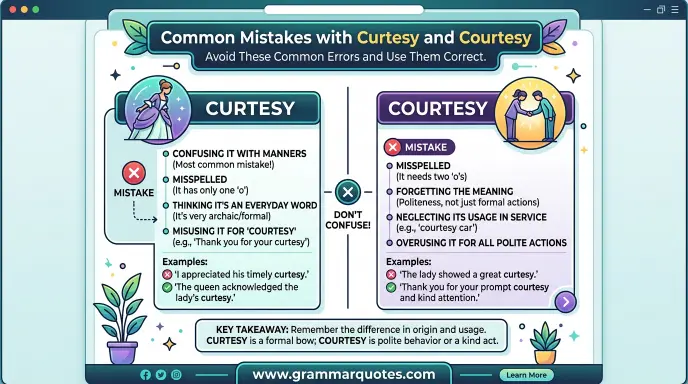
Mistake 1: Writing Curtesy When You Mean Politeness
Incorrect:
Thank you for your curtesy.
Correct:
Thank you for your courtesy.
Why? The sentence expresses gratitude for polite behavior, so courtesy is correct.
Mistake 2: Using Curtesy in Customer Service
Incorrect: Our staff always provides excellent curtesy.
Correct: Our staff always provides excellent courtesy.
Why? The sentence describes respectful service rather than a historical legal right.
Mistake 3: Assuming Curtesy Is Never a Real Word
Incorrect assumption: “Curtesy” is always a spelling error.
Correction: Curtesy is a genuine but rare historical legal term. It is inappropriate only when used in place of courtesy for everyday meanings.
Mistake 4: Confusing Courtesy with a Complimentary Service
The word courtesy can refer to polite behavior or a service provided without charge.
Examples:
- The receptionist treated us with courtesy. (Polite behavior)
- The hotel provides a courtesy car. (A service offered to guests)
Understanding the context helps you interpret the word correctly.
Courtesy vs Curtesy: Everyday Examples
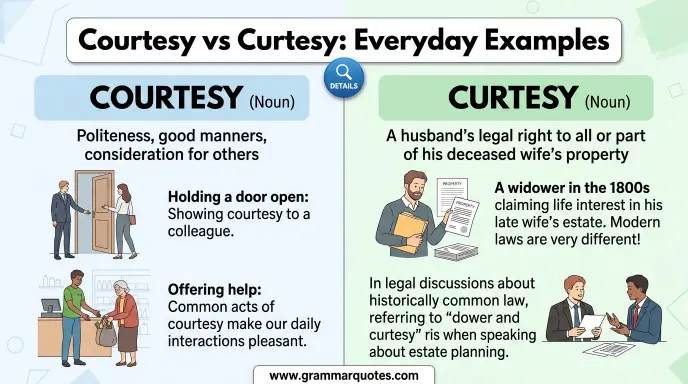
| Context | Correct Example |
| School | Students should treat teachers with courtesy. |
| Workplace | She responded to the complaint with courtesy. |
| Customer service | The company offers a courtesy call. |
| Travel | A courtesy shuttle takes guests to the airport. |
| Family | He showed courtesy by helping his grandparents. |
| Conversation | Please speak with courtesy. |
| History | The book examined the old legal doctrine of curtesy. |
| Property law | The historian explained the historical rules of curtesy. |
These examples show why courtesy is the correct choice in most everyday situations.
Courtesy vs Courteous: What Is the Difference?
Courtesy is a noun, while courteous is an adjective.
- Courtesy: Polite or considerate behavior.
- Courteous: Showing politeness or consideration.
Examples:
- Thank you for your courtesy.
- The receptionist was courteous to every visitor.
Other related forms include:
- Courteously: In a polite or respectful manner.
- Discourteous: Rude or lacking in politeness.
Examples:
- She spoke courteously to the customer.
- Interrupting someone repeatedly can seem discourteous.
Learning these related words can help you use the word family accurately.
Synonyms and Antonyms of Courtesy
Understanding related words makes it easier to express the same idea in different ways.
Synonyms of Courtesy
Depending on the context, synonyms include:
- Politeness: Good manners and respectful behavior.
- Respect: Recognition of another person’s worth.
- Civility: Courteous and considerate conduct.
- Consideration: Thoughtfulness toward other people.
- Manners: Accepted ways of behaving socially.
- Kindness: Friendly and caring behavior.
Example: “She treated the visitors with courtesy” can also be expressed as “She treated the visitors with politeness and respect.”
These words overlap, but they are not identical in every context.
Antonyms of Courtesy
Possible antonyms include:
- Rudeness: Impolite behavior.
- Disrespect: A lack of respect.
- Discourtesy: A failure to show good manners.
- Incivility: Rude or disrespectful conduct.
- Impoliteness: Behavior that lacks politeness.
Example:
“His discourtesy upset the guests.”
Origin and History of Curtesy and Courtesy
Origin of Courtesy
The word courtesy developed from Old French courtoisie, associated with polite behavior and manners at a court. It entered English through the language of courtly life and gradually became a general word for respectful conduct.
Today, it is widely used in everyday conversation, professional communication, hospitality, and customer service.
Origin of Curtesy
Curtesy developed as a legal term in the history of English property law. It is associated with the traditional doctrine of a husband’s interest in certain property of his deceased wife.
Its use is now largely historical or specialized. It should not be confused with courtesy, despite the similarity in spelling.
British English vs American English
Both British and American English use courtesy to mean politeness or considerate behavior. The spelling is the same in both varieties.
Examples:
- British English: “Thank you for your courtesy.”
- American English: “Thank you for your courtesy.”
Curtesy is not a British or American spelling variant of courtesy. It has its own specialized historical legal meaning.
Google Trends and Search Usage
People may search for “curtesy vs courtesy” when checking a spelling mistake or trying to understand an unfamiliar word.
The word courtesy is common in everyday English, especially in phrases such as common courtesy, professional courtesy, and courtesy call. In contrast, curtesy is a rare term associated with historical property law.
Google Trends can help compare relative search interest in these terms across selected periods and locations. However, relative interest does not automatically reveal exact monthly search volume, so numerical claims should not be made without checking the data.
For writing, use courtesy naturally in content about etiquette, communication, customer service, and good manners. Explain curtesy when the distinction between the two terms is relevant to readers.
People Also Ask: Curtesy vs Courtesy
1. Is it curtesy or courtesy?
Courtesy is correct when referring to politeness or good manners. Curtesy is a rare historical legal term.
2. What does courtesy mean?
Courtesy means politeness, respect, or considerate behavior toward others. It can also refer to a complimentary service.
3. What does curtesy mean?
Curtesy traditionally refers to a husband’s life interest in certain property of his deceased wife under historical property law.
4. Is curtesy a real word?
Yes. It is a real but uncommon legal and historical term. It is not a standard alternative spelling of courtesy.
5. Why do people confuse curtesy and courtesy?
The words look and sound similar, and they differ by only one letter. Their meanings, however, are very different.
6. What is an example of courtesy?
“Thank you for your courtesy during the interview.” Here, courtesy refers to respectful and polite behavior.
7. What is another word for courtesy?
Depending on the context, alternatives include politeness, civility, respect, consideration, and good manners.
8. Is courtesy the same as courteous?
No. Courtesy is a noun, while courteous is an adjective describing someone who behaves politely.
9. Is courtesy spelled the same in British and American English?
Yes. Both British and American English use the spelling courtesy.
10. How do you remember the difference between curtesy and courtesy?
Remember that courtesy relates to courtesy and good manners in everyday life. Curtesy is associated with a specific historical property law concept.
Frequently Asked Questions
What is the difference between curtesy and courtesy?
Courtesy means politeness or considerate behavior. Curtesy is a rare historical legal term associated with certain property rights of a husband after his wife’s death.
Is “thank you for your curtesy” correct?
No, not if you mean politeness. The correct sentence is “Thank you for your courtesy.”
What does common courtesy mean?
Common courtesy refers to basic polite behavior, such as saying “please” and “thank you,” listening respectfully, and considering other people’s feelings.
What is the adjective form of courtesy?
The adjective is courteous, meaning polite and respectful. For example, “The staff were courteous and helpful.”
Is curtesy used in modern law?
The term may appear in historical legal discussions or specialized contexts. if any related property right applies today depends on the jurisdiction and its current laws.
Conclusion
The difference between curtesy and courtesy is important because the words have separate meanings. Courtesy is the everyday word for politeness, good manners, and considerate behavior. It is commonly used in personal conversations, professional emails, customer service, and social situations.
Curtesy, on the other hand, is a rare historical legal term traditionally associated with a husband’s interest in certain property of his deceased wife. It is not a suitable substitute for courtesy when talking about respect or polite behavior.
For example, write “Thank you for your courtesy” when appreciating someone’s good manners. Use curtesy only when discussing the specific historical legal concept.
The easiest way to remember the distinction is to connect courtesy with courtesy and good manners, while reserving curtesy for historical property law. Once you understand their meanings and contexts, you can choose the correct spelling with confidence in everyday and formal writing.
Discover More Articles!
Setup vs Set Up: Meaning, Difference, and Examples
Bike or Treadmill: Which Is Better for Exercise?
Bought or Brought: What Is the Difference?(2026)

Ethan Parker is an English-language writer known for his interest in words, language, and clear communication. His work focuses on making everyday English easier to understand through simple explanations and practical examples.