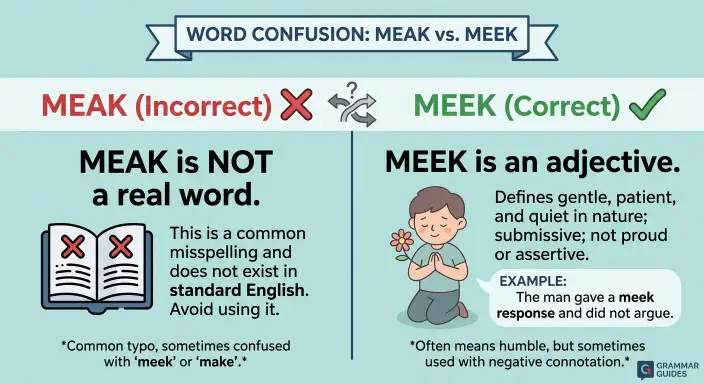
Meek is the correct standard English spelling, while meak is generally a misspelling. The word meek describes someone who is gentle, quiet, mild, or not likely to become angry or aggressive.
The confusion usually comes from pronunciation. Meek has a simple long “ee” sound, which can sometimes make unfamiliar writers guess the spelling incorrectly. However, the standard spelling is always meek when you mean gentle or submissive.
For example, you might say, “He is a meek and gentle person.” Here, meek describes someone who does not behave aggressively and may be quiet or patient.
The word can sometimes have a positive meaning, suggesting calmness, patience, or gentleness. In other situations, it can suggest a lack of confidence or willingness to stand up for oneself. The exact meaning depends on the context.
Understanding the correct spelling and meaning can help you use this word naturally in essays, stories, conversations, descriptions, and professional writing.
Meek or Meak : Quick Answer
Meek is the correct spelling.
Meak is generally incorrect when you mean someone who is gentle, quiet, or submissive.
Examples:
- Correct: He is a meek and gentle person.
- Incorrect: He is a meak and gentle person.
Simple Rule
Meek = correct
Meak = generally incorrect
The word meek is pronounced like “meek” and rhymes with words such as seek, week, and peak.
Definition and Meaning
Meek is an adjective used to describe someone who is gentle, mild, quiet, or submissive.
It can describe a person’s behavior, attitude, or personality.
Simple Meanings of Meek
Depending on the context, meek can mean:
- Gentle
- Quiet
- Mild
- Patient
- Humble
- Not aggressive
- Easily controlled or influenced
Example:
The meek child quietly followed the teacher.
Here, meek suggests a quiet and gentle nature.
Meek Can Have Different Tones
The word is not always negative.
In a positive context:
She remained meek and patient during the difficult situation.
Here, it suggests calmness and gentleness.
In a negative context:
He was too meek to defend his opinion.
Here, it suggests that the person may lack confidence or assertiveness.
The Origin of Meek
The word meek has a long history in English.
It comes from Old Norse and related Germanic forms. Its historical meaning was connected with being gentle, mild, or soft in behavior.
Over time, the word developed the meanings it has today, including gentleness, humility, patience, and submissiveness.
The spelling meek became established in English, while meak is not the standard modern spelling.
This is why writers should use meek when describing someone as gentle or mild.
British English vs American English
There is no major British American spelling difference for this word.
Both British English and American English use:
meek
The meaning and spelling remain the same.
| Feature | British English | American English |
| Correct spelling | meek | meek |
| Meaning | Gentle or submissive | Gentle or submissive |
| Meak | Incorrect | Incorrect |
| Pronunciation | Same | Same |
So, this is not a British versus American spelling issue.
Why Is “Meak” Incorrect?
The spelling meak may look reasonable because English contains many words with similar vowel patterns.
However, the established spelling is meek.
English spelling cannot always be predicted perfectly from pronunciation. Some words need to be learned as fixed spellings.
For example:
- seek
- week
- meek
- sleek
- peek
These words commonly use ee to represent the long “e” sound.
Therefore:
He was very meek.
not:
He was very meak.
Common Mistakes
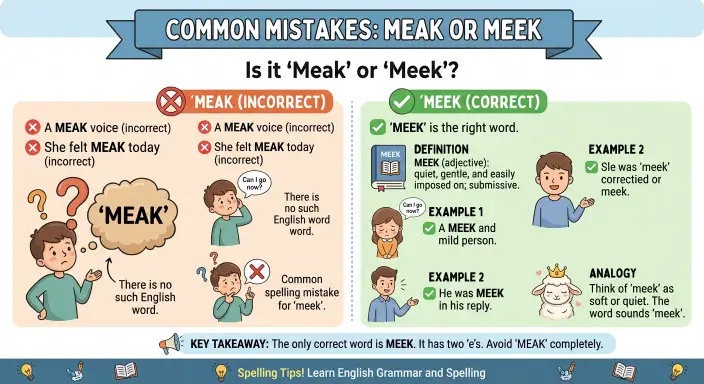
Mistake 1: Writing “meak”
Incorrect:
The boy was meak and quiet.
Correct:
The boy was meek and quiet.
Mistake 2: Confusing spelling with pronunciation
The word sounds simple, but its correct spelling uses ee.
Remember:
meek → ee
Mistake 3: Assuming “meak” is a different English word
In standard modern English, meak is not the normal spelling of the adjective meaning gentle or submissive.
Mistake 4: Thinking meek always means weak
Although meek can imply a lack of assertiveness in some contexts, it does not always mean weak.
Someone can be calm and gentle without being physically or mentally weak.
Meek in Everyday Examples
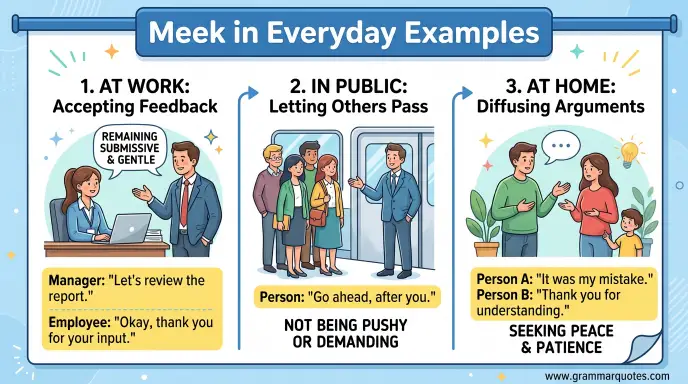
Describing a Person
He was a meek and quiet man.
Describing Behavior
She gave a meek response to the criticism.
In a Story
The meek character rarely argued with anyone.
In Formal Writing
The writer presents the character as meek and humble.
In Conversation
He seems meek, but he is very thoughtful.
These examples show that the meaning depends on the situation.
Meek vs Weak
These two words are sometimes confused because their meanings can overlap in certain contexts.
Meek describes behavior or personality that is gentle, quiet, mild, or submissive.
Weak generally describes a lack of strength, power, ability, or effectiveness.
Compare:
She is meek and avoids arguments.
She is physically weak after being sick.
A person can be meek without being physically weak.
Mild vs Meek
Meek and mild can sometimes describe similar behavior, but they are not identical.
Meek often describes a person’s attitude or willingness to avoid confrontation.
Mild can describe something that is not severe, strong, or intense.
Examples:
He has a meek personality.
The weather is mild today.
She gave a mild response.
Side by Side Comparison
| Feature | Meek | Meak |
| Standard English spelling | Yes | No |
| Meaning | Gentle, quiet, mild, submissive | Not the standard form |
| Adjective | Yes | No |
| Used in formal writing | Yes | No |
| British English | Yes | No |
| American English | Yes | No |
Which Spelling Should You Use?
Use meek whenever you want to describe someone or something as gentle, quiet, mild, humble, or submissive.
Examples:
He has a meek personality.
The character appears meek and humble.
She gave a meek reply.
Avoid meak in standard English writing.
If you are writing an essay, article, story, email, or school assignment, meek is the form you should use.
Google Trends and Usage
Searches for this spelling question usually come from people who hear or see the word meek and want to confirm its spelling or meaning.
Because meak is generally a misspelling, searches for the incorrect form may reflect spelling checks rather than genuine standard usage.
Google Trends data can change over time and vary between countries. Search frequency alone does not determine if a spelling is correct.
For practical writing, the important point is simple: meek is the established standard spelling.
People Also Ask
Is meak a correct word?
Meak is generally not the standard spelling when you mean gentle, quiet, or submissive.
Is meek the correct spelling?
Yes. Meek is the standard spelling.
What does meek mean?
Meek means gentle, mild, quiet, humble, or submissive, depending on context.
Is meek a positive word?
It can be positive when it describes gentleness, patience, or humility. In some contexts, it can suggest a lack of assertiveness.
Does meek mean weak?
Not necessarily. Meek describes behavior or attitude, while weak usually relates to strength, power, or ability.
How do you pronounce meek?
Meek is pronounced with a long “ee” sound, like seek or week.
Is meek British or American English?
Meek is standard in both British and American English.
What is the opposite of meek?
Depending on context, possible opposites include aggressive, assertive, bold, or forceful.
Can meek describe a person?
Yes. It is commonly used to describe someone’s behavior, personality, or attitude.
Why is meak wrong?
Meak is not the established standard spelling of the adjective. The correct spelling is meek.
Frequently Used Expressions
Meek and Mild
This phrase describes someone who is gentle, calm, and not aggressive.
He was known as a meek and mild person.
Meek Personality
This describes someone who is quiet, gentle, or submissive.
She has a naturally meek personality.
Meek Response
This describes a quiet or non confrontational response.
He gave a meek response to the criticism.
Meek Behavior
This refers to behavior that is gentle, quiet, or submissive.
His meek behavior surprised everyone.
Final Takeaway
The correct spelling is meek, not meak, when you want to describe someone as gentle, quiet, mild, humble, or submissive.
The word meek is used in both British and American English, so there is no regional spelling difference to remember. Its meaning can also change slightly depending on context. It may describe positive qualities such as gentleness, patience, and humility, or it may suggest a person is not very assertive.
A useful way to remember the spelling is to connect meek with words such as week, seek, and peek, which also use ee for the long “e” sound.
If you are writing a school assignment, article, story, email, or professional document, always choose meek. The form meak should generally be avoided in standard English.
Once you remember meek = correct, this spelling becomes much easier to use confidently.
Discover More Articles!
Paster or Pastor: Which Spelling Is Correct?
Broche or Brooch: Which Spelling Is Correct?(2026)
Trouper or Trooper: What Is the Difference?(2026)

Ethan Parker is an English-language writer known for his interest in words, language, and clear communication. His work focuses on making everyday English easier to understand through simple explanations and practical examples.