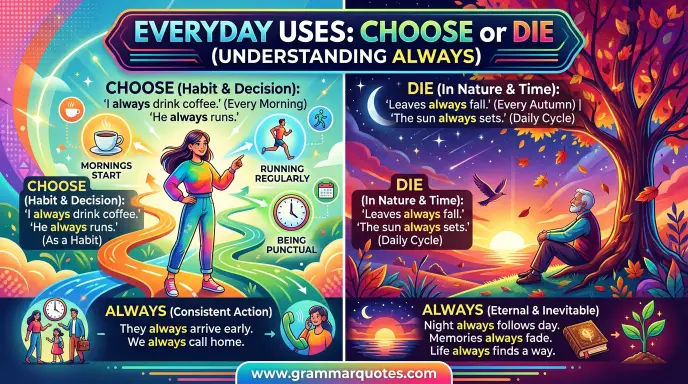
Many people come across the phrase Choose or Die and wonder what it means and how it should be used. Does it simply mean making a difficult choice, or does it have a deeper meaning? Learn the meaning, usage, context, and common interpretations of Choose or Die, with clear examples to make the phrase easy to understand.
People may search for “choose or die” because they want to understand if it is a normal English expression, what it means, or how to use it correctly. The phrase can sound threatening when taken literally, so context matters.
In this guide, you will learn what choose or die means, where the expression comes from, how it differs from similar phrases, and when it is appropriate to use. You will also see practical examples for everyday and formal writing.
Choose or Die : Quick Answer
Choose or die is a dramatic phrase that means you must make a choice, or you may face a very serious consequence.
For example:
- “You have to choose or die” can suggest that there is no way to avoid a decision.
- “It felt like a choose or die moment” describes a situation where a decision seemed extremely important.
- “Choose or die” can also be used for dramatic effect in fiction, entertainment, or informal speech.
The phrase is grammatically understandable, but its tone is very strong. In professional or academic writing, a less dramatic alternative is usually better.
What Does Choose or Die Mean?
Choose or die combines the verb choose with the verb die.
Choose means to select one option from two or more possibilities. Die means to stop living. When these words are placed together in the phrase “choose or die,” the expression creates a strong contrast between making a decision and suffering an extreme consequence.
In everyday use, the phrase is often figurative.
For example:
“We had to choose or die.”
This could mean that the people involved felt they had no safe alternative except to make a decision. It does not necessarily mean that someone would literally die.
The phrase can communicate:
- Extreme pressure
- Urgency
- Limited choices
- High stakes
- A dramatic decision
- A feeling that avoiding a choice is impossible
The context determines if the expression sounds serious, humorous, dramatic, or fictional.
The Origin of Choose or Die
There is no single established historical origin for the exact phrase “choose or die.” It follows a much older English pattern in which two alternatives are presented as a stark choice.
English has long used expressions that place a decision beside its consequence. Phrases such as “do or die” have a much longer history and express determination in a difficult situation.
“Choose or die” follows a similar structure. It emphasizes the idea that a person cannot remain neutral forever.
The phrase has also become familiar through popular culture and fictional scenarios where characters face high pressure decisions. Because of this, modern readers may recognize it as a dramatic expression even when it is not being used literally.
It is best to avoid claiming that one specific person, book, or event invented the phrase unless reliable historical evidence supports that claim.
British English vs American English
The phrase choose or die does not have a major British versus American spelling difference. Choose and die are spelled the same in both varieties of English.
| British English | American English | Example |
| choose or die | choose or die | You must choose or die. |
| choose | choose | You must choose carefully. |
| die | die | The character may die. |
| choice | choice | It was a difficult choice. |
The main difference is therefore style and context, not spelling.
British and American writers can both understand the expression. However, formal writing in either variety may prefer a clearer and less dramatic phrase if the writer is not intentionally using strong language.
Which Version Should You Use?
There is no British or American alternative that replaces choose or die. The same phrase can be used in both varieties.
United States
Use choose or die when the dramatic tone is intentional. For formal documents, consider a neutral alternative.
United Kingdom
The phrase is also understandable and usable in British English. As in American English, context determines if it sounds natural.
Canada
Canadian English generally follows the same spelling for choose and die. The phrase can be understood without changing its form.
Australia
Australian readers can also understand choose or die. Use it when the strong or dramatic tone fits the context.
International Writing
For an international audience, consider explaining the idea more directly. For example:
“You must make a choice because there is no safe alternative.”
This avoids possible confusion about if the phrase is literal.
Academic Writing
Avoid choose or die unless you are analyzing the phrase itself or discussing a quotation, title, fictional work, or cultural expression.
Better:
“The situation presents the decision as unavoidable.”
Business Writing
Business communication usually benefits from a calm and precise tone.
Instead of:
“Choose or die.”
Use:
“We need to make a decision before the deadline.”
Common Mistakes
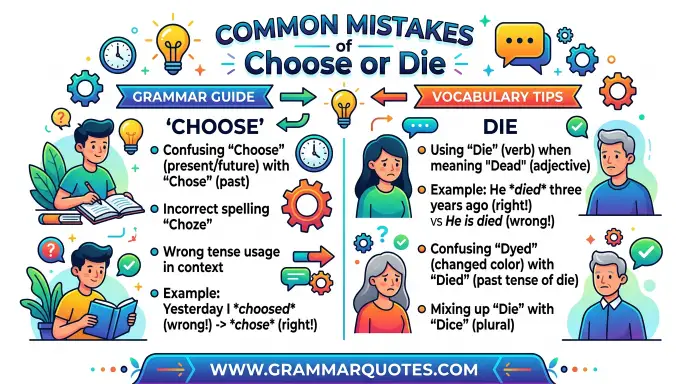
Mistake 1: Treating the phrase as formal language
Incorrect for a formal report:
“Choose or die is the best strategy for the company.”
Better:
“The company must make a decision quickly.”
Why? The original sounds dramatic and potentially threatening.
Memory tip: Use strong expressions only when the tone supports them.
Mistake 2: Confusing “choose” and “choice”
Incorrect:
“You need to choice one.”
Correct:
“You need to choose one.”
Why? Choose is a verb. Choice is a noun.
Memory tip: You choose something, but you make a choice.
Mistake 3: Assuming “or die” is always literal
The phrase often uses exaggeration.
Example:
“Choose a restaurant or die of hunger.”
This can be humorous rather than literal.
Always consider the surrounding words before interpreting the phrase.
Mistake 4: Using the phrase in a sensitive situation
Because the word die refers to death, the phrase can sound aggressive or alarming. Avoid using it casually when a reader might interpret it literally.
Everyday Examples
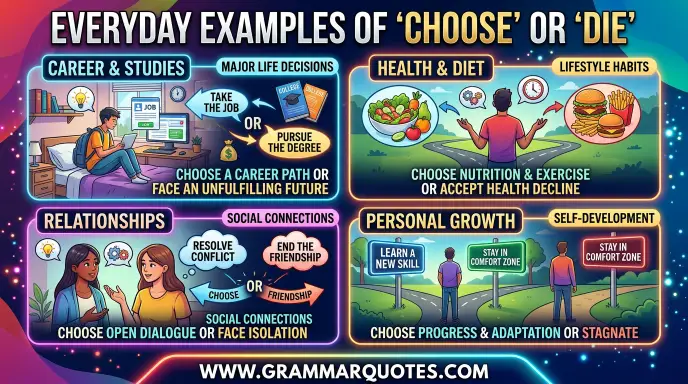
Emails
Informal:
“We need to choose or die before the deadline.”
Professional:
“We need to make a decision before the deadline.”
The second version is clearer and more suitable for workplace communication.
Business Writing
A business writer might say:
“The company faces a critical decision.”
This communicates urgency without using unnecessarily dramatic language.
News Headlines
A headline may use dramatic wording to attract attention:
“Choose or Die: The Decision Facing the Team”
This style can work when the article is intentionally presenting a high stakes situation.
Blogs
Blog writers may use the phrase to create an engaging introduction:
“When every option has a cost, it can feel like a choose or die decision.”
Here, the phrase is clearly figurative.
Social Media
On social media, the expression may be used humorously:
“Choose or die: pizza or burgers tonight?”
The surrounding context makes the exaggeration clear.
Academic Writing
Academic writing should usually avoid dramatic language:
“Participants were required to select one of two options.”
This is more precise.
Daily Conversation
Someone might say:
“You have to choose or die!”
Depending on the situation, this could be joking, dramatic, or genuinely threatening. Tone and context are essential.
Google Trends & Modern Usage
Search interest around choose or die can come from several different intentions. People may search the phrase because they want its meaning, correct usage, examples, or information about entertainment using the expression.
The phrase also benefits from the familiar pattern of expressions such as “do or die.” Readers can understand its meaning because the structure creates an immediate sense of urgency.
Exact Google Trends numbers should not be claimed without checking current Google Trends data for a specific country and date range. General usage patterns suggest that choose or die is more likely to appear in informal, dramatic, fictional, entertainment, or headline style contexts than in formal academic prose.
The key point is simple: the phrase is understandable, but its dramatic tone makes it unsuitable for many formal situations.
Quick Comparison Table
| Version | Meaning | Correct? | Region | Example |
| Choose or die | Make a choice or face an extreme consequence | Yes | International | “It was a choose or die moment.” |
| Choose | Select something | Yes | International | “Choose one option.” |
| Choice | An act or result of choosing | Yes | International | “It was a difficult choice.” |
| Choose or face the consequences | Make a choice and accept its results | Yes | International | “Choose or face the consequences.” |
| Make a decision | Decide between options | Yes | International | “We need to make a decision.” |
Key Takeaways
- Choose or die is grammatically understandable.
- It usually expresses a dramatic or figurative choice.
- It does not have a different British and American spelling.
- The phrase can suggest extreme urgency or high stakes.
- Choose is a verb, while choice is a noun.
- Formal writing usually benefits from more neutral wording.
- Context determines if the phrase sounds serious, humorous, or fictional.
- When in doubt, use “make a decision” for clear and professional communication.
FAQs
Is “choose or die” grammatically correct?
Yes. “Choose or die” is grammatically understandable because it joins two imperative verbs with or. However, grammatical correctness does not mean that it is appropriate in every situation. The phrase has a very strong and dramatic tone, so formal writing often needs a more neutral alternative.
What does “choose or die” mean?
“Choose or die” means that someone must make a decision or face an extremely serious consequence. It is often figurative rather than literal. The expression emphasizes pressure, urgency, or high stakes. Its exact meaning depends on the situation in which it is used.
Is “choose or die” a phrase or an idiom?
It can be described as a dramatic expression or phrase. It is not always treated as a fixed idiom in the same way as well established idioms. Its meaning is easy to understand from the words themselves, especially because English commonly uses structures that contrast an action with a serious consequence.
Is “choose or die” formal English?
No, it is generally not a good choice for formal communication. It sounds dramatic and can sometimes sound threatening. In academic, professional, or official writing, alternatives such as “make a decision,” “select an option,” or “make a choice” are usually clearer and more appropriate.
What is the difference between “choose” and “choice”?
Choose is a verb, while choice is a noun. For example, you can choose between two options, but you can make a choice. A simple memory trick is: You choose, but you make a choice.
Can “choose or die” be used humorously?
Yes. In informal conversation and social media, people may use exaggerated expressions humorously. For example, someone might jokingly say that friends must choose between two restaurants. The phrase should still be used carefully because the word die can make the expression sound serious outside an obvious joking context.
Is “choose or die” the same as “do or die”?
No. The expressions are related in structure but have different meanings. “Do or die” is an established expression about making a determined effort in a very important situation. “Choose or die” focuses specifically on the need to make a choice.
Should I use “choose or die” in an essay?
Usually, no. Academic essays normally require precise and neutral language. You could use the phrase if your essay is discussing the expression itself, a title, a fictional work, or a cultural example. Otherwise, “make a decision” or “the decision is unavoidable” would usually be better.
Is “choose or die” used in both British and American English?
Yes. There is no major spelling difference between British and American English for this phrase. Choose and die are spelled the same in both varieties. The main issue is tone and context rather than regional spelling.
What is a better alternative to “choose or die”?
The best alternative depends on the meaning. For neutral writing, use “make a decision.” For urgency, you could say “make a decision before the deadline.” If you want to emphasize consequences, “choose or face the consequences” may communicate the idea without sounding as extreme.
Conclusion
Choose or die is a clear but highly dramatic English expression. It presents a situation as if a person must make a choice because refusing to choose could lead to an extreme consequence. In many contexts, the phrase is figurative and is used to create urgency, humor, tension, or drama.
The phrase works in informal conversations, fictional situations, entertainment, social media, and attention grabbing headlines. However, it is usually not the best option for academic, business, or professional writing. In those situations, phrases such as “make a decision,” “make a choice,” or “select an option” are more precise.
There is also no special British or American spelling for the phrase. Both varieties use choose or die.
When deciding if to use it, focus on your audience and tone. If the dramatic effect is intentional, the phrase can work well. If clarity and professionalism matter most, choose a calmer alternative.
Memorable takeaway: Choose or die is correct English, but “make a decision” is usually the better choice for formal writing.
Discover More Articles!
i.e. vs e.g.: Meaning, Difference, and Correct Usage
Else’s or Elses: Common Mistakes and Examples(2026)
Perfume or Parfum: What’s the Difference?(2026)

Ethan Parker is an English-language writer known for his interest in words, language, and clear communication. His work focuses on making everyday English easier to understand through simple explanations and practical examples.