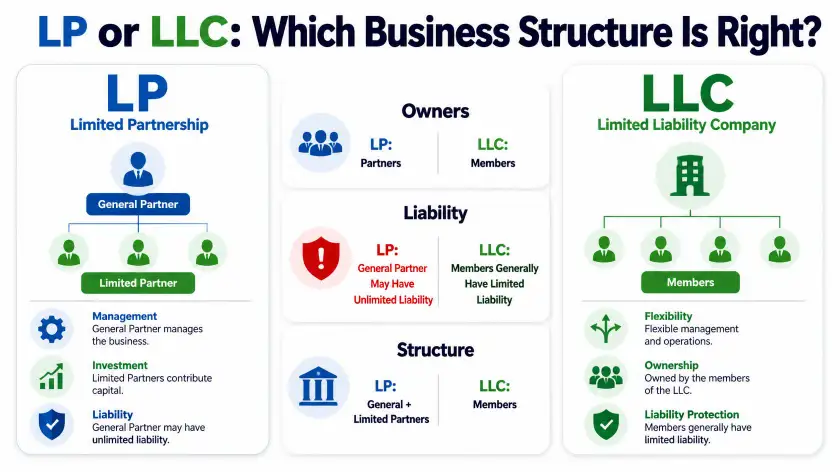
Choosing between LP or LLC can be confusing because both are common U.S. business structures, but they work in very different ways. LP means Limited Partnership, while LLC means Limited Liability Company. The biggest difference is how ownership, management, and personal liability are handled.
An LP generally has at least one general partner and one or more limited partners. The general partner typically manages the business and can have unlimited personal liability, while limited partners generally receive liability protection up to their investment.
An LLC is more flexible. Its owners are called members, and members generally receive limited liability protection even when they actively participate in managing the business. An LLC can also have one owner or multiple owners.
This guide explains LP or LLC, including their meanings, liability protection, management, taxes, regional considerations, common mistakes, and practical examples.
LP or LLC: The Quick Answer You Need
LP stands for Limited Partnership, while LLC stands for Limited Liability Company. An LP normally separates managing general partners from limited partners, while an LLC generally gives all members limited liability protection and offers greater management flexibility. For many small businesses, an LLC is the simpler choice, but an LP can make sense when active and passive partners have different roles.
LP or LLC: Quick Answer
If you’re trying to decide between LP or LLC, start with these differences:
- LP: Limited Partnership
- LLC: Limited Liability Company
- LP owners: General partners and limited partners
- LLC owners: Members
- LP management: Usually handled by general partners
- LLC management: Can be structured in different ways
- LP liability: General partners can have unlimited personal liability
- LLC liability: Members generally have limited personal liability
- LLC ownership: Can include one or multiple members
- LP structure: Often useful when some partners invest without managing the business
For U.S. businesses, the exact rules depend on the state where the entity is formed.
Example 1
Suppose Alice and Bob want to create an investment business. Alice manages the business, while Bob mainly contributes money. An LP may fit this arrangement because it distinguishes between a general partner and a limited partner.
Example 2
Suppose Sarah runs an online consulting company by herself. She wants a business structure that separates the business from her personal assets. A single member LLC may be a suitable structure to investigate.
Example 3
Three people want to run a marketing company together and all participate in management. An LLC may offer a more natural structure because its members can participate in management while generally retaining limited liability protection.
What Does LP or LLC Mean?
What Does LP Mean?
LP means Limited Partnership.
A limited partnership is a partnership with at least one general partner and one or more limited partners. The general partner normally manages the partnership and can have unlimited personal liability for partnership obligations. Limited partners generally have liability protection limited to their investment, subject to applicable law.
An LP can therefore work well when the people running a business are different from the people primarily investing in it.
For example:
General Partner → manages the business
Limited Partner → invests but usually has a less active role
The precise rights and liabilities depend on the applicable state law and partnership agreement.
What Does LLC Mean?
LLC means Limited Liability Company.
An LLC is a business entity created under state law. Its owners are called members, not partners. Members generally are not personally liable for the company’s debts simply because they own the LLC.
An LLC can have:
- One member
- Multiple members
- Individual members
- Certain business or organizational members
The IRS also allows an LLC to receive different federal tax classifications depending on its ownership and elections.
The Origin of LP or LLC
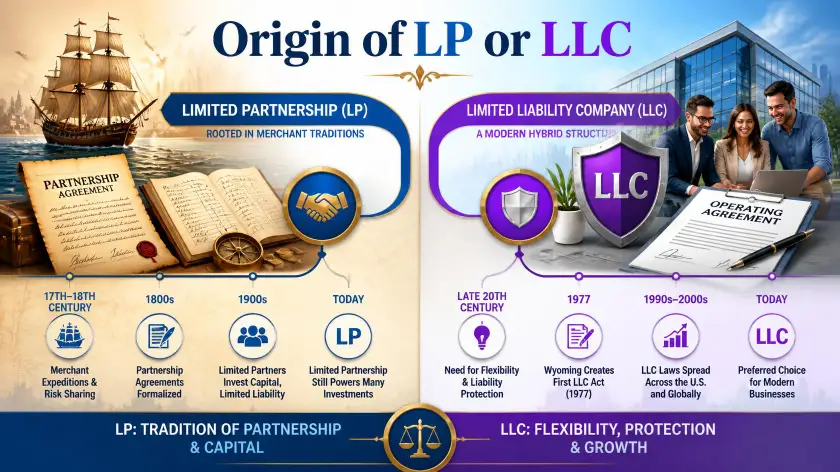
The two terms come from different legal structures.
Limited partnership developed as a form of partnership that could separate investors with limited liability from partners responsible for managing the business. Limited partnerships have been used for centuries, and modern LP laws define the relationship between general and limited partners.
The limited liability company is a different legal structure. In the United States, LLCs are created under state statutes. Rather than being a traditional partnership, an LLC combines features associated with limited liability and flexible business organization.
The terms can look similar because both contain the idea of limited liability. However, LP and LLC are not interchangeable terms.
That distinction matters when you are completing business documents, forming an entity, writing a contract, or describing a company.
British English vs American English
Unlike spelling differences such as color and colour, LP vs LLC is primarily a legal terminology issue rather than a British versus American spelling issue.
The abbreviations are especially common in U.S. business contexts.
| Term | Full Form | Typical Context | Example |
| LP | Limited Partnership | Partnership structure | ABC Investments, LP |
| LLC | Limited Liability Company | Company structure | ABC Consulting, LLC |
| LLP | Limited Liability Partnership | Partnership with broader partner liability protection | ABC Law, LLP |
| Inc. | Incorporated | Corporation | ABC Inc. |
In the United States, the IRS recognizes an LLC as a business structure created under state law. A limited partnership is also formed under state limited partnership law.
A useful warning
Do not confuse LP with LLP.
- LP = Limited Partnership
- LLP = Limited Liability Partnership
- LLC = Limited Liability Company
An LLP is a separate legal structure with different rules.
Which Version Should You Use?
The answer depends on your business, location, ownership arrangement, liability concerns, tax situation, and applicable law.
United States
If you’re forming a business in the U.S., compare the available structures under the law of your state.
An LLC can be attractive for owners who want limited liability protection combined with organizational flexibility. An LP can be useful where one or more people actively manage the business while other partners primarily invest.
United Kingdom
Do not automatically assume that U.S. LLC terminology applies in the UK. Business structures and legal requirements differ between jurisdictions.
Use the terminology required by the jurisdiction where the business is registered.
Canada
Canadian business structures have their own federal and provincial rules. If your company operates in Canada, check the applicable jurisdiction rather than assuming that U.S. LLC rules apply.
Australia
Australia also has its own business entity system. An Australian business should use the structure and terminology recognized by Australian law.
International Writing
When writing for a global audience, spell out the abbreviation the first time:
Limited Liability Company (LLC)
or
Limited Partnership (LP)
This removes ambiguity for readers who may not be familiar with U.S. business terminology.
Academic Writing
In academic writing, define the abbreviation at first use and then use the abbreviation consistently.
Business Writing
In contracts, reports, proposals, and company documents, use the company’s official legal name exactly as registered.
Do not change an LP into an LLC simply because the two structures seem similar.
Common Mistakes With LP or LLC
Mistake 1: Treating LP and LLC as the Same Thing
Incorrect:
“An LP and LLC are basically the same business structure.”
Correct:
“An LP and LLC are different business structures with different ownership and liability rules.”
Why: An LP separates general and limited partners, while an LLC generally provides limited liability protection to its members.
Memory tip:
LP = Partnership. LLC = Company.
Mistake 2: Assuming Every LP Owner Has Limited Liability
Incorrect:
“Everyone in an LP has limited liability.”
Correct:
“Limited partners generally have limited liability, while a general partner can have unlimited personal liability.”
Memory tip:
General partner = generally manages and carries greater liability risk.
Mistake 3: Calling LLC Owners Partners
Incorrect:
“The LLC’s partners voted on the proposal.”
Correct:
“The LLC’s members voted on the proposal.”
The IRS describes LLC owners as members.
Mistake 4: Confusing LP With LLP
Incorrect:
“LP and LLP are two names for the same thing.”
Correct:
“LP and LLP are different partnership structures.”
An LLP provides a different liability framework from an LP.
LP or LLC in Everyday Examples
Emails
LLC example:
Please send the contract to Green Valley Consulting LLC.
LP example:
The investment agreement is between the partners of Green Valley Investments LP.
Business Writing
The company operates as an LLC under applicable state law.
or:
The fund is organized as a limited partnership.
News Headlines
Local Startup Forms New LLC
or:
Investment Group Creates New Limited Partnership
Blogs
Choosing between an LP or LLC depends on how you plan to operate the business.
Social Media
Thinking about starting an LLC? Compare liability, management, taxes, and state requirements first.
Academic Writing
This study examines why entrepreneurs choose a limited liability company (LLC) rather than a limited partnership (LP).
Daily Conversation
“Is your company an LLC?”
“No, it’s a limited partnership.”
Google Trends & Modern Usage
Searches for LP or LLC are usually driven by people trying to understand business structures, company formation, investment arrangements, liability protection, or business terminology.
The confusion is understandable because both abbreviations appear in company names and both relate to legal business structures.
However, search interest does not mean that one structure is universally better.
An LLC is widely relevant to small business owners because it can accommodate a single member or multiple members and can have different federal tax classifications.
LPs remain relevant where the business relationship calls for general and limited partners, particularly when some participants are primarily investors.
There is no single universal “best” structure. State law, business activities, ownership, liability exposure, taxes, and management arrangements all matter.
LP or LLC: Quick Comparison Table
| Version | Meaning | Correct? | Main Structure | Example |
| LP | Limited Partnership | Yes | General + limited partners | ABC Investments, LP |
| LLC | Limited Liability Company | Yes | Members | ABC Consulting, LLC |
| LLP | Limited Liability Partnership | Yes, but different | Partners with LLP protections | ABC Professionals, LLP |
| Limited Company | General description in some jurisdictions | Context dependent | Depends on jurisdiction | Company name |
LP vs LLC at a Glance
| Feature | LP | LLC |
| Full name | Limited Partnership | Limited Liability Company |
| Owners called | Partners | Members |
| One owner possible? | Generally no | Yes, in many states |
| General partner required? | Yes | No |
| Limited partners | Yes | Not applicable |
| Management flexibility | Partnership based | Generally flexible |
| General partner liability | Can be unlimited | Members generally have limited liability |
| Federal tax treatment | Partnership rules generally apply | Can vary depending on classification/election |
| Best known for | Active + passive partner arrangements | Flexible business ownership |
The IRS states that an LP consists of at least one general partner and one or more limited partners, while an LLC is formed under state law and can have different federal tax classifications.
Key Takeaways
- LP means Limited Partnership.
- LLC means Limited Liability Company.
- An LP has general and limited partners.
- An LLC has members.
- A general partner in an LP can have unlimited personal liability.
- LLC members generally have limited liability protection.
- An LLC can have one member or multiple members.
- LPs can be useful when active managers and passive investors have different roles.
- Neither structure is automatically best for every business.
- Always check the laws and requirements of the jurisdiction where the business will operate.
FAQs
Is an LP or LLC better?
Neither is automatically better. An LLC may be attractive for owners who want flexible management and generally limited personal liability. An LP may be useful when a business needs general partners to manage the business and limited partners to invest. The appropriate choice depends on state law, business activities, ownership, taxes, and liability considerations.
What is the main difference between an LP and LLC?
The main difference is their legal structure. An LP is a partnership with at least one general partner and one or more limited partners. An LLC is a separate business structure whose owners are called members. LLC members generally receive limited liability protection, while a general partner in an LP can have unlimited personal liability.
Is an LLC a partnership?
An LLC is not automatically a partnership under state law. However, for U.S. federal income tax purposes, a domestic LLC with two or more members is generally classified as a partnership by default unless it elects corporate treatment. A single member LLC is generally treated as a disregarded entity unless it makes an election to be treated as a corporation.
What does LP stand for in business?
LP stands for Limited Partnership. It is a partnership structure consisting of at least one general partner and one or more limited partners. The general partner typically manages the business, while limited partners generally have limited liability and a less active management role.
What does LLC stand for?
LLC stands for Limited Liability Company. It is a business entity created under state law. Its owners are called members, and members generally are not personally liable for the LLC’s debts solely because they own the business.
Can an LLC be the general partner of an LP?
Yes, an LLC can serve as a general partner of an LP in appropriate circumstances. This type of arrangement can be used to address liability concerns, but the legal and tax consequences depend on the structure and applicable law. Professional legal and tax advice is appropriate before creating such an arrangement.
Do LPs and LLCs pay taxes differently?
They can. An LLC’s federal tax classification depends on factors such as the number of members and elections made with the IRS. An LLC may be treated as a disregarded entity, partnership, or corporation for federal income tax purposes. LPs generally follow partnership tax rules, subject to specific circumstances.
Can one person form an LLC?
Yes. Many states permit single member LLCs. For federal income tax purposes, a single member domestic LLC is generally treated as a disregarded entity unless it elects corporate treatment. It remains a separate entity for certain employment and excise tax purposes.
Are LP and LLP the same?
No. LP means Limited Partnership, while LLP means Limited Liability Partnership. They have different legal structures and liability rules. In an LP, general partners can have unlimited personal liability. An LLP generally provides broader liability protection for partners, subject to applicable law.
Should I choose an LP or LLC for my business?
Do not choose solely based on the abbreviation. Consider who will own the business, who will manage it, the level of liability protection needed, tax treatment, state requirements, and the planned business activities. Because entity selection can have legal and tax consequences, consider advice from a qualified attorney or tax professional before forming the business.
Conclusion
The choice between LP or LLC becomes much easier once you understand that they are different legal structures.
An LP, or Limited Partnership, is built around general and limited partners. The general partner typically manages the business and may face unlimited personal liability, while limited partners generally have liability protection tied to their investment.
An LLC, or Limited Liability Company, uses members rather than partners. It generally gives members limited liability protection and provides considerable flexibility in how the business is organized. It can also have one member or multiple members, and its federal tax classification can vary.
For many entrepreneurs, an LLC is worth considering because of its combination of flexibility and liability protection. But an LP can be the better fit when a business needs a clear distinction between managing partners and passive investors.
Remember: LP means partnership, while LLC means limited liability company.
Before forming either structure, check the rules in your state and consider professional legal or tax advice for your specific situation.
Discover More Articles!
Swum or Swam: Common Mistakes and Easy Examples(2026)
Warp or Woof: What’s the Difference?
Kyoto or Tokyo: Which City Should You Visit?

Ethan Parker is an English-language writer known for his interest in words, language, and clear communication. His work focuses on making everyday English easier to understand through simple explanations and practical examples.