Choosing or vs er can be confusing because both endings can turn a verb into a noun for a person or thing that performs an action. We write teach → teacher, but act → actor, and there is no single spelling rule that works perfectly for every word.
The difference is mainly linked to the history and origin of English words. The er suffix is highly productive in English and appears in common words such as writer, driver, singer, and reader.
The or ending is common in words with Latin influence, such as actor, creator, director, and administrator. Cambridge also lists er and or as nounforming suffixes used for people or things that perform an activity.
If you are unsure which ending to use, the safest approach is to check the established spelling of the word rather than trying to invent a universal rule. This guide explains how or vs er works, where the endings come from, common mistakes, regional usage, and practical examples.
Or vs Er: The Simple Answer
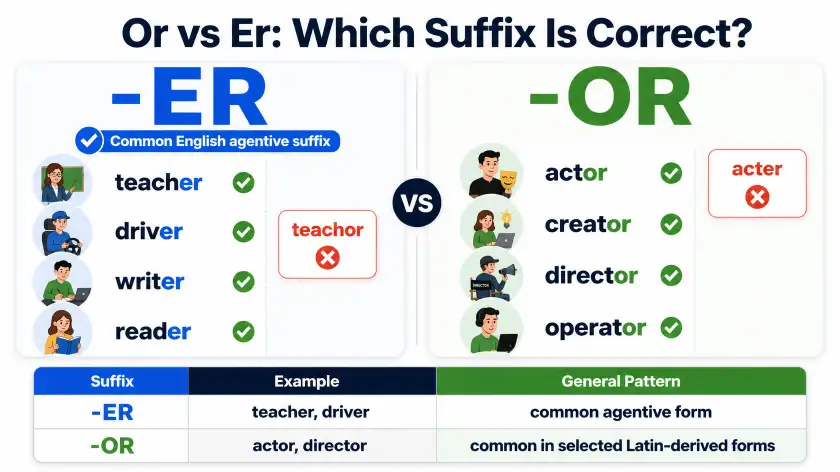
er is generally the more productive English suffix for forming nouns from verbs, as in teach → teacher and drive → driver. or is also used to form agent nouns, especially in words with Latin origins, such as act → actor and create → creator. There is no universal rule that predicts every word, so established spelling matters.
Or vs Er: Quick Answer
When deciding between or and er, remember these basic patterns:
- er is common with ordinary English verb formations: teach → teacher.
- or is common in many Latinderived words: act → actor.
- Both endings can describe a person or thing that performs an action.
- Some words simply have to be learned individually.
- Do not assume that every verb ending in a particular letter takes or.
Examples
er:
- teach → teacher
- drive → driver
- read → reader
- swim → swimmer
or:
- act → actor
- create → creator
- inspect → inspector
- operate → operator
The key point is that er is not simply the British version and or is not simply the American version. These are different suffixes with different historical patterns.
What Does Or vs Er Mean?
In this comparison, er and or are suffixes. A suffix is a letter or group of letters added to the end of a word to create another word.
Both endings can be agentive suffixes. An agentive suffix helps form a noun that identifies someone or something that performs an action.
For example:
- teach + er = teacher
- drive + er = driver
- act + or = actor
- direct + or = director
The resulting noun can refer to a person:
The teacher explained the lesson.
Or, in some cases, an object or device:
The dishwasher is running.
Cambridge specifically gives examples such as singer, swimmer, dishwasher, and actor when explaining this type of suffix.
This is why or vs er is mainly a question of word formation and spelling, not pronunciation. In many words, the endings sound similar even though they are spelled differently.
The Origin of Or vs Er
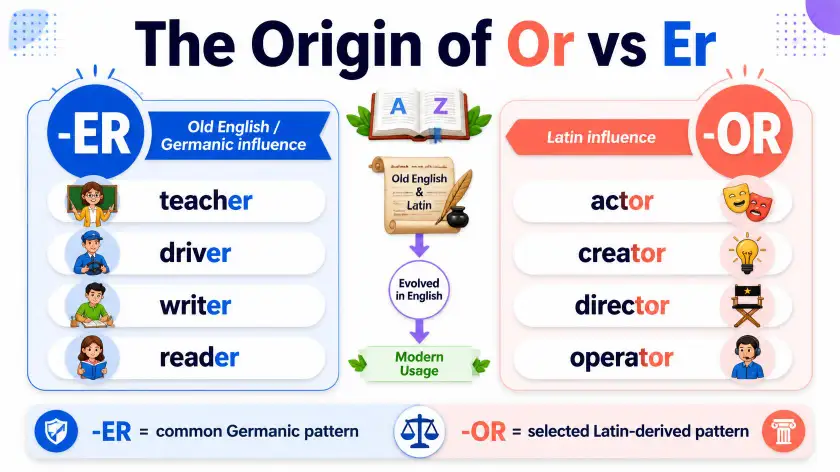
The difference between er and or has deep historical roots.
The er ending has a strong connection with Germanic and Old English word formation. It became a productive way of creating nouns for people who perform an action. This pattern remains extremely common in modern English.
Examples include:
- bake → baker
- farm → farmer
- write → writer
- work → worker
- sing → singer
The or ending entered English strongly through Latin and French influence. It is especially common in words connected with Latinderived vocabulary.
Examples include:
- act → actor
- create → creator
- educate → educator
- inspect → inspector
- supervise → supervisor
Linguistic sources describe er as a highly productive agentive suffix, while or is associated especially with Latinate vocabulary.
However, this history does not create a perfect modern spelling rule. English has borrowed words from many languages and has changed them over centuries. As a result, some words do not fit a simple pattern.
That is why teacher is correct, not teachor, while actor is correct, not acter.
British English vs American English
Unlike differences such as colour/color or centre/center, or vs er is generally not a simple BritishversusAmerican spelling difference.
The choice usually belongs to the individual word rather than the country where the writer lives.
| Word formation | British English | American English | Example |
| er | teacher | teacher | She is a teacher. |
| er | driver | driver | He is a careful driver. |
| er | writer | writer | She is a professional writer. |
| or | actor | actor | The actor won an award. |
| or | director | director | The director approved the plan. |
| or | creator | creator | The creator explained the idea. |
| or | operator | operator | The operator answered the call. |
Both British and American English use words ending in er and or. Cambridge’s grammar guidance likewise presents employer and actor as examples of nounforming suffixes.
There can be individual vocabulary differences and spelling preferences between varieties of English, but you should not treat or as an American spelling and er as a British spelling.
A useful contrast
Some differences really are regional:
- British colour → American color
- British centre → American center
- British theatre → American theater
But:
- British teacher → American teacher
- British actor → American actor
- British director → American director
So, if you are asking if or vs er is a British/American spelling issue, the answer is usually no.
Which Version Should You Use?
The best choice depends on the word you are forming, not simply your location.
United States
Use the standard dictionary spelling used in American English. Words such as teacher, writer, driver, actor, and creator keep their established endings.
United Kingdom
British English uses the same basic forms for most common er and or agent nouns.
For example:
- teacher
- writer
- actor
- director
- creator
Canada
Canadian English can reflect both British and American influences. For er vs or, however, standard established spellings are normally the safest choice.
Australia
Australian English also uses both suffixes according to the established spelling of each word.
International Writing
For international readers, avoid creating new words simply because an ending seems logical.
If you are unsure, check a reliable dictionary.
Academic Writing
Consistency is more important than trying to force a suffix rule. Use the standard spelling accepted by your dictionary, university, publisher, or style guide.
Business Writing
Use familiar standard forms such as:
- manager
- supervisor
- operator
- administrator
- director
Professional writing benefits from conventional spelling because unusual forms can distract readers.
Common Mistakes With Or vs Er
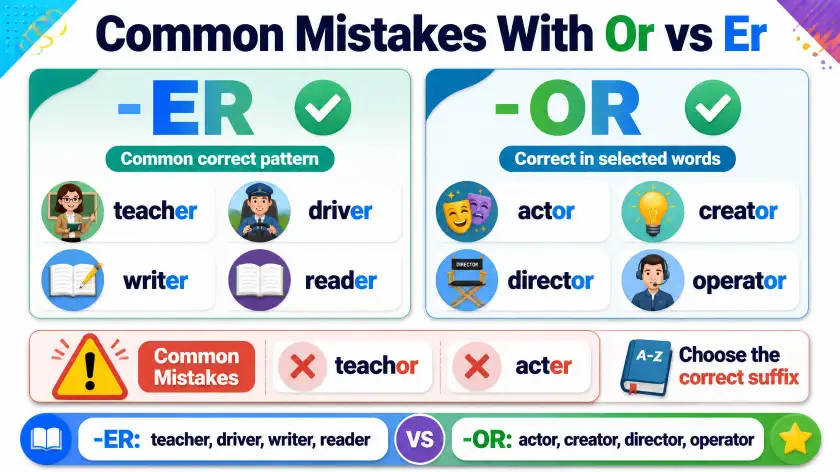
The biggest mistake is assuming that you can always choose the ending based on a simple formula.
Mistake 1: Teachor
❌ She is a teachor.
✅ She is a teacher.
Why?
The established English noun is teacher. The productive er pattern is used here.
Memory tip:
teach → teacher.
Mistake 2: Acter
❌ He wants to become an acter.
✅ He wants to become an actor.
Why?
The established noun is actor, reflecting the historical or pattern.
Memory tip:
act → actor.
Mistake 3: CreatER
❌ The creater designed the website.
✅ The creator designed the website.
Why?
The standard noun formed from create is creator.
Mistake 4: Directer
❌ The directer approved the film.
✅ The director approved the film.
Why?
Director is the established noun.
Mistake 5: Assuming or always follows ate
It is tempting to create a rule such as:
“Verbs ending in ate always use or.”
This can help with many familiar words, but English word formation contains exceptions and competing forms. Historical development and conventional usage matter.
So use patterns as clues, not absolute rules.
Everyday Examples of Or vs Er
Knowing the theory is useful, but seeing the endings in real sentences makes the difference easier to remember.
Emails
Please contact the administrator if you need help.
The manager will review your request.
Business Writing
Our director approved the proposal.
The operator will connect your call.
Every employee must complete the form.
News Headlines
Local builder opens new community center.
Film director announces new project.
Blogs
A skilled writer knows how to make complex ideas simple.
The creator shared the new design online.
Social Media
Thanks to everyone who helped. You’re an amazing supporter!
The creator just posted a new video.
Academic Writing
The researcher collected the data.
The investigator examined the evidence.
Daily Conversation
My brother is a teacher.
Her father is a doctor.
He works as a driver.
These examples show why it is better to learn common words as complete vocabulary items rather than relying on one spelling formula.
Google Trends & Modern Usage
People who search for or vs er are often trying to understand why some English nouns end in er while others end in or.
The confusion is understandable because both suffixes can have a similar grammatical function. Cambridge describes er and or as suffixes that can form nouns referring to people or things that perform an activity.
Common searches may include:
- or vs er suffix
- when to use er or or
- words ending in er and or
- er vs or agent nouns
- teacher or teachor
- actor or acter
- creator or creater
- how to use the suffix or
Exact searchvolume or Google Trends figures should not be claimed without current, verified data. The important usage pattern is clear: er is highly productive, while or appears frequently in established Latinate formations.
This also explains why learners may correctly understand the meaning of a new word but still hesitate over its spelling.
Quick Comparison Table
| Version | Meaning | Correct? | Typical Use | Example |
| er | Agentive suffix | Yes | Very productive English formation | teacher |
| er | Person who performs an action | Yes | Common verbs | driver |
| or | Agentive suffix | Yes | Many Latinate formations | actor |
| or | Person or thing performing an action | Yes | Established vocabulary | operator |
| or instead of established er | Usually incorrect | No | Invented spelling | ❌ teachor |
| er instead of established or | Usually incorrect | No | Invented spelling | ❌ acter |
Er vs Or: Key Takeaways
- er and or are both English suffixes.
- Both can form nouns referring to people or things that perform an action.
- er is generally more productive in ordinary English word formation.
- or is common in many words with Latin influence.
- Teacher, driver, and writer use er.
- Actor, creator, and director use or.
- or vs er is not simply a British vs American spelling difference.
- When uncertain, check the established spelling in a reliable dictionary.
FAQs About Or vs Er
Is er or or more common?
er is generally more productive as an English agentive suffix. It can be added to many verbs to create nouns such as reader, writer, driver, and teacher. or is also common but is strongly represented in words with Latin influence, such as actor, creator, and director.
What is the difference between er and or?
Both endings can form nouns for people or things that perform an action. The main difference is historical and lexical. er has a strong Germanic and English wordformation tradition, while or is especially common in Latinate formations. Modern English does not have one rule that predicts every spelling.
When should I use er?
Use er when it is the established form of the word. It is especially common when forming an agent noun directly from an English verb, such as teach → teacher, drive → driver, and read → reader. Because er is highly productive, it is often the first pattern learners encounter.
When should I use or?
Use or when it is the established spelling of the word. It is especially common in many Latinderived formations, including actor, creator, director, educator, and operator. Do not automatically add or to every verb that looks formal or Latinbased.
Is or American and er British?
No. This is a common misunderstanding. Both British and American English use er and or in the same major vocabulary items. For example, both varieties use teacher, writer, actor, and director. The difference is primarily related to the history and established spelling of individual words.
Is there a rule for choosing er or or?
There are useful patterns, but there is no completely reliable rule. Word origin can provide a clue, with or appearing frequently in Latinate formations and er being highly productive in English. However, conventional spelling and historical development create exceptions, so dictionaries remain the safest authority.
Why is it actor but teacher?
Actor and teacher come from different historical wordformation patterns. Actor reflects a Latinderived formation, while teacher uses the productive English er suffix. The two words therefore use different endings even though both describe people who perform actions.
Can er refer to things as well as people?
Yes. er can describe a person or a thing that performs an activity. For example, teacher refers to a person, while dishwasher can refer to a machine or a person. Cambridge specifically gives dishwasher as an example of this broader use.
Can or refer to things as well as people?
Yes. Although many familiar or words refer to people, the suffix can also occur in words referring to things or devices that perform an action. Examples include operator in certain technical contexts and accelerator for something that accelerates. The exact meaning depends on the word and context.
What is the easiest way to remember or vs er?
Think of er as the common productive English pattern, while or often appears in established Latinate words. Then memorize common examples: teacher, writer, driver versus actor, creator, director. When a word is unfamiliar, check a dictionary rather than relying on a supposed universal rule.
Conclusion
The choice between or vs er becomes much easier once you understand that these are not simply two interchangeable endings.
Both are suffixes that can help form nouns for people or things that perform an action, but they have different historical backgrounds and usage patterns.
The er suffix is highly productive in English. It appears in everyday words such as teacher, writer, driver, reader, and worker.
The or suffix appears frequently in established Latinate formations such as actor, creator, director, educator, and operator.
Most importantly, or vs er is not a simple British English versus American English issue. Both varieties use both endings. The spelling usually depends on the individual word and its historical development.
If you are writing and cannot decide, do not invent a new form. Check a trusted dictionary and use the established spelling.
The easiest rule to remember is this: learn the word, not just the suffix.
Discover More Articles!
Swum or Swam: Common Mistakes and Easy Examples(2026)
Warp or Woof: What’s the Difference?
Kyoto or Tokyo: Which City Should You Visit?

Ethan Parker is an English-language writer known for his interest in words, language, and clear communication. His work focuses on making everyday English easier to understand through simple explanations and practical examples.