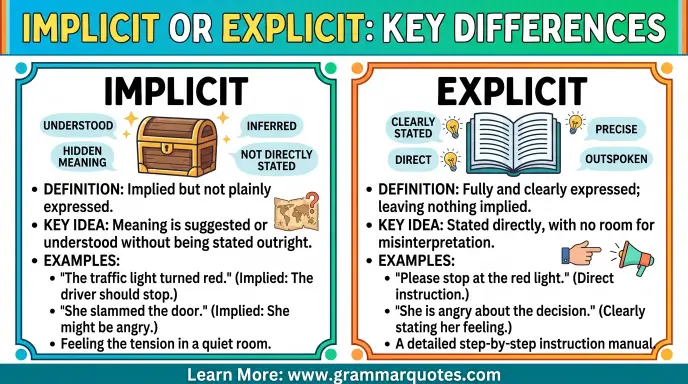
Implicit means suggested or understood without being directly stated, while explicit means clearly expressed or stated directly. Both words describe how information, ideas, or messages are communicated, but they differ in how clearly the meaning is presented.
For example, if someone says, “It is getting late,” they may be implicitly suggesting that it is time to leave. However, if they say, “We should leave now,” the message is explicit because the intention is directly stated.
Understanding the difference between implicit and explicit can improve your reading, writing, communication, and vocabulary. These words are commonly used in education, literature, psychology, technology, and everyday conversations.
Although they are opposites in many contexts, neither word is automatically better than the other. Implicit communication can be subtle and indirect, while explicit communication can reduce confusion by making the meaning clear.
In this guide, you will learn the definitions, examples, differences, synonyms, common mistakes, and practical uses of “implicit” and “explicit.”
Quick Answer: Implicit or Explicit?
Implicit means indirectly expressed or understood, while explicit means directly and clearly stated.
| Word | Meaning | Example |
| Implicit | Suggested without being directly stated | Her silence gave implicit approval. |
| Explicit | Clearly stated or directly expressed | She gave explicit approval. |
Easy memory trick: Think of implicit as an idea hidden within the message and explicit as an idea openly expressed.
Related question: Are implicit and explicit opposites?
Yes, they are opposites in many contexts. Implicit information is often understood indirectly, while explicit information is communicated directly.
1. What Does Implicit Mean?
The word implicit describes something that is suggested, understood, or included without being directly expressed. Its meaning often depends on context, tone, behavior, or shared understanding.
For example, if a teacher says, “Some students have not submitted their assignments,” the statement may implicitly encourage students to submit their work. The teacher does not directly tell a particular student to submit an assignment, but the intended message may be understood.
Definition and Meaning
Implicit is an adjective that describes an unstated meaning, indirect message, or assumption that is understood without being clearly spelled out.
Examples:
- His words carried an implicit warning.
- The agreement included an implicit expectation of honesty.
- Her smile showed implicit approval.
- The story contains an implicit message about kindness.
The word is useful when discussing communication, assumptions, expectations, and meanings that are not directly stated.
What Is the Difference Between Implicit and Explicit?
The main difference is how information is communicated.
- Implicit: The meaning is suggested or understood indirectly.
- Explicit: The meaning is stated clearly and directly.
For example:
- Implicit: “You have an early meeting tomorrow.” This may suggest that someone should go to bed soon.
- Explicit: “Please go to bed early because you have a meeting tomorrow.”
The first statement suggests an action, while the second directly expresses it.
2. What Does Explicit Mean?
The word explicit describes something that is clearly stated, directly expressed, or explained in enough detail to make its meaning understandable.
Explicit communication leaves less room for guessing because the speaker or writer directly communicates the intended message.
For example, a teacher might say, “Submit your assignment by Friday at 5 p.m.” This instruction is explicit because it clearly states what is required and when it is due.
Definition and Meaning
Explicit is an adjective that describes information, instructions, or statements expressed openly and clearly.
Examples:
- The manager gave explicit instructions.
- The contract contains explicit rules about payment.
- She made her expectations explicit.
- The report provides explicit details about the results.
The word is commonly used in professional communication, academic writing, contracts, instructions, and discussions where clarity matters.
Is Explicit Always Better Than Implicit?
No. The best choice depends on the situation.
Explicit communication is helpful when instructions, rules, or expectations must be clear. Implicit communication can be useful when a message is understood through context or when a writer wants to suggest an idea without directly stating it.
For example, a safety instruction should generally be explicit, while a novel may use implicit meanings to encourage readers to think more deeply.
3. Origin of the Words Implicit and Explicit
The histories of these words help explain their contrasting meanings.
Origin of Implicit
“Implicit” comes through Latin implicitus, associated with the idea of something being folded or entangled within something else.
This history connects naturally with the modern meaning: an implicit idea is contained within a statement or situation rather than being openly expressed.
For example, a person’s words may contain an implicit promise even when they never directly say, “I promise.”
Origin of Explicit
“Explicit” comes from Latin explicitus, associated with unfolding or making something clear.
The modern meaning reflects this idea of making information open and understandable.
For example, explicit instructions explain precisely what someone needs to do rather than expecting them to infer the steps.
4. Explicit vs Implicit in British and American English
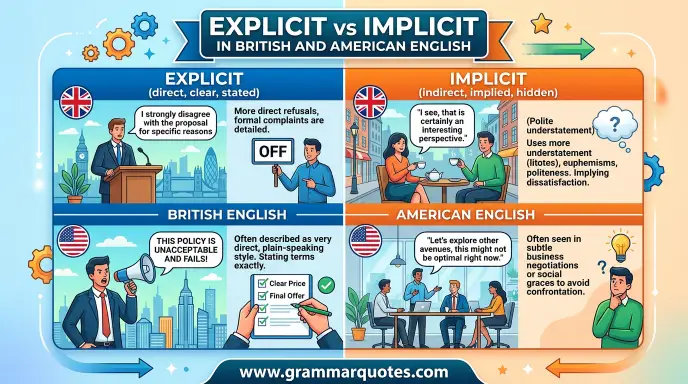
A common question is if British and American English use these words differently.
The answer is no. Implicit and explicit have the same standard meanings and spellings in both varieties of English.
| Feature | British English | American English |
| Indirectly expressed | Implicit | Implicit |
| Clearly stated | Explicit | Explicit |
| Spelling difference | None | None |
| General pronunciation | Similar | Similar |
| Common use | Academic and everyday English | Academic and everyday English |
Are Implicit and Explicit Spelled Differently in the UK and US?
Examples:
- British English: The teacher gave explicit instructions.
- American English: The teacher gave explicit instructions.
The spelling and core meanings remain unchanged.
5. How to Remember the Difference Between Implicit and Explicit
These words can be confusing because both describe the way meaning is communicated. A few simple memory techniques can help.
Method 1: Connect Implicit With Indirect
Think of “implicit” as something implied.
If a person suggests an idea without directly saying it, the message is implicit.
Example: His expression conveyed implicit disappointment.
Method 2: Connect Explicit With Expressed
Think of “explicit” as something openly expressed.
If a person clearly explains an idea, the message is explicit.
Example: She gave explicit instructions about the assignment.
Method 3: Compare Two Sentences
Remember this simple comparison:
- Implicit: “It is cold in here.”
- Explicit: “Please close the window because it is cold in here.”
The first sentence may indirectly suggest closing the window. The second directly states the request.
6. Everyday Examples of Implicit and Explicit
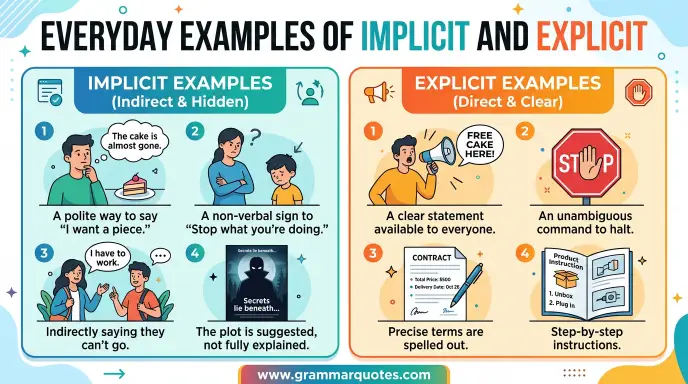
Here are ten examples showing how these words work in everyday English.
Examples of Implicit
- His silence was interpreted as implicit agreement.
- The story contains an implicit lesson about honesty.
- Her comment carried an implicit warning.
- The invitation included an implicit expectation that guests would arrive on time.
- The manager’s response suggested implicit support for the proposal.
Examples of Explicit
- The teacher gave explicit instructions for the project.
- The contract contains explicit rules about refunds.
- She made her opinion explicit during the meeting.
- The recipe provides explicit directions for each step.
- The school clearly stated its expectations in an explicit policy.
These examples show that implicit communication relies more on interpretation, while explicit communication states the message directly.
7. Common Mistakes When Using Implicit and Explicit
Even experienced English writers sometimes confuse these words. Understanding their meanings can help you use them accurately.
Mistake 1: Treating Both Words as Synonyms
Implicit and explicit do not have the same meaning.
- Incorrect: The teacher gave implicit instructions by clearly explaining every step.
- Better: The teacher gave explicit instructions by clearly explaining every step.
Mistake 2: Assuming Implicit Means Unimportant
An implicit message can be very important, even when it is not directly stated.
For example, an implicit warning may communicate a serious concern through tone or context.
Better approach: Use “implicit” to describe how meaning is communicated, not how important that meaning is.
Mistake 3: Assuming Explicit Means Rude
Being explicit does not automatically mean being rude or harsh. It simply means expressing something clearly.
For example, “Please arrive by 9 a.m.” is explicit but polite.
Mistake 4: Confusing Implicit With Impossible to Understand
An implicit message may be easy to understand when the context is clear.
For example, if someone puts on a coat and picks up an umbrella, you might implicitly understand that they expect cold or rainy weather.
The message is indirect, but it is not necessarily confusing.
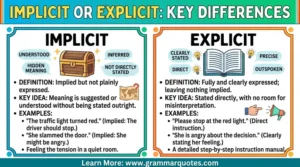
8. Implicit vs. Explicit: Key Differences
The following comparison summarizes the main differences.
| Feature | Implicit | Explicit |
| Meaning | Suggested or understood indirectly | Stated clearly and directly |
| Communication style | Indirect or subtle | Direct and clear |
| Interpretation | Often depends on context | Usually requires less inference |
| Instructions | May leave details unstated | States requirements clearly |
| Literature | Suggests deeper meanings | Directly states information |
| Example | His silence suggested agreement. | He said, “I agree.” |
Which Word Should You Use?
Use “implicit” when the message is suggested rather than directly stated.
Use “explicit” when the message is clearly expressed or explained.
For example:
- Implicit: The policy suggests that employees should arrive on time.
- Explicit: The policy states that employees must arrive by 9 a.m.
The second sentence communicates the requirement more directly.
9. Implicit and Explicit in Different Contexts
These words are useful in many fields, but their precise meanings can vary with context.
Example: A story may implicitly criticize greed through a character’s downfall.
In Education
Explicit instruction involves directly teaching a skill or concept. Implicit learning happens through experience, exposure, or observation without every rule being explained.
Example: A teacher explicitly explains a grammar rule, while students may implicitly learn vocabulary through reading.
In Communication
An implicit message relies on context, tone, or shared understanding. An explicit message directly states the intended meaning.
Example: “We need to talk about your report” may imply concern, while “Your report contains three errors that need correction” is more explicit.
In Technology and Data
Implicit information may be inferred from user behavior or available data, while explicit information is directly provided.
For example, a user may explicitly select a preference in a settings menu. A system might infer an implicit preference from repeated choices.
10. Frequently Asked Questions About Implicit and Explicit
1. What is the difference between implicit and explicit?
Implicit means suggested or understood indirectly. Explicit means clearly stated or directly expressed.
2. Are implicit and explicit opposites?
Yes, in many contexts. They contrast indirect or unstated meaning with direct and clearly stated meaning.
3. What is an example of implicit?
“The room is getting dark” may implicitly suggest turning on a light, depending on the situation.
4. What is an example of explicit?
“Please turn on the light because the room is dark” is explicit because it directly states the request.
5. What are synonyms for implicit?
Common synonyms include implied, indirect, suggested, unspoken, inferred, and tacit. The best choice depends on the sentence.
6. What are synonyms for explicit?
Common synonyms include clear, direct, stated, specific, definite, and unambiguous.
7. Does implicit mean hidden?
Not necessarily. An implicit meaning is not directly stated, but it may be easily understood from context. “Hidden” can suggest that something is deliberately concealed.
8. Does explicit mean detailed?
Sometimes, but not always. Explicit means clearly stated. A short sentence can be explicit if it communicates the message directly.
9. Can a message be both implicit and explicit?
Different parts of a message can be implicit and explicit. For example, a speaker may explicitly state a fact while implicitly suggesting a criticism through tone.
10. How can I remember implicit vs. explicit?
Remember that “implicit” is related to “implied,” while “explicit” is related to “expressed.” One suggests a meaning; the other states it directly.
Conclusion
The difference between implicit and explicit is based on how information is communicated. Implicit means suggested or understood indirectly, while explicit means stated clearly and directly.
Use “implicit” when meaning depends on context, hints, tone, or shared understanding. Use “explicit” when instructions, expectations, or information are openly expressed.
For example, a manager who hints that a report needs improvement communicates implicitly. A manager who identifies the exact changes required communicates explicitly.
Both forms of communication have their place. Implicit messages can make conversations and stories more subtle, while explicit statements can improve clarity and reduce misunderstandings.
By learning these distinctions and practicing the examples in this guide, you can use both words more confidently in academic writing, professional communication, and everyday English.
Discover More Articles!
Southpaw or Orthodox: What Is the Difference?(2026)
Aldi or Lidl: What Is the Difference?
Drove or Driven: What Is the Difference?(2026)

Ethan Parker is an English-language writer known for his interest in words, language, and clear communication. His work focuses on making everyday English easier to understand through simple explanations and practical examples.