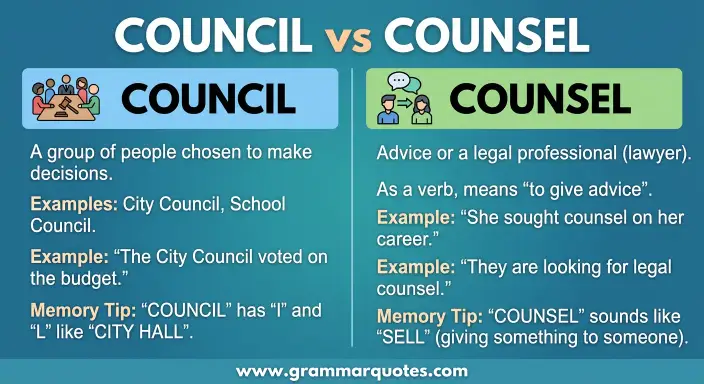
Have you ever confused council with counsel? These words sound similar, but they have different meanings and uses. One refers to a group of people who make decisions, while the other relates to advice or legal guidance.
Understanding the difference between council and counsel can help you write more clearly. You may see these words in school, government, business, or legal documents. Using the wrong word can change the meaning of your sentence.
In this guide, you will learn the definitions, pronunciation, examples, and common mistakes associated with both words. You will also find easy tips to remember which word to use.
Quick Answer: Council vs Counsel
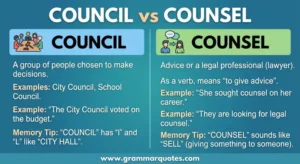
Council is a group of people chosen or appointed to discuss issues, make decisions, or manage an organization.
Counsel means advice or guidance. It can also refer to a lawyer or the act of giving advice.
Examples:
- The city council approved the new park.
- She asked her teacher for counsel.
- The lawyer served as legal counsel for the company.
Easy memory tip: A council is a group; counsel is advice or legal help.
What Does Council Mean?
Definition of Council
The noun council refers to a group of people who meet to discuss, plan, or make decisions about a particular matter.
Councils often work in government, education, business, and community organizations.
Examples of Council in Sentences
- The school council planned a charity event.
- The city council voted on the new rules.
- She was elected to the student council.
- The local council is responsible for maintaining public parks.
- The council held a meeting on Monday.
Common Types of Councils
- City council: A group that manages local government matters.
- Student council: Students who represent their classmates.
- School council: A group involved in school decisions.
- Advisory council: A group that provides recommendations.
- Security council: A body that deals with security issues.
What Does Counsel Mean?
Definition of Counsel
Counsel can be a noun or a verb.
As a noun, it means advice, guidance, or a lawyer who provides legal assistance.
As a verb, it means to advise or guide someone.
Examples of Counsel in Sentences
- She sought counsel from her parents.
- The company hired legal counsel.
- His lawyer provided sound counsel.
- The teacher counseled the student about study habits.
- I would counsel you to think carefully before deciding.
Common Uses of Counsel
- Legal counsel: A lawyer or legal adviser.
- Wise counsel: Helpful and sensible advice.
- Counsel someone: To give advice or guidance.
- Counseling: The process of helping someone work through a problem.
Council and Counsel: Key Differences
The main difference is that council refers to a group, while counsel refers to advice, guidance, or a legal adviser.
| Feature | Council | Counsel |
| Part of speech | Noun | Noun and verb |
| Main meaning | A decision making or advisory group | Advice, guidance, or a legal adviser |
| Common context | Government, schools, organizations | Legal matters, advice, personal guidance |
| Example | The council met today. | She offered helpful counsel. |
| Related word | Councillor or councilor | Counselor or counsellor |
Counsel vs Council: Pronunciation
Both words are pronounced the same way in standard English. They are homophones, meaning they sound alike but have different meanings and spellings.
- Council: /ˈkaʊn.səl/
- Counsel: /ˈkaʊn.səl/
The pronunciation is the same in both American and British English.
How to Remember the Difference
Think of council as a committee. Both words relate to a group or organization.
Think of counsel as consultation. Both words relate to advice or guidance.
These memory tricks can help you choose the correct spelling when writing.
Common Mistakes With Council and Counsel
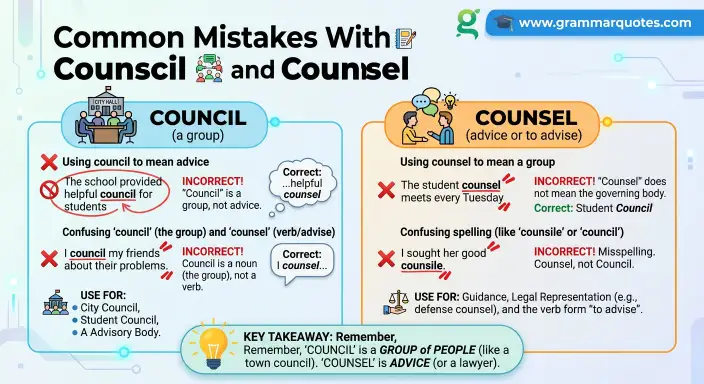
Mistake 1: Using Council Instead of Counsel
Incorrect: I asked my teacher for council.
Correct: I asked my teacher for counsel.
Why? The sentence refers to advice, not a group of people.
Mistake 2: Using Counsel Instead of Council
Incorrect: The city counsel approved the plan.
Correct: The city council approved the plan.
Why? The sentence refers to a local government group.
Mistake 3: Confusing Legal Counsel With a Council
Incorrect: The company hired a legal council.
Correct: The company hired legal counsel.
Why? Legal counsel refers to a lawyer or legal adviser. A legal council would mean a group or body, if that is what the context intends.
Mistake 4: Forgetting That Counsel Can Be a Verb
Incorrect: The teacher councilled the student.
Correct: The teacher counseled the student. (American English)
Correct: The teacher counselled the student. (British English)
Why? Counsel can describe the act of advising someone. Its past tense spelling varies between American and British English.
Everyday Examples of Council or Counsel
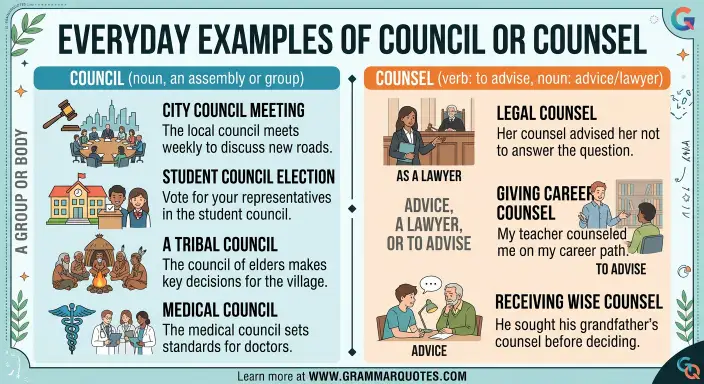
Here are more examples to help you understand the difference.
Examples Using Council
- The council organized a public meeting.
- Our student council raised money for charity.
- The town council discussed road repairs.
- The council members shared their opinions.
- A new member joined the advisory council.
Examples Using Counsel
- My parents gave me valuable counsel.
- The defendant spoke with legal counsel.
- She needed professional counsel before making a decision.
- The mentor counseled him about his career.
- I value her honest counsel.
Council and Counsel: Word Forms
Understanding related words can make the distinction easier.
Words Related to Council
- Councillor: A member of a council; commonly used in British English.
- Councilor: An alternative spelling commonly used in American English.
- Councils: The plural form of council.
Example: The councillors attended the annual meeting.
Words Related to Counsel
- Counselor: A person who gives advice or guidance; common in American English.
- Counsellor: The British English spelling of counselor.
- Counseling: The act or process of providing guidance.
- Counselled: British English past tense of counsel.
- Counseled: American English past tense of counsel.
Example: The school counselor helped students explore career options.
Frequently Asked Questions
1. What Is the Difference Between Council and Counsel?
Council is a group of people who discuss or make decisions. Counsel means advice, guidance, or a legal adviser.
2. Are Council and Counsel Pronounced the Same?
Yes. Both are pronounced /ˈkaʊn.səl/ in standard American and British English.
3. Is It Legal Council or Legal Counsel?
Legal counsel is the usual expression for a lawyer or legal adviser. Use council when referring to an actual group or governing body.
4. Is It a School Council or School Counsel?
Use school council when referring to a group of students, parents, or staff involved in school matters. Use counsel when referring to advice or guidance.
5. Can Counsel Be Used as a Verb?
Yes. Counsel can mean to advise or guide someone.
Example: The doctor counseled the patient about healthy habits.
6. What Is the Plural of Council?
The plural of council is councils.
7. What Is the Difference Between Counsel and Counselor?
Counsel means advice or can refer to a legal adviser. A counselor is someone who provides guidance, such as a school or career counselor.
Conclusion
Although council and counsel sound the same, they have different meanings. A council is a group of people who meet to make decisions or manage an organization. Counsel refers to advice, guidance, or legal assistance, and it can also be used as a verb meaning to advise someone.
Remember this simple rule: a council is a group, while counsel is advice or legal guidance. For example, a city council may approve a new law, while legal counsel may advise the city about legal issues.
Learning this difference will help you avoid common spelling mistakes and write more accurately in school assignments, professional documents, and everyday communication.
Discover More Articles!
Artisan or Agriculturist: What Is the Difference?
Okay or OK: Meaning, Differences, Examples, and Mistakes
Ertz vs Ferguson: Meaning, Origin, and Usage(2026)

Ethan Parker is an English-language writer known for his interest in words, language, and clear communication. His work focuses on making everyday English easier to understand through simple explanations and practical examples.