Affect and effect are two English words that look and sound alike, but they usually have different meanings. Affect is usually a verb that means to influence something, while effect is usually a noun that means a result or outcome. Knowing the difference can help you write clear and correct English.
For example, you might say, “Lack of sleep can affect your mood.” Here, affect means to influence. You could also say, “Lack of sleep has an effect on your mood.” In this sentence, effect means the result.
Many students, English learners, and professional writers confuse these words in essays, emails, reports, and everyday messages. The good news is that you can learn a simple rule to choose the right word in most situations.
This guide explains the meaning of both words, their origins, grammar rules, common mistakes, and everyday uses. You will also learn about their less common meanings, see practical examples, and find answers to frequently asked questions.
Affect vs Effect : Quick Answer
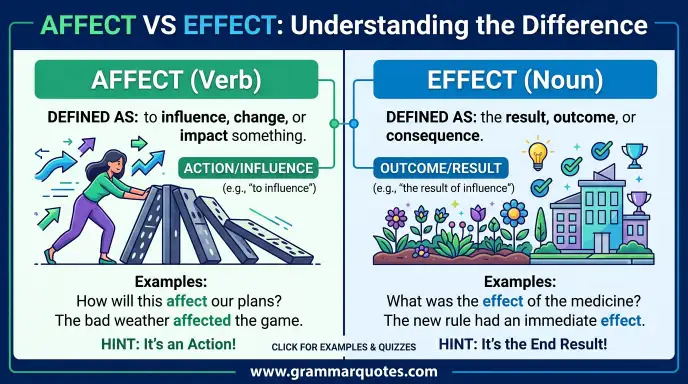
The main difference is that affect usually means to influence, while effect usually means a result.
- Affect (verb): To influence or change something.
- Effect (noun): A result or consequence.
Examples of Affect
- Stress can affect your sleep.
- The weather may affect our travel plans.
- A teacher’s advice can affect a student’s confidence.
Examples of Effect
- Stress can have a negative effect on sleep.
- The weather had an unexpected effect on our plans.
- The teacher’s advice had a positive effect on the student.
Easy rule: Affect is usually the action; effect is usually the end result.
However, both words have less common uses that you should also understand.
What Does Affect Mean?
Affect is most often a verb. It means to influence, change, or have an impact on someone or something.
Affect Definition
Affect means to cause a change in something or influence how a person, situation, or process develops.
For example:
“The new rules may affect all students.”
This means the rules may influence or change something for the students.
Everyday Examples of Affect
- Exercise can affect your energy levels.
- Loud music may affect your concentration.
- Rising prices can affect family budgets.
- A lack of sleep can affect your performance.
Can Affect Be a Noun?
Yes. In psychology, affect can be a noun referring to the outward expression of emotion or feeling.
For example:
“The patient showed a flat affect.”
This is a specialized use. In everyday English, you will usually see affect used as a verb.
What Does Effect Mean?
Effect is most often a noun. It means a result, outcome, or consequence produced by an action or event.
Effect Definition
Effect means a change or result that happens because of something else.
For example:
“The new policy had a positive effect on attendance.”
This means the policy produced a positive result.
Everyday Examples of Effect
- Reading has a positive effect on vocabulary.
- The storm had a serious effect on transport.
- The new schedule had an immediate effect.
- The medicine may cause side effects.
Can Effect Be a Verb?
Yes. As a verb, effect means to bring about, accomplish, or make something happen.
For example:
“The organization hopes to effect meaningful change.”
Here, effect means to bring about change. This usage is more formal than the usual noun form.
The Origin of Affect and Effect
Both words have roots in Latin, which helps explain why they look similar.
The Origin of Affect
Affect comes from Latin afficere, meaning to act upon, influence, or have an impact on something.
Over time, the word developed its common modern meaning of influencing or changing a person or situation.
The Origin of Effect
Effect comes from Latin effectus, which is associated with accomplishment, performance, or a result.
Its modern meaning focuses on the outcome produced by an action or event.
Although the words share a historical connection, their most common uses in modern English are different.
Affect vs Effect: Grammar Rules
Understanding the role each word plays in a sentence can help you avoid mistakes.
| Feature | Affect | Effect |
| Most common part of speech | Verb | Noun |
| Main meaning | To influence | A result |
| Example | Noise can affect sleep. | Noise has an effect on sleep. |
| Past form | Affected | Effected, when used as a verb |
| Related word | Affecting | Effective |
A Simple Grammar Test
If you need a word that means influence, you probably need affect.
Example: “The decision may affect the team.”
If you need a word that means result, you probably need effect.
Example: “The decision had an effect on the team.”
This test works for most everyday sentences.
Affect vs Effect in Everyday Examples
In Education
- Poor sleep can affect a student’s learning.
- Good study habits can have a positive effect on exam results.
Health
- Stress may affect your appetite.
- The treatment had a noticeable effect on the symptoms.
In Business
- Higher costs can affect profits.
- The new strategy had a positive effect on sales.
For Weather
- Heavy rain can affect road conditions.
- The storm had a serious effect on travel.
For Technology
- A software update may affect how an application works.
- The update had an unexpected effect on performance.
Common Mistakes with Affect and Effect
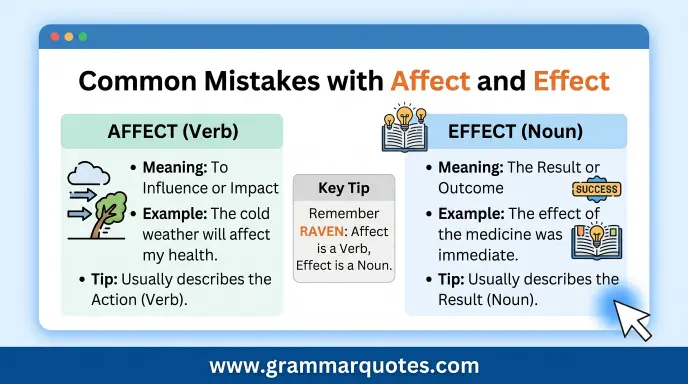
These words are easy to confuse, but a few examples can make the difference clear.
Mistake 1: Using Effect to Mean Influence
Incorrect: “The weather can effect my mood.”
Correct: “The weather can affect my mood.”
Use affect when you mean influence.
Mistake 2: Using Affect to Mean Result
Incorrect: “The affect of the new rule was clear.”
Correct: “The effect of the new rule was clear.”
Use effect when you mean a result.
Mistake 3: Confusing Effect and Effective
These words are related but have different meanings.
- Effect: A result.
- Effective: Successful in producing a desired result.
Example: “The plan was effective and had a positive effect.”
Mistake 4: Forgetting the Exceptions
Affect can be a noun in psychology, and effect can be a verb meaning to bring about something.
These uses are less common, so beginners should first learn the main rule.
British English vs American English
British and American English use the same spelling for both words.
| Feature | British English | American English |
| Verb meaning influence | Affect | Affect |
| Noun meaning result | Effect | Effect |
| Past form of affect | Affected | Affected |
| Plural noun | Effects | Effects |
There is no regional spelling difference between these words.
Affect vs Effect: Comparison Table
| Word or Phrase | Meaning | Example |
| Affect | To influence | Noise can affect sleep. |
| Effect | A result | Noise has an effect on sleep. |
| Affected | Influenced or changed | The storm affected the town. |
| Effective | Producing a desired result | The method was effective. |
| Side effect | An additional result, often unwanted | The medicine may cause side effects. |
| In effect | Operating or in force | The rule is now in effect. |
| Take effect | Begin to produce a result | The changes take effect tomorrow. |
| Effect change | Bring about change | The team hopes to effect change. |
How to Remember the Difference
Use these simple memory tips whenever you are unsure.
1. Remember A for Action
Affect usually describes an action that influences something.
Example: “The news affected her mood.”
2. Remember E for End Result
Effect usually describes the outcome of an action.
Example: “The news had an effect on her mood.”
3. Replace the Word
If influence fits the sentence, try affect.
If result fits the sentence, try effect.
These tricks work in most situations, but always check the full meaning of your sentence.
Affect vs Effect : Google Trends and Usage
Both words are common in education, business, science, professional writing, and everyday communication.
People search for their difference when checking grammar, editing essays, preparing reports, or learning English.
Related searches include:
- Affect meaning
- Effect meaning
- Difference between affect and effect
- Affect or effect in a sentence
- Affect vs effect examples
- How to use affect and effect
- Affect as a noun
- Effect as a verb
Search interest changes over time and across locations. Without verified trend data, exact search volumes or country rankings should not be assumed.
People Also Ask About Affect vs Effect
1. What is the main difference between affect and effect?
Affect usually means to influence something, while effect usually means a result or outcome.
2. Is affect a verb or a noun?
Affect is usually a verb. In psychology, it can also be a noun referring to the outward expression of emotion.
3. Is effect a verb or a noun?
Effect is usually a noun meaning result. As a verb, it can mean to bring about or accomplish something.
4. How do you use affect in a sentence?
Example: “A lack of sleep can affect your concentration.”
5. How do you use effect in a sentence?
Example: “A lack of sleep can have a negative effect on concentration.”
6. Is it side affect or side effect?
The correct expression is side effect. It refers to an additional result, often an unwanted one.
7. Should I write affect or effect on someone?
Usually, use affect someone when you mean to influence them.
Example: “The decision may affect everyone.”
8. What does take effect mean?
“Take effect” means to begin operating or producing a result.
Example: “The new rule will take effect next week.”
9. Can effect be used as a verb?
Yes. It can mean to bring about or accomplish something.
Example: “The team hopes to effect change.”
10. Can affect and effect appear in the same sentence?
Yes. For example: “The weather can affect your mood and have an effect on your energy.”
Frequently Asked Questions
Which word should I use in formal writing?
Use affect as a verb meaning influence and effect as a noun meaning result in most situations. Check the sentence’s meaning before choosing.
What is the difference between affected and effected?
Affected usually means influenced or changed. Effected usually means brought about or accomplished.
- “The storm affected the town.”
- “The agreement effected a major change.”
Is “effected change” correct?
Yes. “Effected change” means brought about change. It is formal and less common than many everyday alternatives.
What is an easy trick for affect and effect?
Remember: Affect = Action; Effect = End result. This works for most everyday sentences.
Why are these words confusing?
They look and sound similar, and both can function as different parts of speech. Their meanings become easier to remember when you focus on the sentence.
Do British and American English use different spellings?
No. Both use affect and effect with the same spellings and main grammatical distinctions.
Final Guide: Affect vs Effect
The difference between these two words becomes easier once you understand their most common uses.
Affect is usually a verb that means to influence, change, or have an impact on something. Effect is usually a noun that means the result or outcome of an action.
For example, “The new rule may affect students” describes an influence. “The new rule had a positive effect on students” describes a result.
There are exceptions. In psychology, affect can be a noun. In formal writing, effect can be a verb meaning to bring about or accomplish something.
For most everyday sentences, however, the action and result rule will help you choose correctly. Look at the meaning of the sentence rather than relying only on how the words sound.
With regular reading and practice, you can use both words confidently in school assignments, professional emails, reports, and everyday conversations.
Conclusion
Affect and effect have different meanings, even though they look and sound similar. Affect is usually a verb that means to influence or change something. Effect is usually a noun that means the result of an action.
For example, “The weather can affect your health” describes an influence, while “The weather had an effect on travel” describes an outcome.
The easiest way to remember the difference is to think of affect as an action and effect as an end result. This rule works in most everyday writing, although both words have less common uses as different parts of speech.
Use these words carefully in essays, emails, reports, and online content. When you are unsure, check if the sentence needs a word meaning influence or a word meaning result.
Discover More Articles!
Axises or Axes: Which Plural Form Is Correct?
DMV or BMV: What’s the Difference?(2026)
Unshakable or Unshakeable: Which Is Correct?

Ethan Parker is an English-language writer known for his interest in words, language, and clear communication. His work focuses on making everyday English easier to understand through simple explanations and practical examples.