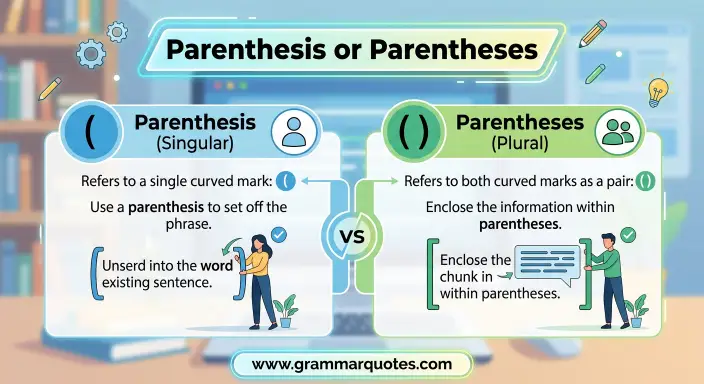
Have you ever wondered if to write parenthesis or parentheses? Both words are correct, but they are used differently. Parenthesis is the singular form, meaning one word, phrase, or statement added to a sentence as extra information. Parentheses is the plural form, meaning more than one parenthesis or the pair of curved brackets used to add extra information.
For example, “The answer is correct (I checked it)” contains one pair of parentheses. You can say, “The parentheses contain extra information.” However, if you are talking about one such punctuation mark or one inserted statement, you can use the word parenthesis.
These words can be confusing because the singular and plural forms look quite different. Learning the difference will help you write more clearly and use punctuation correctly. In this guide, you will discover their meanings, spelling rules, practical examples, common mistakes, and answers to frequently asked questions.
Quick Answer: Parenthesis vs Parentheses
- Parenthesis: Singular; refers to one inserted word, phrase, or statement, or one of the curved marks used to enclose it.
- Parentheses: Plural; refers to more than one parenthesis or to the pair of curved brackets ( ).
Examples:
- The final sentence contains a parenthesis.
- Put the extra information in parentheses.
Easy memory tip: Use parenthesis for one and parentheses for more than one.
What Does Parenthesis Mean?
Parenthesis is a singular noun. It refers to a word, phrase, or statement added to a sentence to provide extra information. It can also refer to one of the curved punctuation marks used to enclose that information.
Parenthesis as Extra Information
A parenthesis adds details that are helpful but not essential to the main sentence.
Examples:
- My brother (who lives in Lahore) is visiting us.
- The meeting, a short one, ended early.
- The result (which surprised everyone) was announced yesterday.
In these examples, the words inside the brackets or between commas provide extra information.
Parenthesis as a Punctuation Mark
The word parenthesis can also refer to one curved bracket: an opening mark ( or a closing mark ).
Examples:
- The opening parenthesis is missing.
- Add a closing parenthesis to complete the expression.
- One parenthesis is placed before the extra information.
In everyday writing, people often use parentheses to refer to the complete pair of curved brackets.
What Does Parentheses Mean?
Parentheses is the plural form of parenthesis. It refers to more than one parenthesis or, commonly, the pair of curved brackets used around extra information.
Parentheses in Writing
Parentheses help separate additional details from the main sentence.
Examples:
- Sara (my best friend) lives nearby.
- The train arrives at 8 p.m. (unless it is delayed).
- Please read the instructions (especially the final section).
The curved marks around the extra information are called parentheses.
Parentheses in Maths
Parentheses are also used in mathematics to group numbers and operations.
Examples:
- ((2 + 3) \times 4 = 20)
- (10 (3 + 2) = 5)
- Solve the expression inside the parentheses first.
In mathematics, parentheses show which numbers or operations belong together.
Parenthesis vs Parentheses: Key Differences
| Feature | Parenthesis | Parentheses |
| Number | Singular | Plural |
| Meaning | One parenthesis or one inserted statement | More than one, or a pair of curved brackets |
| Spelling | Parenthesis | Parentheses |
| Common use | One punctuation mark or inserted detail | A pair of brackets around extra information |
| Example | Add an opening parenthesis. | Put the phrase in parentheses. |
| Memory clue | One | More than one |
When Should You Use Parenthesis?
Use parenthesis when you are referring to one inserted statement or one individual curved bracket.
Common Uses of Parenthesis
1. Referring to one inserted statement
- The sentence contains a short parenthesis.
- The writer added a parenthesis to explain the result.
2. Referring to one curved mark
- The opening parenthesis is missing.
- Place a closing parenthesis at the end.
Remember that parenthesis is singular, even though it may look less familiar than the plural form.
When Should You Use Parentheses?
Use parentheses when referring to multiple parentheses or to the pair of curved brackets around extra information.
Common Uses of Parentheses
1. Adding extra information
- Put your date of birth in parentheses.
- The teacher added a note in parentheses.
- The sentence includes extra details in parentheses.
2. Writing mathematical expressions
- Calculate the value inside the parentheses first.
- The equation contains two sets of parentheses.
3. Giving examples or explanations
- Several countries (including Pakistan and India) are in Asia.
- The website offers free tools (such as grammar checkers and dictionaries).
The main sentence should still make sense when the extra information inside parentheses is removed.
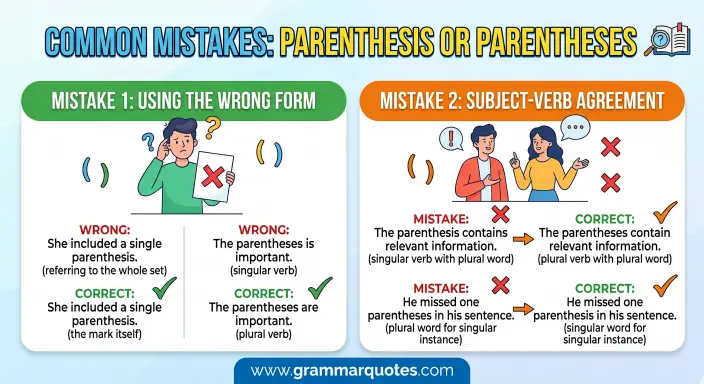
Common Mistakes: Parenthesis or Parentheses
| Incorrect sentence | Correct sentence |
| Put the extra details in parenthesis. | Put the extra details in parentheses. |
| The opening parentheses is missing. | The opening parenthesis is missing. |
| One parentheses is needed here. | One parenthesis is needed here. |
| The sentence contains two parenthesis. | The sentence contains two parentheses. |
In formal writing, choose the singular or plural form based on the number and meaning. When you mean the pair of curved brackets, parentheses is usually the natural choice.
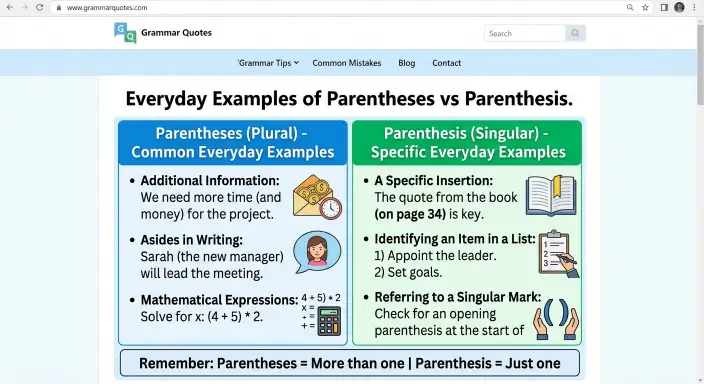
Everyday Examples of Parentheses vs Parenthesis
| Sentence | Correct word | Why? |
| The writer added one ______ to the sentence. | Parenthesis | It refers to one inserted statement. |
| Put the extra details in ______. | Parentheses | It refers to the pair of curved brackets. |
| The opening ______ is missing. | Parenthesis | It refers to one punctuation mark. |
| The equation contains two sets of ______. | Parentheses | It refers to multiple pairs. |
| A short ______ explains the result. | Parenthesis | It refers to one extra statement. |
| Use ______ to group these numbers. | Parentheses | It refers to the curved brackets used in maths. |
Parenthesis vs Parentheses: Word Origins
Origin of Parenthesis
Parenthesis comes from Greek roots meaning something placed beside or inserted. It entered English through Latin and later forms of Greek. Its meaning developed around extra information inserted into a sentence.
Origin of Parentheses
Parentheses is the plural form of parenthesis. English uses the ending es in this word to form the plural.
Unlike many nouns that simply add s, this word changes its ending from is to es.
- Singular: parenthesis
- Plural: parentheses
This spelling pattern also appears in words such as analysis and analyses.
Is Parenthesis or Parentheses More Common?
Parentheses is often more common when people discuss punctuation because writers usually use a pair of curved brackets together. Parenthesis is still correct when referring to one inserted statement or one individual bracket.
Search interest can vary by country, topic, and time. Google Trends can help compare interest in both terms over a selected period. However, popularity does not determine which form is grammatically correct; the singular and plural meanings do.
Parenthesis vs Parentheses: Common Questions
1. What is the main difference between parenthesis and parentheses?
Parenthesis is singular, while parentheses is plural. The first refers to one inserted statement or one curved mark; the second often refers to a pair of curved brackets.
2. Is parentheses singular or plural?
Parentheses is plural. Its singular form is parenthesis.
3. What is the plural of parenthesis?
The plural of parenthesis is parentheses. The spelling changes from is to es.
4. Should I say parenthesis or parentheses for ( )?
Use parentheses when referring to the complete pair ( ). Use parenthesis when referring to one of the two marks.
5. Is “in parenthesis” correct?
It can be used in some contexts, especially when referring to one inserted statement. However, in parentheses is the more common expression when referring to information enclosed in the pair of curved brackets.
6. Are parentheses only used in English grammar?
No. Parentheses are used in writing, mathematics, academic work, and many other forms of communication.
7. What is the difference between parentheses and brackets?
In American English, parentheses usually means the curved marks ( ), while brackets often means square marks [ ]. Usage can vary by region and context.
8. How do you pronounce parenthesis?
It is commonly pronounced puh REN thuh sis. The plural parentheses is commonly pronounced puh REN thuh seez.
9. Can parentheses contain a full sentence?
Yes. Parentheses can contain a complete sentence when it provides additional information. For example: “The event starts at six. (Please arrive early.)”
10. How can I remember parenthesis and parentheses?
Remember that parenthesis means one and parentheses means more than one or the pair of curved brackets.
Frequently Asked Questions
Is parenthesis a correct word?
Yes. Parenthesis is the correct singular form and can refer to one inserted statement or one curved bracket.
Is parentheses the correct plural form?
Yes. Parentheses is the standard plural form of parenthesis.
Which is correct: one parenthesis or one parentheses?
The correct phrase is one parenthesis, because one requires a singular noun.
Which punctuation marks are parentheses?
Parentheses are the curved marks ( ). The opening mark is ( and the closing mark is ).
What is an easy way to use parentheses correctly?
Use parentheses to add information that supports the sentence but is not essential to its main meaning. Make sure the sentence remains clear when the extra information is removed.
Conclusion
The difference between parenthesis and parentheses is mainly about singular and plural forms. Parenthesis refers to one inserted statement or one curved punctuation mark. Parentheses is the plural form and is commonly used for the pair of curved brackets ( ) that surrounds extra information.
For example, you can say, “The opening parenthesis is missing,” when referring to one mark. However, you would say, “Put the explanation in parentheses,” when referring to the complete pair of brackets.
These words may look confusing because their endings change from is to es. Once you learn this spelling pattern, choosing the correct form becomes much easier. Remember the simple rule: parenthesis = singular; parentheses = plural.
Use the examples and comparison table in this guide to practise both forms. With regular use, you will be able to write about punctuation and grammar more accurately and confidently.
Discover More Articles!
Curtesy vs Courtesy: Meaning, Difference, and Examples(2026)
Java AND or OR: Meaning, Differences, and Examples
Seeked or Sought: Which Spelling Is Correct?

Ethan Parker is an English-language writer known for his interest in words, language, and clear communication. His work focuses on making everyday English easier to understand through simple explanations and practical examples.