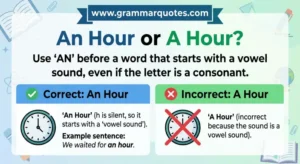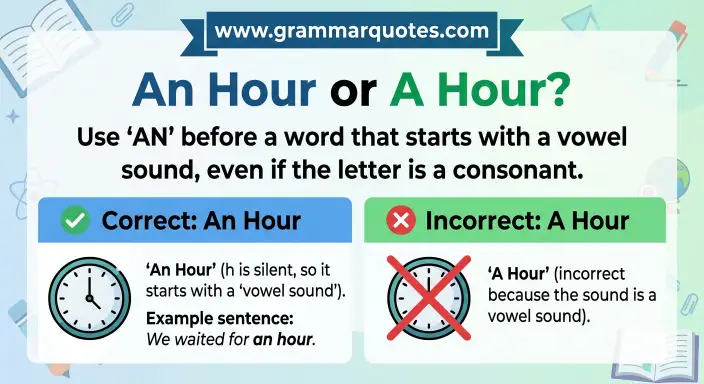
“An hour” is correct, while “a hour” is incorrect in standard English. The reason is simple: the word hour begins with a vowel sound because its initial h is silent. English uses an before a vowel sound and a before a consonant sound.
For example, you should write “I waited for an hour,” not “I waited for a hour.” Although the letter h appears at the beginning of hour, you do not pronounce it. The word sounds like “our,” which begins with a vowel sound.
This rule can confuse English learners because many words beginning with h use a, such as a house and a hotel. The difference comes from pronunciation, not simply from the first written letter.
In this guide, you will learn why an hour is correct, how the article rule works, which common mistakes to avoid, and how to use the phrase in everyday conversations, emails, and academic writing. You will also see examples that make the rule easy to remember.
An Hour or A Hour: Featured Snippet Answer
“An hour” is the correct phrase because the h in hour is silent, so the word begins with a vowel sound. Use an before hour, as in “The meeting lasted an hour.” Do not write a hour in standard English. Remember that the choice between a and an depends on the first sound of a word, not just its first letter.
An Hour or A Hour: Quick Answer
| Phrase | Correct? | Reason | Example |
| An hour | Correct | Hour begins with a vowel sound | I studied for an hour. |
| A hour | Incorrect in standard English | The h is silent | I studied for a hour. |
Quick rule: Write an hour because the h is silent.
The same rule applies when another word comes before hour:
- It took an hour to finish the task.
- We waited for an hour outside.
- She needs an hour to prepare.
What Does “An Hour” Mean?
The phrase an hour means a period of 60 minutes. It uses the indefinite article an before the singular noun hour.
An hour can refer to a specific period of time without identifying exactly which 60 minutes you mean.
Example: I will call you in an hour.
This means the person will call approximately 60 minutes from now.
More examples include:
- The class lasts an hour.
- He spent an hour reading.
- We arrived an hour early.
In each sentence, an is correct because hour starts with a vowel sound.
What Is an Article in English Grammar?
Articles are words that come before nouns. English has two indefinite articles: a and an.
Use a before a consonant sound:
- A book
- A teacher
- A university
Use an before a vowel sound:
- An apple
- An idea
- An hour
Notice that a university is correct even though university begins with the letter u. Its opening sound is /juː/, like “you,” which is a consonant sound.
The key is pronunciation, not spelling.
Why Is “An Hour” Correct?
The main reason is that the h in hour is silent.
The word hour is pronounced /aʊər/ in many English accents. Its first sound is a vowel sound, so the correct indefinite article is an.
Compare these examples:
- An hour: The h is silent.
- A house: The h is pronounced.
- An honest person: The h in honest is silent.
- A happy child: The h in happy is pronounced.
This explains why you write an hour but a house.
The Rule for A and An
Use a before a consonant sound and an before a vowel sound.
| Word | First sound | Correct phrase |
| Hour | Vowel sound | An hour |
| House | Consonant sound | A house |
| Honest | Vowel sound | An honest person |
| Happy | Consonant sound | A happy child |
| Umbrella | Vowel sound | An umbrella |
| University | Consonant sound /j/ | A university |
Memory tip: Say the word aloud. If its first sound is a vowel sound, use an. If its first sound is a consonant sound, use a.
The Origin of the Word “Hour”
The word hour comes through Old French hore from Latin hora, meaning a period of time. Its spelling and pronunciation developed over time, and the initial h is silent in modern standard English pronunciation.
The connection to Latin helps explain the word’s history, but the spelling rule is based on how English speakers pronounce it today.
For modern writing, remember the sound of the word rather than its historical spelling.
British English vs. American English
Is an hour British English, while a hour is American English? No. “An hour” is correct in both standard British and American English.
The article rule does not change between these two varieties. Both use an because the h in hour is silent.
| English variety | Correct phrase | Example |
| British English | An hour | The train arrives in an hour. |
| American English | An hour | I’ll be there in an hour. |
| Canadian English | An hour | The appointment lasted an hour. |
| Australian English | An hour | We drove for an hour. |
Although accents may differ slightly in how some words are pronounced, the standard phrase remains “an hour.”
Which Version Should You Use?
Use an hour in almost every standard English situation.
1. Everyday Conversation
When talking about time, use an hour.
Correct: I’ll be ready in an hour.
Incorrect: I’ll be ready in a hour.
2. Academic Writing
Use an hour when describing the length of an activity, experiment, lesson, or study session.
Example: The students completed the exercise in an hour.
This is grammatically correct because hour begins with a vowel sound.
3. Business Emails
Use an hour when discussing appointments, meetings, or deadlines.
Example: Could we schedule a meeting for an hour tomorrow?
This sentence uses an hour correctly to describe the meeting’s duration, although a clearer version may be: “Could we schedule a one hour meeting for tomorrow?”
4. Stories and Articles
The same rule applies in creative writing, blog posts, news articles, and formal documents.
Example: After an hour of walking, they reached the village.
The article remains an because the noun is still hour.
5. Before Adjectives
The article can also come before an adjective that describes hour.
Correct: It was an unusual hour to receive a phone call.
Here, an is used because the next word, unusual, begins with a vowel sound.
Important: When an adjective comes between the article and the noun, choose a or an based on the first sound of the adjective, not the noun that follows it.
Common Mistakes With “A Hour” and “An Hour”
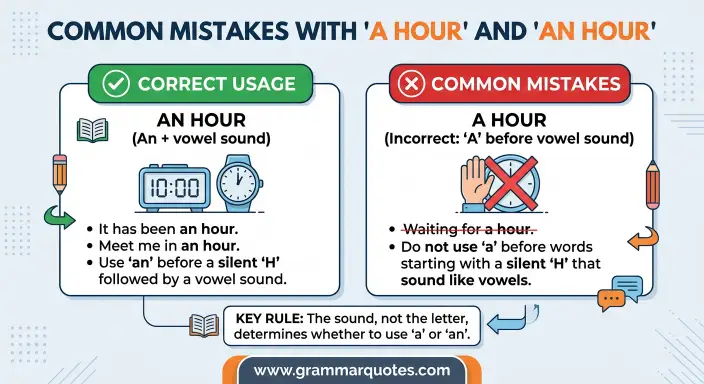
English learners often choose articles by looking at the first letter. However, the first sound is what matters.
Mistake 1: Writing “A Hour”
Incorrect: I waited for a hour.
Correct: I waited for an hour.
Why? The h in hour is silent, so the word begins with a vowel sound.
Mistake 2: Thinking Every Word Beginning With H Uses “A”
Incorrect rule: Always use a before words beginning with h.
Correct rule: Listen to the opening sound.
- An hour: Silent h.
- An honest answer: Silent h.
- A house: Pronounced h.
- A history lesson: Pronounced h.
Mistake 3: Confusing “An Hour” With “One Hour”
Both phrases can be correct, but they are used differently.
Example: The lesson lasted an hour.
Example: The lesson lasted one hour.
The first is a natural, general statement. The second may emphasize the exact duration.
Mistake 4: Using “An” Without Checking the Next Sound
Incorrect: An university.
Correct: A university.
The word university begins with a /j/ sound, like “you,” so it takes a.
Compare this with an hour, where the opening sound is a vowel.
Mistake 5: Ignoring the Word After the Article
Incorrect: A unusual hour.
Correct: An unusual hour.
The article comes directly before unusual, so its opening vowel sound determines the choice.
Easy memory trick: Do not ask, “Which letter does the word start with?” Ask, “Which sound do I hear first?”
Everyday Examples of “An Hour”
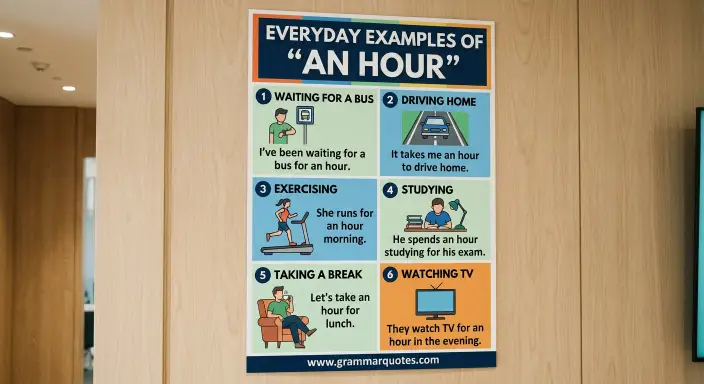
Here are examples showing how to use the phrase naturally in different situations.
1. Daily Conversation
- I’ll meet you in an hour.
- It took an hour to reach the station.
- Can you wait for an hour?
- We spent an hour talking.
2. School and Academic Writing
- The examination lasted an hour.
- I studied mathematics for an hour.
- The teacher gave us an hour to complete the assignment.
- The lecture continued for an hour.
3. Emails and Business Writing
- The meeting should take about an hour.
- Please allow an hour for the consultation.
- I will send the report within an hour.
- We scheduled a one hour meeting for Monday.
4. Headlines and Blog Writing
- How to Learn a New Skill in an Hour
- What Happens When You Walk for an Hour Every Day?
- Plan Your Study Schedule in an Hour
- Five Tasks You Can Complete in an Hour
These headings use an hour correctly because the word begins with a vowel sound.
5. Formal Writing
- The participants completed the task in an hour.
- The procedure requires approximately an hour.
- The researchers observed the process for an hour.
The same grammatical rule applies regardless of the writing style.
Quick Comparison Table: An Hour vs A Hour
| Phrase | Meaning | Correct? | Explanation | Example |
| An hour | A period of 60 minutes | Yes | Hour begins with a vowel sound | We waited an hour. |
| A hour | Intended to mean 60 minutes | No, in standard English | The h is silent | We waited a hour. |
| One hour | Exactly or specifically 60 minutes | Yes | Uses the number one | The trip took one hour. |
| An hour ago | 60 minutes before now | Yes | Hour begins with a vowel sound | She left an hour ago. |
| An entire hour | A complete period of 60 minutes | Yes | Entire begins with a vowel sound | I waited an entire hour. |
Remember: “An hour” is the standard phrase. “A hour” is not accepted in standard English.
Key Takeaways
- “An hour” is correct; “a hour” is incorrect in standard English.
- The h in hour is silent.
- The word hour begins with a vowel sound.
- Use a before consonant sounds and an before vowel sounds.
- The rule is the same in British, American, Canadian, and Australian English.
- The article depends on pronunciation, not simply the first written letter.
- When an adjective comes before a noun, choose the article based on the adjective’s first sound.
Frequently Asked Questions
1. Is it an hour or a hour?
“An hour” is correct. The h in hour is silent, so the word starts with a vowel sound. English uses an before vowel sounds. Therefore, write “I waited for an hour,” not “I waited for a hour.”
2. Why do we say an hour instead of a hour?
We say an hour because the first sound in hour is a vowel sound. The written h is not pronounced. The choice between a and an depends on pronunciation, which is why an hour is correct.
3. Is “an hour” grammatically correct?
Yes. An hour is grammatically correct in standard English. It means a period of 60 minutes. For example, “The class lasted an hour” is a correct sentence.
4. Is “a hour” ever correct?
In standard English, a hour is incorrect. You should write an hour. A writer may reproduce a nonstandard phrase in a quotation or when discussing a grammatical error, but it should not be used as the correct form in ordinary writing.
5. Is it an hour ago or a hour ago?
The correct phrase is “an hour ago.” The word hour begins with a vowel sound because its h is silent. For example, “The bus left an hour ago.”
6. Is it an hour or one hour?
Both an hour and one hour are correct. An hour is a natural way to refer to a 60 minute period, while one hour can emphasize the number or exact duration. For example, “I waited an hour” and “I waited one hour” are both grammatical.
7. Do British and American English use “an hour”?
Yes. Both British and American English use an hour. This article rule is not a difference between the two varieties. The same standard form is used in Canadian and Australian English.
8. Why do we say “a house” but “an hour”?
The h in house is pronounced, giving the word a consonant sound at the beginning. The h in hour is silent, so the word begins with a vowel sound. That is why we say “a house” but “an hour.”
9. Is it an hour long meeting or a hour long meeting?
The correct phrase is “an hour long meeting.” The word hour begins with a vowel sound, so it takes an. You can also write “a one hour meeting,” because one begins with a /w/ consonant sound.
10. What is the easiest way to remember a vs. an?
Remember this rule: Use a before a consonant sound and an before a vowel sound. Say the word aloud if you are unsure. For example, use an hour, an apple, a house, and a university.
Conclusion:
The correct phrase is “an hour,” not “a hour.” The reason is the silent h in hour, which makes the word begin with a vowel sound. In English, the choice between a and an depends on the first sound of the following word rather than simply its first letter.
This rule also explains why we say a house but an honest person. In the first example, the h is pronounced. In the second, it is silent. Learning to recognize these sounds will help you use English articles more confidently.
if you are writing a school assignment, an email, a blog post, or a casual message, remember to write “an hour.” Once you understand the sound based rule, choosing between a and an becomes much easier.
One simple rule can prevent a common grammar mistake: listen to the sound, not just the letter.
Discover More Articles!
Each Other vs Eachother: Meaning, Examples, and Mistakes
Smoky or Smokey: Which Spelling Is Correct?
Enterprise or Hertz: What Is the Difference?

Ethan Parker is an English-language writer known for his interest in words, language, and clear communication. His work focuses on making everyday English easier to understand through simple explanations and practical examples.