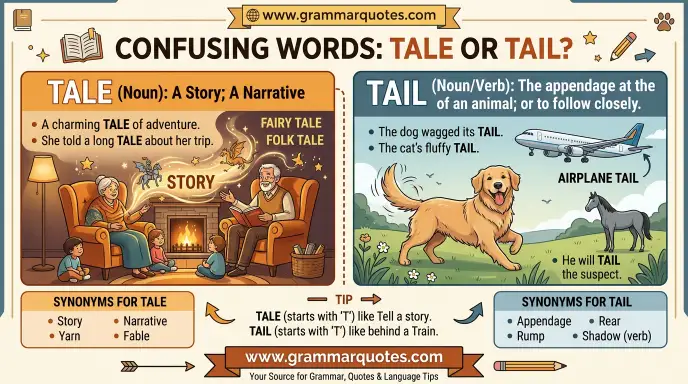
Tale and tail are both correct English words, but they have completely different meanings. Tale usually means a story or account of events, while tail refers to the rear part of an animal or something that extends from the back of an object.
These two words sound exactly the same in standard English, which makes them homophones. However, their spellings and meanings are different. This can make them confusing in writing, especially for English learners.
For example, you might read a tale about a brave hero, but a dog has a tail. The context usually makes the intended meaning clear.
Learning the difference is useful for school assignments, creative writing, emails, social media posts, and everyday English. Once you connect each spelling with its meaning, the distinction becomes easy to remember.
Tale or Tail : Quick Answer
Tale means a story, while tail usually means the rear part of an animal or something extending from the back.
- Tale = story
- Tail = rear part or appendage
Examples
The grandmother told the children a funny tale.
The dog wagged its tail.
Although the words sound alike, you cannot normally use one in place of the other.
Definition and Meaning
What Does Tale Mean?
A tale is a story or account of events. It can be true, fictional, traditional, humorous, or exaggerated.
Examples include:
- A fairy tale
- A folk tale
- A traditional tale
- A personal tale
- A humorous tale
For example:
He told us a fascinating tale about his childhood.
The word can sometimes suggest an interesting or imaginative story rather than a simple factual report.
What Does Tail Mean?
A tail is the part that extends from the rear of an animal’s body. The word can also describe something positioned at the back or end of another thing.
Examples include:
- A dog’s tail
- A cat’s tail
- A bird’s tail
- The tail of a plane
- The tail of a comet
- The tail end of a line
For example:
The cat lifted its tail and walked away.
The Origin of Tail and Tale
Although the two words now have different meanings and spellings, their histories are interesting.
Tale comes from Old English and is related to words meaning a story, account, or something told.
Tail also comes from Old English and developed from an older word referring to the rear part of an animal.
Over time, their spellings became distinct even though their pronunciation remained the same.
This is why modern English has two separate words that sound alike.
Why Do Tale and Tail Sound the Same?
They are homophones.
Homophones are words that have the same pronunciation but different meanings and often different spellings.
Other examples include:
- Their / there / they’re
- Sea / see
- Flower / flour
- Right / write
- Pair / pear
Similarly:
Tale → story
Tail → rear part
Understanding the meaning rather than relying only on sound will help you choose the correct spelling.
Main Difference Between the Two
The easiest way to remember the difference is:
Tale tells a story. Tail follows the body.
| Word | Meaning | Example |
| Tale | A story | She told a wonderful tale. |
| Tail | Rear part of an animal or object | The dog wagged its tail. |
The two words are pronounced the same, but their meanings are unrelated.
When Should You Use Tale?
Use tale when you are talking about a story or account.
Common phrases with Tale
- Fairy tale
- Folk tale
- Tall tale
- Cautionary tale
- Traditional tale
- Love tale
- Adventure tale
- Historical tale
Examples
The children listened to a fairy tale.
He shared a strange tale about his travels.
The book tells a tragic tale of friendship.
When Should You Use Tail?
Use tail when you mean the rear part of an animal, person, object, or group.
Common uses
Animals:
The horse moved its tail.
Aircraft:
The plane’s tail was damaged.
Comets:
The comet has a long tail.
Lines or groups:
We were at the tail end of the queue.
The word has both literal and figurative uses.
Common Expressions With Tale
Several English expressions contain tale.
Fairy Tale
A fictional story, often involving magic or imaginary characters.
She grew up reading fairy tales.
Tall Tale
A story that is greatly exaggerated and may not be true.
His fishing story sounded like a tall tale.
Cautionary Tale
A story that teaches people about the dangers of certain actions.
The accident became a cautionary tale for young drivers.
Common Expressions With Tail
The word tail also appears in many common expressions.
Tail End
The final part of something.
We arrived at the tail end of the event.
Turn Tail
To suddenly turn around and leave or retreat.
The frightened animal turned tail and ran.
Tail Between Your Legs
An expression describing someone leaving after being embarrassed or defeated.
He left with his tail between his legs.
Chase Your Tail
To spend time doing something without making useful progress.
I spent the whole morning chasing my tail.
Tail vs Tale in Everyday Examples
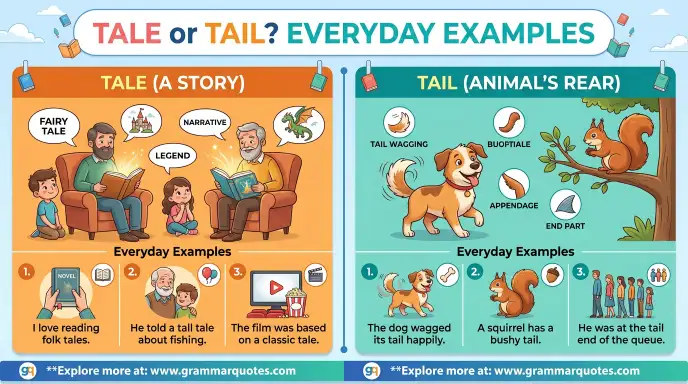
Here are some simple examples:
- She told me an interesting tale.
- The puppy wagged its tail.
- The children enjoyed the fairy tale.
- The bird spread its tail.
- He wrote a short tale for the school magazine.
- The fox has a bushy tail.
- It was a strange tale about a lost traveler.
- The horse’s tail moved in the wind.
- The movie tells a tragic tale.
- The airplane’s tail was visible from the runway.
Common Mistakes
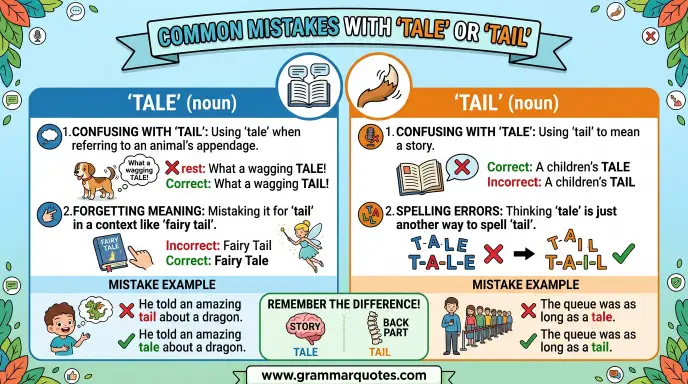
One of the most common mistakes is using tail when you mean a story.
Incorrect:
She told me an interesting tail.
Correct:
She told me an interesting tale.
Another common mistake is using tale for an animal’s rear appendage.
Incorrect:
The dog wagged its tale.
Correct:
The dog wagged its tail.
The pronunciation does not help because both words sound the same. You need to think about the meaning.
A Simple Memory Trick
Here is an easy way to remember them:
Tale = Tell a tale.
Both tale and tell are connected with stories.
Tail = Animal’s tail.
Think about the tail of a dog or cat.
So remember:
Tale = story
Tail = animal’s rear part
Tale or Tail in Formal Writing
Both words are standard English, but they belong in different contexts.
Use tale when discussing:
- Stories
- Literature
- History
- Fiction
- Narratives
- Traditional stories
Use tail when discussing:
- Animals
- Aircraft
- Comets
- Queues
- The end of something
- Physical structures
Choosing the correct spelling is important because replacing one with the other changes the meaning completely.
British English vs American English
There is no major British American spelling difference between these two words.
Both British and American English use:
- Tale for a story
- Tail for the rear part of an animal or object
For example:
British English:
He told an interesting tale.
American English:
He told an interesting tale.
The same applies to tail.
This makes the pair different from spelling variations such as colour/color or favourite/favorite.
Tale or Tail Pronunciation
Both words are pronounced the same:
Tale — /teɪl/
Tail — /teɪl/
They rhyme with words such as:
- Sale
- Scale
- Rail
- Whale
Because their pronunciation is identical, spelling is especially important when writing.
Are Tale and Tail Homophones?
Yes. Tale and tail are homophones because they have the same pronunciation but different meanings and spellings.
This is one reason English learners can confuse them.
When you hear the word without seeing it written, you need context to understand which meaning is intended.
Tale or Tail : Comparison Table
| Feature | Tale | Tail |
| Meaning | Story or account | Rear part or extension |
| Pronunciation | /teɪl/ | /teɪl/ |
| Same pronunciation? | Yes | Yes |
| Homophones? | Yes | Yes |
| Used in literature? | Yes | Sometimes |
| Used for animals? | No | Yes |
| Example | A fairy tale | A dog’s tail |
Tale or Tail : Google Trends & Usage
Both words are common English vocabulary, but their search intent is different.
Searches for tale are often connected with stories, literature, fairy tales, and phrases such as “tall tale.” Searches for tail are more likely to relate to animals, anatomy, science, and expressions involving the end or rear part of something.
Because both words are common, search results can vary greatly depending on the context.
For learners, understanding the meaning behind each word is more useful than focusing only on search popularity.
People Also Ask
1. What is the difference between tale and tail?
Tale means a story, while tail means the rear part of an animal or something extending from the back.
2. Are tale and tail pronounced the same?
Yes. Both are normally pronounced /teɪl/.
3. Is a fairy tale or fairy tail correct?
Fairy tale is correct because it means a fictional story.
4. Is dog tale or dog tail correct?
Dog tail is correct when referring to the animal’s rear appendage.
5. Is tale a homophone of tail?
Yes. They have the same pronunciation but different meanings and spellings.
6. What is an example of tale?
“She told us a fascinating tale about her journey.”
7. What is an example of tail?
“The dog wagged its tail.”
8. What does tall tale mean?
A tall tale is a story that is exaggerated and often difficult to believe.
9. Can tale and tail be used interchangeably?
No. They have different meanings and cannot normally replace each other.
10. How can I remember tale and tail?
Remember tale = story and tail = rear part of an animal or object.
Frequently Asked Questions
Is “tale” the same as “story”?
Usually, yes. A tale is a type of story or account, although it can sometimes sound more literary or traditional.
Is “tail” only used for animals?
No. It can also refer to the rear part of an aircraft, the end of a line, a comet’s visible extension, and other things.
Which spelling is correct for fairy tale?
Fairy tale is correct.
Which spelling is correct for a dog’s tail?
Dog’s tail is correct.
Why are tale and tail confusing?
They are confusing because they sound exactly the same but have different meanings and spellings.
Are both words nouns?
Yes. Both tale and tail are commonly used as nouns. Tail can also be used as a verb.
What is the easiest way to remember them?
Think tale = tell a story and tail = the back part of an animal.
Final Comparison
| Word | Simple Meaning | Example |
| Tale | Story | He told a funny tale. |
| Tail | Rear part | The dog wagged its tail. |
| Pronunciation | Same | /teɪl/ |
| Spelling | Different | Tale ≠ Tail |
| Homophones | Yes | Same sound, different meaning |
Conclusion
Tale and tail are easy to confuse because they sound exactly the same, but they have completely different meanings. Tale refers to a story or account, while tail usually refers to the rear part of an animal or something extending from the back.
The simplest way to remember the difference is to connect tale with telling a story and tail with the back of an animal. For example, you can tell a tale, but a dog can wag its tail.
Both words are used in British and American English with the same spelling and meaning. They are also homophones, which means context and spelling are important when writing.
Once you remember the basic distinction—tale = story and tail = rear part—you can easily choose the correct word in schoolwork, professional writing, creative writing, and everyday English.
Discover More Articles!
Knives or Knifes: Which Spelling Is Correct?(2026)
Sinus or Allergies: What’s the Difference?(2026)
Fourty or Forty: Which Spelling Is Correct?(2026)

Ethan Parker is an English-language writer known for his interest in words, language, and clear communication. His work focuses on making everyday English easier to understand through simple explanations and practical examples.