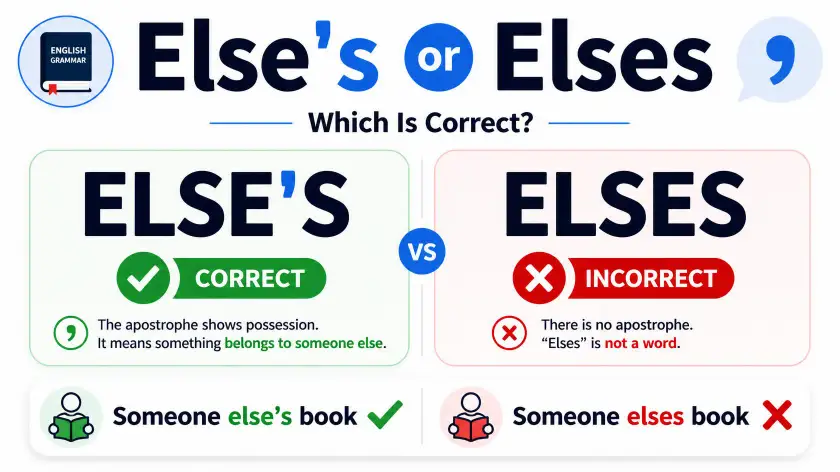
If you are unsure to write else’s or elses, the correct form is usually else’s when you need a possessive form. Elses is not the standard English spelling. For example, “This is someone else’s book” is correct, while “This is someone elses book” is incorrect.
The confusion happens because else often appears after words such as someone, anyone, everyone, and somebody.
When writers want to show ownership, they may be unsure where to place the apostrophe. The rule is simple once you see how the word works.
In this guide, you will learn what else’s means, why the apostrophe matters, when to use it, and why elses is normally incorrect.
You will also see examples from everyday speech, emails, academic writing, business communication, and social media.
you are a student, ESL learner, writer, or editor, understanding this small grammar point can help you avoid a very common possessive mistake.
Else’s or Elses: The Quick Answer for Writers
Else’s is the correct possessive form when you mean that something belongs to another person or thing. Elses is generally incorrect in standard English because else does not normally form a plural by adding s.
Examples:
- Someone else’s phone was left on the table.
- I used someone else’s idea.
- Is this anyone else’s problem?
- We should respect everyone else’s opinion.
The apostrophe in else’s shows possession. Without it, elses does not normally have a standard grammatical role.
Else’s or Elses: Quick Answer
The standard form is else’s, not elses, when you need to show possession.
Use “else’s” when:
- Something belongs to someone else.
- Something belongs to anybody else.
- Something belongs to everybody else.
- You are forming a possessive phrase with an indefinite pronoun.
Examples:
- This is someone else’s jacket.
- I don’t want anyone else’s help.
- That was somebody else’s decision.
What about “someone else’s”?
This is one of the most common uses of else’s. The word else comes after the indefinite pronoun, and the possessive apostrophe is added to else, not to someone.
Correct:
someone else’s car
Incorrect:
someone’s else’s car
The same pattern applies to phrases such as anyone else’s, everyone else’s, and nobody else’s.
What Does Else’s Mean?
Else’s is the possessive form of else. It is used when referring to something belonging to another person or, in some contexts, another thing.
The word else generally means “in addition,” “other,” or “different.” It often follows indefinite pronouns and question words.
For example:
- someone else
- anyone else
- everyone else
- nobody else
- what else
- where else
When possession needs to be shown, ‘s is added:
- someone else → someone else’s
- anyone else → anyone else’s
- everyone else → everyone else’s
- somebody else → somebody else’s
Examples in sentences
Someone else’s:
I accidentally took someone else’s umbrella.
Anyone else’s:
Would anyone else’s answer be different?
Everyone else’s:
The teacher checked everyone else’s work.
Somebody else’s:
This notebook must be somebody else’s.
The meaning is clear because the apostrophe shows that the following noun belongs to or is associated with another person.
The Origin of Else and Its Possessive Form
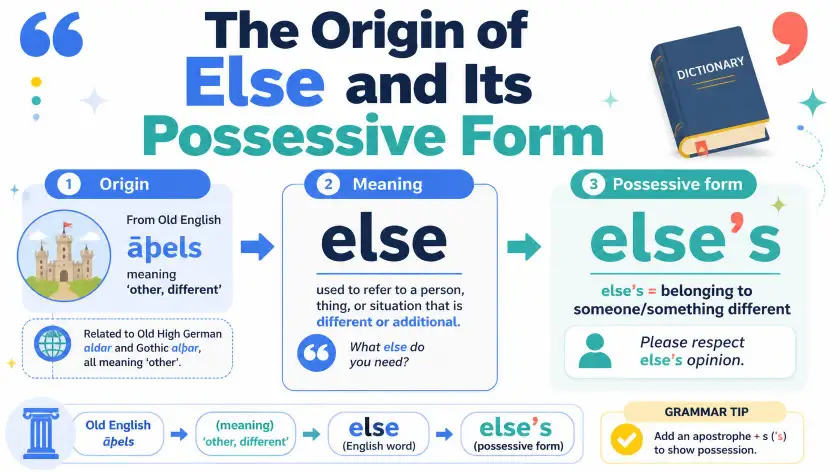
Else is an old English word with the general sense of “otherwise,” “other,” or “in addition.” Its modern uses developed over a long period of English history.
Today, else is especially common after words such as someone, something, anyone, and what:
- someone else
- something else
- anyone else
- what else
English uses apostrophe ‘s to form many singular possessives. When else is part of a phrase and possession is required, the possessive marker is attached to else:
someone else + ‘s + car
someone else’s car
This explains why someone else’s is correct.
The spelling elses is different. Simply adding s does not create the possessive form. The apostrophe is important because it signals possession.
British English vs American English
There is no major British American spelling difference between else’s and elses. Both British and American English use else’s for the possessive construction.
| British English | American English | Example |
| else | else | What else do you need? |
| else’s | else’s | This is someone else’s book. |
| someone else’s | someone else’s | I borrowed someone else’s pen. |
| anyone else’s | anyone else’s | Is this anyone else’s seat? |
| everyone else’s | everyone else’s | Everyone else’s work was finished. |
| elses | elses | Generally incorrect in standard English |
The main difference between British and American English is often found in vocabulary, punctuation preferences, or style choices. The possessive construction itself remains the same.
What style guides recommend
Standard English writing uses an apostrophe to mark possession in constructions such as someone else’s.
For professional, academic, and edited writing, avoid elses when you intend the possessive form.
Which Version Should You Use?
For almost all standard English writing, use else’s when you need the possessive form.
United States
Use else’s in American English:
That’s someone else’s responsibility.
United Kingdom
British English also uses else’s:
It was somebody else’s decision.
Canada
Canadian English generally follows the same possessive pattern:
We should consider everyone else’s opinion.
Australia
Australian English also uses else’s:
Is this anyone else’s property?
International writing
If you are writing for an international audience, else’s is the safe standard form.
Academic writing
Use else’s when the possessive construction is appropriate, although academic writing may often prefer a more precise noun instead.
For example:
The student’s argument differs from someone else’s.
Business writing
Use the standard possessive form:
This document contains someone else’s confidential information.
The key rule is simple: use the apostrophe when you mean possession.
Common Mistakes With Else’s and Elses
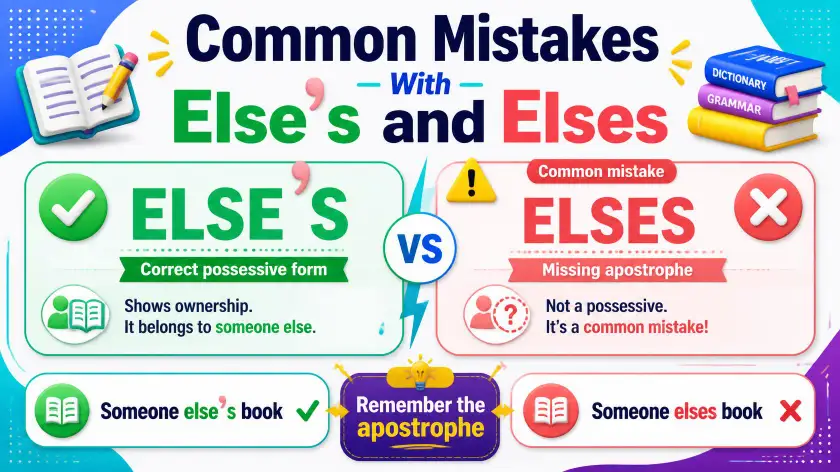
Mistake 1: Writing “elses” for possession
Incorrect:
This is someone elses phone.
Correct:
This is someone else’s phone.
Why?
The apostrophe marks the possessive relationship.
Memory tip: If something belongs to someone else, think else + ‘s = else’s.
Mistake 2: Adding the apostrophe to the wrong word
Incorrect:
Someone’s else book is on the desk.
Correct:
Someone else’s book is on the desk.
Why?
The phrase is someone else. The possessive marker goes after else.
Mistake 3: Confusing “else’s” with “else”
Incorrect:
What else’s can we do?
Correct:
What else can we do?
Why?
In this sentence, else does not show possession. There is no reason to add ‘s.
Mistake 4: Adding an unnecessary plural
Incorrect:
I compared the elses.
Correct alternatives:
I compared the other options.
I compared the alternatives.
Why?
Else is not normally made into a plural noun by adding s.
Elses or Else’s: Everyday Examples
Understanding the rule is easier when you see it in real situations.
In emails
Please don’t use someone else’s account.
We should not share anyone else’s private information.
In business writing
The proposal was based on someone else’s research.
You cannot use another company’s materials as if they were someone else’s.
In news writing
The committee rejected someone else’s proposal.
Officials said the decision was not anyone else’s responsibility.
In blogs
You don’t need to copy someone else’s writing style.
Sometimes someone else’s experience can teach you a useful lesson.
On social media
That’s someone else’s photo, not mine.
Don’t take credit for someone else’s work.
In academic writing
The researcher challenged someone else’s interpretation of the data.
Students should clearly identify someone else’s ideas.
In daily conversation
Is this someone else’s bag?
Did you take someone else’s seat?
What else do you want?
Notice the difference between else’s and else:
someone else’s bag = possession
what else = something additional
The apostrophe changes the grammatical function.
Google Trends and Modern Usage
People often search “else’s or elses” because the two forms sound similar when spoken. In fast speech, the apostrophe cannot be heard, so writers may wonder elses is a legitimate spelling.
The confusion is especially common in phrases such as:
- someone else’s
- anyone else’s
- everyone else’s
- somebody else’s
- nobody else’s
Modern English continues to use these possessive constructions in everyday speech and writing.
There is no need to invent a plural form such as elses simply because else ends up next to a possessive noun phrase. The apostrophe has a grammatical purpose.
Search interest around this type of question usually reflects a spelling and grammar problem rather than a difference in meaning between two accepted forms.
For edited writing, the practical answer remains straightforward:
Write “else’s” for possession. Do not use “elses” as its replacement.
Else’s or Elses: Quick Comparison Table
| Version | Meaning | Correct? | Region | Example |
| else | Other or additional | Yes | All major varieties | What else do you need? |
| else’s | Possessive form | Yes | US, UK, Canada, Australia | This is someone else’s bag. |
| elses | Attempted possessive/plural form | No, in standard usage | None as standard possessive | Someone elses bag ❌ |
| someone else’s | Belonging to another person | Yes | International | It is someone else’s idea. |
| anyone else’s | Belonging to another person | Yes | International | Is this anyone else’s coat? |
| everyone else’s | Belonging to all other people | Yes | International | Everyone else’s work is done. |
Key Takeaways
- Else’s is the standard possessive form.
- Elses is generally incorrect when used as a possessive.
- The apostrophe in else’s shows possession.
- Write someone else’s, not someone elses.
- The same rule applies to anyone else’s and everyone else’s.
- Do not use else’s when you simply mean else.
- British and American English use the same basic form.
- In formal, academic, and business writing, choose else’s for possessive meaning.
FAQs
Is “else’s” correct English?
Yes. Else’s is correct when it shows possession. It commonly appears after indefinite pronouns such as someone, anyone, everyone, and somebody. For example, “This is someone else’s phone” means the phone belongs to another person.
Is “elses” a word?
Elses is not normally used as the standard plural or possessive form of else. If you want to show possession, use else’s. For example, “someone else’s car” is correct, while “someone elses car” is incorrect in standard English.
Is it “someone else’s” or “someone elses”?
The correct form is someone else’s. The apostrophe before s marks the possessive construction. For example: “I accidentally took someone else’s jacket.” The form someone elses is missing the apostrophe and should be avoided in standard writing.
Is it “anyone else’s” or “anyone elses”?
Use anyone else’s. The phrase means that something belongs to another person. For example: “Is this anyone else’s seat?” The apostrophe is necessary because the phrase is possessive.
Why does “else’s” have an apostrophe?
The apostrophe indicates possession. In someone else’s book, the book belongs to someone else. The construction is essentially someone else + possessive marker + book. Therefore, the correct spelling is someone else’s book.
Can “else” be plural?
In ordinary standard English, else is not normally pluralized as elses. If you need to refer to several alternatives, use a suitable noun such as others, alternatives, or options. For example, “We considered the other options” is clearer than trying to pluralize else.
Is “what else” correct?
Yes. What else is completely correct, but it does not need an apostrophe. Here, else means something additional or different. For example: “What else do you need?” Writing “what else’s” would change the construction and is not correct for this meaning.
Is “everyone else’s” grammatically correct?
Yes. Everyone else’s is the correct possessive form. For example: “She finished her work before everyone else’s.” The apostrophe shows possession or association with the other people.
Is “somebody else’s” correct?
Yes. Somebody else’s is a standard possessive construction. For example: “This must be somebody else’s notebook.” The apostrophe belongs after else, because else is the word being made possessive in the phrase somebody else.
What is the easiest way to remember “else’s”?
Use this simple rule: else + ‘s = else’s when you mean possession. Think of “someone else” first, then add the possessive ending: someone else → someone else’s. If you simply mean “another” or “in addition,” use else without an apostrophe.
Conclusion
The difference between else’s or elses is simple once you understand the role of the apostrophe. Else’s is the standard possessive form, while elses is generally not correct when you want to show ownership.
You will often see else’s after words such as someone, anyone, everyone, somebody, and nobody. Examples include someone else’s car, anyone else’s opinion, and everyone else’s responsibility. In each case, the apostrophe signals a possessive relationship.
Do not add ‘s when else simply means “another,” “additional,” or “different.” For example, What else do you need? is correct because there is no possessive meaning.
The same basic rule applies in American, British, Canadian, and Australian English. So if you are writing an email, essay, article, report, or social media post, else’s is the safe standard choice when possession is intended.
Remember: If something belongs to someone else, write “else’s,” not “elses.”
If you found this distinction useful, use the same apostrophe check whenever you are unsure about a possessive phrase.
Discover More Articles!
Swum or Swam: Common Mistakes and Easy Examples(2026)
Warp or Woof: What’s the Difference?
Kyoto or Tokyo: Which City Should You Visit?

Ethan Parker is an English-language writer known for his interest in words, language, and clear communication. His work focuses on making everyday English easier to understand through simple explanations and practical examples.