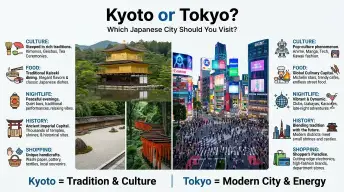
Kyoto and Tokyo offer very different experiences of Japan. Kyoto is the better choice for traditional culture, temples, shrines, gardens, and historic streets, while Tokyo is better for modern city life, shopping, nightlife, technology, and food. If your schedule allows, visiting both gives you a more complete picture of Japan.
Kyoto or Tokyo : Quick Answer
If you are deciding between Kyoto or Tokyo, start with the kind of trip you want.
Choose Kyoto if you want:
- Traditional Japanese culture
- Temples and shrines
- Historic neighborhoods
- Gardens and tea ceremonies
- A slower, more relaxed atmosphere
Choose Tokyo if you want:
- Modern Japanese city life
- Shopping and technology
- Nightlife and entertainment
- Huge food choices
- Busy neighborhoods and skyscrapers
For a first trip lasting several days, visiting both is often the strongest option. The two cities are connected by the Shinkansen, making it practical to combine them in one itinerary.
Example 1: Culture
“I want to see temples, traditional houses, and Japanese gardens.”
Kyoto is the better fit.
Example 2: Modern Japan
“I want shopping, nightlife, technology, and busy city streets.”
Tokyo is the better fit.
Example 3: First Japan trip
“I want to experience both traditional and modern Japan.”
Visit both Kyoto and Tokyo.
What Does Kyoto or Tokyo Mean?
The phrase “Kyoto or Tokyo” usually appears in travel searches. People use it when they are trying to decide which Japanese city to visit.
The question is not really about which city is objectively “better.” It is about which destination matches your interests, available time, and travel style.
Kyoto was Japan’s imperial capital for more than a thousand years and remains strongly associated with temples, shrines, gardens, traditional architecture, and cultural experiences. Tokyo, by contrast, is Japan’s present day capital and a vast modern metropolis known for its neighborhoods, food, shopping, entertainment, and contemporary culture.
This makes the comparison simple:
Kyoto represents traditional Japan. Tokyo represents modern Japan.
That does not mean Kyoto is old fashioned or Tokyo has no history. Both cities combine old and new. The difference is where each city’s character is strongest.
The Origin of Kyoto and Tokyo
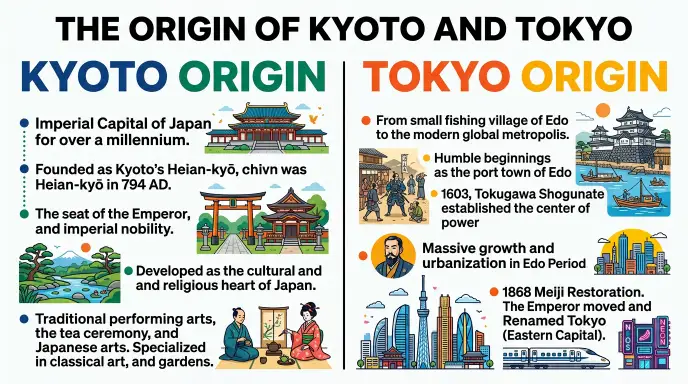
Kyoto and Tokyo have played very different roles in Japanese history.
Kyoto became Japan’s imperial capital in 794 and remained the center of imperial government for centuries. Its long history helped shape its reputation as a center of Japanese art, architecture, religion, cuisine, and traditional culture.
Tokyo has an older history under its former name, Edo. It grew into a major political center and eventually became the capital when the imperial capital moved from Kyoto in 1868.
The historical difference explains much of today’s travel experience.
Kyoto’s historic role helped preserve many cultural traditions. Visitors can explore temples, shrines, gardens, traditional streets, and districts associated with geisha culture.
Tokyo developed into a huge political, economic, and cultural center. Today, it is known for its dense neighborhoods, transportation network, fashion, technology, restaurants, and entertainment.
So when travelers compare Kyoto vs Tokyo, they are also comparing two different chapters of Japanese history.
British English vs American English
This comparison is not about British and American spelling. Kyoto and Tokyo are both Japanese place names, so the choice depends on the destination rather than an English regional spelling difference.
| British English | American English | Example |
| Kyoto | Kyoto | “I visited Kyoto last spring.” |
| Tokyo | Tokyo | “Tokyo is Japan’s capital.” |
| Kyoto or Tokyo | Kyoto or Tokyo | “Which should I visit first?” |
English speakers in the UK, US, Canada, Australia, and other countries generally use the same English spellings: Kyoto and Tokyo.
The important distinction is geographical and cultural, not linguistic.
Which Version Should You Use?
If you mean which city should you visit, use your travel goals to decide.
United States
For travelers from the United States, either city can be an excellent starting point.
Choose Tokyo if you prefer:
- Large cities
- Pop culture
- Shopping
- Nightlife
- Modern architecture
Choose Kyoto if you prefer:
- History
- Temples
- Gardens
- Traditional experiences
- Quiet neighborhoods
United Kingdom
The same basic advice applies to travelers from the UK. Your country does not determine which city is better.
Instead, consider the experience you want from Japan.
Canada
Canadian travelers can use the same comparison. Kyoto is particularly attractive for travelers interested in Japanese history and culture, while Tokyo offers a much broader metropolitan experience.
Australia
Australian visitors should consider trip length and itinerary. If you have enough time, combining Tokyo and Kyoto can reduce the need to choose.
International Travelers
For international visitors, both cities are worth considering.
A useful rule is:
Short trip = choose one.
Longer trip = consider both.
Academic Writing
If you are writing about Japanese history, culture, tourism, or geography, use the official city names Kyoto and Tokyo. Be specific about if you mean the city, metropolitan area, historical capital, or surrounding region.
Business Writing
Use the city name that matches the location being discussed. Avoid treating Kyoto and Tokyo as interchangeable because they have different business, cultural, and geographic identities.
Common Mistakes
Mistake 1: Thinking Kyoto Is Only About History
Incorrect:
“Kyoto is just an old city with temples.”
Correct:
“Kyoto combines traditional culture with modern restaurants, shopping, nightlife, and everyday city life.”
Kyoto has a strong historical identity, but it is still a living city.
Mistake 2: Thinking Tokyo Has No Traditional Culture
Incorrect:
“Tokyo is completely modern.”
Correct:
“Tokyo combines modern urban life with historic temples, shrines, gardens, and traditional neighborhoods.”
Tokyo has famous historic attractions, including Senso ji and Meiji Jingu.
Mistake 3: Choosing Only by Popularity
Incorrect:
“Tokyo is more famous, so it must be better.”
Correct:
“Tokyo and Kyoto suit different travel interests.”
Popularity does not tell you which city is right for your trip.
Memory Tip
Remember:
Kyoto = culture and tradition.
Tokyo = energy and modern life.
This is a useful starting point, although both cities offer much more than these labels suggest.
Everyday Examples
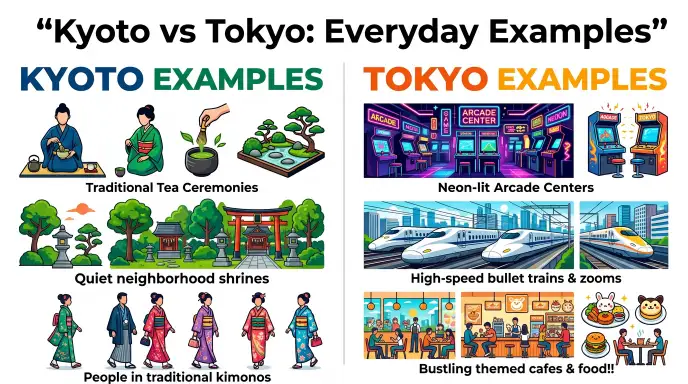
The phrase “Kyoto or Tokyo” appears in many types of writing.
Emails
“I’m planning my first trip to Japan. Should I visit Kyoto or Tokyo?”
Business Writing
“The company is considering if to open its first Japanese office in Tokyo or Kyoto.”
News Headlines
“Kyoto or Tokyo: Which Japanese City Should Travelers Visit?”
Blogs
“If you’re deciding between Kyoto or Tokyo, consider what kind of Japanese experience you want.”
Social Media
“Kyoto or Tokyo? Which one would you choose for your first Japan trip?”
Academic Writing
“The differences between Kyoto and Tokyo reflect distinct historical and urban developments in Japan.”
Daily Conversation
“Are you going to Kyoto or Tokyo?”
These examples show that “Kyoto or Tokyo” is natural English when someone is comparing the two destinations.
Google Trends & Modern Usage
Searches for Kyoto or Tokyo, Kyoto vs Tokyo, and Tokyo or Kyoto are closely connected to travel planning.
People usually search these phrases when they have limited time and want to know which destination better matches their interests.
Modern travel discussions often describe the cities as complementary rather than direct competitors. Tokyo is associated with its enormous scale, food scene, nightlife, shopping, and contemporary culture. Kyoto is associated with temples, shrines, gardens, historic streets, and traditional Japanese experiences.
Exact Google Trends numbers are not included here because search popularity changes over time and depends on the selected country, date range, and search term.
One consistent pattern in current travel guidance is that visitors with enough time are encouraged to experience both cities. The Shinkansen makes the journey between them relatively straightforward, with travel times commonly around two to two and a half hours depending on the service.
Quick Comparison Table
| Version | Meaning | Correct? | Region | Example |
| Kyoto | Japanese city known for history and traditional culture | Yes | Japan | “Kyoto has many historic sites.” |
| Tokyo | Japan’s modern capital city | Yes | Japan | “Tokyo is a major global city.” |
| Kyoto or Tokyo | A choice between the two cities | Yes | International English | “Should we visit Kyoto or Tokyo?” |
| Kyoto vs Tokyo | A comparison of the two cities | Yes | International English | “Kyoto vs Tokyo is a common travel question.” |
Kyoto vs Tokyo at a Glance
| Category | Kyoto | Tokyo |
| Main character | Traditional and historic | Modern and energetic |
| Best known for | Temples, shrines, gardens | Shopping, food, nightlife |
| Atmosphere | Slower and calmer | Fast and busy |
| Architecture | Historic and traditional | Modern mixed with historic sites |
| Culture | Strong traditional focus | Contemporary and traditional |
| Food | Kaiseki, markets, local specialties | Sushi, ramen, global cuisine |
| Nightlife | Smaller and more relaxed | Huge variety |
| Shopping | Traditional crafts and local stores | Fashion, electronics, luxury |
| Best for | History and culture lovers | Big city travelers |
| Ideal choice | Traditional Japan | Modern Japan |
Key Takeaways
- Kyoto and Tokyo are both excellent destinations, but they offer different experiences.
- Kyoto is especially strong for traditional culture, temples, shrines, gardens, and historic neighborhoods.
- Tokyo is ideal for modern city life, shopping, food, entertainment, and nightlife.
- Kyoto is not only historical. It has a vibrant modern side too.
- Tokyo is not only futuristic. It also has important temples, shrines, gardens, and historic areas.
- Choose based on your interests rather than popularity.
- If your itinerary allows enough time, visiting both Kyoto and Tokyo is often the best option.
- The easiest way to remember the difference is Kyoto for tradition, Tokyo for modern urban energy.
FAQs
Is Kyoto or Tokyo better for a first trip to Japan?
Neither is universally better. Tokyo is a strong choice if you want modern city life, shopping, food, and entertainment. Kyoto is better if your priority is traditional culture, temples, gardens, and historic streets. If your trip is long enough, visiting both gives you two very different views of Japan.
Should I visit Tokyo or Kyoto first?
If you have the opportunity to visit both, the order is less important than giving each city enough time. Tokyo can introduce you to Japan’s modern urban side, while Kyoto provides a strong contrast through its traditional culture and historic sights. Your flight route and overall itinerary can help determine which city comes first.
Is Kyoto cheaper than Tokyo?
Costs vary based on hotels, restaurants, transportation, season, and travel style. Tokyo can have a wider range of premium options, while Kyoto also offers different price levels. Rather than assuming one city is always cheaper, compare accommodation and activity prices for your specific travel dates.
How many days do I need in Kyoto?
A few days can give you a useful introduction to Kyoto, but the ideal length depends on how many temples, neighborhoods, cultural experiences, and nearby attractions you want to visit. Travelers who prefer a relaxed pace may want more time rather than trying to see everything quickly.
How many days do I need in Tokyo?
Tokyo is enormous and its attractions are spread across many neighborhoods. A short visit can cover major highlights, but additional days allow you to explore areas such as Shibuya, Shinjuku, Asakusa, Harajuku, and other districts without rushing.
Can I visit Kyoto and Tokyo on the same trip?
Yes. Many Japan itineraries combine the two cities. The Shinkansen provides a fast connection between Tokyo and Kyoto, with journey times commonly around two to two and a half hours depending on the train service.
Which is better for traditional Japanese culture, Kyoto or Tokyo?
Kyoto is generally the stronger choice for travelers specifically seeking traditional Japanese culture. Its historic temples, shrines, gardens, traditional architecture, tea culture, and preserved neighborhoods make it particularly attractive for this type of trip.
Which is better for nightlife, Kyoto or Tokyo?
Tokyo generally offers a larger and more varied nightlife scene because of its size. You can find everything from small bars and izakayas to major entertainment districts. Kyoto also has nightlife, but its overall atmosphere is less dominated by the huge metropolitan entertainment scene found in Tokyo.
Which city is better for food?
Both are excellent food destinations. Tokyo offers an enormous range of Japanese and international food, from sushi and ramen to high end restaurants. Kyoto is known for traditional cuisine and experiences such as kaiseki, while markets and local restaurants add more casual choices.
Kyoto or Tokyo: Which one should I choose if I only have three days?
If you have only three days, choose the city that best matches your interests. Pick Tokyo for modern Japan, shopping, food, nightlife, and big city energy. Pick Kyoto for temples, traditional neighborhoods, gardens, and cultural experiences. Trying to squeeze both into a very short trip may leave you spending too much time traveling.
Conclusion
The choice between Kyoto or Tokyo becomes much easier once you stop asking which city is “better” and ask which experience you want.
Choose Kyoto if your idea of Japan includes temples, shrines, traditional architecture, gardens, historic streets, tea culture, and a slower pace. Choose Tokyo if you want skyscrapers, shopping, technology, nightlife, diverse restaurants, and the excitement of a huge modern city.
The two destinations are different, but that difference is exactly what makes them work so well together.
Kyoto shows a deeply traditional side of Japan, while Tokyo shows how quickly the country has evolved into a modern global power. Current travel guides consistently frame them as complementary experiences rather than simple competitors.
If you have enough time, visiting both is the strongest choice. If you must pick one, let your interests decide.
Memorable takeaway: Kyoto shows you Japan’s traditions; Tokyo shows you Japan’s modern energy.
Discover More Articles!
31th or 31st: Which Is Correct?
Telluride or Palisade: Which SUV Is Better?
Everybody’s vs Everybodies: Correct Spelling and Usage(2026)

Ethan Parker is an English-language writer known for his interest in words, language, and clear communication. His work focuses on making everyday English easier to understand through simple explanations and practical examples.