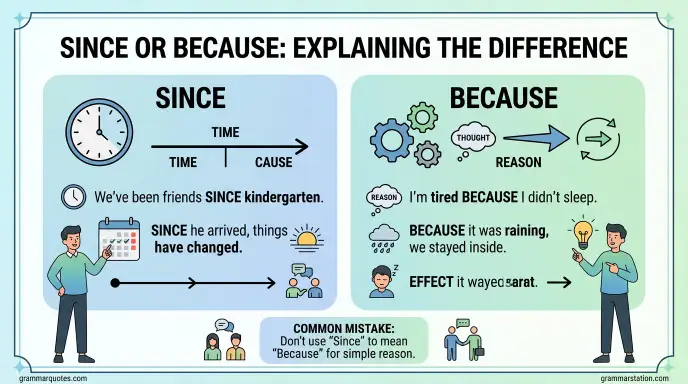
Since and because can both introduce a reason, but they are not always interchangeable. The main difference is that because clearly emphasizes the reason for something, while since can introduce a reason when that reason is already known, obvious, or less important to the main point.
For example, “I stayed home because I was sick” clearly explains why I stayed home. The word “because” puts attention on the reason.
In “Since I was sick, I stayed home,” the reason is presented more like background information. The main point is that I stayed home.
The word since also has another completely different meaning related to time. For example, “I have lived here since 2020” refers to a period beginning in the past and continuing to the present.
This double meaning is one reason learners sometimes find the word confusing.
Understanding the difference can make your writing clearer, especially in essays, emails, professional communication, and everyday English.
Since or Because : Quick Answer
Both since and because can be used to give a reason.
Compare these sentences:
- “I stayed home because I was tired.”
- “Since I was tired, I stayed home.”
Both sentences explain the reason for staying home.
However, because usually gives stronger emphasis to the reason, while since often introduces information that the speaker or writer expects the reader to understand or accept.
Simple Rule
Use because when you want to answer “Why?” directly.
“Why did you leave early?”
“I left early because I was tired.”
Use since when the reason is more like background information.
“Since it was getting late, we decided to leave.”
But remember that since can also mean “from a particular time until now.”
“I have known her since 2020.”
Definition and Meaning
What Does “Because” Mean?
Because is a conjunction used to introduce the reason or cause of something.
Examples:
- “I stayed inside because it was raining.”
- “She was late because the bus was delayed.”
- “He studied hard because he wanted to pass.”
In each sentence, the word explains why something happened.
What Does “Since” Mean?
Since has two major uses.
The first is to introduce a reason:
“Since it was raining, we stayed inside.”
The second is to describe time:
“I have lived here since 2020.”
When since means “because,” it introduces a cause. When it refers to time, it identifies the point when something began.
The Origin of the Words
The word because developed from Middle English forms meaning “by cause of” or “by reason of.” Over time, it became the common English conjunction used to introduce a reason.
The word since has a much longer history and developed from Old English forms related to the idea of “after” or “from the time that.” Its meanings gradually expanded to include both time and reason.
This is why modern English uses the same word since in sentences about both time and cause.
Main Difference Between Since and Because
The most important difference is emphasis.
Because Gives a Direct Reason
When you use because, the reason is usually an important part of the message.
“I canceled the trip because I was sick.”
The listener is likely interested in the reason for the cancellation.
Since Gives Background Information
When since means “because,” the reason often feels less important or already understood.
“Since you are already here, let’s start.”
The main idea is “let’s start.” The first part simply gives the situation or reason.
This difference is not absolute. In many everyday sentences, the two words can be exchanged without changing the basic meaning.
British English vs American English
There is no major British American spelling difference between since and because.
| British English | American English |
| since | since |
| because | because |
| since = reason | since = reason |
| since = time | since = time |
| because = reason | because = reason |
Both varieties use the same spellings and basic grammar rules.
The main difference is related to style and context, not nationality.
When Should You Use “Because”?
Use because when the reason is important, direct, or needs to be clearly understood.
Examples
- “I was late because I missed the bus.”
- “She stayed home because she was sick.”
- “We canceled the match because of the rain.”
- “He worked hard because he wanted to succeed.”
Because is especially useful when answering a direct why question.
Question and Answer
Why did you leave?
“I left because I was tired.”
This is one of the clearest uses of the word.
When Should You Use “Since”?
Use since when giving a reason that works as background information.
Examples:
- “Since it was raining, we stayed inside.”
- “Since everyone is ready, we can begin.”
- “Since you asked, I will explain it.”
- “Since the store was closed, we went somewhere else.”
In these examples, the main statement is usually more important than the reason.
“Since” Can Also Mean Time
This is one of the most important points to remember.
Since does not always mean “because.”
It can describe a starting point in time.
Examples:
- “I have lived here since 2020.”
- “She has been studying since morning.”
- “We have known each other since childhood.”
- “He has worked there since January.”
Here, since means something like “from that time until now.”
Compare the Two Meanings
Reason:
“Since it was late, we went home.”
Meaning: Because it was late.
Time:
“I have been here since noon.”
Meaning: From noon until now.
The context tells you which meaning is intended.
Because or Since: Sentence Structure
Both words can introduce a dependent clause.
Because
“I stayed home because I was sick.”
The structure is:
Main clause + because + reason
You can also place the reason first:
“Because I was sick, I stayed home.”
Since
“I stayed home since I was sick.”
Or:
“Since I was sick, I stayed home.”
When a dependent clause comes first, a comma is commonly used before the main clause.
Because vs Since: Strength of the Reason
One useful way to understand the difference is to think about how strongly you want to highlight the reason.
Stronger Focus on Reason
“I couldn’t attend because I was sick.”
The reason is central to the sentence.
More Background Like
“Since I was sick, I couldn’t attend.”
The reason is presented as background information leading to the main statement.
This is a style difference rather than a strict rule. Native speakers may use either word in many situations.
Common Mistakes
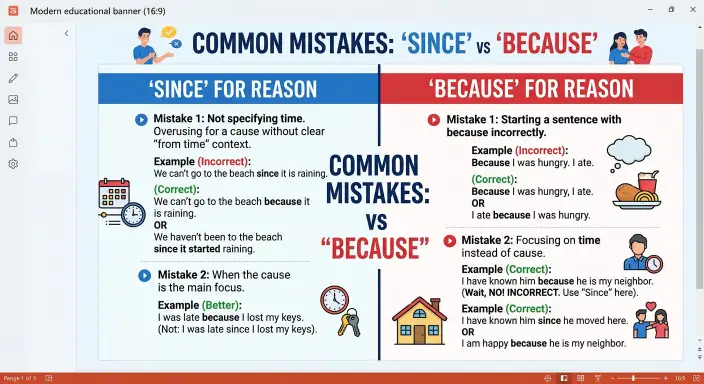
Mistake 1: Thinking “Since” Always Means Time
It does not.
“Since it was raining, we stayed home.”
Here, since means “because.”
Mistake 2: Using “Because” for Time
Because does not normally mean “from a particular time.”
Incorrect:
“I have lived here because 2020.”
Correct:
“I have lived here since 2020.”
Mistake 3: Confusing “Since” With “For”
When talking about time, since normally introduces a starting point.
“I have lived here since 2020.”
For usually introduces a duration.
“I have lived here for six years.”
Mistake 4: Thinking Since and Because Are Always Identical
They can have the same basic meaning when introducing a reason, but the tone and emphasis can differ.
Mistake 5: Creating Ambiguity With “Since”
Because since has both time and reason meanings, a sentence can sometimes be unclear.
For example:
“Since he arrived, I have been busy.”
This could relate to the time after his arrival rather than giving a reason.
When clarity matters, choose the word that makes your intended meaning obvious.
Everyday Examples
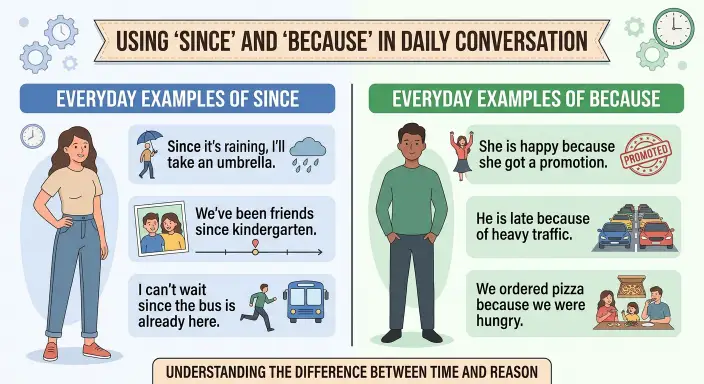
In Casual Conversation
- “I stayed home because I was tired.”
- “Since you’re here, let’s have some tea.”
- “I haven’t seen him since Monday.”
Emails
- “Because the meeting was canceled, we changed the schedule.”
- “Since you requested the information, I have attached the document.”
In Academic Writing
Both words can be useful in formal writing.
“Because the results were inconsistent, the experiment was repeated.”
“Since the results were inconsistent, the experiment was repeated.”
The first version puts slightly more focus on the reason.
In Professional Writing
“Since the deadline has changed, we will update the schedule.”
This sounds natural when the changed deadline is background information.
Side by Side Comparison
| Feature | Since | Because |
| Gives a reason | Yes | Yes |
| Can refer to time | Yes | No |
| Directly answers “why?” | Sometimes | Yes |
| Can introduce background information | Yes | Yes |
| Can mean “from a time” | Yes | No |
| Common in everyday English | Yes | Yes |
| British spelling | Since | Because |
| American spelling | Since | Because |
Which One Should You Use?
A simple way to choose is to ask yourself what you want to communicate.
Choose “Because” If:
- You are directly answering “why?”
- The reason is important.
- You want the cause to be very clear.
- You want to avoid the time related meaning of “since.”
Example:
“I left because I was tired.”
Choose “Since” If:
- The reason is already known or obvious.
- You are giving background information.
- You want a slightly smoother or more formal connection.
- You are talking about a starting point in time.
Examples:
“Since everyone is ready, let’s begin.”
“I have lived here since 2021.”
Google Trends & Usage Data
Both since and because are extremely common English words, so they naturally have broad search and language usage.
Searches around this topic usually come from English learners trying to understand:
- Since vs because
- Difference between since and because
- Since meaning
- Because meaning
- Since grammar
- Since or because in a sentence
- Since meaning because
- Since vs for
Search interest can vary depending on educational content, grammar lessons, and language learning trends.
For purposes, related questions are especially useful because people often search for the difference through complete questions rather than only the two word phrase.
People Also Ask
1. Can since and because be used interchangeably?
Sometimes. When since is being used to introduce a reason, it can often replace because, although the emphasis may change slightly.
2. Is since the same as because?
Not always. Since can mean “because,” but it can also refer to a point in time.
3. When should I use because instead of since?
Use because when you want to make the reason clear and direct, especially when answering a “why” question.
4. Does since mean because?
It can. For example, “Since it was raining, we stayed home” means “Because it was raining, we stayed home.”
5. Can since be used for time?
Yes. “I have lived here since 2020” uses since to identify when something began.
6. What is the difference between since and for?
Since introduces a starting point, while for usually introduces a period of time.
7. Is because more formal than since?
Neither word is automatically more formal. The best choice depends on the sentence, meaning, and emphasis.
8. Can I start a sentence with since?
Yes. For example, “Since it was late, we went home.”
9. Can I start a sentence with because?
Yes. For example, “Because it was raining, we stayed inside.”
10. Which is better, since or because?
Neither is always better. Because is often clearer when the reason needs emphasis, while since can work well for background information or time.
Easy Trick to Remember the Difference
Use this simple rule:
Because = reason
Since = reason OR time
Examples:
“I left because I was tired.”
Reason.
“Since I was tired, I left.”
Reason.
“I have been tired since morning.”
Time.
If you remember that since has two meanings, you will avoid many common mistakes.
Conclusion
Since and because are both useful words for connecting ideas, especially when explaining a reason. When since means “because,” the two words can often be used in the same sentence without changing the basic meaning. However, they can create a slightly different emphasis.
Because is usually the clearest choice when you want to directly explain why something happened. It puts more attention on the cause and works especially well as an answer to a “why” question.
Since can also introduce a reason, but it often presents that reason as background information. It has another important meaning as well: it can identify a starting point in time.
For example, “Since it was raining, we stayed home” gives a reason, while “I have lived here since 2020” refers to time.
The easiest rule is to remember that because focuses on reason, while since can mean reason or time. Choosing the right word will make your writing clearer and easier to understand.
Discover More Articles!
Analize or Analyze: Which Spelling Is Correct?(2026)
UTI or Period: What’s the Difference? Symptoms and Key Signs
Musty or Musky: Which Word Is Correct?(2026)

Ethan Parker is an English-language writer known for his interest in words, language, and clear communication. His work focuses on making everyday English easier to understand through simple explanations and practical examples.