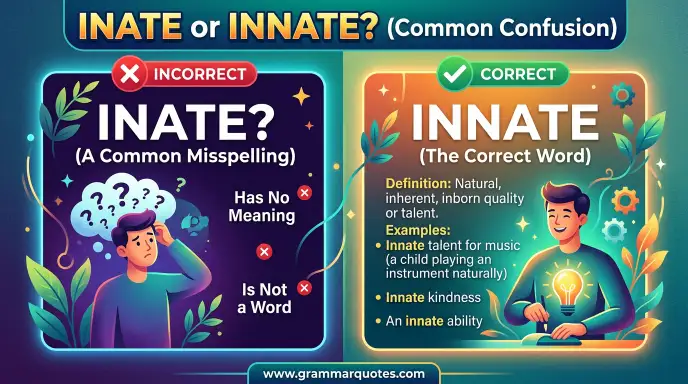
Innate is the correct spelling when you mean something natural, inborn, or present from birth, while inate is generally a misspelling.
Many English learners confuse inate or innate because the two words sound very similar. When writing quickly, it is easy to leave out one “n” and write inate. However, standard English uses innate for qualities, abilities, feelings, or characteristics that exist naturally rather than being learned.
For example, you can say, “She has an innate ability to understand music.” Here, innate means the ability is natural or inborn.
This guide explains the difference between inate and innate, their meanings, origins, correct usage, common mistakes, pronunciation, and examples. It also shows how to remember the correct spelling and when to use innate in everyday and formal writing.
Inate or Innate : Quick Answer
Innate is the correct word in standard English. Inate is normally a spelling mistake.
- ✅ Innate — correct
- ❌ Inate — incorrect in standard English
Example:
Humans have an innate ability to learn language.
Here, innate means the ability is naturally present.
Definition and Meaning
Innate means something that is natural, inborn, or present from birth. It does not usually need to be learned through experience or training.
Examples include:
- innate ability
- innate talent
- innate quality
- innate behavior
- innate instinct
- innate understanding
Inate, with one “n,” does not normally have this meaning in standard modern English.
Is “Inate” a Word?
For most everyday English writing, inate should be treated as an incorrect spelling of innate.
If you are unsure if to write inate or innate, choose innate when you mean “natural” or “inborn.”
What Does Innate Mean?
Innate is an adjective used to describe something that exists naturally in a person or living thing.
For example:
- He has an innate talent for drawing.
- Babies have some innate abilities.
- She showed an innate understanding of the subject.
- Some animals have innate behaviors that help them survive.
The key idea is natural rather than learned.
Innate Meaning in Simple English
You can remember the meaning of innate as:
Innate = natural + inborn + not learned
For example:
She has an innate ability to lead.
This means leadership seems to be a natural ability for her.
The Origin of Innate
The word innate comes from Latin innatus, meaning “born in” or “inborn.” It developed through French and entered English centuries ago.
The word has kept its basic idea of something being naturally present.
This origin also makes the meaning easier to remember. Innate is connected with the idea of something being present from birth rather than something developed later through education or practice.
Why Do People Write “Inate”?
The spelling inate is usually caused by pronunciation. When people hear innate, the two “n” letters are not strongly noticeable in speech.
Because of this, someone may write:
❌ He has an inate ability to learn languages.
The correct version is:
✅ He has an innate ability to learn languages.
Innate vs Learned Abilities
One of the easiest ways to understand innate is to compare it with something learned.
An innate ability is naturally present.
A learned ability develops through education, practice, or experience.
| Type | Meaning | Example |
| Innate | Natural or inborn | innate curiosity |
| Learned | Developed through experience | learned skill |
| Innate talent | Natural ability | innate musical talent |
| Learned skill | Practiced ability | learned programming skills |
This does not always mean that an innate ability needs no practice. A person may have a natural ability but still need training to develop it.
British English vs American English Spelling
There is no British vs American spelling difference between innate and inate.
Both British and American English use:
Innate ✅
Examples:
- British English: “Children have innate curiosity.”
- American English: “Children have innate curiosity.”
The spelling remains the same in both varieties of English.
So if you are writing for a British, American, Australian, or international audience, innate is the standard spelling.
When Should You Use Innate?
Use innate when you want to describe something that is naturally present rather than acquired.
1. Innate Ability
She has an innate ability to solve problems.
2. Innate Talent
He seems to have an innate talent for music.
3. Innate Quality
Patience was one of her innate qualities.
4. Innate Instinct
The animal followed its innate instincts.
5. Innate Knowledge
The theory suggests that humans may have some innate knowledge.
6. Innate Curiosity
Children often show an innate curiosity about the world.
Common Mistakes With Inate or Innate
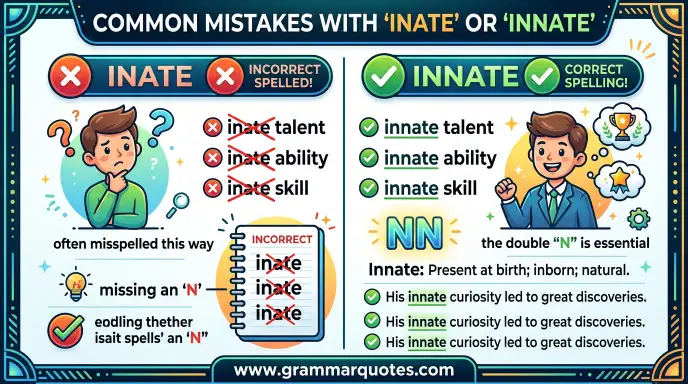
Mistake 1: Writing “inate”
❌ She has an inate talent for painting.
✅ She has an innate talent for painting.
Mistake 2: Forgetting the Double N
❌ He showed an inate understanding of mathematics.
✅ He showed an innate understanding of mathematics.
Mistake 3: Using Innate for Every Natural Looking Thing
Innate usually describes a characteristic, ability, quality, behavior, tendency, or similar feature that is naturally present.
For a physical object simply found in nature, words such as natural, native, or organic may be more appropriate depending on the context.
Mistake 4: Thinking “Inate” Is the American Spelling
It is not.
Both British and American English use innate.
Inate or Innate in Everyday Examples
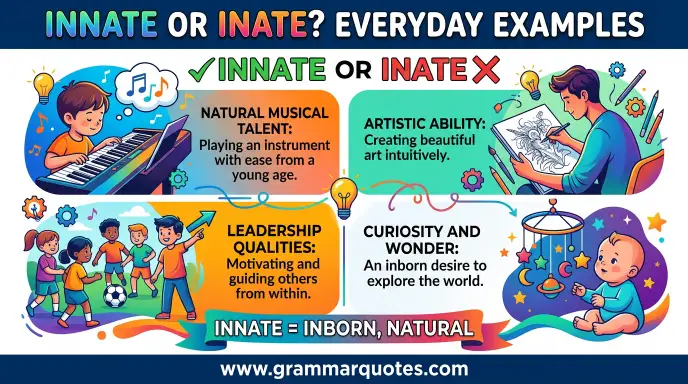
Here are some simple examples:
- Innate curiosity can encourage children to ask questions.
- She has an innate ability to communicate clearly.
- Some animals display innate behaviors.
- He discovered his innate talent for music.
- Good teachers can help students develop their natural abilities.
- The researcher studied innate responses.
- Her innate confidence helped her during the presentation.
- Humans may have certain innate tendencies.
- The child showed an innate interest in numbers.
- He appears to have an innate sense of rhythm.
Innate in Formal and Academic Writing
Innate is common in academic, scientific, psychological, educational, and formal writing.
You may see phrases such as:
- innate behavior
- innate ability
- innate characteristics
- innate response
- innate immunity
- innate knowledge
- innate tendency
For example:
Researchers examined if the behavior was innate or learned.
This sentence contrasts something naturally present with something developed through experience.
Is Innate a Formal Word?
Yes. Innate is perfectly suitable for formal and academic writing.
However, in very simple writing, natural or inborn may sometimes be easier for readers to understand.
Easy Trick to Remember Innate
A simple spelling trick is:
IN + NATE = INNATE
Remember the double N:
INNATE = natural or inborn
You can also connect the word with born:
Innate → inborn
Whenever you mean “present naturally from birth,” think of innate.
Inate or Innate: Comparison Table
| Feature | Inate | Innate |
| Standard English word | ❌ Usually no | ✅ Yes |
| Correct spelling | ❌ | ✅ |
| Meaning “inborn” | ❌ | ✅ |
| Meaning “natural” | ❌ | ✅ |
| British English | ❌ | ✅ |
| American English | ❌ | ✅ |
| Common usage | Spelling error | Standard word |
| Example | ❌ inate talent | ✅ innate talent |
Inate or Innate : Google Trends & Usage
Searches for “inate or innate” are usually driven by spelling confusion. People often search both forms when they are unsure if the word requires one or two “n” letters.
The standard form innate is widely used in English writing, especially in academic, scientific, educational, and general descriptive contexts.
The misspelling inate may appear in searches because users type the word as they hear it. This does not make it an accepted alternative spelling.
For content, dictionaries, educational material, and professional writing, innate should be used as the correct form.
People Also Ask Questions About Inate or Innate
1. Is it inate or innate?
Innate is the correct spelling. Inate is generally a misspelling.
2. What does innate mean?
Innate means natural, inborn, or present from birth.
3. Is inate a correct word?
In standard modern English, inate is generally not the correct spelling for the meaning “natural” or “inborn.”
4. How do you spell innate?
The correct spelling is I N N A T E: innate.
5. What is an example of innate?
“Humans may have an innate ability to learn language.”
6. Is innate British or American?
Innate is used in both British and American English.
7. What is the opposite of innate?
Depending on the context, learned, acquired, or developed can be used as an opposite of innate.
8. Is innate the same as natural?
They can have similar meanings when describing an inborn quality or ability, but innate specifically emphasizes that something is naturally present.
9. How do you remember the spelling of innate?
Remember the double N: INNATE.
10. Can you say innate talent?
Yes. Innate talent is a common phrase meaning a natural ability or talent.
Frequently Asked Questions
Is “inate” ever correct?
For normal English writing where you mean “inborn” or “natural,” use innate. Inate is generally a misspelling.
What is the simple meaning of innate?
It means natural or inborn.
What is an innate ability?
An innate ability is a natural ability that a person or living thing has without having to acquire it through formal learning.
Is innate a noun or adjective?
Innate is an adjective.
Example:
She has an innate ability to teach.
Can innate mean natural?
Yes. In many contexts, innate means naturally present or inborn.
What is the opposite of innate ability?
A learned, acquired, or developed ability can be described as the opposite, depending on the context.
Should I write inate in an essay?
No. If you mean “natural” or “inborn,” write innate with two “n” letters.
Final Comparison: Inate or Innate
The difference between inate and innate is simple: innate is the standard and correct spelling, while inate is generally a misspelling.
Use innate when describing something natural, inborn, or present without being learned. It can describe abilities, talents, behaviors, qualities, instincts, tendencies, and other characteristics.
For example:
“She has an innate ability to understand people.”
The word is used in both British and American English, so you do not need to change its spelling depending on your audience.
The easiest way to remember it is to focus on the double N:
INNATE = natural or inborn
If you see inate in ordinary English writing, check if the writer intended innate. In most cases, that is the correction you need.
Understanding this small spelling difference can help you avoid errors in school assignments, professional writing, blog posts, and everyday communication.
Conclusion
Innate is the correct spelling, while inate is generally an incorrect spelling when you mean something natural or inborn. The word innate is an adjective that describes an ability, quality, behavior, tendency, or characteristic that is naturally present.
The most important rule is easy to remember: innate has two “n” letters. It is spelled I N N A T E.
For example, you can write, “He has an innate talent for music,” or “Children often show an innate curiosity about the world.” Both British and American English use the same spelling.
If you are writing an essay, article, email, assignment, or academic paper, choose innate rather than inate. Once you connect innate with the idea of something being inborn or naturally present, the spelling becomes much easier to remember.
Discover More Articles!
Recognisable or Recognizable: Which Is Correct?
Purple or Nectar Explained: Meaning, Uses, and Examples(2026)
Me vs I: What Is the Difference and When Should You Use Each?

Ethan Parker is an English-language writer known for his interest in words, language, and clear communication. His work focuses on making everyday English easier to understand through simple explanations and practical examples.