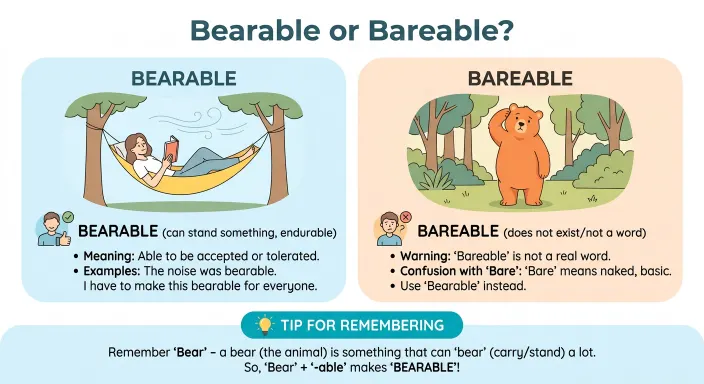
Bearable is the correct standard English spelling when you mean something that can be endured, tolerated, or managed, while bareable is generally considered a misspelling. The word bearable comes from the verb bear, meaning to tolerate, endure, or deal with something.
Many people search for bearable or bareable because these two spellings sound very similar. When spoken, the difference can be difficult to notice, especially for English learners. This often leads people to spell the word as bareable, even though the standard form is bearable.
Knowing the difference is useful for students, writers, bloggers, and anyone who wants to improve their English spelling. Once you understand that bearable comes from bear + able, the spelling becomes much easier to remember.
In this guide, we will explain the meaning and origin of bearable, why bareable is usually incorrect, how to use the word in sentences, common mistakes, British and American English usage, pronunciation, examples, FAQs, and an easy memory trick.
Bearable or Bareable : Quick Answer
Bearable is the correct spelling when you mean something that can be endured or tolerated.
- ✅ Bearable
- ❌ Bareable
Examples
- The pain was bearable.
- The weather became more bearable in the evening.
- The noise was loud but still bearable.
- The workload is bearable if you manage your time well.
❌ The pain was bareable.
✅ The pain was bearable.
So, if you are asking “bearable or bareable?”, choose bearable when you mean “able to be endured.”
Bearable or Bareable : Definition and Meaning
What Does Bearable Mean?
Bearable is an adjective meaning able to be endured, tolerated, or managed without becoming too difficult.
For example:
The heat was bearable after the sun went down.
Here, bearable means the heat could be tolerated.
Other examples include:
- a bearable level of pain
- a bearable temperature
- a bearable workload
- a bearable situation
- a bearable amount of noise
What Does Bareable Mean?
Bareable is generally not the standard spelling when you mean “able to be endured.”
The confusion comes from the fact that bearable and bareable can sound similar.
If your intended meaning is “able to be tolerated or endured,” use:
bearable
People Also Ask: Is bareable a word?
“Bareable” is not the standard spelling for the common meaning “able to be endured.” In that context, bearable is the correct form.
The Origin of Bearable
The word bearable comes from the verb bear.
The verb bear has several meanings, but one important meaning is to endure, tolerate, or deal with something difficult.
For example:
I cannot bear the noise.
From this meaning, English forms the adjective:
bear + able = bearable
The suffix able commonly means “capable of” or “able to be.”
Therefore:
bearable = able to be borne or endured
This connection makes the spelling easier to understand.
Why Is Bearable Spelled With “Bear”?
The spelling comes directly from the verb bear in the sense of enduring something.
For example:
- bear the pain
- bear the pressure
- bear the responsibility
- bear the cost
- bear the situation
Then:
bear → bearable
People Also Ask: Where does the word bearable come from?
Bearable comes from the verb bear, in the sense of enduring or tolerating something, combined with the suffix able.
Bearable vs Bareable: The Main Difference
The main difference is spelling and standard usage.
| Word | Meaning | Standard English? |
| Bearable | Able to be endured or tolerated | Yes |
| Bareable | Usually intended as “bearable” | No |
Example
The workload is bearable.
This means the workload can be managed or tolerated.
Writing:
The workload is bareable.
would normally be considered a spelling error.
Why Do People Write Bareable?
The most common reason is pronunciation.
The words bear and bare are homophones in standard English. They have the same pronunciation but different spellings and meanings.
This can make bearable confusing.
Compare:
- bear → endure
- bare → uncovered or exposed
When people hear the word bearable, they may connect it with bare and incorrectly write bareable.
People Also Ask: Why is bearable spelled with bear instead of bare?
Because bearable comes from the verb bear, meaning to endure or tolerate. It is not formed from bare.
Bearable vs Bare: Understanding the Root Words
Understanding the difference between bear and bare helps you remember bearable.
Bear
Bear can mean to tolerate or endure something.
Example:
She could not bear the noise.
Bare
Bare means uncovered, exposed, or without something normally present.
Example:
The room had bare walls.
Because bearable describes something that can be endured, it comes from bear, not bare.
Simple connection
Bear → endure → bearable
Bare → uncovered → bare
This is one of the easiest ways to remember the spelling.
How to Use Bearable in a Sentence
Bearable usually describes something difficult, uncomfortable, unpleasant, or challenging that can still be tolerated.
Examples
- The cold was bearable with a warm jacket.
- The pain became more bearable after some rest.
- The long journey was bearable because we had good company.
- The noise was bearable during the day.
- The workload is bearable this week.
- The waiting time was bearable.
The word often appears with words such as:
- pain
- heat
- cold
- noise
- pressure
- stress
- workload
- discomfort
- situation
- conditions
Common Mistakes with Bearable or Bareable
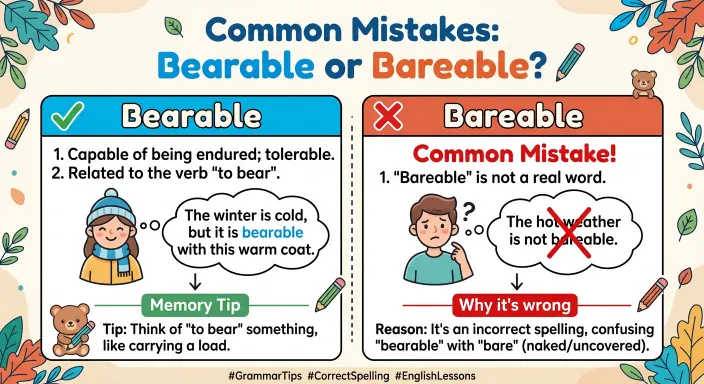
Mistake 1: Writing bareable
❌ The temperature is bareable.
✅ The temperature is bearable.
Mistake 2: Connecting the word with “bare”
Because bare is a real English word, learners sometimes assume that bareable must also be correct.
But the meaning determines the root.
If you mean “able to be endured,” the correct word is bearable.
Mistake 3: Confusing bearable with unbearable
Bearable means something can be tolerated.
Unbearable means something is extremely difficult or impossible to tolerate.
For example:
The heat was bearable.
But:
The heat became unbearable.
People Also Ask: Is unbearable the opposite of bearable?
Yes. Bearable means something can be endured, while unbearable means it is too difficult or unpleasant to endure.
Bearable or Bareable in Everyday Examples
Here are some natural examples:
| Incorrect | Correct |
| The pain is bareable. | The pain is bearable. |
| The heat is bareable. | The heat is bearable. |
| The noise became bareable. | The noise became bearable. |
| The workload is bareable. | The workload is bearable. |
| The journey was bareable. | The journey was bearable. |
More examples
- The situation is difficult but bearable.
- The temperature is finally bearable.
- The noise was bearable for a short time.
- The cost is bearable for most people.
- The pressure became bearable after the deadline was extended.
Bearable in Formal and Academic Writing
Bearable is acceptable in both everyday and formal English.
It can be used in:
- essays
- reports
- articles
- academic discussions
- reviews
- emails
- conversations
- descriptive writing
For example:
The researchers examined if the environmental conditions remained bearable for the participants.
In less formal writing, you might also use words such as:
- tolerable
- manageable
- acceptable
- survivable
The best choice depends on the exact context.
Bearable in British and American English
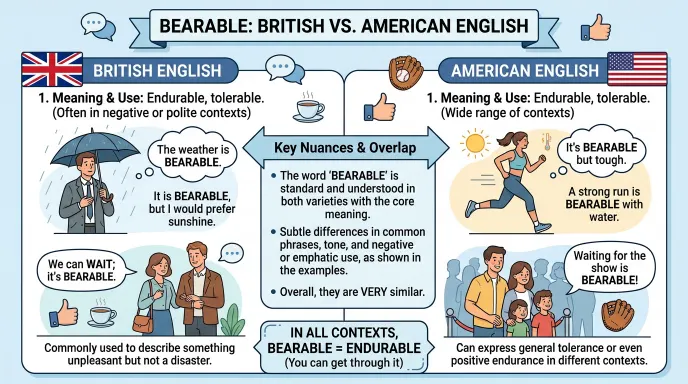
There is no major spelling difference between British and American English for bearable.
Both varieties use:
bearable
Comparison
| English variety | Correct spelling |
| British English | bearable |
| American English | bearable |
| Canadian English | bearable |
| Australian English | bearable |
Bareable is not an alternative British or American spelling of bearable.
People Also Ask: Is bearable British or American English?
Bearable is standard in both British and American English.
Bearable vs Tolerable
Bearable and tolerable have very similar meanings, but their usage can differ slightly.
Bearable often emphasizes the ability to endure something unpleasant.
The heat was bearable.
Tolerable can emphasize that something is acceptable within certain limits.
The noise level was tolerable.
Both words can work in many situations.
Other alternatives include:
- manageable
- acceptable
- endurable
- survivable
However, bearable is the correct choice when you want the adjective formed from bear.
Bearable or Bareable : Pronunciation
Bearable is pronounced according to the pronunciation of bear, followed by the ending able.
The interesting part is that bear and bare sound alike in standard English.
That is why the spelling can be confusing.
Remember:
Same sound does not always mean same spelling.
For example:
- bear / bare
- right / write
- sea / see
- their / there
In bearable, the correct spelling follows bear, because the word comes from the verb meaning “to endure.”
Bearable or Bareable : Easy Memory Trick
Here is the easiest trick:
Think of “bear the pain.”
I can bear the pain.
Then turn it into an adjective:
The pain is bearable.
So remember:
Bear → bearable
Not:
Bare → bareable
Another simple rule is:
If it means “able to be endured,” use BEARABLE.
Bearable or Bareable : Comparison Table
| Feature | Bearable | Bareable |
| Standard spelling | Yes | No |
| Means “able to be endured” | Yes | No |
| Comes from “bear” | Yes | No |
| Common in English | Yes | No |
| British English | Yes | No |
| American English | Yes | No |
| Suitable for formal writing | Yes | No |
| Common spelling mistake | No | Yes |
Bearable or Bareable : Google Trends and Usage
Searches for bearable or bareable are mainly connected with spelling confusion. People often search for both forms because bearable contains the same sound as the word bare, creating uncertainty about which spelling is correct.
In standard English usage, bearable is the established form.
The word is also common in contexts involving discomfort, difficulty, weather, pressure, costs, and unpleasant situations.
Search interest can vary over time and across countries, but the spelling rule remains unchanged:
bearable = correct
bareable = generally incorrect
People Also Ask Questions About Bearable or Bareable
1. Is it bearable or bareable?
Bearable is the correct spelling when you mean “able to be endured.”
2. Is bareable a correct word?
It is generally not the standard spelling for the meaning “able to be endured.” Use bearable.
3. What does bearable mean?
Bearable means something that can be endured, tolerated, or managed.
4. Why is bearable spelled with an E A?
Because it comes from bear, meaning to endure or tolerate.
5. What is the opposite of bearable?
The opposite is unbearable, meaning too difficult or unpleasant to endure.
6. Is bearable a real word?
Yes. Bearable is a standard English adjective.
7. Is bearable British or American?
It is standard in both British and American English.
8. What is the root word of bearable?
The root word is bear, in the sense of enduring or tolerating something.
9. Is bearable the same as tolerable?
They have very similar meanings. Both can describe something that can be endured or accepted.
10. How do you remember the spelling of bearable?
Remember the phrase “bear the pain” and connect it with bearable.
Frequently Asked Questions
Is “bareable” ever correct?
For the normal meaning “able to be endured,” bareable is not the standard spelling. Use bearable.
What is the difference between bearable and unbearable?
Bearable means something can be endured, while unbearable means something is too difficult or unpleasant to endure.
Is bearable an adjective?
Yes. Bearable is an adjective that describes something that can be tolerated or endured.
Can I use bearable for pain?
Yes. For example:
The pain was bearable.
Can bearable describe weather?
Yes. You can say:
The weather became more bearable in the evening.
Does bearable have the same spelling in British and American English?
Yes. Both use bearable.
What is a synonym for bearable?
Depending on the context, synonyms include tolerable, manageable, and acceptable.
Final Comparison: Bearable or Bareable
When choosing between bearable or bareable, the correct standard spelling is bearable when you mean something that can be endured, tolerated, or managed.
The word comes from the verb bear, which can mean to endure or tolerate something difficult. Adding able gives us bearable, meaning “able to be borne” or “able to be endured.”
The incorrect form bareable is a common spelling mistake. The confusion happens because bear and bare have the same pronunciation in standard English, even though they have different meanings and spellings.
A simple way to remember the correct form is to think of the sentence “I can bear the pain.” If the pain can be endured, it is bearable.
There is also no British versus American spelling difference. Both varieties of English use bearable.
So whenever you mean “able to be tolerated,” remember:
Bear → bearable → correct
Bare → bareable → incorrect in this meaning.
Discover More Articles!
Nineth or Ninth: Which Spelling Is Correct?(2026)
Poll or Pole: Meaning, Difference, and Correct Usage
Sewed vs Sowed: Definitions, Examples, and Usage(2026)

Ethan Parker is an English-language writer known for his interest in words, language, and clear communication. His work focuses on making everyday English easier to understand through simple explanations and practical examples.