When people search feen or fiend, they are usually trying to decide if the word should be spelled fiend or feen, especially after seeing slang, music, social media posts, or casual messages.
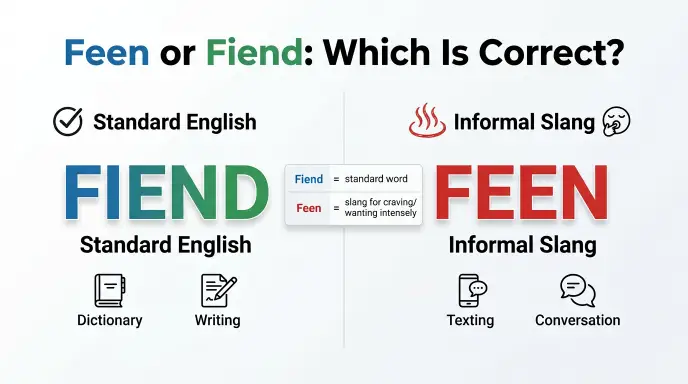
The short answer is simple: fiend is the standard English spelling, while feen is mainly used as an informal slang spelling with a different, modern usage.
The two forms can sound similar, but they do not always serve the same purpose. In informal slang, it can also be used in expressions such as “fiending for something,” meaning to crave it strongly.
Feen, on the other hand, is commonly used as a slang verb meaning to want or crave something intensely. It is especially associated with casual speech, online language, and music culture.
This guide explains the difference, shows when each form works, and gives practical examples so you can choose the right spelling with confidence.
Feen or Fiend: The Quick Answer for Searchers
Fiend is the standard English spelling and is the safest choice in formal, academic, professional, and edited writing. Feen is an informal slang spelling generally used to express an intense desire or craving. The words may sound alike in some contexts, but they are not interchangeable in every sentence.
Feen or Fiend: Quick Answer
Here is the easiest way to remember the difference:
- Fiend = the standard English word.
- Feen = an informal slang spelling, often meaning “to crave” or “want badly.”
- Fiend can be a noun or, informally, part of the verb fiending.
- Feen is most often seen in casual slang.
- Use fiend in school, business, academic, and professional writing.
Examples
Standard English:
She is a coffee fiend.
Here, fiend means someone who strongly enjoys or is devoted to something.
Informal slang:
I’m feening for some pizza.
Here, feening means craving pizza intensely.
Formal writing:
He is a devoted student of classical music.
This is better than using slang such as feening in an academic context.
The key point is that fiend is the standard spelling, while feen is a slang form.
What Does Feen or Fiend Mean?
The meanings become clearer when the two forms are separated.
What Does “Fiend” Mean?
Fiend is an established English noun. Its traditional meaning is an evil or demonic being. Over time, it also developed informal meanings for someone who is extremely interested in something or addicted to something.
For example:
- The story’s villain was described as a cruel fiend.
- She is a fitness fiend.
- He is a coffee fiend.
- The character was portrayed as a drug fiend.
In informal use, fiend can also appear in the expression fiend for or fiending for, meaning to desire something strongly.
What Does “Feen” Mean?
Feen is used as slang for intensely wanting or craving something. Wiktionary records it as a slang verb derived from fiend, with the meaning “to want something obsessively” or “to have a strong desire for” something.
For example:
- I’m feening for coffee.
- She was feening for a vacation.
- They were feening for some good food.
Because this spelling is informal, it may look incorrect to readers who expect standard English.
Why Do They Cause Confusion?
The main reason is pronunciation.
In casual speech, fiend and feen can sound very similar. Slang users may write a word according to how it sounds rather than according to its standard spelling.
That is why you may see feen, feening, or similar forms online even though fiend is the established dictionary spelling.
The Origin of Feen or Fiend
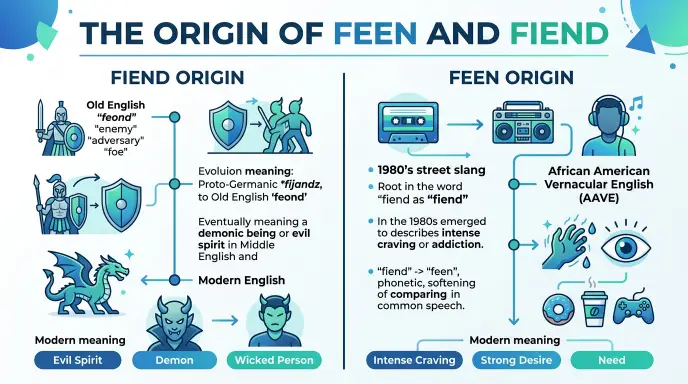
The history of fiend is much older than the modern slang spelling feen.
Fiend is an old English word. Its historical development is connected to the Old English word fēond, meaning an enemy or hostile person. Over centuries, its meaning became strongly associated with an evil being or demon.
Modern English later expanded the word’s meaning. Today, fiend can describe not only an evil being but also someone who is extremely enthusiastic about something, such as a “sports fiend” or “coffee fiend.”
The slang form feen developed from the use of fiend in expressions involving craving or addiction. Wiktionary identifies this slang usage as deriving from fiend, particularly the expression “drug fiend.”
So, feen is not simply an alternative standard spelling of fiend. It developed as an informal slang form.
There is also another meaning of feen in Irish slang, where it can refer to a man or guy. This is a separate usage and should not be confused with the modern slang verb meaning “to crave.”
British English vs American English
Unlike pairs such as color/colour or favorite/favourite, fiend does not have a British versus American spelling difference.
Both British and American English use fiend as the standard spelling.
| British English | American English | Example |
| fiend | fiend | She is a coffee fiend. |
| fiend | fiend | He is a sports fiend. |
| fiending | fiending | I’m fiending for some food. |
| feen* | feen* | I’m feening for pizza. |
* Feen is informal slang rather than a standard regional spelling.
Regional Differences
The important distinction is not really British versus American spelling. It is standard English versus informal slang.
You can use fiend in:
- British English
- American English
- Canadian English
- Australian English
- International English
The slang feen is more context dependent. It may appear in online conversations, music, texting, and other informal settings.
What About Style Guides?
Professional style guides generally favor standard vocabulary and conventional spelling. If you are writing an essay, report, article, business document, or application, fiend is the safer choice when that is the intended word.
If you are quoting someone or discussing slang, however, feen may be appropriate because preserving the original wording can be important.
Which Version Should You Use?
The best spelling depends on your audience and the context.
United States
Use fiend in standard writing.
For casual online communication, feen may appear when you intentionally want to use slang.
United Kingdom
Use fiend for standard English. The spelling does not change to feen simply because you are writing British English.
Canada
Fiend is the standard choice. Use feen only when the informal slang context calls for it.
Australia
Use fiend in formal and standard writing. Treat feen as informal slang rather than a regional spelling.
International Writing
If your readers come from different countries, fiend is much clearer. It is widely recognized as a standard English word.
Academic Writing
Choose fiend when it is the word you actually mean.
Avoid slang such as feen unless you are analyzing slang, quoting a source, or discussing informal language.
Business Writing
Use fiend or, better yet, a more precise standard expression such as:
- enthusiastic user
- devoted fan
- strong interest
- intense desire
Avoid slang unless your brand voice specifically calls for it.
Common Mistakes With Feen or Fiend
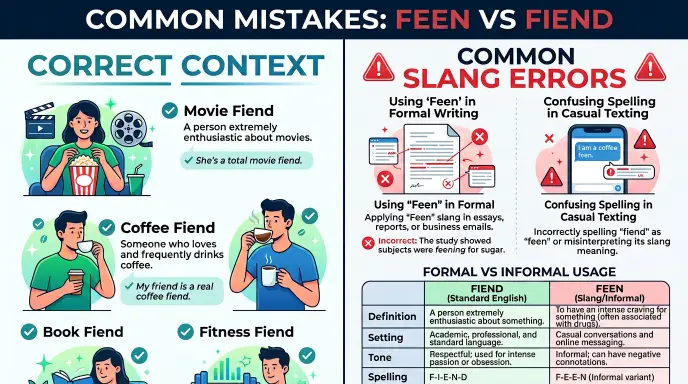
Mistake 1: Treating “Feen” as the Standard Spelling
Incorrect for standard writing:
I am feening for a promotion.
Better:
I am eager for a promotion.
Or, in informal slang:
I’m fiending for a promotion.
Why?
Feen is generally recognized as slang, so it can look like a spelling mistake in formal writing.
Memory tip:
Formal = fiend. Slang = feen.
Mistake 2: Assuming “Feen” Is a British Spelling
Incorrect assumption:
British English uses feen, while American English uses fiend.
Correct:
Both British and American English use fiend as the standard spelling.
The difference is about usage and slang, not a normal regional spelling rule.
Mistake 3: Using “Fiend” When You Mean “Friend”
These words are completely different.
Fiend can mean a demon, a wicked person, or someone intensely interested in something.
Friend means a person you know and like.
For example:
She is my friend.
Not:
She is my fiend.
A missing r completely changes the word.
Mistake 4: Assuming Every “Feen” Has the Same Meaning
Context matters.
In modern slang, feen can mean to crave something. But dictionaries also record other regional meanings, including an Irish slang use for “man” or “guy.”
Always examine the sentence before deciding what the writer means.
Feen or Fiend in Everyday Examples
The difference becomes easier when you see the words in real situations.
Emails
Professional:
I am very interested in attending the conference.
Informal:
I’m really feening for some time off.
The first is suitable for professional communication. The second has a casual slang tone.
Business Writing
The company has become a leader in customer focused technology.
Using slang such as feening would normally be unnecessary in this setting.
News Headlines
Standard vocabulary is generally preferred:
Fans Are Eager for the Team’s Return
rather than:
Fans Are Feening for the Team’s Return
The second could work in a deliberately informal headline, but it has a much more conversational tone.
Blogs
A lifestyle blog may use slang for personality:
I’m a total coffee fiend.
Here, fiend works naturally and is not necessarily negative.
Social Media
Informal slang is more common:
I’m feening for this new album.
This style fits casual online conversation.
Academic Writing
Prefer standard language:
The participants demonstrated a strong interest in the subject.
Avoid:
The participants were feening for more information.
Unless the paper is specifically studying slang or quoting informal speech.
Daily Conversation
Both forms can appear, depending on the speaker:
He’s a real sports fiend.
or:
I’m feening for some ice cream.
The first uses an established noun. The second uses informal slang.
Google Trends & Modern Usage
Searches for feen or fiend often come from people who encounter the slang spelling online and want to know if it is a mistake.
This is especially understandable because modern communication often removes the boundary between spoken slang and written language. Social media, text messages, music, and online communities can popularize spellings that are not normally used in formal English.
The modern slang meaning of feen is closely connected with the idea of craving or wanting something intensely.
However, exact search volume or regional popularity figures should not be assumed without checking current Google Trends data. General usage evidence shows that fiend remains the standard English form, while feen is context driven slang.
That distinction is more useful than simply labeling one word “right” and the other “wrong.”
Feen vs Fiend: Quick Comparison Table
| Version | Meaning | Correct? | Region | Example |
| fiend | Demon or evil person | Yes | Standard English | The villain was a fiend. |
| fiend | Person intensely interested in something | Yes | Standard English | She is a coffee fiend. |
| fiending | Craving or strongly desiring | Informal | English slang | I’m fiending for pizza. |
| feen | Crave or want intensely | Informal slang | Context dependent | I’m feening for pizza. |
| feen | Man or guy in some Irish slang | Regional slang | Ireland | Who is that feen? |
Key Takeaways
- Fiend is the standard English spelling.
- Feen is commonly used as an informal slang spelling.
- Feen can mean to crave or want something intensely.
- British and American English both use fiend as the standard spelling.
- Use fiend in academic, business, professional, and formal writing.
- Use feen only when the informal slang context is intentional.
- Context matters because feen can have different regional meanings.
FAQs
- “Feen” ka real meaning kya hai?
Feen slang mein kisi cheez ki shaddid talab ya craving karne ke liye istemal hota hai. - Kya “feen” aur “fiend” aik hi baat hain?
Haan, lekin “fiend” standard English spelling hai jabke “feen” uski bol-chaal wali informal slang form hai. - Kya school ya essay mein “feen” likhna sahi hai?
Nahi, formal writing aur schoolwork mein hamesha “fiend” ya “crave” ka istemal karein. - Kiya “feen” kehna bura ya offensive hai?
Aam taur par nahi, lekin ziada tar casual baaton ya doston ke sath slang ke taur par hi use hota hai.
Conclusion
The difference between feen or fiend is mainly a matter of standard English versus informal slang, although the words can have different meanings depending on context.
Fiend is the established English spelling. It can also appear in informal expressions such as “fiending for” something.
Feen is commonly used as slang for intensely wanting or craving something. It is especially likely to appear in casual speech, online communication, and music or youth culture.
There is no standard British versus American spelling distinction here. Both varieties use fiend. So, if you are writing an essay, email, report, article, or professional document, fiend is usually the better choice.
Remember: use “fiend” for standard English, and “feen” when the slang context is intentional.
Discover More Articles!
WAV or FLAC: Which Audio Format Is Better for Music Production?
Understanding the Difference Between Lynx and Linx(2026)
Daddy’s vs Daddies: Meaning, Plural, and Usage

Ethan Parker is an English-language writer known for his interest in words, language, and clear communication. His work focuses on making everyday English easier to understand through simple explanations and practical examples.