Why do people confuse lose vs loose, and what is the simple difference between them? Learn the meanings, correct usage, and easy examples to understand when to use lose and when to use loose. This guide will help you avoid common spelling and grammar mistakes in everyday English.
This small spelling difference can change the meaning of a sentence completely. For example, “I don’t want to lose my keys” means you do not want to misplace them. “My shoelaces are loose” means they are not tied tightly.
The confusion is common because both words contain similar letters, and their pronunciation can also cause problems for English learners. The good news is that there is an easy way to remember the difference.
In this guide, you will learn the meanings, origins, pronunciation, common mistakes, regional usage, everyday examples, and simple memory tricks for lose vs loose.
Lose vs Loose: Quick Answer
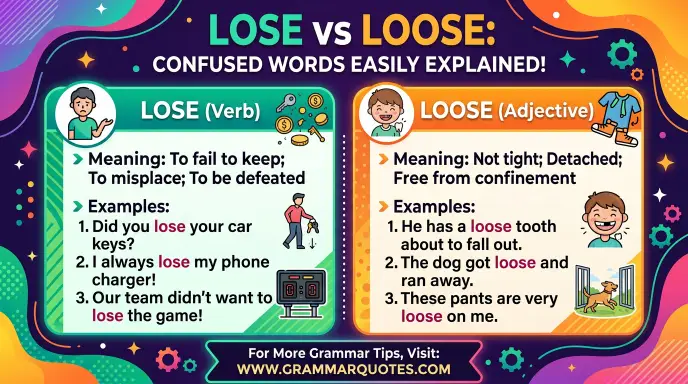
Lose is a verb meaning to misplace something, fail to win, or no longer have something. Loose is usually an adjective meaning not tight, not firmly attached, or free.
Examples:
- Don’t lose your phone.
- I don’t want to lose the game.
- This shirt is too loose.
- One of the screws is loose.
Memory tip: Lose has one “o” after the L, while loose has two. Think of the extra “o” in loose as giving the word extra room.
What Does Lose vs Loose Mean?
What Does Lose Mean?
Lose is most often a verb. It has several common meanings.
It can mean to misplace something:
I don’t want to lose my wallet.
It can also mean to fail to win:
Our team may lose the match.
Another meaning is to no longer have something:
She lost her job last year.
Lose can also describe becoming unable to find or follow something:
I lost my way in the city.
The past tense of lose is lost, not “losed.”
What Does Loose Mean?
Loose is usually an adjective. It describes something that is not tight, firmly attached, or controlled.
For example:
These pants are too loose.
It can also describe something that is not securely fixed:
The door handle is loose.
Loose can sometimes be used as a verb, especially in formal or literary writing, meaning to release or set free:
The rider loosed the arrow.
However, this use is much less common in everyday English.
Lose vs Loose Pronunciation
The pronunciation is another source of confusion.
- Lose sounds like “looz.”
- Loose also sounds like “loos.”
Their vowel sound is similar, but the final sound differs. Lose ends with a /z/ sound, while loose ends with an /s/ sound.
This is why hearing the words alone can sometimes make them difficult to distinguish.
The Origin of Lose vs Loose
The two words have different historical roots even though their modern spellings look similar.
Lose comes from Old English forms related to the idea of destruction, separation, or being deprived of something. Over time, it developed into the modern verb lose.
Loose has roots connected with ideas such as being free, released, or not tightly bound. Its history is related to older Germanic words expressing freedom or release.
Their similar appearance does not mean they are different spellings of the same word. They developed separately and have different meanings today.
Understanding this can help explain why adding another “o” to lose changes the word entirely.
British English vs American English
There is no major British American spelling difference between lose and loose. Both forms are standard in American English, British English, Canadian English, and Australian English.
| Meaning | British English | American English | Example |
| Misplace something | lose | lose | Don’t lose your keys. |
| Fail to win | lose | lose | They could lose the game. |
| Not tight | loose | loose | These shoes are loose. |
| Not firmly attached | loose | loose | The handle is loose. |
The main issue is therefore correct word choice, not regional spelling.
Style guides and dictionaries treat lose and loose as separate words. Writers should choose between them based on meaning rather than the country in which they are writing.
Which Version Should You Use?
Use the word that matches the meaning of your sentence.
United States
Use lose when you mean misplace, fail to win, or no longer have something.
Use loose when something is not tight or firmly attached.
United Kingdom
The same distinction applies in British English.
- Lose = misplace or fail to win
- Loose = not tight or firmly fixed
Canada
Canadian English follows the same basic distinction.
Australia
Australian English also uses lose and loose with their standard meanings.
International Writing
For international readers, the safest approach is simple: use lose for the verb and loose for the adjective.
Academic Writing
Accuracy matters in academic writing. A sentence such as “The experiment may loose data” is incorrect if the intended meaning is that data may be lost.
Correct:
The experiment may lose some data.
Business Writing
The same rule applies to emails, reports, presentations, and professional documents.
Correct:
We do not want to lose this customer.
Correct:
The connection is loose.
Common Mistakes
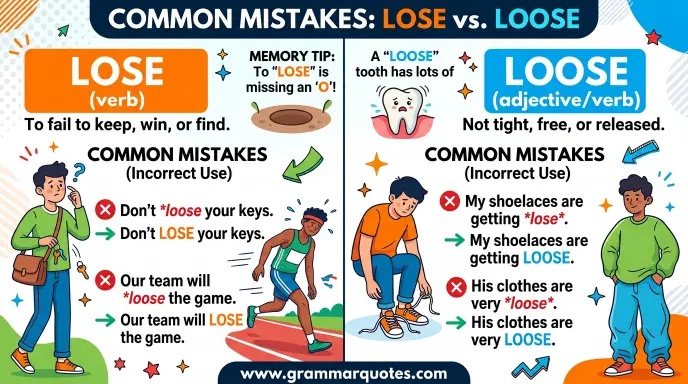
Mistake 1: Using “loose” instead of “lose”
Incorrect:
I don’t want to loose my phone.
Correct:
I don’t want to lose my phone.
Why?
“Lose” is the verb meaning to misplace something.
Memory tip: If you can replace the word with misplace, use lose.
Mistake 2: Using “lose” instead of “loose”
Incorrect:
My shirt is lose.
Correct:
My shirt is loose.
Why?
The shirt is not tight, so loose is the correct adjective.
Memory tip: Think of the extra o in loose as extra space.
Mistake 3: “I lost my weight”
This sentence can be grammatically correct, but the intended expression is usually:
I lost weight.
When talking about changes in body weight, “lose weight” is the standard expression.
Mistake 4: “Loose the game”
Incorrect:
We might loose the game.
Correct:
We might lose the game.
Why?
A team can lose a game. The word loose does not mean “fail to win.”
Everyday Examples of Lose vs Loose
Emails
Please make sure you don’t lose the attached document.
The cable appears to be loose.
Business Writing
We cannot afford to lose an important customer.
The connection may be loose and should be checked.
News Headlines
Local Team Could Lose Final Match
Officials Investigate Loose Equipment
Blogs
Five Ways to Avoid Losing Important Files
How to Fix a Loose Door Handle
Social Media
I almost lost my phone today!
These shoes are way too loose.
Academic Writing
The study could lose valuable information if the records are not preserved.
A loose definition may create confusion in the research.
Daily Conversation
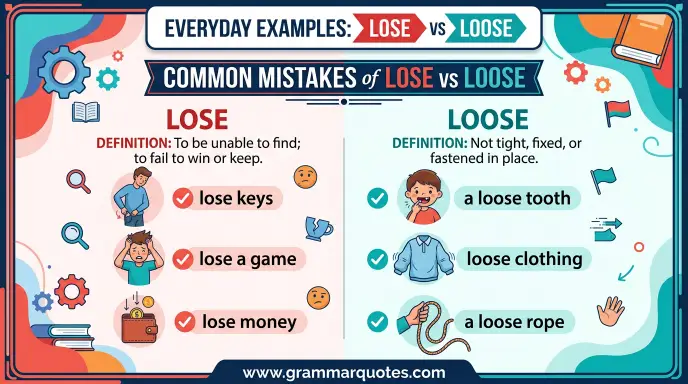
Did you lose your keys?
No, but my jacket feels loose.
Don’t lose your ticket.
My shoelaces are loose.
Google Trends & Modern Usage
People frequently search for “lose vs loose” because the words are visually similar and commonly confused in writing.
The confusion appears across several types of searches, including:
- lose vs loose meaning
- lose or loose
- lose vs loose examples
- how to spell lose
- how to spell loose
- loose meaning
- lose meaning
- difference between lose and loose
Exact search volume or Google Trends figures should be checked directly in Google Trends for a specific country and date range. Without current trend data, it would be misleading to assign exact popularity numbers.
The continued confusion is understandable because lose and loose differ by only one letter in spelling, while their meanings are completely different.
Quick Comparison Table
| Version | Meaning | Correct? | Region | Example |
| Lose | Misplace or no longer have | Yes | All major English varieties | Don’t lose your keys. |
| Lose | Fail to win | Yes | All major English varieties | They may lose the match. |
| Loose | Not tight | Yes | All major English varieties | This shirt is loose. |
| Loose | Not firmly attached | Yes | All major English varieties | The screw is loose. |
| Loose | Misplace something | No | None | Don’t loose your phone. |
Easy Rule
If you mean misplace, fail, or no longer have, choose lose.
If you mean not tight, free, or not firmly attached, choose loose.
Key Takeaways
- Lose is usually a verb.
- Loose is usually an adjective.
- Lose can mean misplace something or fail to win.
- Loose means not tight, firmly fixed, or controlled.
- Lose has one “o”; loose has two.
- There is no major US UK spelling difference between the two.
- Use lose when talking about losing a game, object, opportunity, or possession.
- Use loose when describing clothing, screws, connections, or other things that are not tight.
FAQs
Is it lose or loose?
It depends on the meaning. Use lose when you mean to misplace something, fail to win, or no longer have something. Use loose when you mean not tight or not firmly attached. For example, “Don’t lose your keys” is correct, while “My shoelaces are loose” is also correct.
What is the difference between lose and loose?
Lose is generally a verb, while loose is generally an adjective. “Lose” means to misplace something or fail to win. “Loose” means not tight or not securely attached. The extra “o” in loose is a useful visual clue for remembering the difference.
Is “loose” the past tense of “lose”?
No. The past tense of lose is lost. For example, “I lost my keys yesterday.” Loose is a separate word with a different meaning, usually describing something that is not tight or firmly attached.
Is it “lose weight” or “loose weight”?
The correct expression is lose weight. The verb lose is used because the phrase describes a reduction in weight. “Loose weight” is incorrect when you mean a reduction in body weight.
Is it “lose a game” or “loose a game”?
The correct phrase is lose a game. If a person or team does not win a game, they lose it. For example, “Our team could lose the game.” Loose does not mean fail to win.
Is “loose” an adjective?
Yes. Loose is commonly an adjective. It describes something that is not tight, firmly attached, or controlled. Examples include “loose clothing,” “a loose screw,” and “loose papers.” The word can have other grammatical uses, but its adjective use is especially common.
Why do people confuse lose and loose?
People confuse them because they look almost identical and have similar pronunciation. The only spelling difference is an extra o, but their meanings are different. A simple way to remember them is: lose = misplace or fail; loose = not tight.
How do you remember lose vs loose?
Remember that loose has an extra o, which you can imagine as giving the word “extra room.” Something loose has space and is not tight. Lose has only one “o” and is used for losing something, losing a game, or losing an opportunity.
What is the correct phrase: “loose change” or “lose change”?
The correct phrase is loose change. “Loose change” means small coins that are not being kept in a particular place, such as coins in a pocket or container. Here, loose describes the coins as being free or uncontained.
Can “loose” be a verb?
Yes, although this use is less common in everyday English. As a verb, loose can mean to release or set free. For example, formal or literary writing may use “loosed” to mean released. In normal conversation, however, loose is much more commonly used as an adjective.
Conclusion
The difference between lose vs loose is simple once you connect each word with its main meaning. Lose is usually a verb. It means to misplace something, fail to win, or no longer have something. Loose is usually an adjective that describes something that is not tight, firmly attached, or controlled.
There is no major difference between American and British spelling here. The same basic rule works across standard varieties of English. When writing an email, essay, blog post, social media caption, or academic paper, focus on the meaning rather than the spelling alone.
If you mean misplace, fail, or no longer have, use lose. If you mean not tight or not firmly attached, use loose.
The easiest rule to remember is this: Lose means you no longer have it; loose means it is not tight.
Keep this rule in mind, and you will avoid one of the most common spelling mistakes in English.
Discover More Articles!
i.e. vs e.g.: Meaning, Difference, and Correct Usage
Else’s or Elses: Common Mistakes and Examples(2026)
Perfume or Parfum: What’s the Difference?(2026)

Ethan Parker is an English-language writer known for his interest in words, language, and clear communication. His work focuses on making everyday English easier to understand through simple explanations and practical examples.