If you have ever checked a world clock, scheduled an international meeting, or worked with timestamps, you may have wondered about GMT or UTC.
The two terms are closely related, but they are not technically the same thing. In everyday use, they can often show the same clock time, which is why the difference can be confusing.
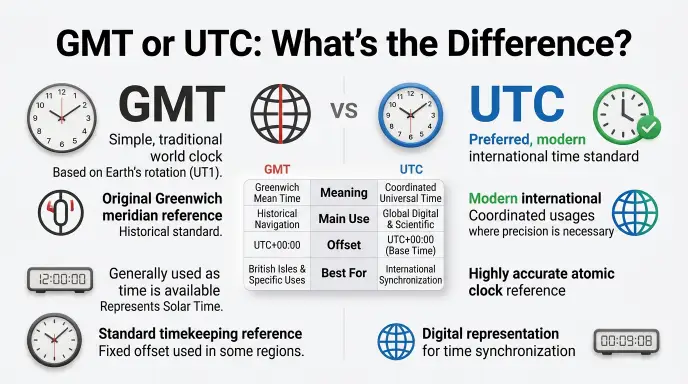
GMT stands for Greenwich Mean Time and is historically connected to the mean solar time at Greenwich, England. UTC, or Coordinated Universal Time, is the modern international time standard used for global timekeeping.
For most everyday purposes, GMT and UTC show the same time when the offset is +00:00. However, UTC is the better choice for computers, international systems, timestamps, science, and technical communication.
This guide explains the difference between GMT and UTC, their history, regional use, common mistakes, and when you should use each term.
GMT or UTC: The Quick Answer
UTC is the modern international time standard, while GMT is a historical time system that is still widely used as a name for the zero offset time zone.
Today, GMT and UTC are normally the same clock time at the zero meridian. However, UTC is the technically preferred standard for precise international timekeeping, computing, data exchange, and timestamps.
For example:
- 12:00 UTC = 12:00 GMT
- 18:30 UTC = 18:30 GMT
- A timestamp such as 2026 08 31T12:00:00Z uses UTC.
The important difference is not usually the displayed hour. It is what the terms represent and where they are appropriate.
What Does GMT or UTC Mean?
What Is GMT?
GMT means Greenwich Mean Time. It originated from the mean solar time associated with the Royal Observatory at Greenwich, England.
Historically, GMT was based on astronomical observations and the Earth’s rotation. The modern use of GMT commonly refers to the time at the zero meridian or to the UTC+00:00 time zone.
NIST notes that the original astronomical meaning of GMT has been replaced by modern astronomical and atomic time scales, although GMT remains widely used as a time zone term.
What Is UTC?
UTC means Coordinated Universal Time. It is the internationally agreed standard used as the basis for worldwide civil timekeeping.
UTC is derived from international atomic time and is kept closely aligned with Earth’s rotation through adjustments known as leap seconds.
UTC is widely used in:
- Computer systems
- Internet timestamps
- Aviation
- Telecommunications
- Scientific research
- GPS related systems
- International business
- Government data
- Software development
Why Do GMT and UTC Often Show the Same Time?
Both can represent the time at the prime meridian, which is associated with 0° longitude near Greenwich, England.
So if a clock says:
10:00 UTC
another clock labeled:
10:00 GMT
will normally show the same hour.
That does not mean GMT and UTC are technically identical concepts.
The Origin of GMT or UTC
GMT has a much older history than UTC.
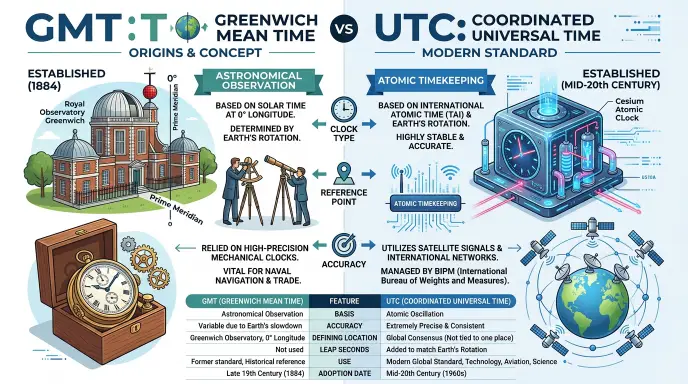
The term Greenwich Mean Time developed from astronomical timekeeping at Greenwich. Greenwich became an important reference point for navigation and international timekeeping, and the prime meridian was eventually established there.
UTC came much later as timekeeping became increasingly dependent on highly precise atomic clocks.
Modern UTC combines the stability of atomic time with adjustments that keep it closely related to Earth’s rotation. NIST describes UTC as the internationally agreed standard for world time.
The name UTC itself is unusual because the initials do not directly match the English phrase “Coordinated Universal Time.” The abbreviation was chosen internationally so that different languages could use the same designation.
Why Did UTC Replace GMT as the Technical Standard?
Earth does not rotate at a perfectly constant rate. Atomic clocks provide a much more stable way to define precise time.
UTC therefore became the better international standard for precise timekeeping. GMT remained useful as a familiar time zone name and continues to appear in everyday language.
This explains why you may see both terms even though modern technical systems generally prefer UTC.
British English vs American English
GMT and UTC are not mainly a British versus American spelling issue. Both terms are used in British English, American English, and international English.
The difference is primarily technical, historical, and contextual.
| Aspect | British English | American English | Example |
| GMT | Common and understood | Common and understood | 3:00 GMT |
| UTC | Preferred in technical contexts | Preferred in technical contexts | 15:00 UTC |
| Zero offset | GMT/UTC+00:00 | GMT/UTC+00:00 | 09:00 UTC |
| Technical timestamps | UTC preferred | UTC preferred | 2026 08 31T09:00Z |
| Summer time in UK | BST, UTC+1 | Depends on U.S. time zone | 10:00 BST |
| International systems | UTC preferred | UTC preferred | Event starts at 14:00 UTC |
The UK changes from GMT to British Summer Time (BST) during daylight saving months. UTC itself does not change seasonally.
This is one reason UTC is especially useful for international systems.
Which Version Should You Use?
The best choice depends on your audience and the purpose of the information.
United States
Use UTC for:
- Software
- APIs
- Scientific data
- International schedules
- Technical documentation
- Machine readable timestamps
GMT is still understandable, but UTC is usually clearer for technical purposes.
United Kingdom
GMT is natural when discussing the UK during the period when the country is on GMT.
However, remember that the UK uses BST, which is one hour ahead of UTC, during British Summer Time.
For technical timestamps, UTC is usually the safer choice.
Canada
Use UTC for international and technical communication. GMT may still appear in general references to the zero offset time zone.
Australia
UTC is generally preferable when communicating internationally because Australia has several local time zones and some regions observe daylight saving changes.
International Writing
For a worldwide audience, UTC is usually the best option.
For example:
The online event begins at 18:00 UTC.
This gives readers a clear reference point regardless of their location.
Academic Writing
Use the time standard required by your field or publication style.
When precision matters, UTC is generally preferable because it clearly identifies the international reference time.
Business Writing
Use UTC when dealing with:
- International teams
- Global customers
- Software releases
- Online meetings
- Server maintenance
- Financial systems
- Worldwide events
If your audience is local, a local time plus UTC can be even clearer.
For example:
The meeting starts at 3:00 PM Pakistan Standard Time (10:00 UTC).
Common Mistakes With GMT or UTC
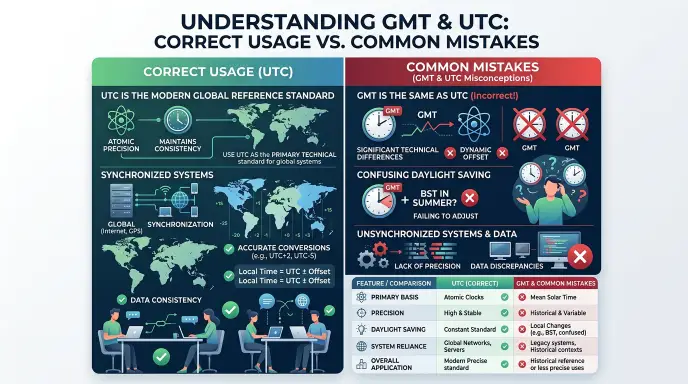
Mistake 1: Saying GMT and UTC Are Always Technically Identical
Incorrect:
GMT and UTC are exactly the same time standard.
Correct:
GMT and UTC normally show the same time at UTC+00:00, but they are technically different time concepts.
Why?
GMT has historical and time zone meanings, while UTC is the modern international time standard.
Memory tip:
Think GMT = Greenwich time zone term and UTC = global technical standard.
Mistake 2: Treating UTC as a Time Zone That Changes
Incorrect:
UTC moves forward one hour in summer.
Correct:
UTC remains at UTC+00:00; local time zones may change because of daylight saving time.
UTC itself does not switch between summer and winter time.
Mistake 3: Confusing UK Time With UTC All Year
Incorrect:
London is always on UTC.
Correct:
The UK uses GMT in winter and BST in summer.
This distinction matters when scheduling events.
Mistake 4: Using Local Time Without a Time Zone
Unclear:
The server update starts at 8:00.
Better:
The server update starts at 08:00 UTC.
The second version is much easier for an international team to understand.
Mistake 5: Using GMT in Technical Timestamps
GMT may be understood by people, but technical systems generally benefit from standardized UTC based timestamps.
For machine readable date and time data, GOV.UK recommends ISO 8601 formats and explains how UTC offsets can be included.
GMT or UTC in Everyday Examples
Emails
Better:
The webinar starts at 16:00 UTC.
This avoids confusion when recipients live in different countries.
Business Writing
System maintenance will begin at 02:00 UTC on September 1.
This is clearer than giving a time without a time zone.
News Headlines
A news organization might use GMT when discussing UK time:
The announcement is expected at 10:00 GMT.
For international reporting, UTC may be more precise.
Blogs
The livestream begins at 18:00 UTC.
This works well when readers come from multiple countries.
Social Media
New episode drops at 20:00 UTC!
Adding UTC helps international followers convert the time to their own local time.
Academic Writing
The observations were recorded at 12:30 UTC.
UTC provides a consistent reference for readers and researchers around the world.
Daily Conversation
In casual British English, someone may say:
The flight leaves at 7 GMT.
In technical or international communication, you are more likely to see:
The flight leaves at 07:00 UTC.
Google Trends & Modern Usage
People search “GMT or UTC” because the two terms are closely associated with the same zero hour reference.
Common search questions include:
- Is GMT the same as UTC?
- Should I use GMT or UTC?
- What is the difference between GMT and UTC?
- Is London GMT or UTC?
- Does UTC change for daylight saving time?
- What does UTC mean?
- What does GMT mean?
- Is UTC the same as GMT+0?
Modern usage strongly favors UTC in technical and international contexts. Government data standards, computing systems, scientific applications, and international timekeeping commonly use UTC.
GMT remains familiar because of its historical importance and its continued use as a time zone label.
Rather than treating one term as simply “right” and the other as “wrong,” it is more useful to choose the term that matches your context.
Quick Comparison Table
| Version | Meaning | Correct? | Region | Example |
| GMT | Greenwich Mean Time | Yes | Global, especially UK related contexts | 12:00 GMT |
| UTC | Coordinated Universal Time | Yes | International | 12:00 UTC |
| UTC+00:00 | Zero UTC offset | Yes | International | 12:00 UTC+00:00 |
| BST | British Summer Time | Yes | United Kingdom | 13:00 BST |
| Z | Zulu time, equivalent to UTC | Yes | Aviation, military, technical contexts | 1200Z |
GMT and UTC can represent the same displayed time at zero offset, but UTC is the modern international standard. NIST also explains that “Zulu” time refers to UTC in military and related contexts.
GMT vs UTC: At a Glance
| Feature | GMT | UTC |
| Full name | Greenwich Mean Time | Coordinated Universal Time |
| Main association | Greenwich, England | International time standard |
| Historical role | Major time reference | Modern global standard |
| UTC offset | Usually +00:00 | +00:00 |
| Changes with daylight saving? | UK local use may switch to BST | No |
| Technical use | Less preferred | Preferred |
| Computing | Sometimes seen | Standard choice |
| International data | Understandable | Recommended |
| Everyday use | Very common | Very common |
| Best for precise timestamps | Not usually | Yes |
Key Takeaways
- GMT means Greenwich Mean Time.
- UTC means Coordinated Universal Time.
- GMT and UTC normally show the same clock time at UTC+00:00.
- UTC is the modern international standard for timekeeping.
- GMT has important historical and time zone significance.
- The UK uses GMT during standard time and BST during daylight saving time.
- UTC does not change because of seasonal daylight saving rules.
- Use UTC for software, timestamps, international schedules, and technical data.
- Use GMT when it fits a historical, geographical, or familiar UK related context.
- When precision matters, UTC is usually the better choice.
FAQs
1. Is GMT the same as UTC?
Yes, GMT and UTC show the same time at UTC+00:00, but they are different time standards. GMT has historical roots, while UTC is the modern international standard.
2. Should I use GMT or UTC?
Use UTC for technical, scientific, software, and international purposes. GMT is still suitable for everyday or UK-related references.
3. Is GMT always UTC+0?
In modern time-zone use, GMT corresponds to UTC+0. However, GMT and UTC are not technically identical concepts.
4. Does UTC change for daylight saving?
No. UTC stays at the same reference time. Local time zones may change because of daylight saving rules.
5. Is London always on GMT?
No. London uses GMT in winter and BST (UTC+1) in summer.
6. Is UTC better for software?
Yes. UTC is preferred for software, databases, APIs, and timestamps because it provides a consistent global reference.
7. What does UTC+0 mean?
UTC+0 means there is no time difference from UTC. GMT is commonly associated with this zero-hour offset.
8. Is Zulu time the same as UTC?
Yes. Zulu time (Z) is another way to identify UTC, especially in aviation, military, and technical communication.
9. Can GMT and UTC be used interchangeably?
Often, yes, when referring to the zero-hour time. However, UTC is the better choice when technical accuracy is important.
10. Which should I use for international time?
UTC is the best choice for international schedules, meetings, systems, and timestamps because it provides a clear global reference.
Conclusion
The choice between GMT or UTC can seem confusing because both terms commonly point to the same clock time at the zero UTC offset. The key difference is that they describe different concepts.
GMT has historical roots in mean solar time at Greenwich and remains a familiar name for the zero offset time zone. UTC is the modern, internationally agreed standard used for precise global timekeeping.
For everyday UK related conversations, GMT can still be perfectly appropriate. However, if you are writing technical documentation, creating software, recording timestamps, coordinating international meetings, or publishing scientific data, UTC is usually the better choice.
Remember that the UK can move from GMT to BST during daylight saving time, while UTC itself does not shift seasonally.
The simplest rule is: use GMT when the context is Greenwich or the familiar zero offset time zone, and use UTC when precision and international consistency matter.
Discover More Articles!
Rolex or Omega: Which Luxury Watch Brand Is Better for You?
Camry or Accord: A Complete Comparison to Find the Better Sedan
Iceland vs Greenland: Which One Should You Choose?

Ethan Parker is an English-language writer known for his interest in words, language, and clear communication. His work focuses on making everyday English easier to understand through simple explanations and practical examples.