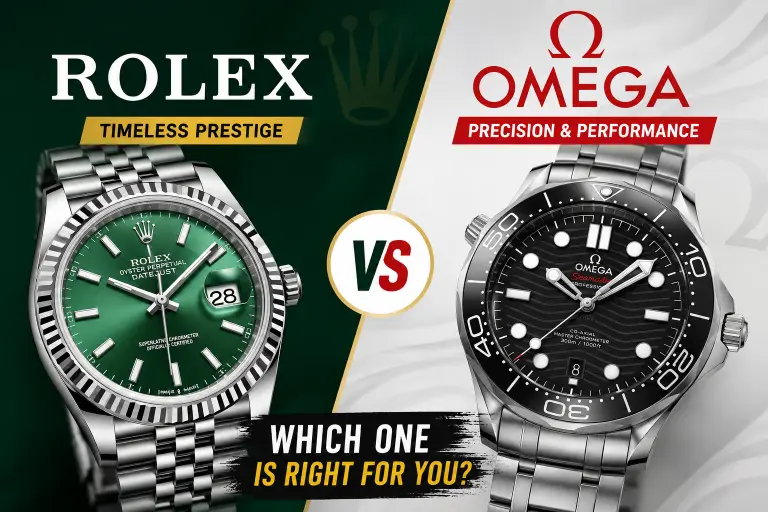
Choosing between Rolex or Omega can be hard. Both are famous Swiss watch brands with long histories, strong reputations, and loyal fans. But they are not exactly the same.
People search for “Rolex or Omega” because they want to know which brand offers better quality, style, accuracy, value, durability, or prestige. Some buyers want a watch that feels like a luxury status symbol.
Others care more about movement technology, history, daily wear, or getting strong value for their money.
The good news is that there is no single winner for every buyer. Rolex is known for its powerful brand image, iconic designs, strong demand, and high resale interest. Omega is known for its technical innovation, rich space and sports history, excellent movements, and broad model range.
This guide compares Rolex or Omega in simple terms. You will learn how the brands started, how they differ, which one may suit your needs, and what current market data says. By the end, you should have a clearer idea of which luxury watch brand fits your style, budget, and goals.
Rolex or Omega : Quick Answer
If you want maximum brand prestige, strong resale demand, and iconic luxury designs, Rolex is usually the better choice.
If you want technical features, movement innovation, famous history, and strong value, Omega can be the better choice.
For example, Rolex is famous for collections such as the Submariner, Datejust, Daytona, and GMT Master II. Omega is best known for collections such as the Speedmaster, Seamaster, and Constellation.
Both brands make excellent Swiss watches. Your best choice depends on what matters most to you.
| Factor | Rolex | Omega |
| Brand prestige | Excellent | Excellent |
| Technical innovation | Excellent | Excellent |
| Resale demand | Very strong | Strong |
| Sports history | Strong | Very strong |
| Space history | Limited | Exceptional |
| Everyday wear | Excellent | Excellent |
| Model variety | Strong | Very strong |
| Collector appeal | Very high | Very high |
The Origin of Rolex or Omega

Rolex and Omega are both Swiss watchmaking names, but their histories began in different ways.
Rolex traces its roots to 1905, when Hans Wilsdorf and Alfred Davis established a watch business in London. The Rolex name later became closely linked with Swiss watchmaking and the company’s focus on precision, water resistance, and practical wristwatches.
Omega has an older history. Its origins go back to 1848, when Louis Brandt began assembling watches in La Chaux de Fonds, Switzerland. The Omega name became associated with the company later and grew into one of Switzerland’s best known watch brands.
The brands also built different identities. Rolex became strongly associated with luxury, achievement, durability, and recognizable designs. Omega developed a reputation around precision, technical progress, sports timing, exploration, and space.
This history helps explain why people still compare Rolex or Omega today. They are both prestigious, but they appeal to buyers for somewhat different reasons.
British English vs American English Spelling
The phrase “Rolex or Omega” does not involve a British versus American spelling difference. Rolex and Omega are brand names, so their official spellings stay the same in both forms of English.
| Term | American English | British English |
| Rolex | Rolex | Rolex |
| Omega | Omega | Omega |
| Rolex watch | Rolex watch | Rolex watch |
| Omega watch | Omega watch | Omega watch |
| luxury watch | luxury watch | luxury watch |
So if you are writing for readers in the United States, the United Kingdom, Canada, Australia, or another English speaking market, use Rolex and Omega exactly as written.
Which Spelling Should You Use?
There is only one standard spelling for each brand:
- Rolex correct
- Omega correct
Do not change the spelling based on your audience.
For content, use Rolex or Omega naturally in the title, headings, introduction, and relevant sections. Avoid repeating the keyword too often because this can make the article sound unnatural.
If you are writing for an international audience, simple phrases such as Rolex vs Omega, Rolex or Omega, and Rolex compared with Omega can help cover different search intents naturally.
Common Mistakes with Rolex or Omega
People searching for luxury watches can make several common mistakes when comparing these brands.
1. Thinking One Brand Is Always Better
Rolex is not automatically better for every buyer. Omega has strengths that may matter more to someone who values technical features or historical significance.
2. Comparing Only Prices
Price alone does not tell you which watch is better. Consider movement, materials, design, servicing, availability, and resale demand.
3. Ignoring the Specific Model
Comparing an entire brand can be misleading. A Rolex Submariner and an Omega Speedmaster serve very different purposes.
4. Assuming Resale Value Is Guaranteed
Luxury watch prices can change. Market demand, condition, rarity, box and papers, and model popularity can all affect resale value.
5. Buying Only for Status
A famous logo is not the only reason to buy a watch. Comfort, size, movement, design, and personal taste should also matter.
Rolex or Omega in Everyday Examples
The keyword can appear naturally in different types of writing.
Email:
“I am deciding between Rolex or Omega and would like advice on which model is better for daily wear.”
News or editorial writing:
“The Rolex or Omega debate continues among luxury watch collectors.”
Social media:
“Rolex or Omega? Which one would you choose for your next watch?”
Formal writing:
“This comparison examines Rolex or Omega based on design, technology, brand reputation, and market demand.”
The key is to use the phrase naturally. You do not need to force the exact keyword into every sentence.
Rolex or Omega : Google Trends & Usage Data
Search interest can change over time, so exact Google Trends numbers should be checked for a specific country and date range. Market data, however, gives a useful picture of the brands’ current positions.
In the 2025 Swiss luxury watch market, estimates based on Morgan Stanley and LuxeConsult data put Rolex at about 32.9% market share, while Omega was estimated at about 6.4%. Rolex remained the largest brand by a wide margin.
Secondary market data also shows strong interest in both brands. Chrono24 reported that Rolex remained the market leader in the first half of 2025, while Omega held the second highest brand share in its secondary market analysis.
Bezel’s H1 2025 data found Rolex accounted for 37% of wants and 33% of sales on its platform, while Omega represented 12% of wants and 15% of transactions.
These numbers do not mean Rolex is automatically the better watch. They show that Rolex has stronger overall market demand, while Omega also has a large and active collector following.
Rolex vs Omega: Key Differences
| Feature | Rolex | Omega |
| Founded | 1905 | 1848 |
| Main identity | Luxury and prestige | Technical watchmaking and heritage |
| Famous model | Submariner | Speedmaster |
| Diving watches | Excellent | Excellent |
| Chronographs | Daytona | Speedmaster |
| Space connection | Limited | Strong |
| Brand recognition | Extremely high | Very high |
| Secondary market demand | Extremely strong | Strong |
| Technical appeal | Very high | Very high |
| Best for | Prestige and long term demand | Technology, history, and versatility |
Rolex or Omega: Which Is Better for Quality?
Both brands offer very high quality watches.
Rolex has built its reputation around durable cases, reliable movements, water resistance, and strict quality standards. Its designs are also highly recognizable.
Omega places strong emphasis on movement technology and precision. Many modern Omega watches use advanced co axial movements and Master Chronometer certification.
So the answer depends on what you mean by “quality.”
For brand recognition and proven luxury appeal, Rolex has an edge.
For technical innovation and movement focused features, Omega is a strong competitor.
Rolex or Omega: Which Is Better for Resale Value?
Rolex generally has the stronger resale market.
Its most popular models can have high demand on the secondary market, and some references can be difficult to obtain at retail. Current secondary market research continues to show Rolex as the leading brand by market share.
Omega can also hold value well, especially for popular models such as the Speedmaster and selected Seamaster references. However, resale performance varies by model and condition.
If resale value is one of your top priorities, Rolex usually has the advantage.
Rolex or Omega: Which Is Better for Daily Wear?
Both can work very well as daily watches.
A Rolex Datejust can suit business, casual, and formal settings. A Submariner offers a sporty design with strong water resistance.
Omega also offers many daily wear choices. The Seamaster is popular for sporty use, while models from the Aqua Terra range can work well in both casual and professional settings.
The best daily watch is the one that fits your wrist, lifestyle, clothing, and comfort needs.
Rolex or Omega: Which Should You Buy?
Choose Rolex if you want:
- Strong global brand recognition
- High resale demand
- Iconic luxury designs
- Strong collector interest
- A watch that is widely recognized
Choose Omega if you want:
- Strong technical features
- A rich history in exploration and space
- Excellent mechanical movements
- More model variety
- Strong luxury value without relying only on brand status
There is no wrong answer. The right choice depends on your priorities.
FAQs
Is Rolex better than Omega?
Rolex has an advantage in brand prestige, recognition, and resale demand. Omega is highly competitive in technical innovation, heritage, and model variety.
Is Omega more accurate than Rolex?
Both brands produce highly accurate mechanical watches. Modern Omega Master Chronometer models are tested to strict precision standards, while Rolex also uses rigorous testing and certification.
Which is more expensive, Rolex or Omega?
Prices vary greatly by model, material, and market. Rolex often commands higher prices, especially for highly sought after models.
Which has better resale value, Rolex or Omega?
Rolex generally has stronger resale demand. However, individual Omega models can also perform well on the secondary market.
Is Omega a luxury brand like Rolex?
Yes. Omega is a major Swiss luxury watch brand with a long history, strong technical reputation, and a large global collector base.
Which is better for investment, Rolex or Omega?
Neither should be treated as a guaranteed investment. Watch prices can rise or fall. If resale performance matters, Rolex generally has stronger market demand.
Should I buy a Rolex or Omega for everyday use?
Both are suitable. Rolex may be better if you want maximum recognition, while Omega can be a great choice if you value technical features and variety.
Conclusion
The Rolex or Omega debate has no universal winner. Both brands have earned their place among the world’s best known Swiss watchmakers, but they offer different experiences.
Rolex is the stronger choice for buyers who care about prestige, global recognition, iconic designs, and strong secondary market demand. Current market data clearly shows Rolex leading the Swiss luxury watch market by a wide margin.
Omega is an excellent alternative for buyers who want technical innovation, a long history, strong mechanical movements, and famous connections to exploration and space. Its position in the secondary market also shows that it remains highly popular with collectors.
The smartest approach is to compare specific models rather than only the logos. Look at comfort, movement, size, materials, features, price, and your long term needs.
If your priority is prestige and resale demand, choose Rolex. If your priority is technology, history, and value, consider Omega. Either way, choose the watch you genuinely enjoy wearing.
Discover More Articles!
Youth vs Youths: What’s the Difference?
Obay or Obey: Which Spelling Is Correct?
Potatoe or Potato: Is “Potatoe” a Correct Word?

Hi,I am a Adrian walker. I’m passionate about making English grammar simple and easy to understand. I write clear comparisons that explain confusing words, spelling differences, and common grammar mistakes so readers can write with confidence. My goal is to provide accurate, practical, and easy-to-follow language guides for learners and writers worldwide.