Obay or Obey: Which spelling is correct, and what does each version mean? Learn why obey is the correct standard English spelling.
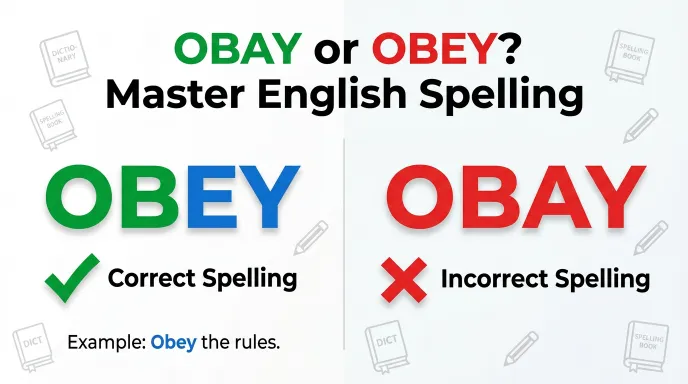
The correct spelling is obey. Obay is normally a misspelling and should not be used in standard English writing. The word obey is a common verb that means to do what someone tells you to do or to follow a rule, law, command, or instruction.
People often search for obay or obey when they are checking a spelling, writing an assignment, proofreading an email, or learning English. The confusion usually comes from pronunciation rather than from a real British or American spelling difference.
In this article, you will learn the meaning of obey, its origin, correct usage, pronunciation, common mistakes, and examples. You will also see if British and American English use different forms. Let’s clear up the confusion.
Obay or Obey : What Is the Correct Spelling?
Obey is the correct spelling, while obay is normally a misspelling. The word obey means to follow an order, rule, law, command, or instruction. For example, “Children should obey their parents” and “Drivers must obey traffic laws.”
Obay or Obey: Quick Answer
The answer is simple:
- ✅ Obey = correct standard English spelling
- ❌ Obay = normally incorrect
- Obey = to follow an order, rule, law, or instruction
- Obeyed = past tense
- Obeying = present participle
- Obeys = third person singular form
Examples
- You must obey the law.
- Children should obey their parents.
- All students must obey the school rules.
Incorrect:
- ❌ You must obay the law.
Correct:
- ✅ You must obey the law.
There is no standard British or American spelling difference here. Both varieties use obey.
What Does Obay or Obey Mean?
Obey is a verb. It means to do what someone tells you to do or to act according to a rule, law, command, or instruction.
You can obey a person:
- obey your parents
- obey your teacher
- obey your boss
- obey a police officer
You can also obey something such as:
- obey the law
- obey the rules
- obey an order
- obey instructions
- obey a command
- obey safety regulations
Examples in Context
“Please obey the instructions.”
This means you should follow the instructions.
“Drivers must obey traffic laws.”
This means drivers must follow the laws that apply to traffic.
“The students obeyed their teacher.”
This means the students did what their teacher asked them to do.
The word can also be used in a less literal way. For example:
The machine does not always obey the commands.
Here, obey means to respond or operate according to a command.
The Origin of Obay or Obey
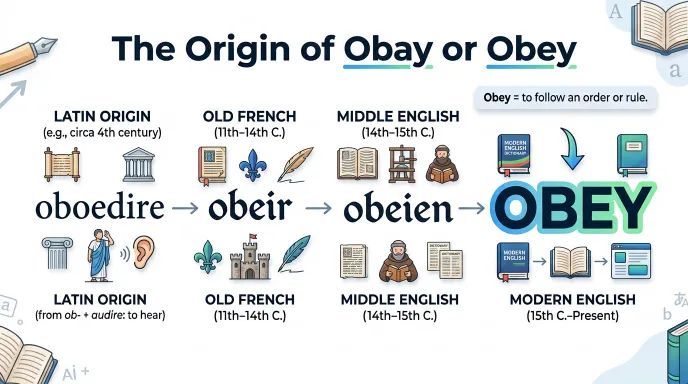
The correct form obey has a long history in English.
The word came into English through Middle English and Old French. It ultimately traces back to the Latin word oboedire, meaning to listen to or obey. The history of the word is connected with the idea of hearing and responding to authority.
Over time, the spelling developed into the modern English form obey.
This history also explains why obay is not simply an alternative English spelling. The modern standard spelling became established as obey, and dictionaries today recognize obey as the normal English form.
The pronunciation can make the spelling confusing. The final sound of obey is similar to the sound in words such as day and say. Because of this, some writers spell it incorrectly as obay.
However, pronunciation does not always tell us the exact spelling of an English word.
Easy way to remember it
Think:
O + BEY = OBEY
Not:
O + BAY = OBAY
The correct word always uses ey:
OBEY
British English vs American English
One useful fact is that obey does not change spelling between British and American English.
| Feature | British English | American English | Example |
| Standard spelling | obey | obey | Obey the rules. |
| Past tense | obeyed | obeyed | He obeyed the order. |
| Present participle | obeying | obeying | She is obeying instructions. |
| Third person form | obeys | obeys | He obeys the law. |
| Incorrect spelling | obay | obay | ❌ Obay the rules. |
Regional Differences
Some English words have different spellings in British and American English.
For example:
- colour / color
- centre / center
- organise / organize
But obey is not one of them.
if you write for readers in the United States, United Kingdom, Canada, Australia, or another English speaking country, the standard spelling is:
obey
Which Version Should You Use?
The safest choice is obey in all standard English writing.
United States
Use obey in school assignments, emails, websites, reports, and everyday communication.
Example:
Drivers must obey traffic laws.
United Kingdom
British English also uses obey.
Example:
Visitors must obey the safety instructions.
Canada
Canadian English uses obey as well.
Example:
All passengers must obey the crew’s instructions.
Australia
Australian English also uses obey.
Example:
Everyone is expected to obey the rules.
International English
If you are writing for a global audience, use obey. It is the standard form and will be understood by English speakers worldwide.
Academic Writing
Use obey in essays, assignments, research papers, and academic discussions.
Example:
The system must obey the conditions specified by the model.
Business Writing
Obey is also suitable for formal business writing when discussing policies, regulations, instructions, or laws.
Example:
Employees are required to obey all workplace safety procedures.
Common Mistakes with Obay or Obey
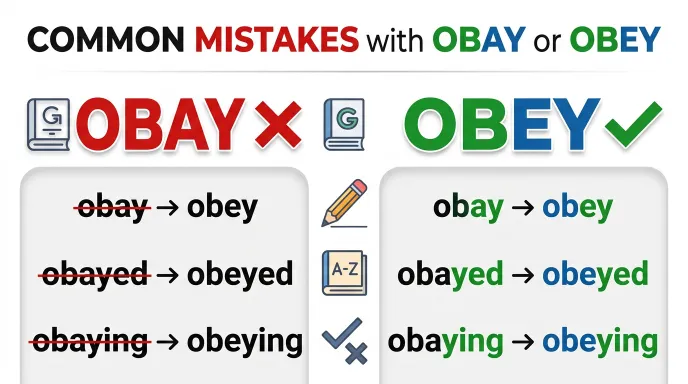
The most common mistake is replacing ey with ay.
| Incorrect | Correct | Explanation |
| ❌ obay | ✅ obey | The standard spelling is obey. |
| ❌ obayed | ✅ obeyed | The past tense is obeyed. |
| ❌ obaying | ✅ obeying | The ing form is obeying. |
| ❌ obays | ✅ obeys | The third person form is obeys. |
Mistake 1: Obay
❌ You should obay the rules.
✅ You should obey the rules.
Why?
The standard spelling is obey, not obay.
Mistake 2: Obayed
❌ He obayed his teacher.
✅ He obeyed his teacher.
Why?
The past tense of obey is obeyed.
Mistake 3: Obaying
❌ They are obaying the instructions.
✅ They are obeying the instructions.
Why?
When adding ing, the final e is removed:
obey → obeying
Memory Tip
Remember this simple rule:
OBEY ends with EY, not AY.
If you mean “follow an instruction,” write obey.
Obay or Obey in Everyday Examples
Emails
Please obey the instructions provided in the document.
All employees must obey the updated safety rules.
Business Writing
Employees are expected to obey company policies.
Customers must obey the terms and conditions.
News Headlines
Drivers Urged to Obey New Traffic Rules
Residents Asked to Obey Safety Instructions
Blogs
Why Children Should Learn to Obey Rules
How to Teach Students to Obey Classroom Rules
Social Media
Always obey local traffic laws.
Remember to obey the safety instructions.
Academic Writing
The variables must obey the conditions established by the study.
Daily Conversation
You should obey your parents.
Please obey the signs.
The dog learned to obey basic commands.
Google Trends & Modern Usage of Obay or Obey
People who search for obay or obey are usually looking for a spelling correction. This type of search is common among English learners, students, writers, and people proofreading their work.
The confusion is easy to understand because obey ends with the /eɪ/ sound. A person hearing the word may naturally think of spellings such as ay.
However, standard dictionaries consistently use obey as the correct spelling. There is no established British or American spelling called obay for the verb meaning “to follow an order or rule.”
Search intent around this keyword can include:
- Is obay a word?
- Obay or obey spelling
- How do you spell obey?
- What does obey mean?
- Obey meaning in English
- Obey pronunciation
- Past tense of obey
- Is obey British or American English?
- Obey spelling mistake
- How to use obey in a sentence
Exact search volume or Google Trends statistics can change by country and time period, so specific numbers should not be claimed without checking current Google Trends data.
Quick Comparison Table
| Version | Meaning | Correct? | Region | Example |
| obey | Follow an order, rule, or instruction | ✅ Yes | Worldwide English | Please obey the rules. |
| obay | Usually intended to mean obey | ❌ No | No standard regional use | ❌ Please obay the rules. |
| obeyed | Past tense of obey | ✅ Yes | Worldwide English | He obeyed the order. |
| obeying | ing form of obey | ✅ Yes | Worldwide English | They are obeying the rules. |
| obeys | Third person singular | ✅ Yes | Worldwide English | She obeys the law. |
Key Takeaways
- Obey is the correct spelling.
- Obay is normally a spelling mistake.
- Obey means to follow an order, rule, law, command, or instruction.
- British and American English both use obey.
- The past tense is obeyed.
- The ing form is obeying.
- The third person form is obeys.
- Remember: OBEY ends with EY, not AY.
FAQs
What does “obey” mean?
Obey means to follow an order, rule, law, command, or instruction. For example, “Children should obey their parents” means children should do what their parents ask them to do.
What does “obey you” mean?
Obey you means to do what you tell someone to do or to follow your instructions. For example, “You must obey me” means “You must do what I tell you to do.”
What are synonyms for “obey”?
Common synonyms for obey include follow, comply, submit, heed, observe, and listen to. The best synonym depends on the sentence. For example, “follow the rules” can often replace “obey the rules.”
Is “obey” plural?
Obey is a verb, so it does not have a plural form like a noun. Its third-person singular form is obeys. For example, “They obey the rules,” but “He obeys the rules.” The past tense is obeyed.
Conclusion
When choosing between obay or obey, the correct answer is obey. The spelling obay is normally a mistake caused by the pronunciation of the word. Although the ending sounds like “ay,” the standard spelling uses ey.
Obey is a common English verb meaning to follow an instruction, command, law, rule, or order. It can be used in everyday conversation, school assignments, business writing, academic work, news articles, and formal documents.
There is also no British versus American spelling difference. Both British and American English use obey.
The related forms are obeys, obeyed, and obeying, so learning the complete word family can help prevent future spelling mistakes.
If you are proofreading your writing and see obay, replace it with obey when you mean “to follow a rule or instruction.”
The easiest rule to remember is simple: if you mean “follow,” spell it O B E Y.
Discover More Articles!
Keith or Kieth: Which Spelling Is Correct?
Bit or Byte: What’s the Difference and Which One Should You Use?
Oases or Oasis: Meaning, Difference, and Correct Usage

Hi,I am a Adrian walker. I’m passionate about making English grammar simple and easy to understand. I write clear comparisons that explain confusing words, spelling differences, and common grammar mistakes so readers can write with confidence. My goal is to provide accurate, practical, and easy-to-follow language guides for learners and writers worldwide.