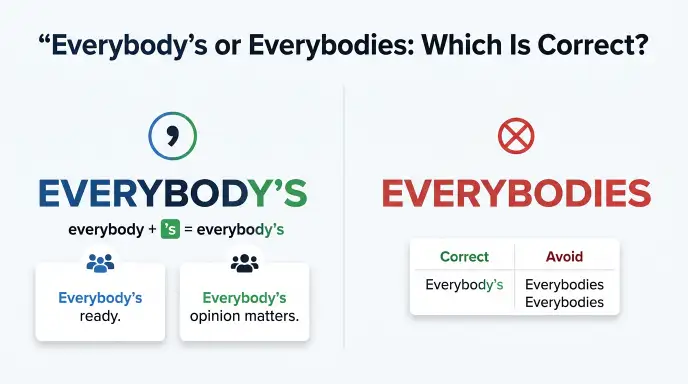
If you are unsure if to write everybody’s or everybodies, the correct form depends on what you are trying to say. In standard English, everybody’s is correct, while everybodies is generally incorrect.
The confusion happens because everybody refers to a group of people, and learners may assume that adding s creates a plural form. However, everybody is already treated as a singular indefinite pronoun in grammar. When you need the possessive form, you add an apostrophe and s, giving you everybody’s.
For example, you can say, “Everybody’s ready,” where everybody’s means “everybody is.” You can also say, “Everybody’s opinion matters,” where it shows possession or association.
This small apostrophe can change the meaning and grammar of a sentence. So, understanding when to use everybody’s, everybody, and everybody is is useful for students, ESL learners, writers, and anyone who wants to write clearly. Let’s look at the difference in simple terms.
Everybody’s or Everybodies: The Quick Answer for Search
Everybody’s is the standard correct form in English. It can mean “everybody is” or show possession, as in “everybody’s opinion.” Everybodies is not normally used in standard English. Since everybody is already an indefinite pronoun referring to all people in a group, you do not make it plural by adding s.
Everybody’s or Everybodies: Quick Answer
The correct spelling is everybody’s.
Use everybody’s in two main situations:
- As a contraction of everybody is: “Everybody’s coming to the party.”
- To show possession: “Everybody’s opinion was different.”
Do not normally write everybodies in standard English.
Examples
Correct:
- Everybody’s ready to leave.
- Everybody’s opinion matters.
- Everybody’s looking forward to the event.
Incorrect:
- Everybodies ready to leave.
- Everybodies opinion matters.
- Everybodies ideas were discussed.
The key point is simple: everybody does not become plural by adding s. When an apostrophe is needed, use everybody’s.
What Does Everybody’s Mean?
Everybody’s is the possessive form of everybody, but it can also be a contraction.
The word everybody is an indefinite pronoun. It means all the people in a particular group or situation.
For example:
Everybody enjoyed the concert.
Here, everybody means all the people who attended or were being discussed.
When you add an apostrophe and s, the meaning depends on the sentence.
1. Everybody’s = Everybody is
In many sentences, everybody’s is a contraction of everybody is.
For example:
- Everybody’s happy.
= Everybody is happy. - Everybody’s waiting outside.
= Everybody is waiting outside. - Everybody’s invited.
= Everybody is invited.
A useful test is to replace everybody’s with everybody is. If the sentence still makes sense, you are using the contraction.
2. Everybody’s = Possessive form
Everybody’s can also show possession or a connection to everybody.
For example:
- Everybody’s name was written on the list.
- Everybody’s opinion deserves consideration.
- Everybody’s responsibility is to follow the rules.
In these sentences, everybody’s means something like “the name/opinion/responsibility belonging to or associated with everybody.”
What About Everybodies?
Everybodies is generally not correct in standard English.
You should not add s to everybody simply to make it plural. The word already refers to people collectively.
If you need to refer to possessions belonging to different people, you may need a different construction:
- Everybody’s bags were placed near the door.
- Everyone’s bags were placed near the door.
- The bags of all the people were placed near the door.
The apostrophe matters.
The Origin of Everybody
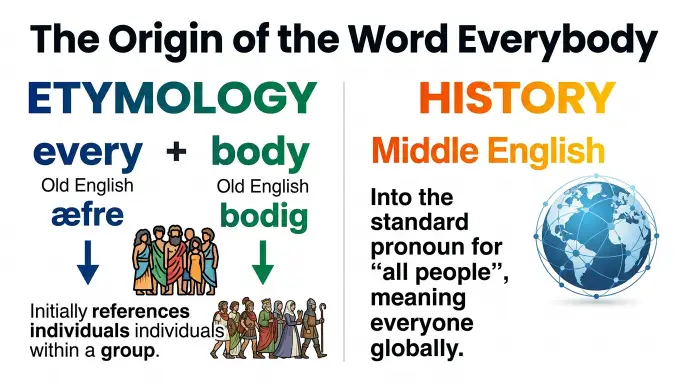
The word everybody is formed from every and body. In this word, body does not mean only a physical body. It is part of an older pattern of words used to refer to people.
English developed several similar indefinite pronouns and compounds, including:
- everybody
- everyone
- somebody
- someone
- nobody
- no one
- anybody
- anyone
Although everybody refers to many people, English grammar normally treats it as a singular pronoun.
That is why we say:
- Everybody is here.
- Everybody has a ticket.
- Everybody wants to participate.
We do not normally say:
- Everybody are here.
- Everybody have a ticket.
- Everybody want to participate.
The possessive form follows the same grammatical pattern. Therefore, everybody’s is the normal possessive form, not everybodies.
British English vs American English
There is no major British American spelling difference between everybody’s and everybodies. Both British and American English generally use everybody’s.
| Feature | British English | American English | Example |
| Everybody | Correct | Correct | Everybody is welcome. |
| Everybody’s | Correct | Correct | Everybody’s ready. |
| Everybody’s as possessive | Correct | Correct | Everybody’s opinion matters. |
| Everybodies | Not standard | Not standard | Avoid this spelling. |
The apostrophe is important in both varieties of English.
British and American style guides may differ in punctuation or house style in some areas, but everybody’s remains the standard form in ordinary writing.
You will therefore see everybody’s in:
- British publications
- American publications
- Academic writing
- Business communication
- News writing
- General online content
If you are writing for an international audience, everybody’s is also the safest standard form.
Which Version Should You Use?
Use everybody’s in standard English.
United States
American English uses everybody’s for both the contraction and possessive form.
Example:
Everybody’s excited about the new project.
United Kingdom
British English also uses everybody’s.
Example:
Everybody’s welcome to join us.
Canada
Canadian English generally follows the same standard usage.
Example:
Everybody’s opinion should be considered.
Australia
Australian English also uses everybody’s.
Example:
Everybody’s invited to the meeting.
International Writing
For international readers, choose everybody’s. It is widely understood and follows standard English grammar.
Academic Writing
In formal academic writing, contractions such as everybody’s = everybody is may sometimes be avoided for a more formal tone.
Instead of:
Everybody’s responsible for following the rules.
You might write:
Everybody is responsible for following the rules.
However, the possessive everybody’s is perfectly normal:
Everybody’s response was recorded.
Business Writing
Both forms can work, depending on the tone.
Informal:
Everybody’s ready for the presentation.
More formal:
Everybody is ready for the presentation.
Possessive:
Everybody’s feedback will be reviewed.
Common Mistakes With Everybody’s and Everybodies
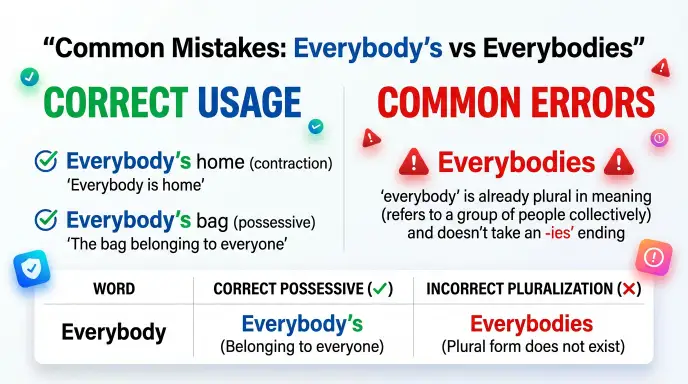
The most common mistake is treating everybody as if it were a regular plural noun.
Mistake 1: Writing Everybodies
Incorrect:
Everybodies opinion matters.
Correct:
Everybody’s opinion matters.
Why?
The apostrophe shows the possessive relationship. Everybodies does not normally function as the possessive form of everybody.
Memory tip:
Think everybody + ‘s = everybody’s.
Mistake 2: Confusing Everybody’s With Everybody Is
Example:
Everybody’s ready.
This is correct because:
Everybody’s = Everybody is
But:
Everybody’s opinion matters.
Here, everybody’s is possessive.
Memory tip:
Try expanding everybody’s to everybody is. If that works, it is a contraction. If it does not, the word is likely showing possession.
Mistake 3: Treating Everybody as Plural
Incorrect:
Everybody are invited.
Correct:
Everybody is invited.
Although everybody refers to many people, it is grammatically singular.
Mistake 4: Removing the Apostrophe
Incorrect:
Everybodys opinion matters.
Correct:
Everybody’s opinion matters.
Without the apostrophe, everybodys is not the standard possessive spelling.
Everybody’s in Everyday Examples
Understanding real world examples makes the rule easier to remember.
Emails
Everybody’s welcome to attend the meeting.
This is an informal contraction of everybody is.
For a more formal email:
Everybody is welcome to attend the meeting.
Business Writing
Everybody’s feedback will be considered before the final decision.
Here, everybody’s is possessive.
News Headlines
Headlines often avoid unnecessary words, so you may see constructions such as:
Everybody’s Talking About the New Policy
Here, everybody’s means everybody is.
Blogs
Everybody’s experience with learning English is different.
Here, everybody’s indicates possession or association.
Social Media
Everybody’s invited!
This is a natural informal contraction of everybody is.
Academic Writing
Everybody’s response was included in the analysis.
Here, everybody’s is possessive.
In highly formal contexts, however, writers may prefer everybody is when they are using the contraction.
Daily Conversation
Everybody’s here.
This means:
Everybody is here.
Another example:
Everybody’s favorite part was the ending.
Here, the word is possessive.
Google Trends and Modern Usage
People often search “everybody’s or everybodies” because the apostrophe can be confusing. English learners may see everybody, recognize that it refers to many people, and assume that everybodies should be the plural or possessive version.
That assumption does not match standard English grammar.
Modern English consistently uses everybody as an indefinite pronoun and everybody’s when an apostrophe s form is needed. The form everybodies may occasionally appear online as a spelling error, but it is not the standard form recommended for careful writing.
Search interest around this phrase is therefore closely connected to common grammar questions, especially:
- Is everybody’s correct?
- Is everybodies a word?
- What is the possessive of everybody?
- Is everybody singular or plural?
- Should everybody’s have an apostrophe?
- What does everybody’s mean?
- Can everybody be plural?
The important distinction is not really British versus American spelling. It is grammar and apostrophe usage.
Quick Comparison Table
| Version | Meaning | Correct? | Region | Example |
| Everybody | All people | Yes | Standard English | Everybody is here. |
| Everybody’s | Everybody is | Yes | British, American, Canadian, Australian | Everybody’s ready. |
| Everybody’s | Possessive form | Yes | Standard English | Everybody’s opinion matters. |
| Everybodies | Intended plural/possessive of everybody | No, in standard English | Avoid | Everybodies opinion matters. |
| Everybodys | Intended possessive | No | Avoid | Everybodys opinion matters. |
Key Takeaways
- Everybody’s is the standard correct form.
- Everybodies is generally incorrect in standard English.
- Everybody’s can mean everybody is.
- Everybody’s can also show possession or association.
- Everybody is grammatically singular even though it refers to many people.
- Use everybody is in place of everybody’s when a more formal style is preferred.
- Remember the possessive spelling as everybody + ‘s = everybody’s.
- British and American English generally agree on this usage.
FAQs
Is “everybody’s” grammatically correct?
Yes. Everybody’s is grammatically correct in standard English. It can be a contraction of everybody is, as in “Everybody’s ready,” or it can be possessive, as in “Everybody’s opinion matters.” The apostrophe is essential when using the possessive form.
Is “everybodies” a correct word?
Everybodies is not normally considered correct standard English when it is intended as the plural or possessive form of everybody. The standard possessive form is everybody’s. If you need to express possession, use the apostrophe s form.
What is the possessive form of everybody?
The possessive form of everybody is everybody’s. For example, “Everybody’s opinion matters” means that the opinions of all the people being discussed matter. The apostrophe followed by s marks the possessive construction.
Is everybody singular or plural?
Everybody is grammatically singular, even though it refers to all the people in a group. That is why we say “Everybody is ready,” rather than “Everybody are ready.” The same pattern applies to other indefinite pronouns such as everyone, someone, and nobody.
Is “everybody’s” a contraction?
Yes, everybody’s can be a contraction of everybody is. For example, “Everybody’s happy” means “Everybody is happy.” However, everybody’s can also be a possessive form, so its exact meaning depends on the sentence.
Should I write “everybody is” or “everybody’s”?
Both can be correct. Everybody’s is a natural contraction and works well in conversation and informal writing. Everybody is can sound more formal and may be preferred in some academic or professional contexts. If everybody’s is possessive, keep the apostrophe s form.
Is “everybody’s” used in British English?
Yes. Everybody’s is standard in British English. British and American English generally use the same spelling for this word. The difference is not a major regional spelling issue. Both varieties recognize everybody’s as the standard form.
Why do people write “everybodies”?
People may write everybodies because they assume that everybody needs an s ending when referring to multiple people. However, everybody is already an indefinite pronoun that refers collectively to all people. Its possessive form is everybody’s, not everybodies.
What is the difference between everybody’s and everyone’s?
Everybody’s and everyone’s often have the same meaning. Both can mean “everybody is” or show possession. For example, “Everybody’s ready” and “Everyone’s ready” mean the same thing. The choice is usually a matter of style or personal preference.
Which is correct: “everybody’s opinion” or “everybodies opinion”?
The correct form is everybody’s opinion. The apostrophe s marks the possessive relationship. Everybodies opinion is not standard English. A simple way to remember this is that the possessive form of everybody is made by adding ‘s, not just s.
Conclusion
The choice between everybody’s or everybodies is straightforward once you understand how everybody works in English. Everybody’s is the standard form, while everybodies should normally be avoided in standard writing.
Remember that everybody is an indefinite pronoun. Although it refers to many people, grammar treats it as singular. When you need to show possession, add an apostrophe and s: everybody’s. When everybody’s means everybody is, you are using it as a contraction.
For example, “Everybody’s ready” means “Everybody is ready,” while “Everybody’s opinion matters” uses everybody’s as a possessive form.
The same rule works across British, American, Canadian, and Australian English, so there is no need to choose between regional spellings here. If you are writing for school, work, a website, or an international audience, everybody’s is the safe standard choice.
The easiest rule to remember is: everybody + ‘s = everybody’s, never everybodies.
If you often confuse apostrophes and possessive forms, learning a few similar examples such as everyone’s, someone’s, and nobody’s can make the pattern much easier to remember.
Discover More Articles!
Calm vs Headspace: Which App Should You Choose?(2026)
Intercom vs. Zendesk: Full Features, Pricing, and AI Comparison
Graduate or Undergraduate: What’s the Difference?

Ethan Parker is an English-language writer known for his interest in words, language, and clear communication. His work focuses on making everyday English easier to understand through simple explanations and practical examples.