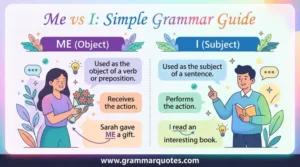
“Me” and “I” are both pronouns, but “I” is used as the subject of a sentence, while “me” is usually used as the object. Choosing between them can be confusing, especially when talking about yourself with another person.
For example, you would say, “I went to the store,” because “I” performs the action. But you would say, “She called me,” because “me” receives the action.
The confusion becomes even more common in sentences such as “Ali and me went to school” or “The teacher spoke to Sara and I.” These sentences may sound formal or familiar, but one of them is grammatically incorrect.
Understanding me vs I is useful for everyday speaking, emails, school assignments, professional writing, and formal communication. The good news is that the basic rule is simple: look at the role the pronoun plays in the sentence.
This guide explains the difference between me and I, gives easy examples, covers common mistakes, and shows a quick way to choose the correct pronoun.
Me vs I : Quick Answer
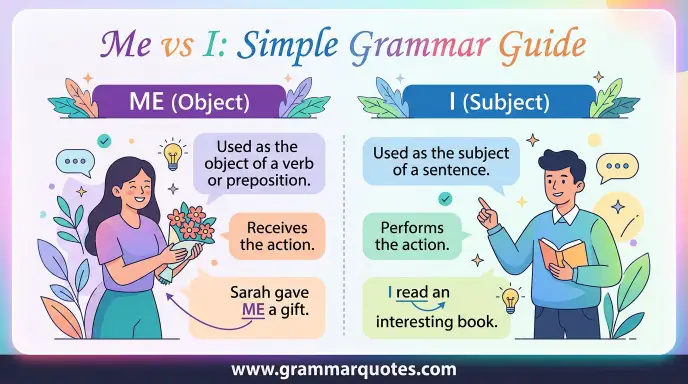
Use I when you are the subject performing the action. Use me when you are the object receiving the action or following a preposition.
Examples
- I finished my homework.
- My friend helped me.
- I called Ahmed.
- Ahmed called me.
- Sara and I went shopping.
- The teacher spoke to Sara and me.
A simple test is to remove the other person from the sentence.
For example:
“Ahmed and I went to school.”
Remove “Ahmed”:
“I went to school.”
That sounds correct, so I is the right choice.
Now try:
“The teacher spoke to Ahmed and me.”
Remove “Ahmed”:
“The teacher spoke to me.”
That is correct, so me is the right choice.
Definition and Meaning of “I”
I is a first person singular pronoun used when the speaker is the subject of a sentence.
Examples:
- I like English.
- I am learning grammar.
- I completed the project.
Definition and Meaning of “Me”
Me is a first person singular pronoun used when the speaker is the object of a verb or preposition.
Examples:
- She helped me.
- They invited me.
- This gift is for me.
The Origin of Me and I
Both I and me have very old roots in the English language. They developed from forms used in earlier stages of English and Germanic languages.
The distinction between subject and object forms has existed in English for centuries. Modern English has simplified many older pronoun patterns, but the difference between I and me remains.
Historically, I developed as the subject form, while me became the object form.
This is similar to other pronoun pairs:
| Subject | Object |
| I | me |
| he | him |
| she | her |
| we | us |
| they | them |
Knowing these pairs makes me vs I much easier to understand.
Me vs I: The Main Grammar Difference
The main difference is grammatical function.
I = subject
Me = object
The subject normally performs the action.
I wrote the email.
The object receives the action.
My teacher corrected me.
This rule works in most everyday situations.
When Should You Use “I”?
Use I when you are doing the action.
Examples:
- I play football.
- I understand the question.
- I finished the work.
- I went to Lahore.
- I need some help.
A useful question is:
Who is doing the action?
If the answer is you, I is usually correct.
When Should You Use “Me”?
Use me when something is being done to you or when you come after a preposition.
Examples:
- He called me.
- She invited me.
- They helped me.
- Please send it to me.
- This message is for me.
A useful question is:
Who is receiving the action?
If the answer is you, use me.
Me vs I With Another Person
One of the most common problems occurs when I or me appears with another person.
For example:
❌ Ali and me went to school.
✅ Ali and I went to school.
Why?
Remove “Ali”:
I went to school.
That is correct.
Now consider:
❌ The teacher called Ali and I.
✅ The teacher called Ali and me.
Remove “Ali”:
The teacher called me.
That is correct.
A Simple Trick for Choosing Me or I
When you are unsure, temporarily remove the other person’s name.
Example 1:
Ahmed and I studied together.
Remove Ahmed:
I studied together.
The structure shows that I is correct.
Example 2:
The teacher praised Ahmed and me.
Remove Ahmed:
The teacher praised me.
So me is correct.
This trick is one of the easiest ways to solve me vs I questions.
Common Mistakes With I vs Me
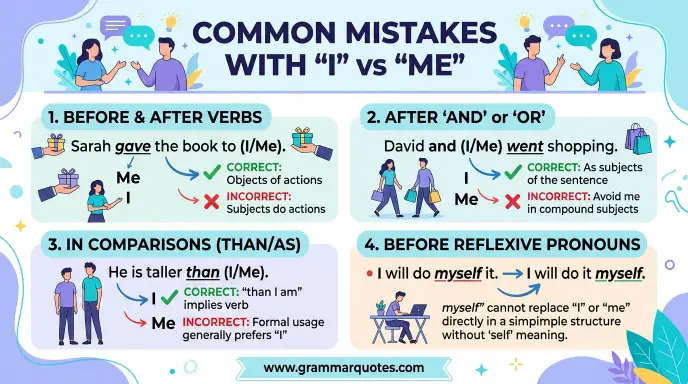
Many people make mistakes because they think I always sounds more formal.
That is not true.
Mistake 1: “Me and Ali went…”
❌ Me and Ali went to the market.
✅ Ali and I went to the market.
“I” is the subject because the speakers are performing the action.
Mistake 2: “The teacher helped Ali and I”
❌ The teacher helped Ali and I.
✅ The teacher helped Ali and me.
“Me” is the object of “helped.”
Mistake 3: Using “I” After a Preposition
❌ This gift is for I.
✅ This gift is for me.
After the preposition for, use me.
Other examples:
- with me
- to me
- from me
- beside me
- between me and Ali
Mistake 4: Thinking “Me” Is Always Informal
Some people believe that me is less correct or less formal than I.
That is incorrect.
Both are standard English pronouns. The correct choice depends on the grammatical role.
Me vs I in Everyday Examples
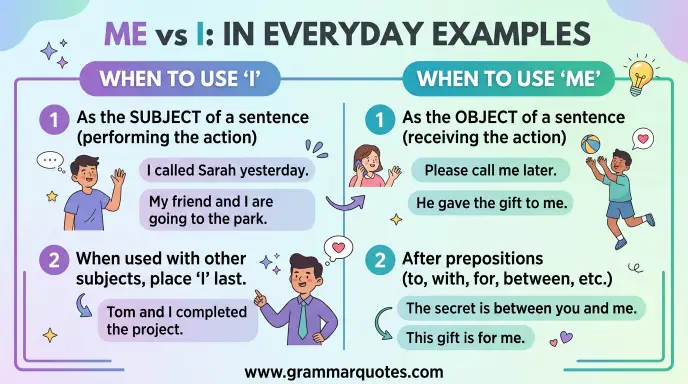
Here are some common examples you may hear or write every day.
| Incorrect | Correct |
| Me went home. | I went home. |
| She called I. | She called me. |
| Ahmed and me went there. | Ahmed and I went there. |
| He gave the book to I. | He gave the book to me. |
| Sara and I were invited. | Sara and I were invited. |
| The teacher asked Sara and I. | The teacher asked Sara and me. |
In School Writing
Use I when you are the subject:
I completed the assignment.
Use me when you are the object:
The teacher gave me feedback.
In Emails
Correct:
Please send the document to me.
Correct:
I will review the document.
In Conversation
Correct:
I think we should leave now.
Correct:
Can you help me?
Me vs I After “And”
The word and often causes confusion.
Consider:
John and I went to the park.
Here, “John and I” is the subject.
But:
John invited Sarah and me.
Here, “Sarah and me” is the object.
So the presence of and does not determine if you should use I or me. The sentence’s grammatical role does.
Is “Me and I” Ever Correct?
No. You normally would not use “me and I” together as a pair.
Instead, choose the pronoun based on its role:
- I went with Ali.
- Ali went with me.
British English vs American English
The basic rule for me vs I is the same in both British and American English.
Both varieties use:
- I as the subject pronoun.
- me as the object pronoun.
For example:
British English: Sarah and I went home.
American English: Sarah and I went home.
There is no major spelling difference between these pronouns.
However, informal speech can sometimes produce structures that do not follow formal grammar rules. These patterns may be common in conversation, but formal writing should still follow standard grammar.
Which One Should You Use: Me or I?
Choose I if the pronoun is performing the action.
I wrote the report.
Choose me if the pronoun receives the action or follows a preposition.
The manager praised me.
A quick way to remember it is:
I = doer
Me = receiver
This simple rule works for most sentences.
Me vs I in Formal and Informal English
The same grammar rule applies in both formal and informal English.
Formal:
My colleague and I prepared the presentation.
Informal:
My brother and I watched a movie.
Formal:
The manager spoke with my colleague and me.
Informal:
She came with my brother and me.
The important point is not if the sentence sounds formal. The important point is the pronoun’s grammatical function.
I vs Me: Google Trends and Usage
Searches for “me vs I” are common because English learners and native speakers often become unsure when these pronouns appear with another person.
Questions such as:
- “Should I say me or I?”
- “Is it John and I or John and me?”
- “Which is correct, me and my friend or my friend and I?”
show that the confusion usually comes from sentence structure rather than the meanings of the words.
Search interest can change over time and across regions, so exact Google Trends numbers should be checked directly for a specific country and date range rather than assumed.
People Also Ask Questions About Me vs I
1. Is it “me and I” or “I and me”?
Neither phrase is normally used as a pair. Choose I or me according to its role in the sentence.
2. Is it “John and I” or “John and me”?
Use John and I when they are the subject. Use John and me when they are the object.
3. Is “Me and my friend went” grammatically correct?
In standard formal English, use “My friend and I went.”
4. When should I use “I” instead of “me”?
Use I when you are the subject performing the action.
5. When should I use “me” instead of “I”?
Use me when you are the object or follow a preposition.
6. Is “between you and I” correct?
No. Standard grammar uses “between you and me” because “between” is a preposition.
7. Is “my brother and I” always correct?
No. It is correct when “my brother and I” is the subject, but “my brother and me” can be correct when they are the object.
8. Why do people say “I” instead of “me”?
People sometimes use I because they have learned that it sounds more formal. But grammar, not formality, determines the correct choice.
9. Is “She gave it to I” correct?
No. The correct sentence is “She gave it to me.”
10. How can I remember me vs I?
Remember: I usually does the action; me usually receives the action.
Me vs I : Quick Comparison Table
| Feature | I | Me |
| Type | First person pronoun | First person pronoun |
| Main role | Subject | Object |
| Action | Usually performs it | Usually receives it |
| Example | I called him. | He called me. |
| After prepositions | Usually not used | Commonly used |
| With another person | Ali and I | Ali and me |
| Example | Ali and I went. | Ali helped Ali and me. |
Frequently Asked Questions
Is “I” a subject pronoun?
Yes. I is the first person singular subject pronoun.
Is “me” an object pronoun?
Yes. Me is the first person singular object pronoun.
Which is correct: “My friend and I” or “my friend and me”?
Both can be correct, depending on the sentence.
My friend and I went shopping.
But:
The teacher called my friend and me.
Is “between you and I” wrong?
In standard English, yes. The correct form is:
Between you and me.
Can “me” start a sentence?
In standard formal English, me should not normally be used as the subject.
❌ Me went to school.
✅ I went to school.
Can “I” come after a preposition?
Normally, no.
❌ She spoke to I.
✅ She spoke to me.
Final Comparison: Me vs I
The difference between me and I is simple once you understand subject and object pronouns. I is generally used when you perform the action, while me is used when you receive the action or follow a preposition.
For example, “I helped Sara” uses “I” because it is the subject. In “Sara helped me,” “me” is the object.
The same rule applies when another person’s name appears in the sentence. Say “Ali and I went home” because they are the subjects. Say “The teacher spoke to Ali and me” because they are the objects of the preposition “to.”
The easiest test is to remove the other person’s name and see which pronoun works. If I sounds right, use I. If me sounds right, use me.
Once you remember I = subject and me = object, most me vs I questions become much easier to solve.
Conclusion
Me vs I is one of the most common English grammar questions, but the rule is straightforward. Use I when you are the subject performing an action, and use me when you are the object receiving an action or following a preposition.
For example, say “I called Ahmed” because I performed the action. Say “Ahmed called me” because me received the action. When another person is included, the same rule still applies: “Ahmed and I went home” but “The teacher spoke to Ahmed and me.”
If you are unsure, remove the other person’s name from the sentence. This quick test often makes the correct answer obvious.
Remember the simplest version: I is the doer, and me is the receiver. With a little practice, you can use both pronouns confidently in schoolwork, emails, conversations, and formal writing.
Discover More Articles!
Parfum or Toilette: What Is the Difference?(2026)
May vs Might: When to Use May and Might(2026)
Coat or Jacket: Style, Fit, and Usage Compared(2026)

Ethan Parker is an English-language writer known for his interest in words, language, and clear communication. His work focuses on making everyday English easier to understand through simple explanations and practical examples.