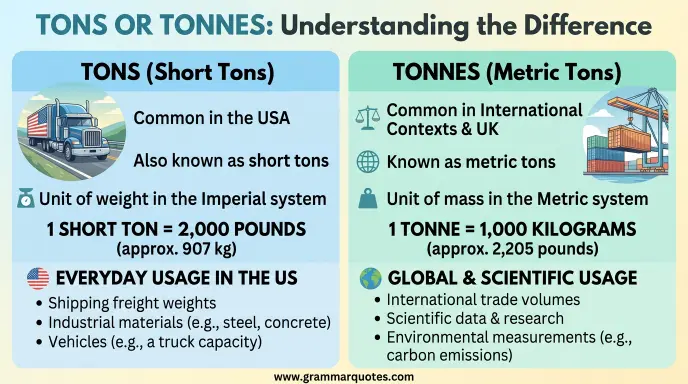
Tons and tonnes are both units used to measure weight or mass, but they are not exactly the same measurement. “Ton” usually refers to a US or imperial unit, while “tonne” means a metric unit equal to 1,000 kilograms.
The spelling and measurement can be confusing because different countries use different systems.
In American English, ton usually means a short ton, which equals 2,000 pounds. In British English, the word can refer to an imperial ton, also called a long ton, which equals 2,240 pounds.
A tonne, however, belongs to the metric system and equals exactly 1,000 kilograms, or about 2,204.62 pounds.
These differences matter when discussing heavy objects, vehicles, industrial materials, shipping, agriculture, construction, or scientific measurements. A number without the correct unit can sometimes create confusion.
This guide explains the meanings, origins, measurements, British and American usage, common mistakes, examples, pronunciation, and an easy way to remember the difference.
Tons or Tonnes : Quick Answer
The main difference is both spelling and measurement.
- Ton → commonly used for the US short ton or the British imperial long ton, depending on context.
- Tonne → metric unit equal to exactly 1,000 kilograms.
The most common comparison is:
| Unit | Equivalent |
| 1 short ton | 2,000 lb |
| 1 tonne | 1,000 kg |
| 1 long ton | 2,240 lb |
A tonne is therefore slightly heavier than a US short ton but lighter than a British imperial long ton.
Definition and Meaning
What Is a Ton?
The word ton can refer to different units depending on the measurement system.
In the United States, a short ton equals:
2,000 pounds
In the British imperial system, a long ton equals:
2,240 pounds
Because the same word can represent different quantities, the country and context are important.
What Is a Tonne?
A tonne is a metric unit of mass.
One tonne equals:
1,000 kilograms
It is also equal to:
1,000,000 grams
and approximately:
2,204.62 pounds
Unlike the word “ton,” the metric unit has a fixed definition of 1,000 kilograms.
What Is the Difference in Measurement?
The easiest way to understand the difference is to compare their values.
| Unit | Kilograms | Pounds |
| 1 short ton | 907.18 kg | 2,000 lb |
| 1 tonne | 1,000 kg | 2,204.62 lb |
| 1 long ton | 1,016.05 kg | 2,240 lb |
This means:
- A short ton is lighter than a tonne.
- A tonne is lighter than a long ton.
- The difference can matter in technical and commercial situations.
For everyday conversations, people may use these terms loosely, but in technical contexts the exact unit should be stated.
Why Are There Different Measurements?
The word ton has a long history and was used in different weight systems before modern metric standards became widespread.
Different countries developed or retained different measurement systems. The United States continued using the short ton in many contexts, while Britain historically used the long ton.
The metric system introduced a simpler standard unit called the tonne, defined as 1,000 kilograms.
This is why modern English contains several related units with similar names.
The Origin of the Words
The word ton has a long history and is related to an old word referring to a large cask or container. Over time, the term became associated with a large quantity or weight.
The metric word tonne was adopted from French usage and became associated with the metric system.
Although the two words look very similar, their histories and measurement standards developed differently.
British English vs American English
This is where the distinction becomes especially useful.
American English
American English commonly uses:
ton
When it means the standard US short ton:
1 ton = 2,000 pounds
For example:
The truck can carry five tons.
British English
British English uses:
tonne
when referring to the metric unit:
1 tonne = 1,000 kilograms
The traditional British imperial system also used ton for a long ton, equal to 2,240 pounds.
Modern British contexts often use metric measurements, so tonne is common when discussing large weights.
Which One Is Used in Pakistan?
Pakistan commonly uses the metric system for official and everyday measurements.
Therefore, tonne is generally the clearer term when you mean exactly 1,000 kilograms.
For example:
- 5 tonnes of wheat
- 10 tonnes of cement
- 20 tonnes of steel
However, the word ton may still appear in international business, product descriptions, machinery specifications, or content influenced by American English.
When precision matters, writing tonne or specifying the exact weight in kilograms removes confusion.
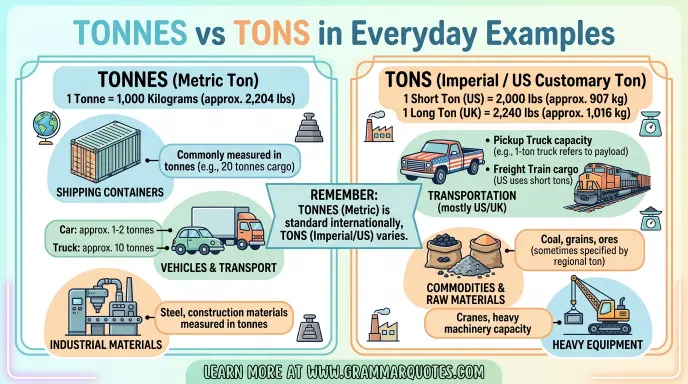
Tonnes vs Tons in Everyday Examples
Agriculture
- The farm produced 50 tonnes of wheat.
- The shipment contained 20 tonnes of rice.
Construction
- The bridge requires several tonnes of steel.
- The company delivered 100 tonnes of cement.
Transportation
- The truck can carry 10 tonnes.
- The vehicle has a maximum load of several tonnes.
American Context
- The truck carries five tons.
- The factory produced 20 tons of material.
The correct choice depends on the measurement system being used.
Common Mistakes
1. Assuming Both Words Always Mean Exactly the Same Thing
They do not necessarily represent the same quantity.
A US short ton is 2,000 pounds, while a metric tonne is 1,000 kilograms.
2. Using “Tonne” as an American Spelling
American English normally uses ton for the short ton measurement.
3. Assuming “Ton” Always Means 1,000 Kilograms
This can create confusion because ton may refer to different units.
If you mean exactly 1,000 kilograms, tonne is the clearer metric term.
4. Forgetting the Plural
The plural depends on the spelling and context:
- one ton → two tons
- one tonne → two tonnes
5. Mixing Measurement Systems
A technical document should clearly identify which unit system it uses.
For example, saying simply “the machine weighs 10 tons” may be less precise than saying:
The machine weighs 10 metric tonnes.
or:
The machine weighs 10 US short tons.
Singular and Plural Forms
The singular forms are:
- one ton
- one tonne
The plural forms are:
- two tons
- two tonnes
Examples:
- The truck carries one tonne.
- The trucks carry five tonnes.
- The machine weighs one ton.
- The machines weigh five tons.
The s ending marks the plural.
Pronunciation
The two words are pronounced differently in many varieties of English.
Ton sounds approximately like:
tun
Tonne is commonly pronounced approximately like:
tun
In many English accents, the pronunciation is very similar or effectively the same.
The spelling therefore gives you more information about the measurement system than the sound does.
Ton, Tonne, and Kilogram
Understanding kilograms makes the difference easier.
The metric system is based on kilograms.
Important conversions
- 1 tonne = 1,000 kg
- 2 tonnes = 2,000 kg
- 5 tonnes = 5,000 kg
- 10 tonnes = 10,000 kg
For comparison:
- 1 US short ton ≈ 907 kg
- 1 UK long ton ≈ 1,016 kg
This is why the exact unit should be identified in technical or commercial writing.
When Should You Use “Tonne”?
Use tonne when you mean the metric unit of exactly 1,000 kilograms.
It is especially useful in:
- Scientific writing
- Engineering
- Construction
- Shipping
- Agriculture
- Manufacturing
- International trade
- Environmental reports
Examples:
The factory produces 2,000 tonnes of steel each year.
The shipment weighs 15 tonnes.
When Should You Use “Ton”?
Use ton when following a measurement system or source that specifically uses that unit.
For example, American publications may use the short ton.
In historical or British imperial contexts, ton can refer to the long ton.
Therefore, the surrounding context is important.
Is a Tonne Heavier Than a Ton?
If ton means a US short ton, yes.
- 1 short ton = 907.18 kg
- 1 tonne = 1,000 kg
So a tonne is about 92.82 kilograms heavier than a US short ton.
However, if ton means a British imperial long ton, the relationship changes:
- 1 long ton ≈ 1,016.05 kg
- 1 tonne = 1,000 kg
In that case, the long ton is slightly heavier.
Easy Memory Trick
A simple way to remember the spelling is:
Tonne = metric = 1,000 kilograms
If you see tonne, think of the metric system.
If you see ton, check the country or context because it can represent different measurements.
This is especially useful when reading American and British websites.
Tons or Tonnes in Formal Writing
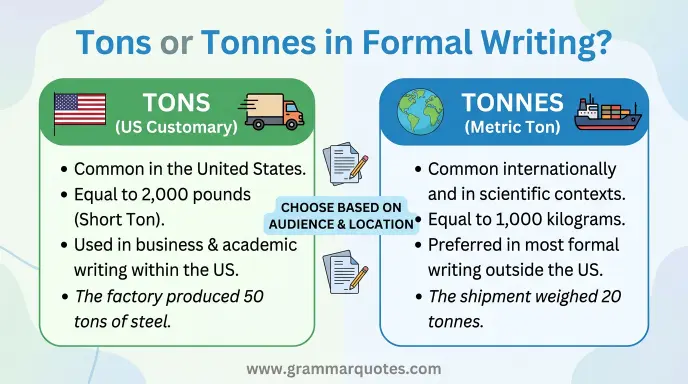
For formal or technical writing, clarity is more important than simply choosing one spelling.
If your audience uses the metric system, writing tonne is often clearer.
You can also write the weight in kilograms:
The shipment weighs 10,000 kg.
This removes any possible ambiguity.
In international documents, adding the word metric can make the meaning even clearer:
10 metric tonnes
Google Trends & Usage Data
Searches for the two spellings vary by country and language variety.
The form ton is strongly associated with American English, while tonne is common in countries that use metric measurements and British style English.
Search interest can also increase around topics such as:
- shipping
- agriculture
- fuel
- construction
- industrial production
- climate reports
- vehicle weight
Exact Google Trends results change by country and date, so a specific comparison should use a defined location and time period.
People Also Ask: Common Search Questions
Is a tonne the same as a ton?
Not always. A metric tonne is 1,000 kilograms, while a short ton is 2,000 pounds.
Which is heavier, a ton or a tonne?
A metric tonne is heavier than a US short ton but lighter than a British long ton.
Is tonne British or American?
Tonne is widely used in British English and other metric English varieties. American English normally uses ton.
How many kilograms are in a tonne?
One tonne equals exactly 1,000 kilograms.
How many kilograms are in a US ton?
One US short ton equals approximately 907.18 kilograms.
What is the plural of tonne?
The plural is tonnes.
What is the plural of ton?
The plural is tons.
Does “ton” always mean 2,000 pounds?
No. In the US, a ton commonly means 2,000 pounds, but historical British usage also includes the long ton of 2,240 pounds.
Should Pakistan use ton or tonne?
For a metric measurement of 1,000 kilograms, tonne is generally the clearer choice.
Why are ton and tonne different?
They developed through different measurement traditions. The metric tonne was standardized at 1,000 kilograms, while “ton” has been used for different traditional units.
Frequently Asked Questions
What is the difference between a ton and a tonne?
A tonne is exactly 1,000 kilograms. A ton can refer to different units, including the US short ton and British long ton.
Is one tonne 1,000 kg?
Yes. One metric tonne equals exactly 1,000 kilograms.
Is one ton 1,000 kg?
Not necessarily. A US short ton is about 907.18 kilograms, while a British long ton is about 1,016.05 kilograms.
Which spelling is used in American English?
American English normally uses ton.
Which spelling is common in British English?
British English commonly uses tonne for the metric unit.
Which term is clearer in international writing?
If you mean 1,000 kilograms, tonne or metric tonne is usually clearer because it identifies the metric measurement.
Are tons and tonnes pronounced differently?
They are often pronounced very similarly, depending on the speaker and variety of English.
Final Comparison
| Feature | Ton | Tonne |
| Common spelling | Ton | Tonne |
| Measurement | Can vary | Exactly 1,000 kg |
| US short unit | 2,000 lb | — |
| UK long unit | 2,240 lb | — |
| Metric unit | — | 1,000 kg |
| American usage | Common | Uncommon |
| British/metric usage | Context dependent | Common |
| Plural | Tons | Tonnes |
Conclusion
The difference between ton and tonne is more than a spelling preference because the units can represent different amounts of weight.
A tonne is a metric unit equal to exactly 1,000 kilograms. The word ton, however, can refer to different traditional units. In American usage, it commonly means a short ton of 2,000 pounds. In historical British imperial usage, it can mean a long ton of 2,240 pounds.
For everyday writing, the safest approach is to consider your audience and measurement system. If you are referring to exactly 1,000 kilograms, tonne is the clearest metric term. If you are following American measurements, ton is commonly used.
The important point is not to treat the two units as automatically identical. In technical, scientific, commercial, or international writing, specifying the measurement system can prevent confusion.
A simple rule to remember is: tonne = metric = 1,000 kilograms, while ton needs context to show which measurement is intended.
Discover More Articles!
Litre or Liter : Which Spelling Is Correct?
Portland or Homeless: What Do These Terms Mean?(2026)
Allways or Always: Which Spelling Is Correct?(2026)

Ethan Parker is an English-language writer known for his interest in words, language, and clear communication. His work focuses on making everyday English easier to understand through simple explanations and practical examples.