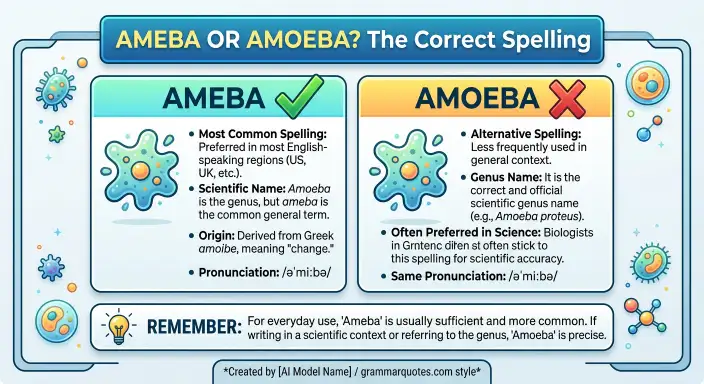
Ameba and amoeba are both correct spellings of a tiny organism that usually consists of a single cell. The main difference is regional spelling. Ameba is commonly used in American English, while amoeba is the traditional spelling used in British English and many other varieties of English.
Imagine a student writing a biology assignment about organisms found in pond water. The student writes “amoeba,” but an American science website uses “ameba.” This does not necessarily mean one spelling is wrong. Both words refer to the same type of organism.
These spellings can confuse students, teachers, bloggers, and English learners because they differ by only one letter. Choosing the right form can help you keep your writing consistent, especially in schoolwork, scientific articles, and educational content.
In this guide, you will learn the meanings, pronunciation, origins, scientific background, and regional spelling differences between these words. You will also find examples, common mistakes, comparison tables, and answers to frequently asked questions.
Ameba or Amoeba: Quick Answer
Both ameba and amoeba are correct. They refer to the same kind of single celled organism.
- Ameba: The spelling commonly preferred in American English.
- Amoeba: The traditional British English spelling, also widely used internationally.
Examples:
- The student observed an ameba under a microscope.
- The biology book explains how an amoeba moves.
Both sentences are correct. The best choice depends on your audience, style guide, or textbook.
An Easy Way to Remember
Remember this simple rule:
- Ameba = commonly American English
- Amoeba = commonly British English
If you are writing for an American audience, ameba may be the preferred choice. For British English or a textbook that uses the traditional spelling, choose amoeba.
Most importantly, use one spelling consistently throughout the same article or assignment.
Definition and Meaning
What Does “Ameba” Mean?
Ameba (noun): A single celled organism that can change its shape and move or capture food using temporary extensions of its cell.
Examples:
- The scientist studied an ameba in a drop of water.
- An ameba can use temporary cell extensions to move.
The spelling ameba is commonly associated with American English.
What Does “Amoeba” Mean?
Amoeba (noun): A single celled organism that can change its shape and often uses extensions called pseudopodia for movement and feeding.
Examples:
- The amoeba moved across the microscope slide.
- Students learned how an amoeba takes in food.
The word amoeba has the same basic meaning as ameba.
What Is an Amoeba in Biology?
An amoeba is a single celled organism. Many amoebas move by extending parts of their cell called pseudopodia, a term that means “false feet.”
Amoebas can be found in different environments, including freshwater, soil, and other habitats. Some species live freely in the environment, while others live in or on other organisms.
Not every amoeba is harmful. Some are harmless environmental organisms, while certain species can cause disease.
The Origin of Ameba and Amoeba
Origin of “Amoeba”
The word amoeba comes from Greek amoibē, meaning “change” or “exchange.” The name refers to the organism’s ability to change shape.
The spelling entered scientific terminology through European languages and became widely established in biology.
Origin of “Ameba”
Ameba is a simplified spelling of amoeba. It reflects a spelling pattern used in American English, where some words have been simplified compared with traditional British forms.
Both spellings refer to the same scientific concept.
Historical Development
Old English (450–1100)
Neither modern spelling was part of ordinary Old English vocabulary. The word developed much later through scientific terminology based on Greek.
Middle English (1100–1500)
The word was not yet an established everyday English term during most of this period. Scientific vocabulary based on Greek and Latin expanded later.
Modern English (1500–Present)
As scientific study developed, amoeba became established as the traditional spelling. Ameba also gained use, particularly in American English, as a simplified spelling.
British English vs American English
Which Spelling Is Used in Each Country?
The main distinction is regional preference rather than a difference in meaning.
| Feature | British English | American English |
| Common spelling | Amoeba | Ameba |
| Meaning | Single celled organism | Single celled organism |
| Scientific context | Amoeba | Ameba |
| Plural form | Amoebae or amoebas | Amebae or amebas |
| Related adjective | Amoebic | Amebic |
| Alternative spelling accepted? | Ameba may appear | Amoeba is also understood |
Scientific publications and individual style guides may use different conventions, so follow the spelling required by your textbook, teacher, or publication.
When Should You Use Ameba or Amoeba?
Use “Ameba” in American English
Use ameba when writing for an American audience or following a style guide that prefers simplified American spelling.
Examples:
- The ameba was observed under a microscope.
- The biology lesson explained how an ameba moves.
Use “Amoeba” in British English
Use amoeba when writing in British English or following a source that uses the traditional spelling.
Examples:
- The amoeba lives in freshwater environments.
- The class examined an amoeba in a laboratory.
Use the Required Spelling in Scientific Writing
In biology assignments, research articles, and educational content, consistency is important. If your textbook uses amoeba, follow that spelling throughout your work. If an American style guide specifies ameba, use that form.
The spelling does not change the organism being discussed.
Common Mistakes with Amoeba and Ameba
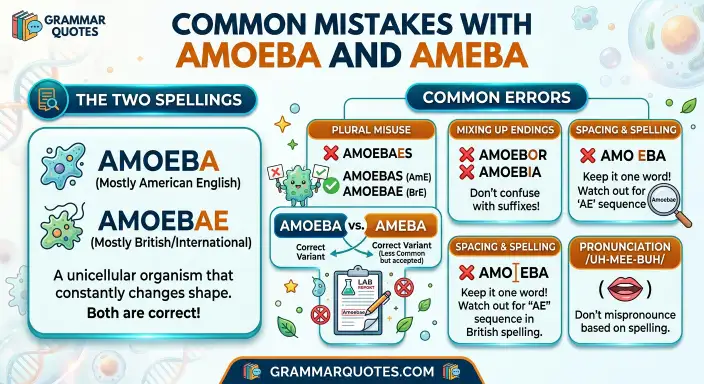
Mistake 1: Thinking Ameba Is Always Incorrect
Incorrect claim: “Ameba is a spelling mistake.”
Correct: “Ameba is a recognized spelling, especially in American English.”
Why? English spelling varies by region, and both forms are accepted.
Mistake 2: Thinking Amoeba Refers to a Different Organism
Incorrect claim: “Ameba and amoeba are two different organisms.”
Correct: “Ameba and amoeba are alternative spellings for the same general type of organism.”
Why? The difference is spelling, not basic meaning.
Mistake 3: Mixing Both Spellings in One Article
Less consistent: “The ameba moves in water. The amoeba then takes in food.”
Better: Choose one spelling and use it consistently unless you are explaining the spelling difference itself.
Why? Consistent spelling makes your writing easier to read and edit.
Mistake 4: Confusing an Amoeba with a Bacterium
An amoeba is a eukaryotic organism, meaning its cell has a nucleus. Bacteria are prokaryotes and do not have a membrane bound nucleus.
Although both can be microscopic, they are biologically different.
Mistake 5: Assuming Every Amoeba Causes Disease
Most amoebas encountered in general biology discussions are not necessarily harmful to humans. Certain species can cause disease, but many live freely in the environment.
Ameba and Amoeba in Everyday Examples
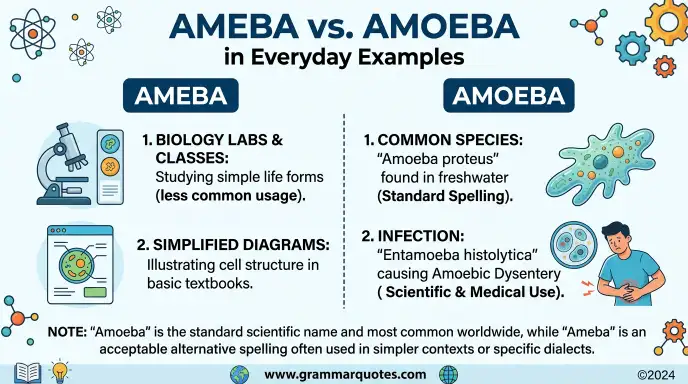
In School Biology
- Ameba: An ameba can change its shape as it moves.
- Amoeba: An amoeba is often studied in basic biology lessons.
Laboratory Work
- Ameba: The researcher observed an ameba under a microscope.
- Amoeba: The class examined an amoeba in a water sample.
In Science Articles
- Ameba: The article describes how an ameba feeds.
- Amoeba: The article explains how an amoeba uses pseudopodia.
For Educational Content
- Ameba: This American spelling may be used in a US focused science guide.
- Amoeba: This spelling may be used in a British English biology textbook.
In Formal Writing
Both spellings are suitable when they match the required regional convention or style guide.
Ameba vs Amoeba: Comparison Table
| Feature | Ameba | Amoeba |
| Part of speech | Noun | Noun |
| Main meaning | Single celled organism | Single celled organism |
| Spelling style | Commonly American | Traditional British and international use |
| Pronunciation | Generally the same | Generally the same |
| Scientific meaning | Same | Same |
| British English | Less common | Common |
| American English | Common | Also understood and used |
| Related adjective | Amebic | Amoebic |
| Example | An ameba was observed. | An amoeba was observed. |
A Simple Trick to Remember the Difference
Think about your audience before choosing the spelling.
- Ameba: Remember the shorter spelling commonly used in American English.
- Amoeba: Remember the traditional spelling often used in British English.
Try these examples:
- A US focused science article uses the spelling _____.
Answer: ameba - A British English textbook uses the spelling _____.
Answer: amoeba - Do the two words have different scientific meanings?
Answer: No. They refer to the same general type of organism.
If you are unsure, follow the spelling used by your teacher, textbook, or publication.
Frequently Asked Questions
1. Is ameba or amoeba correct?
Both spellings are correct. Ameba is commonly used in American English, while amoeba is the traditional British English spelling.
2. What is the difference between ameba and amoeba?
The difference is spelling preference, not basic meaning. Both words refer to a single celled organism.
3. Is amoeba British or American?
Amoeba is the traditional British English spelling, but it is also widely understood and used in other varieties of English.
4. Is ameba an American spelling?
Yes. Ameba is commonly used in American English.
5. Do ameba and amoeba mean the same thing?
Yes. They are alternative spellings for the same general type of organism.
6. How does an amoeba move?
Many amoebas move by extending temporary parts of their cell called pseudopodia, or “false feet.”
7. Is an amoeba a bacterium?
No. Amoebas are eukaryotic organisms, while bacteria are prokaryotes. Their cell structures are different.
8. Can amoebas cause disease?
Some species can cause disease, but many amoebas are harmless environmental organisms. The effects depend on the species.
9. What is the plural of amoeba?
Common plural forms include amoebas and amoebae. The preferred form depends on the writing context.
10. Which spelling should I use in a biology assignment?
Follow the spelling used by your textbook, teacher, or required style guide. Use the same form consistently throughout the assignment.
Conclusion
Understanding ameba or amoeba is simple once you know that both spellings refer to the same general type of single celled organism. The main difference is regional spelling preference. Ameba is commonly used in American English, while amoeba is the traditional British English spelling and remains widely used internationally.
Neither word represents a different organism, and both can appear in scientific and educational writing. The best choice depends on your audience, textbook, or publication style guide. In a biology assignment, consistency matters more than switching between the two forms.
Remember the simple rule: ameba is commonly American, while amoeba is traditionally British. If you follow this distinction and use one spelling consistently, you can avoid confusion and write more clearly about biology.
Discover More Articles!
Boat or Ship: What’s the Difference?(2026)
YAML vs YML: What’s the Difference?(2026)
Offered vs Offerred: Which Spelling Is Correct and Why It Matters

Ethan Parker is an English-language writer known for his interest in words, language, and clear communication. His work focuses on making everyday English easier to understand through simple explanations and practical examples.