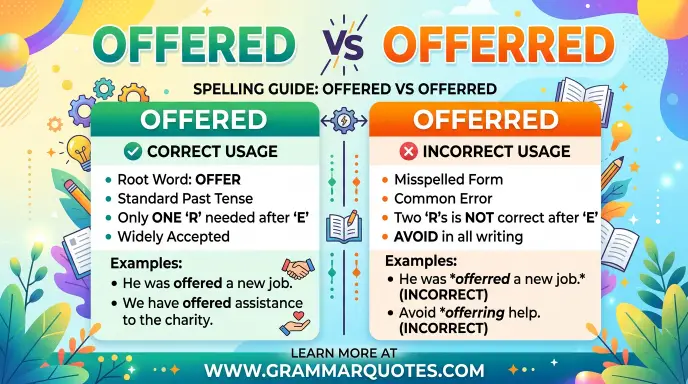
Offered is the correct spelling, while offerred is a common misspelling. The word comes from the verb offer, which means to give, provide, suggest, or present something for someone to accept or consider.
Many English learners are unsure if the past tense should contain one or two r letters. The confusion happens because some verbs double their final consonant when adding ed. However, offer does not follow that pattern.
The correct forms are:
- Offer — present form
- Offered — past tense
- Offered — past participle
- Offering — present participle
This guide explains the spelling rule, meaning, pronunciation, grammar, common mistakes, examples, British and American usage, and simple ways to remember the correct form.
Offerred or Offered : Quick Answer
The correct spelling offered.
Offer + ed = offered
Not:
Offer + red = offerred
Examples
- She offered me some help.
- The company offered him a new position.
- They offered a lower price.
- He offered to drive us home.
The form offerred is generally a spelling mistake in standard English.
Definition and Meaning
What does “offered” mean?
Offered is the past tense and past participle of offer.
The verb can have several related meanings.
To give something
It can mean to give something to someone or make it available.
Example:
The waiter offered us some water.
To suggest help
It can describe a willingness to help.
Example:
She offered to help with the project.
To suggest an amount of money
It can also describe a price someone is willing to pay.
Example:
He offered $500 for the table.
To provide something
A company, school, or organization can make something available.
Example:
The university offered several courses.
Why Is “Offered” Correct?
The base verb is:
offer
When we make its simple past tense, we normally add ed:
offer → offered
The final r does not need to be doubled.
This gives:
offer + ed = offered
The spelling has two f letters, but only one r.
That distinction is important because the eye may make the extra r in “offerred” look natural.
Why Is “Offerred” Incorrect?
Offerred is not the standard spelling of the past tense of offer.
The mistake usually happens because English has many verbs that double their final consonant before adding ed.
For example:
- stop → stopped
- plan → planned
- admit → admitted
But the rule does not mean every verb doubles its final consonant.
With offer, the standard form is simply:
offer → offered
The Grammar of “Offered”
The word can work as both a simple past form and a past participle.
Simple past
Use it to describe something that happened in the past.
Example:
The manager offered me a job yesterday.
Present perfect
Use the past participle with has or have.
Example:
The company has offered her a position.
Past perfect
Use it with had.
Example:
They had offered him the role before he accepted another job.
Passive voice
It can also appear in passive sentences.
Example:
She was offered a scholarship to study at the university.
Offer, Offered, and Offering
Understanding the word family makes the spelling easier.
| Form | Use | Example |
| Offer | Present | I offer my help. |
| Offered | Past | She offered help. |
| Offered | Past participle | They have offered help. |
| Offering | ing form | He is offering help. |
The important spelling change is:
offer → offered
There is no extra r.
The Origin of “Offer”
The English verb offer has a long history. It came into English through Old French and Latin forms related to the idea of presenting or bringing something forward.
Over time, it developed several meanings connected with giving, presenting, proposing, or making something available.
The modern past form follows the regular English ed pattern:
offer → offered
The historical origin does not change the modern spelling rule.
Common Spelling Mistakes
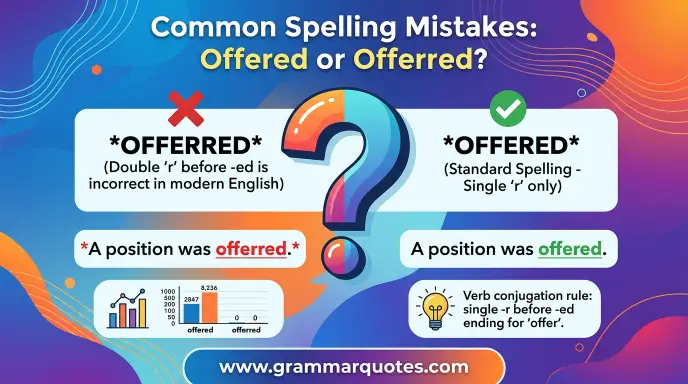
1. Offerred
❌ Offerred
✅ Offered
2. Offerd
❌ Offerd
✅ Offered
The e before d must remain.
3. Of fered
❌ Incorrect spacing
✅ Offered
4. Offering
Do not confuse the past form with the ing form.
offered = past
offering = ongoing/action form
Offered in Everyday Examples
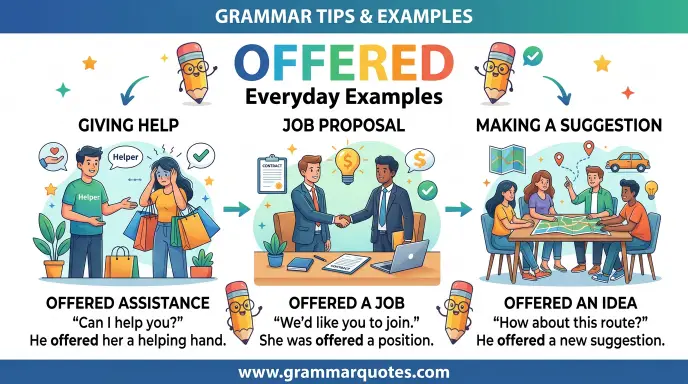
At work
- My manager offered me a promotion.
- The company offered flexible hours.
- They offered him a permanent position.
At school
- The university offered several degree programs.
- The teacher offered extra help.
- The school offered students a new course.
In shopping
- The seller offered me a discount.
- They offered a lower price.
- The store offered free delivery.
In daily conversation
- She offered me some tea.
- He offered to carry the bag.
- They offered their support.
Offering or Offered
These two forms have different grammatical jobs.
Offered usually refers to a completed action or a past event.
Example:
She offered me a seat.
Offering describes an action in progress or something that is being provided.
Example:
She is offering me a seat.
This simple difference can help you choose the correct form.
British English vs American English
There is no spelling difference between British and American English for this word.
Both varieties use:
offered
Examples:
- British English: The company offered him the job.
- American English: The company offered him the job.
So you do not need to change the spelling based on your audience.
Is “Offerred” Ever Correct?
In standard modern English, offerred is not the normal past tense or past participle of offer.
If you mean the verb “offer,” use:
offered
A different word or a name could theoretically contain unusual spelling, but that does not make offerred the standard grammatical form of offer.
How Do You Remember the Correct Spelling?
A simple trick is to remember:
OFFER + ED = OFFERED
Do not add another r.
You can also break the word into:
off + er + ed
This gives:
offered
Think:
One r before ed.
Easy memory example
I offer today.
I offered yesterday.
The base word does not need another r.
Offered vs Offered: Pronunciation
The correct form offered is generally pronounced with two syllables:
OFF erd
The ending is usually pronounced like /d/ rather than creating a separate “ed” syllable.
For example:
offered → “OFF erd”
This is different from some regular verbs where ed creates an extra syllable.
Common Questions About the Spelling
Is offered spelled with one R or two?
It is spelled with one r:
offered
It already has two f letters in the base word, which may cause some learners to expect another doubled consonant.
What is the past tense of offer?
The simple past tense is:
offered
What is the past participle of offer?
The past participle is also:
offered
Is offerred a word?
As the standard past tense or past participle of offer, offerred is incorrect. Use offered instead.
Comparison Table
| Word | Correct? | Meaning |
| Offer | ✅ | Present form |
| Offered | ✅ | Past tense and past participle |
| Offering | ✅ | ing form |
| Offerred | ❌ | Common misspelling |
| Offerd | ❌ | Incorrect spelling |
Offered or Offerred : Google Trends & Usage Data
Searches for spelling pairs often come from people who have seen both forms and want to confirm which one is correct.
For this topic, related searches may include:
- offered or offerred
- how to spell offered
- past tense of offer
- offered meaning
- offer past tense
These searches show different forms of the same search intent: users want to confirm the spelling or grammar of the past form.
Rather than repeating the exact phrase throughout an article, related terms such as past tense of offer, correct spelling, past participle, and offer + ed can cover the topic naturally.
People Also Ask
Is “offered” the correct spelling?
Yes. Offered is the standard spelling.
Is “offerred” a misspelling?
Yes. When you mean the past form of offer, the standard spelling is offered.
What is the past tense of offer?
The past tense is offered.
What is the past participle of offer?
The past participle is also offered.
Does offer double the R?
No. The standard spelling is offered, with one r.
How do you spell offered correctly?
Spell it O F F E R E D.
Why is offerred wrong?
Because the verb forms its past tense by adding ed without doubling the final r.
Is offered the same in British and American English?
Yes. Both use offered.
How many syllables are in offered?
It is normally pronounced with two syllables: OFF erd.
Can offered be used as a past participle?
Yes. For example: “The job has been offered to her.”
FAQs
What is the correct form: offered or offerred?
Offered is correct. Offerred is a common misspelling.
Why does “offer” not become “offerred”?
English spelling rules do not require every final consonant to double before ed. The standard past form is simply offered.
Can I use “offered” in formal writing?
Yes. Offered is completely standard and suitable for academic, professional, and formal writing.
What is the difference between offered and offering?
Offered usually describes a completed or past action, while offering is the ing form used for an action in progress or a current act of providing something.
Is “offered” a verb?
Yes. It is the past tense and past participle of the verb offer.
Does the spelling change in American English?
No. American and British English both use offered.
Final Comparison
| Feature | Offered | Offerred |
| Standard spelling | ✅ Yes | ❌ No |
| Base verb | Offer | Offer |
| Past tense | ✅ Yes | ❌ No |
| Past participle | ✅ Yes | ❌ No |
| One “r” | ✅ Yes | ❌ No |
| Formal writing | ✅ Correct | ❌ Avoid |
| British English | ✅ | ❌ |
| American English | ✅ | ❌ |
Conclusion
Offered is the correct standard English form of the verb offer, while offerred is a common spelling mistake. The past tense and past participle are both formed by adding ed to the base verb:
offer → offered
There is no need to add another r. The word can describe giving something, suggesting help, proposing a price, or making a service available.
Remember the simple pattern:
Offer + ed = offered
The same spelling is used in both British and American English. if you are writing an email, school assignment, business message, or everyday sentence, offered is the form you should use.
Discover More Articles!
67 Meaning : Spelling, Facts, and How to Write It Correctly
Immigration or Emigration: What Is the Difference?
Tweeking or Tweaking: Which Spelling Is Correct?(2026)

Ethan Parker is an English-language writer known for his interest in words, language, and clear communication. His work focuses on making everyday English easier to understand through simple explanations and practical examples.