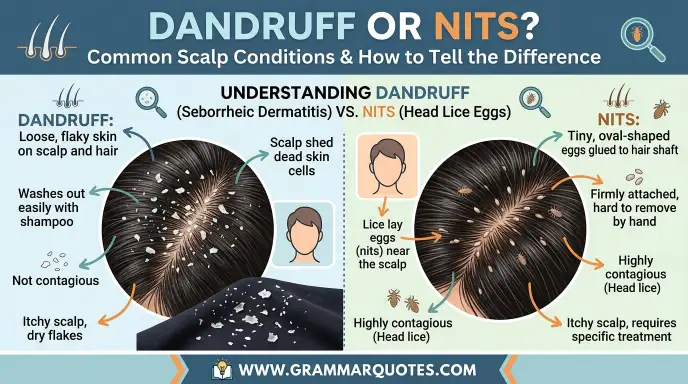
Dandruff and nits can both appear as small white or pale particles in the hair, but they are very different things.
Dandruff is made up of flakes of dead skin from the scalp, while nits are lice eggs that attach firmly to individual hair strands. Knowing the difference can help you understand what you are seeing and choose the right next step.
At first glance, dandruff and nits can look almost identical. This is why many people search for “dandruff or nits” when they notice tiny white spots in their hair. The biggest clue is how easily the particles move. Dandruff usually flakes off or falls away easily, while nits are attached to the hair and are much harder to remove.
This guide explains the differences between dandruff and nits, where they come from, what they look like, common mistakes, and simple ways to tell them apart.
Dandruff or Nits : Quick Answer
Dandruff is loose, flaky skin from the scalp, while nits are lice eggs attached to hair.
| Feature | Dandruff | Nits |
| What is it? | Flakes of scalp skin | Lice eggs |
| Location | On the scalp and hair | Attached to hair strands |
| Appearance | White or yellowish flakes | Small oval eggs |
| Attachment | Loose | Firmly attached |
| Easy to remove? | Usually yes | Usually difficult |
| Main connection | Scalp flaking | Head lice |
Definition and Meaning
Dandruff is a common scalp condition that causes visible flakes. The flakes may be white, gray, or slightly yellow and can sometimes be accompanied by an itchy scalp.
Nits are the eggs laid by head lice. They are usually attached close to the scalp on individual hairs. Nits are not the same thing as adult lice.
How can you tell if it is dandruff or nits?
A useful first check is to look at if the particle is attached to the hair.
If it falls away easily when you move or brush the hair, it is more likely to be dandruff. If it stays firmly attached to a hair strand, it may be a nit.
However, appearance alone is not always enough. Other scalp conditions and hair products can also create particles that look similar.
What Is Dandruff?
Dandruff is a common form of scalp flaking. It happens when the scalp sheds skin cells more noticeably than usual.
People with dandruff may notice:
- White or yellowish flakes
- An itchy scalp
- Flakes on dark clothing
- Dry or oily looking scalp
- More visible flakes around the hairline
Dandruff is not caused by head lice and is not the same as a lice infestation.
Is dandruff contagious?
No. Ordinary dandruff is not contagious. You cannot catch dandruff from another person through normal contact.
A person can have scalp flaking for many reasons, including scalp dryness, oiliness, or sensitivity.
What Are Nits?
Nits are the eggs of head lice. Adult head lice lay their eggs on individual hairs, usually close to the scalp.
Nits are:
- Very small
- Usually oval shaped
- Firmly attached to hair
- Often found close to the scalp
- More difficult to remove than ordinary flakes
A nit can look like a tiny white, yellowish, or grayish dot on a hair.
Are nits the same as lice?
No. Nits are lice eggs, while lice are the living insects.
This difference is important because finding an egg like object does not automatically mean that live lice are currently present. A closer inspection can help determine what is happening.
Dandruff vs Nits: The Main Differences
The easiest way to compare them is by looking at attachment, location, shape, and movement.
1. How firmly are they attached?
Dandruff usually rests loosely on the scalp or hair. It can often be brushed or shaken away.
Nits are attached to individual hairs with a sticky substance. They generally do not fall away easily.
2. Where are they found?
Dandruff can appear across different areas of the scalp and may fall onto the shoulders.
Nits are commonly found attached to hairs near the scalp, although their exact location can vary.
3. What do they look like?
Dandruff often looks irregular and flaky.
Nits tend to look more like tiny oval or teardrop shaped objects attached to a hair.
4. Do they move?
Dandruff flakes do not move by themselves.
Nits are eggs and do not crawl around. Live lice, however, can move through the hair.
How Do Nits Look Compared With Dandruff?
One of the most common questions is, “How do I know if I have nits or dandruff?”
Look closely at an individual hair.
If the white material looks like a loose flake sitting on the hair, dandruff is more likely.
If it looks like a tiny object firmly attached around one side of the hair shaft, it may be a nit.
Another clue is if several similar objects are attached close to the scalp.
Still, visual inspection is not always perfect. If you are unsure, a healthcare professional or another qualified person can help identify the cause.
Common Mistakes When Comparing Dandruff and Nits
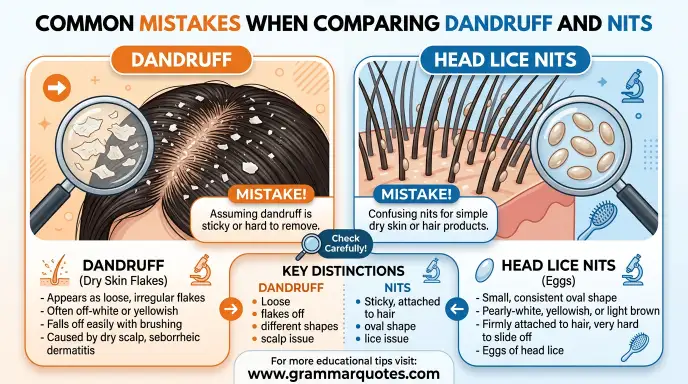
Mistake 1: Assuming every white particle is a nit
Not every white spot in the hair is a lice egg. Dandruff, dried hair products, and other debris can look similar.
Mistake 2: Assuming itching always means lice
An itchy scalp can have many causes. It does not automatically mean someone has head lice.
Mistake 3: Looking only at color
Both dandruff and nits can appear pale or white. Color alone is not a reliable way to distinguish them.
Mistake 4: Checking only the scalp
It can be useful to examine individual hair strands because nits are attached to hairs rather than simply sitting loosely on the scalp.
Mistake 5: Confusing nits with adult lice
Nits are eggs. Adult lice are small insects. They are different stages of the same life cycle.
Dandruff or Nits in Everyday Examples
Here are a few simple examples:
Example 1:
You notice loose white flakes falling onto your black shirt. This is more consistent with dandruff.
Example 2:
You see tiny oval particles firmly attached to individual hairs. These may be nits.
Example 3:
You find a white particle that falls away when you gently brush the hair. It is less likely to be a nit.
Example 4:
You notice something attached to a hair near the scalp and cannot easily slide it off. Further checking may be useful.
Can Dandruff Look Like Nits?
Yes. Dandruff can sometimes look like nits, especially when the flakes are small and close to the scalp.
The key difference is usually attachment. Dandruff is generally loose, while nits are attached to the hair.
However, this is not an absolute rule. Hair products, dry skin, and other scalp debris can also stick to hair. That is why a careful examination is more useful than relying on color alone.
Can nits be mistaken for dandruff?
Yes. Nits can be mistaken for dandruff because both can appear as small pale particles.
The difference becomes clearer when you examine how the material is attached to the hair.
British English vs American English
There is no major spelling difference between dandruff and nits in British and American English.
| Term | British English | American English |
| Dandruff | Dandruff | Dandruff |
| Nit | Nit | Nit |
| Nits | Nits | Nits |
| Head lice | Head lice | Head lice |
The words are generally written the same way in both varieties of English.
Which Term Should You Use?
Use dandruff when you mean scalp flakes.
Nit when you mean an individual head lice egg.
Use nits when referring to more than one lice egg.
For example:
- “I have dandruff on my scalp.”
- “I found a nit attached to a hair.”
- “The examination found several nits.”
Using the correct word makes your meaning much clearer.
Dandruff or Nits: Comparison Table
| Question | Dandruff | Nits |
| Is it a scalp condition? | Yes, commonly | No |
| Is it a lice egg? | No | Yes |
| Usually loose? | Yes | No |
| Attached to hair? | Usually not | Yes |
| Can it cause itching? | Yes | Head lice can cause itching |
| Can it fall onto clothing? | Yes | Usually less likely |
| Is it contagious? | No | Head lice can spread between people |
| Is it an insect? | No | It is an egg of an insect |
Dandruff or Nits : Google Trends & Usage Data
Searches for both terms are common because people often notice flakes or small particles in their hair and want to identify them.
“Dandruff” is widely used in everyday discussions about scalp care. “Nits” is more commonly searched when people are concerned about head lice, especially among children and families.
Search interest can change with seasons, school schedules, public health awareness, and common outbreaks of head lice. Exact Google Trends numbers also vary by country and time period, so a single worldwide number would not give a reliable picture.
10 People Also Ask Questions
1. How can you tell the difference between dandruff and nits?
Dandruff is usually loose and flaky, while nits are small eggs firmly attached to individual hairs.
2. Can dandruff look like lice eggs?
Yes. Small dandruff flakes can look similar to lice eggs, especially when viewed from a distance.
3. Are nits easy to remove?
Nits are usually firmly attached to hair, so they do not come away as easily as ordinary dandruff flakes.
4. Does dandruff mean you have lice?
No. Dandruff and head lice are different conditions.
5. Can nits cause an itchy scalp?
The presence of head lice can cause itching, although an itchy scalp can also have many other causes.
6. What color are nits?
Nits may appear pale, white, yellowish, grayish, or brownish depending on their stage and appearance.
7. Do nits fall off like dandruff?
Usually not. Nits are attached to hair, while dandruff flakes commonly fall away.
8. Can you have dandruff and nits at the same time?
Yes. Having dandruff does not prevent someone from also having head lice.
9. Are nits alive?
A nit is a lice egg. The egg itself does not move around like an adult louse.
10. What should I do if I cannot tell what the particles are?
If you are unsure, consider having the scalp and hair examined by a healthcare professional or another qualified person.
FAQs
Is dandruff worse than nits?
They are different problems, so it is not useful to describe one as simply “worse.” Nits are associated with head lice, while dandruff involves scalp flaking.
Can dandruff turn into nits?
No. Dandruff does not turn into lice eggs.
Do nits look like white flakes?
They can look similar, but nits are usually attached to individual hairs, while flakes are generally loose.
Can you have nits without itching?
Yes. Not everyone with head lice notices itching immediately.
What is the easiest clue to remember?
Remember this simple rule: flakes usually come loose; nits usually stay attached to the hair.
Are dandruff and head lice the same thing?
No. Dandruff involves scalp flaking, while head lice are insects that live on the scalp and lay eggs called nits.
Final Guide: Dandruff or Nits?
Dandruff and nits may look similar at first, but they have different causes and characteristics. Dandruff is loose scalp flaking, while nits are lice eggs attached to individual hairs.
The most useful clue is how firmly the material is attached. Dandruff usually flakes away or falls from the hair, while nits tend to remain attached to a hair strand. Nits may also have a small oval appearance and are often found close to the scalp.
It is important not to assume that every white particle means head lice. Hair products, dry skin, and other debris can also look similar. If you cannot confidently identify what you are seeing, getting a professional examination can help.
Knowing these basic differences can make it easier to understand what you are seeing and avoid confusing ordinary scalp flakes with lice eggs.
Conclusion
Dandruff and nits are easy to confuse because both can appear as small pale particles in the hair. However, they are not the same. Dandruff is loose scalp skin, while nits are eggs produced by head lice.
The biggest difference is attachment. Dandruff usually comes away easily, while nits are firmly attached to individual hairs. Their location, shape, and appearance can also provide useful clues.
If you notice small particles in your hair, do not automatically assume they are lice eggs. Look carefully at if they are attached to the hair and consider other possible causes. When the difference remains unclear, a healthcare professional can help identify what you are seeing.
Understanding the difference between these two terms can prevent unnecessary worry and help you use the right words when describing a scalp or hair concern.
Discover More Articles!
Thats or That’s: Which Spelling Is Correct?(2026)
Volume or Volumn: Which Spelling Is Correct?(2026)
Preventative or Preventive: Which One Is Correct?(2026)

Ethan Parker is an English-language writer known for his interest in words, language, and clear communication. His work focuses on making everyday English easier to understand through simple explanations and practical examples.