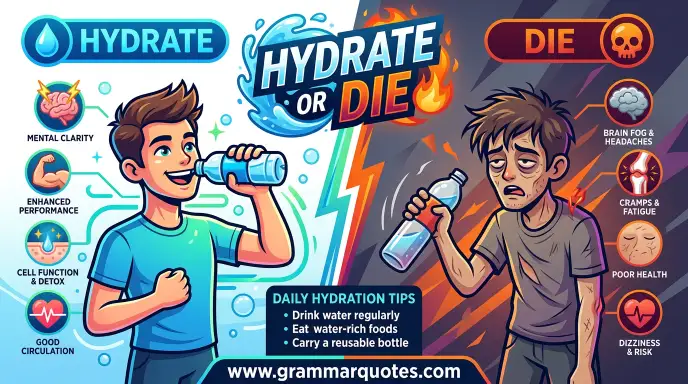
Hydrate or die is a dramatic phrase used to emphasize the importance of staying adequately hydrated, but it should not be understood as medical advice or a literal rule.
The expression became popular because hydration is an important part of normal body function. Water helps the body regulate temperature, support circulation, and perform many everyday processes. However, more water is not always better. Drinking excessive amounts can also be dangerous.
In everyday language, this phrase is often used humorously, dramatically, or as a motivational slogan. Someone might use it when encouraging friends to remember their water during exercise, a hot day, or a long trip.
The phrase can therefore have two sides. Its basic message is about remembering hydration, while its exaggerated wording makes it memorable. Understanding the difference is useful, especially because health related slogans should not replace practical medical guidance.
This guide explains the meaning, origin, grammar, everyday usage, common mistakes, British and American English, related expressions, and the important difference between staying hydrated and drinking excessive amounts of water.
Hydrate or Die : Quick Answer
The phrase is an exaggerated way of saying “stay hydrated” or “remember to drink enough fluids.”
It is usually used as:
- A humorous slogan
- A motivational phrase
- A social media caption
- A reminder during exercise or hot weather
- An exaggerated way to talk about hydration
The word hydrate means to provide the body with enough fluid or to add water to something.
The word die refers to death, so the complete phrase sounds intentionally dramatic.
Example
Bring your water bottle. Hydrate or die!
In casual conversation, this would usually be understood as a joke or exaggerated reminder rather than a literal instruction.
Definition and Meaning
What does “hydrate” mean?
Hydrate means to provide the body with enough fluid or to add water to something.
When talking about people, hydration refers to having enough fluid in the body for normal functions.
For example:
Remember to hydrate during a hot day.
What does “die” mean?
Die is a verb meaning to stop living.
In this phrase, however, it is normally used for dramatic emphasis. The speaker is not necessarily making a literal prediction.
Compare:
Stay hydrated.
with:
Hydrate or die!
The first sounds like ordinary health advice. The second sounds dramatic, humorous, or playful.
The Meaning Behind the Phrase
The basic idea is simple:
Hydration matters, so remember to drink fluids.
However, the wording is deliberately extreme.
Similar expressions are often used in everyday language to make a message more memorable:
- Work hard or go home.
- Use it or lose it.
- Eat well, live well.
- Stay ready.
These phrases are not always meant to be interpreted literally.
The same principle applies here. The expression is usually about emphasis rather than a medical rule.
The Origin and Popularity of the Phrase
The expression follows a common English slogan structure: “X or Y.”
This structure presents two exaggerated alternatives and is often used to make a short message catchy.
The phrase became especially recognizable through fitness culture, social media, memes, and casual conversations about drinking water.
Because it is short and dramatic, it works well as a caption, joke, poster slogan, or motivational phrase.
It should still be separated from evidence based health guidance. A catchy slogan cannot tell someone exactly how much fluid they personally need.
Hydration and the Human Body
Water is essential for normal body function.
Adequate fluid intake supports processes such as:
- Temperature regulation
- Normal circulation
- Digestion
- Transportation of nutrients
- Removal of waste
- Normal cellular function
Fluid needs vary from person to person. Factors such as weather, physical activity, diet, age, illness, and other circumstances can affect how much fluid someone needs.
This is why there is no single amount that is perfect for every person in every situation.
Can You Drink Too Much Water?
Yes.
Although dehydration can be harmful, excessive water intake can also cause problems. Drinking a very large amount of water in a short period can dilute the sodium level in the blood, a condition known as hyponatremia.
Possible symptoms can include:
- Headache
- Nausea
- Confusion
- Weakness
- Changes in alertness
Severe cases can become a medical emergency.
So the phrase should not be interpreted as encouragement to drink as much water as possible.
The practical message is simply to maintain appropriate hydration rather than forcing excessive amounts of fluid.
British English vs American English
The phrase can be understood in both British and American English.
There is no major spelling difference.
| English Variety | Usage | Example |
| British English | Commonly understood | Stay hydrated on hot days. |
| American English | Commonly understood | Remember to hydrate during practice. |
| Canadian English | Commonly understood | Keep some water with you. |
| Australian English | Commonly understood | Make sure you stay hydrated. |
The slogan itself is informal, so it is more likely to appear in conversation, social media, fitness content, or humorous writing than in formal medical writing.
Which Expression Should You Use?
Choose the wording based on your audience.
For formal or health related writing
Use:
Stay hydrated.
or:
Maintain adequate hydration.
These expressions sound clearer and more professional.
For casual conversation
You might hear:
Don’t forget to hydrate!
For humor or social media
The dramatic slogan can work as a joke or caption.
However, it should not be presented as a literal medical instruction.
Common Mistakes
1. Taking the phrase literally
The expression is usually exaggerated.
It does not mean that someone will immediately die if they do not drink water.
2. Thinking more water is always better
The body needs an appropriate balance of fluids and electrolytes. Excessive water intake can be harmful.
3. Using the phrase in serious medical advice
A dramatic slogan is not a substitute for personalized medical guidance.
4. Confusing “hydrate” with “hydrated”
Hydrate is a verb:
Remember to hydrate.
Hydrated is an adjective:
I am properly hydrated.
5. Assuming everyone has identical fluid needs
Fluid requirements can vary depending on individual circumstances.
Die or Hydrate in Everyday Examples
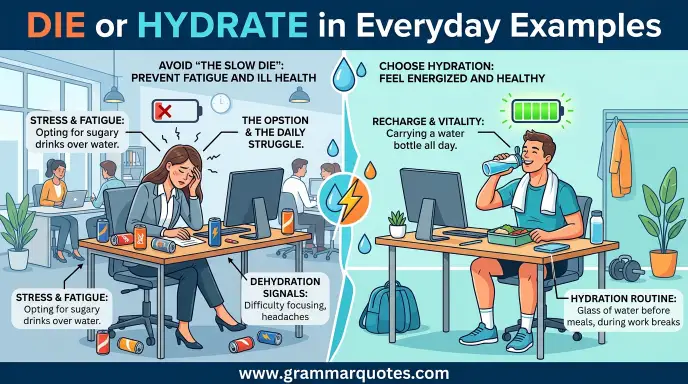
Social media caption
Long hike today. Water bottle packed. Hydrate or die!
Here, the phrase is clearly being used dramatically.
Hot weather
It is really hot today, so don’t forget to hydrate.
This is a straightforward reminder.
Exercise
Bring some water to practice and take regular breaks.
This is clearer than relying only on a slogan.
Funny conversation
I forgot my water bottle again. Hydrate or die!
The wording adds humor to an ordinary situation.
Professional communication
Please remember to drink enough fluids during the activity.
This is more appropriate for formal communication.
Hydration vs Dehydration
Understanding the opposite concepts can make the phrase easier to understand.
| Term | Meaning |
| Hydration | Having sufficient body fluids |
| Dehydration | Losing more fluid than the body replaces |
| Hydrate | To provide or take in fluid |
| Hydrated | Having adequate fluid |
| Overhydration | Having excessive fluid intake or water relative to the body’s needs |
Both dehydration and excessive fluid intake can be problematic.
The goal is appropriate hydration, not simply consuming the largest possible amount of water.
Signs You May Need More Attention to Hydration
Everyday signs can vary, but dehydration can be associated with:
- Thirst
- Dry mouth
- Darker urine
- Tiredness
- Dizziness
However, these signs can have other causes as well.
People who are ill, exercising heavily, exposed to extreme heat, or taking certain medications may have different hydration needs.
If someone has severe symptoms or appears seriously unwell, medical advice is appropriate.
Hydrate or Die vs Stay Hydrated
These expressions communicate a related idea but have different tones.
| Expression | Tone | Typical Use |
| Hydrate or die | Dramatic / humorous | Memes, captions, jokes |
| Stay hydrated | Neutral | Everyday reminders |
| Keep drinking fluids | Direct | Practical advice |
| Maintain hydration | Formal | Professional or medical contexts |
For most health related content, stay hydrated is the clearer choice.
The dramatic version works better when the goal is humor or emphasis.
Why Is This Phrase So Popular?
Short slogans are easy to remember and share.
The phrase combines:
- A simple health concept
- Very short wording
- Strong contrast
- Humor
- Dramatic language
This makes it suitable for social media captions, memes, posters, gym culture, and casual conversation.
Its popularity does not mean that every part of the wording should be treated as scientifically precise.
Google Trends & Usage Data
Search interest in hydration related phrases can change with seasons, weather, fitness trends, social media activity, and health awareness campaigns.
Exact Google Trends numbers should be checked for a specific country and date range because search behavior changes over time.
Useful related searches include:
- hydrate meaning
- stay hydrated meaning
- hydration meaning
- hydration benefits
- signs of dehydration
- can you drink too much water
- hydration during exercise
- how much water should I drink
- overhydration meaning
These related terms can help explain the topic naturally without repeating the same exact phrase throughout an article.
People Also Ask Questions
1. What does “hydrate or die” mean?
It is an exaggerated phrase encouraging people to remember hydration. It is usually humorous rather than literal.
2. Is “hydrate or die” a medical term?
No. It is an informal slogan, not a medical term.
3. Is staying hydrated important?
Yes. Adequate hydration supports many normal body functions.
4. Can you drink too much water?
Yes. Excessive water intake can disturb the body’s electrolyte balance and may cause hyponatremia.
5. What does hydrate mean?
To hydrate means to provide the body or another substance with fluid, especially water.
6. Is “stay hydrated” better than the dramatic slogan?
For health or professional communication, “stay hydrated” is generally clearer and less likely to be misunderstood.
7. Does everyone need the same amount of water?
No. Fluid needs vary according to factors such as activity, climate, diet, health, and individual circumstances.
8. What are common signs of dehydration?
Thirst, dry mouth, darker urine, tiredness, and dizziness can occur, although these symptoms can have other causes.
9. Can hydration help during exercise?
Adequate fluid intake can help replace fluid lost through sweating. Individual needs vary with exercise intensity, duration, and environmental conditions.
10. What is the difference between hydrate and hydrated?
Hydrate is a verb, while hydrated describes a state of having sufficient fluid.
Conclusion
The phrase hydrate or die is a dramatic and often humorous way of reminding someone to pay attention to hydration. It is commonly used in social media posts, memes, fitness conversations, and casual speech rather than formal medical writing.
The underlying idea is reasonable: the body needs adequate fluid for normal functions. However, the slogan should not be interpreted as a command to drink as much water as possible. Excessive water consumption can also be harmful because it may disturb the body’s electrolyte balance.
For professional or health related communication, phrases such as “stay hydrated” or “maintain adequate hydration” are clearer and more appropriate. The dramatic version works mainly because its exaggerated wording makes the message memorable.
The most useful takeaway is simple: pay attention to your body’s fluid needs, consider factors such as activity and weather, and avoid treating catchy slogans as personalized medical advice. If you have a health condition that affects fluid balance, follow guidance from a qualified healthcare professional.
Discover More Articles!
Weening or Weaning: One Letter Changes the Entire Meaning
Pidgeon vs Pigeon: Which Spelling Is Correct?
Pickens vs Sutton: Stats, Matchups, and Value(2026)

Ethan Parker is an English-language writer known for his interest in words, language, and clear communication. His work focuses on making everyday English easier to understand through simple explanations and practical examples.