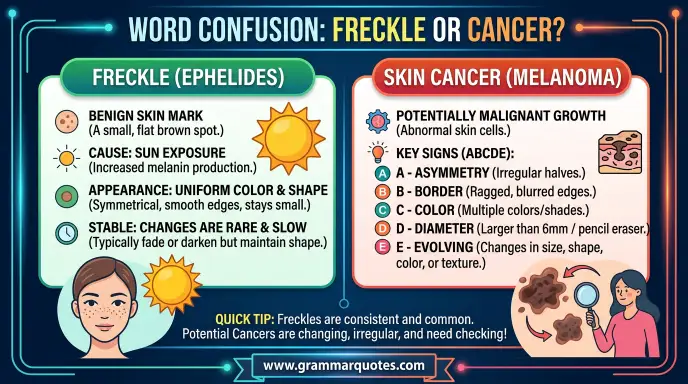
A freckle is usually a harmless, flat, pigmented spot, while skin cancer can sometimes appear as a new or changing pigmented mark. However, appearance alone cannot reliably determine if a spot is harmless or cancerous.
Freckles are common, especially in people whose skin is more sensitive to sunlight. They are usually small, flat, and tan or brown. They may become more noticeable after sun exposure and can fade when there is less sunlight.
Skin cancer is different. Some skin cancers can develop from existing spots, while others appear as new marks on previously normal skin. Certain changes in size, shape, color, or behavior can be warning signs that deserve medical attention.
This makes the subject important for anyone who notices a new or changing mark. A simple comparison can help you understand what features are worth watching, but it should not be used as a self diagnosis.
In this guide, we will explain the meaning of freckles, how concerning skin changes can differ, common warning signs, British and American usage, everyday examples, and when professional evaluation may be appropriate.
Freckle or Cancer : Quick Answer
A typical freckle is a small, flat, evenly colored spot that is usually harmless. A potentially cancerous skin lesion may show changes in its size, shape, color, border, or behavior.
However, not every unusual looking spot is cancer, and not every skin cancer looks the same.
Typical differences
| Feature | Freckle | Possible Skin Cancer |
| Usually | Harmless | May require medical evaluation |
| Surface | Usually flat | Can be flat, raised, scaly, or otherwise different |
| Color | Often fairly uniform | May contain multiple or changing colors |
| Shape | Usually simple and even | May become irregular |
| Change over time | Often changes with sun exposure | A new or changing lesion can be concerning |
| Size | Usually small | Can vary |
| Symptoms | Usually none | May itch, bleed, crust, hurt, or change |
| Diagnosis | Usually recognizable clinically | Requires professional assessment |
These are general patterns, not a diagnostic test.
Definition and Meaning
What is a freckle?
A freckle is a small, flat area of increased pigmentation in the skin.
Freckles are often:
- Tan
- Light brown
- Brown
- Small
- Flat
- More noticeable after sun exposure
They are related to increased production of melanin in localized areas of the skin.
Freckles can appear on sun exposed areas such as the:
- Face
- Arms
- Shoulders
- Upper chest
They are generally harmless.
What is skin cancer?
Skin cancer is a group of cancers that develop in skin cells.
The main types include:
- Basal cell carcinoma
- Squamous cell carcinoma
- Melanoma
Melanoma develops from pigment producing cells called melanocytes. It can sometimes resemble a dark mole or other pigmented mark, which is one reason changes in pigmented spots deserve attention.
What Does a Typical Freckle Look Like?
Freckles often have several predictable features.
They are generally:
- Small
- Flat
- Brown or tan
- Relatively uniform in color
- Clearly defined
- More visible after sun exposure
Freckles may also become lighter during periods when there is less sun exposure.
The presence of freckles does not mean that a person has skin cancer.
However, having freckles can be associated with greater sensitivity to ultraviolet radiation, so protecting the skin from excessive UV exposure remains important.
Warning Signs of a Concerning Skin Spot
One useful approach is to remember the ABCDE warning signs commonly used when assessing pigmented lesions.
A : Asymmetry
One half of the spot does not look similar to the other half.
B : Border
The edge may be irregular, uneven, blurred, or poorly defined.
C : Color
There may be several colors within one lesion, or the color may change.
D : Diameter
A lesion that is larger than about 6 millimeters can deserve attention, although skin cancers can be smaller than this.
E : Evolving
The spot changes in size, shape, color, or appearance over time.
The E is particularly important because a changing lesion can be a reason to seek professional advice.
The ABCDE method is a useful awareness tool, not a way to diagnose cancer at home.
Skin Cancer vs Freckle: Appearance
Appearance can provide clues, but there is significant variation.
Typical freckle
A freckle often has:
- A flat surface
- A fairly consistent color
- A small size
- A simple shape
- No bleeding or crusting
Potentially concerning lesion
A concerning lesion may show:
- Noticeable change
- Irregular borders
- Multiple colors
- Rapid growth
- Bleeding
- Crusting
- Persistent itching
- A different appearance from other marks
These signs do not automatically mean cancer. Other harmless skin conditions can also cause unusual changes.
Why Can Sun Exposure Matter?
Ultraviolet (UV) radiation from the sun can affect the skin.
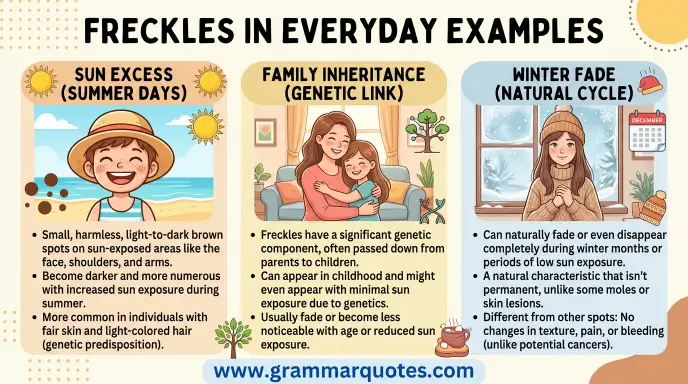
Sun exposure can make freckles more noticeable because pigment production increases in response to UV exposure.
Too much UV exposure can also damage skin cells and increase the risk of skin cancer.
This is why sun protection is useful even for people who have never had a suspicious skin lesion.
Helpful measures include:
- Seeking shade when appropriate
- Wearing protective clothing
- Using sunscreen as directed
- Avoiding unnecessary tanning
- Being aware of prolonged sun exposure
British English vs American English
The word freckle is used in both British and American English.
There is no meaningful spelling difference.
| English Variety | Standard Spelling | Example |
| British English | Freckle | She has freckles on her face. |
| American English | Freckle | He noticed a new freckle. |
| Canadian English | Freckle | The freckles became darker in summer. |
| Australian English | Freckle | She has several freckles. |
Medical terms such as melanoma, basal cell carcinoma, and squamous cell carcinoma are also used across these varieties.
Which Description Should You Use?
If you are describing a normal looking pigment spot, you can use freckle when it fits the appearance.
For example:
She has small brown freckles on her cheeks.
If you are unsure what a new or changing mark is, avoid making a definite diagnosis.
Instead of:
This is skin cancer.
A safer description is:
I noticed a new dark spot that has changed recently.
This gives a healthcare professional useful information without assuming the cause.
Common Mistakes
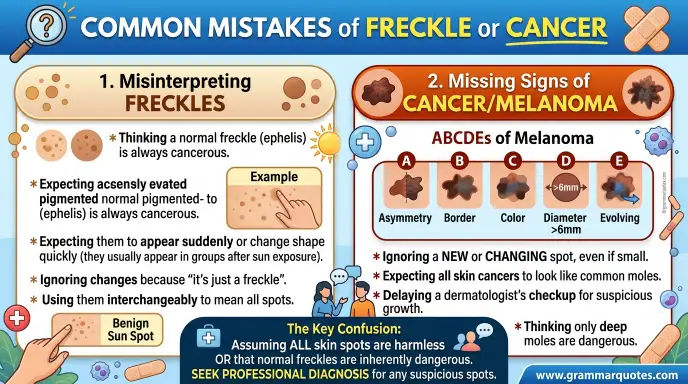
1. Assuming every brown spot is a freckle
Not every pigmented spot is a freckle. Moles and other skin lesions can also be brown.
2. Assuming every unusual spot is cancer
A strange looking mark can have many possible causes. Only an appropriate medical assessment can determine what it is.
3. Ignoring a changing spot
A new or changing lesion should not automatically be dismissed as a normal freckle.
4. Relying only on color
Color is just one feature. Shape, border, size, and changes over time can also matter.
5. Trying to diagnose a lesion from an online photo
Photos and general descriptions cannot replace an examination by a qualified healthcare professional.
Freckles in Everyday Examples
Talking about appearance
She has small freckles across her cheeks.
Talking about sunlight
His freckles become more noticeable during the summer.
Talking about a new mark
I noticed a new brown spot on my arm.
Talking to a doctor
This spot has changed in size and color over the last few months.
The final example is more useful than simply saying that a spot “looks strange” because it describes an actual change.
When Should You Get Medical Advice?
Consider having a skin mark professionally checked if it:
- Is new and unusual
- Changes in size
- Changes in shape
- Changes in color
- Has an irregular border
- Starts bleeding
- Develops persistent crusting
- Becomes painful
- Itches persistently
- Looks noticeably different from your other spots
The “ugly duckling” idea can also be useful: a mark that looks clearly different from the other spots on your skin may deserve attention.
You do not need to wait for a spot to develop every warning sign before asking a healthcare professional about it.
Freckle vs Cancer: Comparison Table
| Feature | Typical Freckle | Potentially Concerning Lesion |
| Shape | Usually simple and regular | May become irregular |
| Color | Often fairly uniform | May contain several colors |
| Surface | Usually flat | Can vary |
| Change | May darken with sun exposure | Persistent or noticeable evolution can be concerning |
| Border | Usually clear | May become uneven |
| Bleeding | Not typical | Can occur in some skin cancers |
| Itching | Not typical | Can occur |
| Growth | Usually stable in general appearance | A changing or growing lesion deserves attention |
| Diagnosis | Usually harmless | Needs professional assessment if suspicious |
Why Is This Confusion So Common?
The confusion exists because many skin conditions can produce brown, tan, or dark spots.
Freckles, moles, sun spots, and some skin cancers can all involve pigmentation. A person may therefore have difficulty identifying a mark based only on its color.
Another reason is that skin cancers do not always look dramatic. Some can begin as relatively subtle changes.
This is why monitoring changes over time can be useful. Knowing what is normal for your own skin can make an unusual change easier to notice.
However, self monitoring should support professional care rather than replace it.
Google Trends & Usage Data
Search interest in skin related questions can vary by country, season, age group, and public awareness campaigns.
People may search these terms after noticing a new brown spot or after learning about skin cancer warning signs.
Exact Google Trends numbers should be checked for a specific country and time period because search interest changes over time.
Useful related searches include:
- freckle vs skin cancer
- how to tell if a freckle is cancerous
- skin cancer warning signs
- ABCDE melanoma
- changing skin spots
- suspicious mole signs
- melanoma symptoms
- normal freckles
- when to see a dermatologist
These related topics can help readers understand the subject without repeatedly using the same exact phrase.
People Also Ask Questions
1. Can a freckle turn into skin cancer?
A typical freckle is generally harmless. However, a new or changing pigmented spot should be assessed if it appears unusual.
2. How can you tell if a brown spot is cancerous?
Changes in shape, border, color, size, or appearance can be warning signs, but a healthcare professional is needed for diagnosis.
3. Are freckles dangerous?
Freckles themselves are generally harmless.
4. Can freckles change with the seasons?
Yes. They can become more noticeable after sun exposure and may fade when there is less sunlight.
5. What is the ABCDE rule for skin cancer?
It refers to Asymmetry, Border, Color, Diameter, and Evolving. It is a commonly used awareness guide for suspicious pigmented lesions.
6. Does every unusual mole mean cancer?
No. Many unusual looking or changing marks are not cancer, but they may still deserve professional evaluation.
7. Can skin cancer look like a freckle?
Yes. Some pigmented skin cancers can resemble a dark or unusual spot, which is why changes in a mark can be important.
8. When should I see a dermatologist about a spot?
Seek professional advice if a spot is new, changing, bleeding, painful, persistently itchy, or otherwise unusual.
9. Can sun exposure make freckles darker?
Yes. UV exposure can make freckles more noticeable or darker.
10. Can you diagnose skin cancer by looking at a picture?
A photograph may provide information, but it cannot reliably establish a diagnosis. A qualified healthcare professional may need to examine the lesion directly and perform further testing when appropriate.
Conclusion
Freckles are common, flat pigmented spots that are usually harmless, while skin cancer can sometimes appear as a new or changing pigmented lesion. The two can look similar in some situations, which is why color alone is not enough to identify a skin mark.
A typical freckle is often small, flat, and relatively uniform in color. It may also become more noticeable after sun exposure.
A potentially concerning lesion may show changes in size, shape, border, color, or overall appearance. The ABCDE method can help people recognize some warning signs, but it should not be used as a substitute for professional diagnosis.
Sun protection is also important because ultraviolet radiation can damage skin cells and increase skin cancer risk. If a mark is new, changing, bleeding, painful, persistently itchy, or noticeably different from other spots, consider having it evaluated by a qualified healthcare professional.
The safest approach is simple: know what is normal for your skin, pay attention to meaningful changes, and seek medical advice when something looks unusual
Discover More Articles!
Weening or Weaning: One Letter Changes the Entire Meaning
Pidgeon vs Pigeon: Which Spelling Is Correct?
Fruits or Vegetables: What Is the Difference?

Ethan Parker is an English-language writer known for his interest in words, language, and clear communication. His work focuses on making everyday English easier to understand through simple explanations and practical examples.