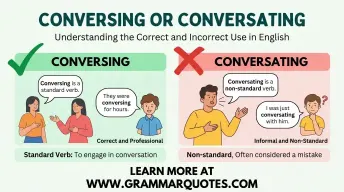
Conversing is the standard and widely accepted word for talking or having a conversation, while conversating is generally considered nonstandard in formal English.
Both forms are connected to the verb “converse,” but they do not have the same level of acceptance in modern English.
This confusion often appears because English has many verbs that form their present participles by adding ing. Someone may naturally assume that “conversate” works in the same way as “converse.” However, standard English uses converse, not “conversate,” for the verb meaning to talk with someone.
The word conversing is common in dictionaries, books, professional writing, and everyday speech. “Conversating” can sometimes be heard in informal speech or seen online, but it is not normally recommended for formal writing.
Understanding the difference is useful when writing emails, school assignments, articles, applications, or professional messages. This guide explains the meanings, grammar, history, common mistakes, examples, and correct usage in simple English.
Conversing or Conversating : Quick Answer
Conversing is the standard and preferred form. Conversating is generally considered nonstandard and should be avoided in formal English.
The correct verb is converse.
Its common forms are:
- Base form: converse
- Present participle: conversing
- Past tense: conversed
- Past participle: conversed
Definition and Meaning
Conversing means talking with another person or having a conversation.
For example:
The two friends were conversing after class.
Here, “conversing” simply means talking.
“Conversating” is formed from the less standard verb conversate. Although some speakers use it informally, it is not the normal standard English form.
Is “Conversating” a Real Word?
You may encounter “conversating” in online posts, casual speech, music, social media, or regional varieties of English. Its appearance does not mean it is the preferred form in standard English.
For formal communication, conversing is the safer and more widely accepted choice.
What Does “Conversing” Mean?
Conversing means exchanging thoughts, ideas, or information through spoken communication.
It is the ing form of “converse.”
Examples:
- We were conversing about the new project.
- She enjoys conversing with her classmates.
- The guests were quietly conversing.
- He was conversing with a colleague.
The word can sound slightly more formal than talking, but its meaning is straightforward.
Conversing vs Talking
These words are close in meaning, but their tone can differ.
| Word | Meaning | Typical tone |
| Talking | Speaking with someone | Very common |
| Conversing | Having a conversation | More formal |
| Chatting | Talking in a relaxed way | Informal |
| Discussing | Talking about a particular subject | Neutral/formal |
So, instead of saying:
We were conversating.
Use:
We were conversing.
Or, in everyday speech:
We were talking.
Where Does “Converse” Come From?
The verb converse has a long history in English. It comes from Latin roots connected with spending time or associating with others and later developed the meaning of talking or communicating.
English has used converse as a verb for centuries.
The important point is that the standard verb already exists. Because of this, English does not normally need a separate verb such as “conversate” to express the same idea.
Why Do People Say “Conversating”?
English speakers sometimes create new verbs by adding endings to familiar words.
For example:
- conversation → converse
- communication → communicate
- explanation → explain
Because conversation is a familiar noun, some speakers may naturally create “conversate” as a verb.
This explains why the form can sound understandable even though it is not preferred in standard English.
Conversing vs Conversating in Grammar
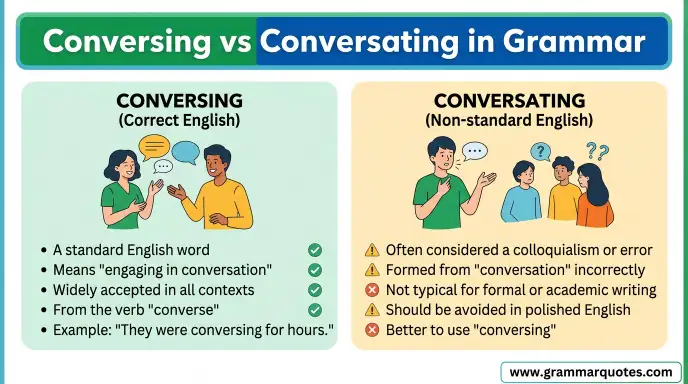
The main grammatical difference is simple.
Conversing is the present participle of converse.
Examples:
- I am conversing with my teacher.
- They are conversing outside.
- She was conversing with her friend.
“Conversating” comes from the nonstandard verb “conversate.”
For standard English writing, use:
converse → conversing
not:
conversate → conversating
What Is the Correct Past Tense?
The correct past tense is:
conversed
Examples:
- We conversed for an hour.
- They conversed about their plans.
- She conversed with the manager.
Do not replace it with “conversated” in formal standard English.
Common Mistakes
Mistake 1: Using “Conversating” in Formal Writing
Incorrect:
The students were conversating during the lesson.
Better:
The students were conversing during the lesson.
Even simpler:
The students were talking during the lesson.
Mistake 2: Thinking Every Noun Needs a Matching Verb
The noun conversation does not require “conversate” as its verb.
English already has:
conversation → converse
Mistake 3: Assuming “Conversating” Is the Normal ing Form
The correct ing form of converse is:
conversing
The final e is dropped before adding ing.
Similar examples include:
- write → writing
- make → making
- converse → conversing
Conversing in Everyday Examples
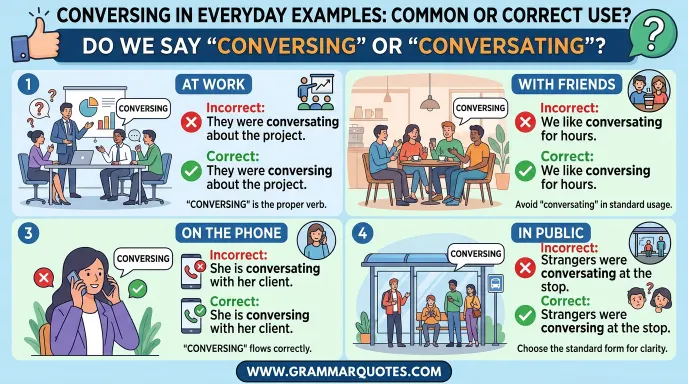
Here are natural examples you can use in real writing.
Example 1: Friends
My friends were conversing in the garden.
Example 2: School
The students were conversing quietly before the class began.
Example 3: Workplace
The manager was conversing with an employee.
Example 4: Formal Writing
The participants spent several minutes conversing about the proposal.
Example 5: Casual English
We were just talking about the weekend.
In everyday conversation, talking is often more natural than the slightly formal conversing.
British English vs American English
Conversing is accepted in both British and American English.
There is no major spelling difference between the two varieties.
| British English | American English |
| conversing | conversing |
| converse | converse |
| conversed | conversed |
| conversation | conversation |
The issue is therefore not mainly about British versus American spelling.
It is about standard versus nonstandard usage.
Which Word Should You Use?
Use conversing when you need the standard verb form.
It works well in:
- School assignments
- Essays
- Articles
- Professional emails
- Reports
- Formal conversations
- Academic writing
If you want a simple everyday alternative, use talking.
For example:
Formal:
The researchers were conversing about the results.
Natural everyday English:
The researchers were talking about the results.
Both are clear, but “conversing” is the correct standard form related to converse.
Conversing vs Conversation
These words are related but have different grammatical jobs.
Conversation is a noun.
We had an interesting conversation.
Conversing is a verb form.
We were conversing after dinner.
A simple way to remember this is:
conversation = the discussion
conversing = the action of talking
Is “Conversate” Ever Used?
Yes, you may see or hear conversate and its forms in informal English.
However, it is not the preferred form in standard English. Major formal writing generally favors converse.
Therefore, if your goal is correct grammar for school, work, websites, applications, or professional communication, choose converse and conversing.
People Also Ask: Is Conversating Grammatically Correct?
“Conversating” is generally considered nonstandard. In standard English, conversing is the preferred form.
Pronunciation
The two forms can also create confusion because the words look similar.
Conversing is pronounced approximately:
kuhn VUR sing
The stress falls on the middle part of the word.
Learning the pronunciation can help reinforce the correct spelling.
A Simple Memory Trick
Remember this:
CONVERSE → CONVERSING
If you are unsure, think of the base verb first.
Ask:
What is the verb?
The answer is:
Converse.
Then add ing:
Conversing.
This makes the correct form much easier to remember.
Conversating or Conversing in Formal Writing
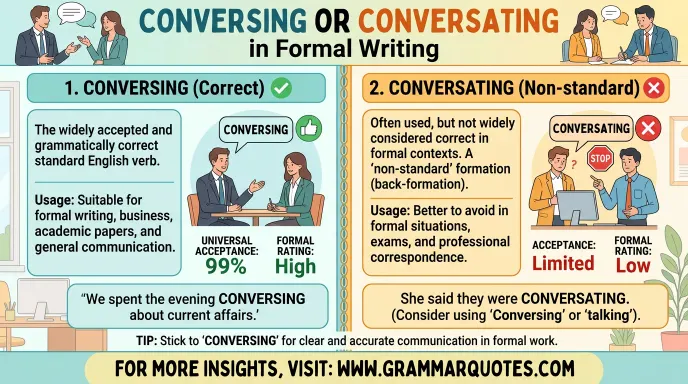
For formal writing, conversing is the clear choice.
For example:
Better:
The two researchers were conversing about the results.
Avoid:
The two researchers were conversating about the results.
You can also choose discussing or talking, depending on the context.
This matters because formal writing should normally use established standard vocabulary rather than forms that may be viewed as nonstandard.
Google Trends & Usage Data
Search interest around this spelling and grammar question often comes from people checking if a word they have heard is standard English.
Related searches may include:
- conversing meaning
- conversating meaning
- is conversating a word
- converse or conversate
- conversing definition
- correct word for talking
- conversing in a sentence
Search behavior can vary over time, but the main grammar rule remains stable: conversing is the standard form derived from converse.
People Also Ask Questions
- Is conversing the correct word?
- Is conversating a real word?
- Is conversating grammatically correct?
- What is the correct form of converse?
- What does conversing mean?
- Can I use conversing in formal writing?
- What is the past tense of converse?
- Is conversing the same as talking?
- Why do people say conversating?
- What is another word for conversing?
Frequently Asked Questions
Is conversing correct English?
Yes. Conversing is the standard present participle of converse.
Is conversating wrong?
“Conversating” is generally considered nonstandard. It may appear in informal speech, but it is best avoided in formal English.
What is the past tense of converse?
The past tense is conversed.
Example:
We conversed for several minutes.
Is conversing formal?
It can sound somewhat more formal than “talking,” but it is completely correct in both everyday and formal English.
What is an easier word than conversing?
Talking is the simplest everyday alternative.
Other choices include chatting, speaking, and discussing, depending on the context.
Can I use conversing in an essay?
Yes. Conversing is suitable for essays, reports, academic writing, and other formal contexts when the meaning fits.
Why does conversating sound correct?
It follows a pattern that can feel natural to English speakers. However, sounding logical does not necessarily make a form standard. The established verb is converse, so its ing form is conversing.
Final Comparison
| Feature | Conversing | Conversating |
| Standard English | Yes | Generally no |
| Base verb | Converse | Conversate |
| Meaning | Talking or communicating | Intended to mean talking |
| Formal writing | Recommended | Avoid |
| Academic writing | Recommended | Avoid |
| Everyday speech | Correct | Sometimes heard |
| Present participle | Correct | Nonstandard |
| Safer choice | Yes | No |
Conclusion
Conversing is the correct and standard form when you want to describe the act of talking or having a conversation. It comes directly from the established verb converse, making it suitable for formal writing, academic work, professional communication, and everyday English.
Conversating may appear in informal speech or online communication, but it is generally not considered standard English. That is why it is better to avoid the form when accuracy matters.
If you are writing an essay, email, article, report, or application, choose conversing. If you want an even simpler and more natural everyday word, talking is usually the best option.
The easiest rule to remember is simple: converse → conversing. Once you remember the base verb, the correct form becomes easy to recognize.
Discover More Articles!
Parfum or Toilette: What Is the Difference?(2026)
Coat or Jacket: Style, Fit, and Usage Compared(2026)
Since vs For: Meaning, Rules, and Examples(2026)

Ethan Parker is an English-language writer known for his interest in words, language, and clear communication. His work focuses on making everyday English easier to understand through simple explanations and practical examples.