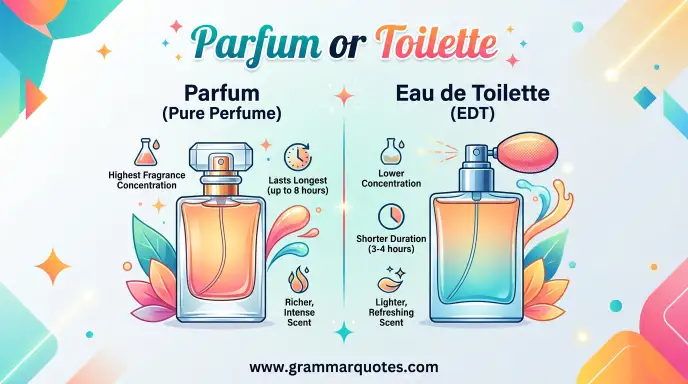
Parfum usually has a higher fragrance concentration and lasts longer than Eau de Toilette, while Eau de Toilette is lighter and often more suitable for everyday wear. Both are types of fragrance, but they differ in concentration, strength, longevity, and typical use.
Many people search for parfum or toilette when they are choosing between two fragrance bottles and want to know which one is stronger or lasts longer.
The wording can also be confusing because the full term is usually Eau de Toilette, while parfum may also be called Eau de Parfum (EDP) depending on the product.
The difference is mainly about the amount of aromatic fragrance material in the formula. However, concentration is not the only factor that affects how long a fragrance lasts. Skin type, weather, ingredients, and application can also influence the experience.
In this guide, we will explain parfum or toilette in simple English, compare their meanings and uses, discuss their history, and show which term is appropriate in different situations.
Parfum or Toilette : Quick Answer
Parfum generally refers to a fragrance with a higher concentration of aromatic compounds, while Eau de Toilette usually has a lower concentration and feels lighter.
In simple terms:
- Parfum: richer, stronger, and often longer lasting.
- Eau de Toilette: lighter, fresher, and often suited to daytime or casual use.
For example:
“I prefer parfum because I want a stronger fragrance.”
“I wear Eau de Toilette during the day because it feels lighter.”
The exact strength and longevity can vary between fragrances, so the name alone does not guarantee how long a product will last.
Parfum and Toilette : Definition and Meaning
What Does Parfum Mean?
Parfum is a fragrance category traditionally associated with a relatively high concentration of aromatic compounds.
It is also commonly called:
- Extrait de Parfum
- Parfum
- Pure perfume
Parfum is often richer and more concentrated than lighter fragrance types.
What Does Eau de Toilette Mean?
Eau de Toilette, often shortened to EDT, is a lighter fragrance concentration.
The French phrase literally relates to “toileting” or personal grooming, but in modern English, Eau de Toilette simply refers to a type of fragrance.
It is commonly used for:
- Everyday wear
- Daytime occasions
- Warm weather
- Casual settings
Parfum vs Eau de Toilette: Main Difference
The main difference is fragrance concentration.
Parfum generally contains more aromatic fragrance material than Eau de Toilette. This can make it feel richer and potentially last longer.
Eau de Toilette usually contains less fragrance material and is often perceived as lighter and fresher.
| Feature | Parfum | Eau de Toilette |
| Common abbreviation | Parfum | EDT |
| Concentration | Generally higher | Generally lower |
| Character | Richer | Lighter |
| Longevity | Often longer | Often shorter |
| Best for | Evening, special occasions | Everyday and daytime use |
| Price | Often higher | Often lower |
| Sillage | Often stronger | Often lighter |
These are general differences. Individual fragrances can perform differently depending on their ingredients and formulation.
The Origin of Parfum and Eau de Toilette
The history of perfume goes back thousands of years. Ancient civilizations used fragrant oils, plants, resins, and other materials for personal, cultural, and religious purposes.
The modern perfume industry developed strongly in Europe, particularly in France. French terminology became widely used in the fragrance world.
The word parfum comes from French and is related to the idea of fragrance or scent.
Eau de Toilette is also French. “Eau” means water, while “toilette” historically relates to personal grooming or dressing.
Today, these French terms are used internationally on fragrance packaging.
Is Parfum Stronger Than Eau de Toilette?
Generally, yes. Parfum usually has a higher concentration of aromatic compounds than Eau de Toilette.
However, “stronger” can mean different things.
A fragrance can have:
- Higher concentration
- Stronger projection
- Longer longevity
- More noticeable opening notes
These qualities are related but are not exactly the same.
A high concentration fragrance does not automatically smell stronger to every person.
DoesEau de Toilette Last Longer Than Parfum?
Parfum often lasts longer than Eau de Toilette, but there is no universal fixed duration.
Longevity depends on several factors, including:
- Fragrance ingredients
- Skin chemistry
- Weather
- Humidity
- Application
- Product formulation
For this reason, it is better to say that parfum tends to last longer, rather than claiming that every parfum will always outlast every EDT.
Which lasts longer, parfum or toilette?
In general, parfum lasts longer, because it usually contains a higher concentration of aromatic compounds. However, individual formulas can behave differently.
Eau de Toilette or Parfum for Everyday Wear?
Both can work for everyday wear.
Eau de Toilette is often preferred for daytime because its lighter character can feel comfortable in offices, schools, casual outings, and warm weather.
Parfum may be preferred when someone wants a richer fragrance or longer lasting scent.
There is no universal rule. Personal preference and the environment matter.
Is Eau de Toilette weaker than parfum?
Usually, yes. EDT generally has a lower concentration of aromatic compounds than parfum.
But weaker does not mean worse. A lighter fragrance can be exactly what someone wants for daily use.
Parfum or Toilette for Summer?
Eau de Toilette is often a popular choice in warm weather because lighter fragrances can feel fresher.
Parfum can also be worn in summer, but the fragrance’s ingredients and overall composition matter.
Fresh citrus, aquatic, green, and aromatic scents may feel different from heavy woody, sweet, or spicy compositions.
The best choice depends on the individual fragrance rather than the label alone.
Parfum or Toilette for Winter?
Parfum can be a popular choice during colder months because richer fragrances can work well in cool weather.
However, Eau de Toilette can also be suitable for winter.
There is no strict seasonal rule. The fragrance’s notes and composition are more important than simply choosing a concentration.
Common Mistakes with Parfum or Toilette
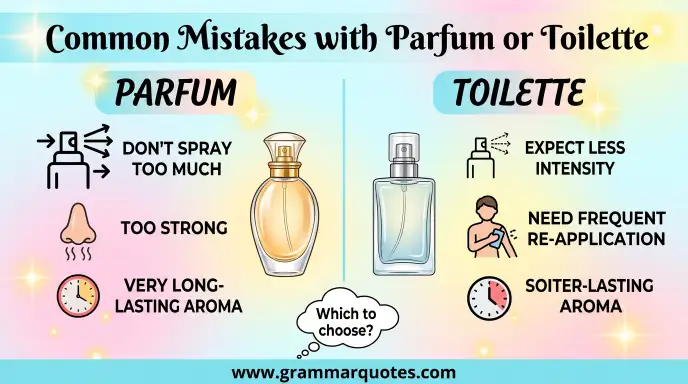
Mistake 1: Thinking Parfum Always Lasts Exactly the Same Amount of Time
Fragrance longevity varies between products.
Better: Say that parfum generally tends to last longer.
Mistake 2: Thinking EDT Means Low Quality
Eau de Toilette is not a lower quality version simply because it has a lower concentration.
It is a different fragrance concentration and can be designed intentionally to feel lighter.
Mistake 3: Thinking Stronger Means Better
A stronger fragrance is not automatically better.
Some people prefer subtle scents, while others prefer richer fragrances.
Mistake 4: Confusing Eau de Parfum With Parfum
Eau de Parfum (EDP) and Parfum are related fragrance categories but are not necessarily identical.
Parfum generally has a higher concentration than EDP, although exact concentrations vary by brand and formulation.
Parfum or Toilette in Everyday Examples
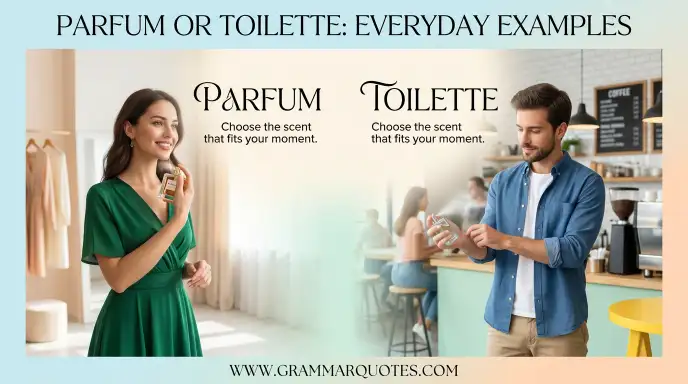
Here are natural examples:
- I bought a new parfum for special occasions.
- She prefers Eau de Toilette for daytime.
- This parfum has a rich scent.
- His EDT feels fresh and light.
- Which should I buy, parfum or Eau de Toilette?
- The Eau de Toilette is perfect for a casual outing.
- I usually choose parfum when I want longer lasting fragrance.
How do you say Eau de Toilette?
Eau de Toilette is a French phrase. In English conversation, it is commonly pronounced approximately as “oh duh twah LET.”
The exact French pronunciation is different, but this English approximation is widely understandable.
British English vs American English
There is no major spelling difference between parfum and Eau de Toilette in British and American English.
| Term | British English | American English |
| Parfum | Parfum | Parfum |
| Eau de Parfum | EDP | EDP |
| Eau de Toilette | EDT | EDT |
| Perfume | Perfume | Perfume |
| Fragrance | Fragrance | Fragrance |
The terms are international fragrance vocabulary, so the same labels are commonly found in both varieties of English.
Which One Should You Use: Parfum or Toilette?
Use parfum when you are referring to the more concentrated fragrance category.
Use Eau de Toilette or EDT when referring to the lighter fragrance category.
If you are writing about the general topic, “parfum or Eau de Toilette” is clearer than simply saying “parfum or toilette”, because toilette by itself does not normally mean the fragrance.
For example:
Less precise:
“Which is better, parfum or toilette?”
More precise:
“Which is better, parfum or Eau de Toilette?”
Parfum or Toilette : Google Trends and Usage Data
Search interest for parfum, perfume, Eau de Parfum, and Eau de Toilette can vary by country and season.
People often search these terms when comparing fragrance types, shopping for perfumes, or trying to understand labels on fragrance bottles.
Search behavior can also change around holidays, gift giving seasons, and major fashion or fragrance launches.
Because Google Trends interest changes over time and differs between countries, specific trend results should be checked for the target country and date range rather than assuming one term is always more popular.
People Also Ask Questions About Parfum or Toilette
1. Is parfum better than Eau de Toilette?
Not necessarily. Parfum is generally more concentrated, while EDT is lighter. The better choice depends on personal preference and occasion.
2. Which lasts longer, parfum or toilette?
Parfum generally lasts longer than Eau de Toilette, although the actual performance varies by fragrance.
3. Is parfum stronger than Eau de Toilette?
Usually, parfum is more concentrated, so it may feel richer or stronger. However, concentration does not always equal stronger projection.
4. Is Eau de Toilette good for everyday use?
Yes. Its lighter character makes it a common choice for everyday and daytime wear.
5. Is parfum good for special occasions?
It can be. Its richer and more concentrated character can suit evening events and special occasions.
6. What does EDT stand for in perfume?
EDT stands for Eau de Toilette.
7. What does parfum mean in perfume?
Parfum refers to a relatively highly concentrated fragrance category.
8. Is Eau de Toilette cheap perfume?
No. Price and quality are not determined simply by if a fragrance is EDT or parfum.
9. Can I wear parfum every day?
Yes. Parfum can be worn every day if you enjoy its scent and intensity.
10. What is the difference between EDP and EDT?
Eau de Parfum generally has a higher fragrance concentration than Eau de Toilette, although exact concentrations vary between products.
Frequently Asked Questions
What is the simplest difference between parfum and EDT?
Parfum is generally more concentrated and longer lasting, while EDT is usually lighter and fresher.
Is parfum the same as perfume?
The words can overlap in everyday English, but parfum can also refer specifically to a fragrance concentration/category.
Is Eau de Toilette a type of perfume?
Yes. Eau de Toilette is a type of fragrance.
Which is more expensive, parfum or EDT?
Parfum is often more expensive because it generally contains a higher concentration of aromatic fragrance material, but prices vary by brand and product.
Does higher concentration always mean longer lasting?
No. Concentration is important, but ingredients, formulation, skin, and environment also affect longevity.
Can Eau de Toilette smell better than parfum?
Yes. “Better” is subjective. Someone may prefer the lighter character of an EDT over a richer parfum.
Should I buy parfum or Eau de Toilette?
Choose based on the fragrance you enjoy, the setting, your preferred intensity, and how you want the fragrance to perform.
Parfum or Toilette : Final Comparison
| Question | Parfum | Eau de Toilette |
| Higher concentration? | Generally yes | Generally lower |
| Usually longer lasting? | Often | Usually less |
| Lighter feeling? | Usually less | Usually more |
| Good for daytime? | Yes | Yes |
| Good for evening? | Yes | Yes |
| Good for warm weather? | Depends on scent | Often suitable |
| Good for cold weather? | Often suitable | Also possible |
| Usually more expensive? | Often | Often less expensive |
Conclusion
When comparing parfum or toilette, the key difference is fragrance concentration. Parfum generally contains a higher concentration of aromatic compounds and often provides a richer, longer lasting fragrance experience. Eau de Toilette, or EDT, usually has a lower concentration and is often lighter and fresher.
However, concentration does not tell the whole story. The ingredients, formulation, skin chemistry, weather, and application can all affect how a fragrance smells and how long it lasts. This means an EDT can be an excellent choice even if someone wants a pleasant and noticeable fragrance.
For everyday and daytime use, many people enjoy the lighter feel of Eau de Toilette. For a richer scent or longer wear, parfum may be preferred. Neither option is automatically better.
One important point is that “toilette” alone is not normally the correct name for the fragrance category. The full term is Eau de Toilette. Therefore, when writing about the comparison, “Parfum or Eau de Toilette” is the clearest wording.
Discover More Articles!
Dig or Die: Meaning, Usage & Examples(2026)
Absents or Absence: Meaning, Difference & Examples(2026)
Unbalanced or Imbalanced: Meaning, Differences & Examples

Ethan Parker is an English-language writer known for his interest in words, language, and clear communication. His work focuses on making everyday English easier to understand through simple explanations and practical examples.