English has many words that look almost the same but are used in slightly different ways. Unbalanced or imbalanced is one of those confusing pairs.
Both forms are correct, and both can describe something that is not in balance. The real question is: when should you choose one over the other?
People often search for this comparison because the two adjectives can work in similar sentences. For example, you may hear about an unbalanced diet, an imbalanced diet, an unbalanced load, or an imbalanced distribution. This can make it hard to know which form sounds natural.
The good news is that you do not need to memorize a long grammar rule. The main difference is often about meaning, context, and common usage.
One form is more common when talking about stability, while the other often appears when discussing unequal amounts, proportions, systems, or distributions.
This guide explains the difference in clear English. You will learn where each form comes from, how American and British English use them, which one works best in formal writing, and how to avoid common mistakes.
Imbalanced or Unbalanced : Quick Answer
Both words are correct.
The easiest way to remember the difference is this:
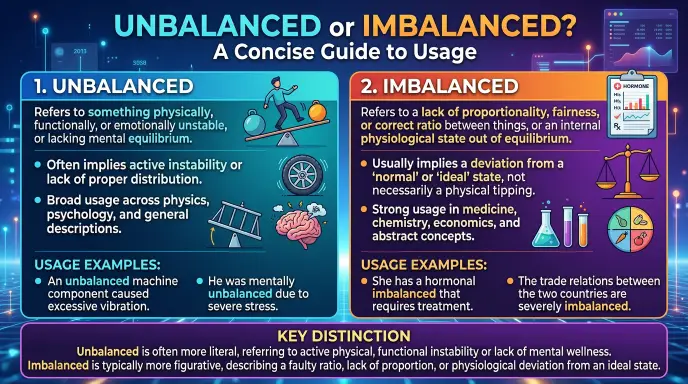
- Unbalanced often describes something that lacks stability, equilibrium, or fairness.
- Imbalanced often describes something that has an unequal distribution, ratio, or proportion.
However, the meanings overlap. They are sometimes interchangeable.
Examples
Unbalanced:
The washing machine became unbalanced during the spin cycle.
Here, the focus is on physical stability.
Imbalanced:
The company has an imbalanced distribution of workers.
Here, the focus is on unequal distribution.
Another example is a diet:
She has an unbalanced diet.
This is a very familiar expression.
You may also see:
She has an imbalanced diet.
This is understandable and grammatically acceptable, but the first version is often more natural in everyday English.
So, do not treat the two words as strict opposites. Think about what kind of balance is missing.
The Origin of Unbalanced or Imbalanced
The two forms come from different English prefix patterns.
Unbalanced is formed by adding un to “balanced.” The prefix un commonly means “not” or “the opposite of.” Similar examples include:
- unhappy
- unfair
- unclear
- unstable
- unnecessary
The word therefore has a simple structure:
un + balanced = unbalanced
The form imbalanced uses im , which is related to the prefix in . English changes in to forms such as im before certain sounds. You can see a similar pattern in words such as:
- impossible
- impatient
- immature
- imperfect
Its structure is:
im + balanced = imbalanced
Historical word formation helps explain why both forms exist. English has borrowed and developed words from several language traditions, so it does not always use one single prefix for every negative meaning.
Modern dictionaries recognize both forms. Wiktionary, for example, defines the first as “not balanced” and the second as experiencing an imbalance or being out of balance.
The important point is simple: neither spelling is a mistake.
British English vs American English Spelling
There is no simple rule saying that one form belongs only to British English and the other belongs only to American English.
Both varieties can use both adjectives.
The difference is more strongly connected to context and common collocations than to spelling rules.
In everyday English, “unbalanced” is a long established form. It is common when describing physical objects, people, arguments, accounts, and situations.
For example:
- an unbalanced chair
- an unbalanced machine
- an unbalanced argument
- an unbalanced account
- an unbalanced view
The other form is especially useful when the focus is on unequal distribution or proportion.
Examples include:
- an imbalanced dataset
- imbalanced resources
- imbalanced hormone levels
- an imbalanced system
- an imbalanced distribution
Modern technical and professional writing often uses the second form in specialized contexts.
Comparison Table
| Feature | Unbalanced | Imbalanced |
| Basic idea | Not balanced | Experiencing an imbalance |
| Physical stability | Very common | Possible |
| Unequal distribution | Possible | Very common |
| Everyday English | Very common | Less common |
| Technical writing | Common | Often preferred |
| Data science | Less typical | Very common |
| Emotional stability | Common | Less natural |
| One sided argument | Common | Possible |
| Diet | Very common | Also possible |
| Ratio or distribution | Possible | Often natural |
The key difference is not a strict grammar rule. It is the context in which each form sounds most natural.
Which Spelling Should You Use?
The best choice depends on your audience and the subject you are discussing.
For American English
American writers can use either form. However, imbalanced is common in technical, scientific, medical, financial, and data related contexts.
For example:
The model was trained on an imbalanced dataset.
This sounds natural in data science.
For physical stability, “unbalanced” remains a strong choice:
The machine stopped because the load was unbalanced.
For British English
British English also accepts both forms. “Unbalanced” is very familiar in general writing.
For example:
The report gave an unbalanced view of the issue.
This sounds natural because the word describes a lack of fairness or equal treatment.
For Commonwealth English
Readers in countries such as Australia, New Zealand, and Canada will understand both forms.
The safest approach is to follow the vocabulary normally used in your field.
For a Global Website
If your website targets readers around the world, focus on clarity rather than forcing a regional preference.
Choose the form that best matches the context.
For example:
- physical stability → unbalanced
- emotional stability → unbalanced
- one sided argument → unbalanced
- unequal data classes → imbalanced
- unequal distribution → imbalanced
- uneven resources → imbalanced
This approach is more useful than saying that one form is always British and the other is always American.
Common Mistakes with Imbalanced or Unbalanced
Many mistakes happen because writers assume the two words have completely separate meanings.
They do not.
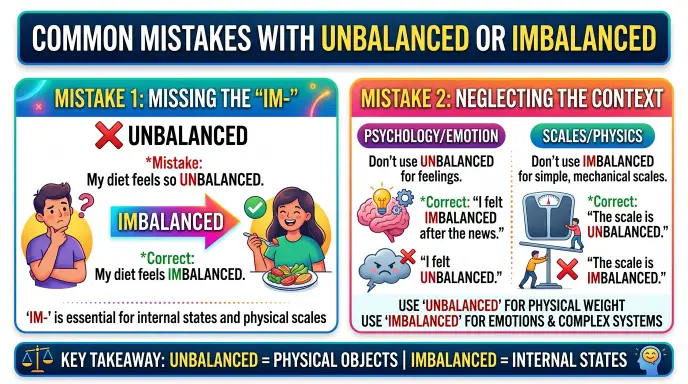
Mistake 1: Thinking One Word Is Incorrect
Some people believe “imbalanced” is not a real English word.
That is incorrect. It is a recognized adjective and is widely used, especially in technical and professional contexts.
Mistake 2: Assuming They Are Always Interchangeable
Although the meanings overlap, one form can sound much more natural in a particular phrase.
For example:
The washing machine is unbalanced.
This is more natural than:
The washing machine is imbalanced.
The first sentence clearly describes physical stability.
Mistake 3: Using the Technical Form Everywhere
A technical word is not always the best choice for everyday writing.
For example:
He has an imbalanced mind.
This sounds unusual and can also sound insensitive.
A more natural phrase is:
He seems emotionally unbalanced.
Mistake 4: Confusing “Imbalance” and “Unbalance”
The noun imbalance is extremely common:
There is an imbalance between supply and demand.
It is also common in phrases such as:
- hormonal imbalance
- power imbalance
- trade imbalance
- chemical imbalance
“Unbalance” exists as a word, but it is much less common as a noun in modern English.
Mistake 5: Ignoring the Subject
Always ask yourself what you are describing.
Is it:
- physically unstable?
- emotionally unstable?
- unfair?
- unevenly distributed?
- statistically skewed?
- unequal in proportion?
Your answer will usually guide you toward the more natural form.
Unbalanced or Imbalanced in Everyday Examples
Context makes the difference much easier to understand.
In Emails
Imagine an employee writes:
I think the workload is unbalanced across the team.
This sounds natural and focuses on fairness.
A more formal version could be:
The workload is imbalanced across departments.
The second sentence sounds more analytical.
In News Writing
News reports may use either form depending on the subject.
For example:
Critics said the debate was unbalanced because one side received more speaking time.
Here, the focus is fairness.
For economic reporting, you may see:
The country faces an imbalanced trade relationship.
Here, the focus is unequal distribution.
In Social Media
Everyday users tend to prefer familiar language:
My diet has been completely unbalanced this week.
This sounds natural and conversational.
A technical discussion might use:
The dataset is highly imbalanced.
In Formal Writing
Professional writing should favor precision.
For example:
The study examined an imbalanced distribution of participants.
But:
The equipment became unbalanced during testing.
Both sentences are clear because each word matches the situation.
In Academic Writing
Academic writers often choose vocabulary based on their field.
Statistics and machine learning commonly use imbalanced data or imbalanced datasets when one class has far more examples than another.
On the other hand, chemistry commonly uses unbalanced equation when an equation has not yet been balanced.
This shows why context matters more than a simple US versus UK rule.
Imbalanced or Unbalanced : Google Trends & Usage Data
Search interest around these two forms usually comes from people who see both versions in different contexts.
The exact popularity can change by country, industry, and search period. More importantly, general English and specialist English use the forms differently.
Unbalanced has a long history and broad everyday use. It can describe physical objects, opinions, accounts, emotional states, and many other situations. Dictionary sources list several established meanings, including lack of equilibrium, unfair presentation, and accounting differences.
Imbalanced is strongly associated with situations involving unequal proportions or distributions. It is common in areas such as statistics, business, health, economics, and science.
This creates an important search pattern:
General English → “unbalanced” is often the familiar choice.
Technical English → “imbalanced” often appears more naturally.
For writers, this distinction matters. A page should not force one word into every sentence simply to increase keyword frequency. Search engines understand related terms and context. Clear writing is more useful for readers.
So, if your article explains the difference, use natural examples rather than repeating the same phrase again and again.
Imbalanced vs Unbalanced: Side by Side Comparison
| Situation | More Natural Choice | Example |
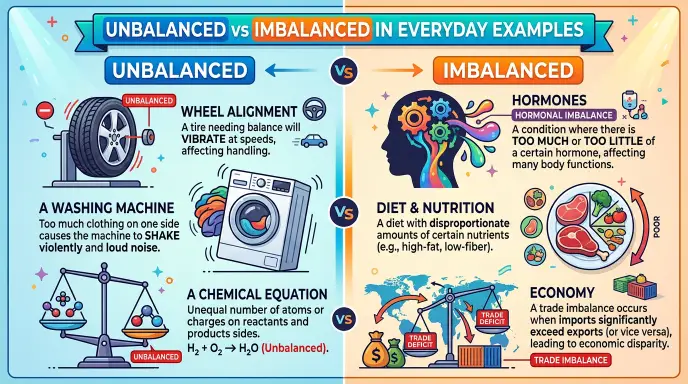
| Physical object | Unbalanced | The table is unbalanced. |
| Washing machine | Unbalanced | The load became unbalanced. |
| Emotional state | Unbalanced | He seemed emotionally unbalanced. |
| One sided argument | Unbalanced | The article presented an unbalanced view. |
| Diet | Unbalanced | He follows an unbalanced diet. |
| Data science | Imbalanced | The dataset is imbalanced. |
| Unequal distribution | Imbalanced | The resources are imbalanced. |
| Trade | Imbalanced | The trade relationship is imbalanced. |
| Hormone levels | Imbalanced | The test showed imbalanced hormone levels. |
| Financial proportions | Imbalanced | The portfolio is imbalanced. |
| Chemistry equation | Unbalanced | The equation is unbalanced. |
| General “not balanced” meaning | Either | Both forms may work. |
The table shows the main pattern: stability and everyday situations often favor “unbalanced,” while distribution and technical contexts often favor “imbalanced.”
A Simple Trick to Remember the Difference
Use this mental picture:
Think about a person standing on one foot.
If the person cannot stay steady, think unbalanced.
Now imagine two boxes containing different amounts of weight.
If one box has much more than the other, think imbalanced.
So:
Stability → unbalanced
Distribution → imbalanced
This is not an absolute grammar rule, but it is a useful memory trick.
Another useful clue is the noun imbalance.
If you would naturally say:
There is an imbalance in the system.
Then imbalanced may also fit:
The system is imbalanced.
However, some fixed phrases have their own established patterns. That is why common usage still matters.
Unbalanced vs Imbalanced vs Uneven
There is another word worth considering: uneven.
“Uneven” is often the simplest choice when you only want to say that things are not equal.
For example:
The results were uneven.
This could mean the results were inconsistent.
Compare:
The distribution was imbalanced.
This focuses more on unequal proportions.
And:
The machine was unbalanced.
This focuses on physical stability.
These words overlap, but they are not always interchangeable.
Quick Guide
| Word | Main Idea |
| Unbalanced | Lack of balance or stability |
| Imbalanced | Unequal proportion or distribution |
| Uneven | Not equal, smooth, or consistent |
| Unstable | Likely to change, move, or fail |
Choosing the most precise word can make your writing sound more natural.
Frequently Asked Questions
1. Is “imbalanced” a correct English word?
Yes. It is a correct and established English adjective. It is especially common in technical, scientific, business, health, and data related writing.
2. Are unbalanced and imbalanced synonyms?
Yes, they can be synonyms in many situations. However, their common uses differ. The first often focuses on stability or equilibrium, while the second often focuses on unequal distribution or proportion.
3. Which word is more common in everyday English?
“Unbalanced” is generally the more familiar everyday form. It has a broad range of uses, including physical, emotional, financial, and figurative meanings.
4. Should I say “unbalanced diet” or “imbalanced diet”?
Both can be understood and used. “Unbalanced diet” is a very familiar phrase in general English. In a technical or clinical context, “imbalanced” may also appear.
5. Which word should I use for a dataset?
Use imbalanced when talking about a dataset where the classes are distributed unevenly.
For example:
The machine learning model was trained on an imbalanced dataset.
This is the standard technical expression.
6. Is an unbalanced equation correct?
Yes. “Unbalanced equation” is a standard phrase, especially in chemistry.
For example:
The student needs to balance the unbalanced chemical equation.
7. What is the noun form?
The most common noun is imbalance.
Examples include:
- an imbalance of power
- a hormonal imbalance
- an economic imbalance
- an imbalance between supply and demand
“Unbalance” exists but is much less common as a modern noun.
8. Which form should I use in professional writing?
Choose based on meaning. Use the form that matches the normal terminology of your field. For data, statistics, distribution, and some scientific contexts, “imbalanced” is often natural. For physical stability, fairness, and everyday situations, “unbalanced” is often better.
Final Verdict: Which One Should You Choose?
Both forms are correct, but they are not equally natural in every situation. The best choice depends on what you mean.
Use unbalanced when you are talking about physical stability, emotional stability, one sided views, or common everyday situations. Examples include an unbalanced machine, an unbalanced argument, and an unbalanced diet.
Use imbalanced when the main idea is unequal distribution, proportion, or a system that has too much of one element and too little of another. This form is especially useful in technical areas such as statistics, data science, finance, business, and some health contexts.
There is also no need to treat this as a strict British versus American spelling issue. Both varieties of English use both forms. Context and common usage are more important.
If you are writing for a broad audience, choose the word that sounds most natural for the sentence. Do not repeat one form simply because you think it is more correct. Clear, precise writing is the better goal.
In short: think “stability” for unbalanced and “unequal distribution” for imbalanced.
Discover More Articles!
Or vs Er: Which Suffix Is Correct?(2026)
LP or LLC: Which Business Structure Is Better?
Alpha or Beta: Meaning, Differences, and Usage(2026)

Ethan Parker is an English-language writer known for his interest in words, language, and clear communication. His work focuses on making everyday English easier to understand through simple explanations and practical examples.