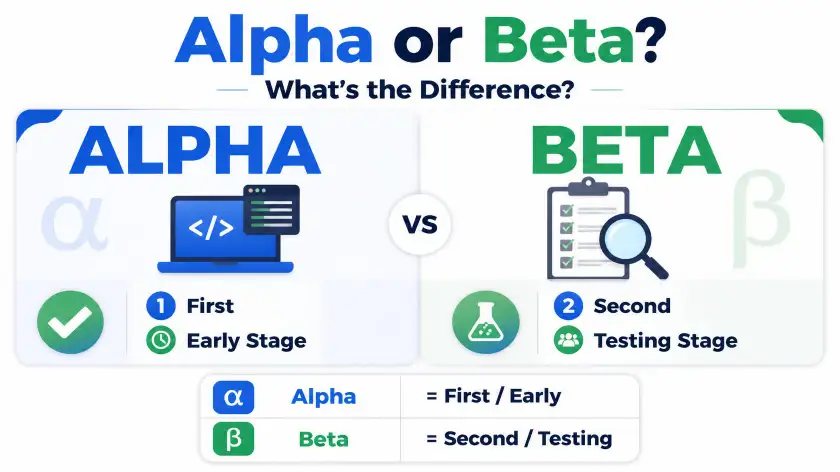
When you see the terms alpha and beta, it can be hard to know what they mean or which one comes first. The words are often used to describe stages, types, qualities, or positions, but their meaning depends on the context.
In simple terms, alpha usually refers to the first, leading, or earlier stage, while beta often refers to the second stage or a version that comes after an initial development phase.
However, this is not always the meaning. In science, technology, mathematics, finance, and everyday language, the two terms can have different uses.
This guide explains the difference in plain English. You will learn where these words come from, how they are used, when each term is appropriate, and what common mistakes to avoid. You will also see practical examples from software, business, education, and daily communication.
By the end, you should be able to understand the terms quickly and choose the right one for your context.
Alpha or Beta: The Simple Answer
Alpha generally means the first, leading, or initial stage, while beta commonly refers to the next stage or a testing version. The exact meaning depends on the subject. For example, an alpha release usually comes before a beta release in software development.
The easiest way to remember the basic relationship is:
Alpha → earlier or first stage
Beta → later or second stage
However, these words do not always describe quality. Something called “alpha” is not automatically better, and something called “beta” is not necessarily worse.
Alpha or Beta : Quick Answer
If you are comparing the two terms, think about sequence and context.
- Alpha can mean first, beginning, or leading.
- Beta can mean second, following, or testing.
- In software, alpha testing normally happens before beta testing.
- In finance, beta has a specific meaning related to market movement.
- In science, both words can identify different forms, particles, or stages.
- In everyday speech, “alpha” may describe a dominant or leading person.
So, there is no single definition that works in every situation.
Examples
Software:
“The app is still in alpha testing.”
Later testing stage:
“The company released a beta version to selected users.”
Leadership:
“He was seen as the alpha member of the group.”
The context tells you which meaning applies.
What Do These Terms Mean?
Both words come from the Greek alphabet.
Alpha is the first letter of the Greek alphabet. Because it comes first, it has long been associated with ideas such as beginning, first position, and leadership.
Beta is the second letter. This gives it a natural connection with something that follows the first stage.
That basic sequence explains many modern uses. For example, software companies may use these labels to show that a product has moved from an early development phase into a broader testing phase.
But context matters.
In some subjects, the terms are simply labels. They do not necessarily mean “good” and “bad” or “strong” and “weak.”
A useful way to think about them
| Term | Basic idea | Common association |
| Alpha | First or initial | Beginning, early stage, leading |
| Beta | Second or following | Testing, later stage, next step |
This is only a general guide. Specialized fields can give the terms more precise meanings.
The Origin of the Terms
The words come from the Greek alphabet.
Alpha comes from the Greek letter alpha, which is the first letter. Beta comes from beta, the second letter.
Their position in the alphabet helped make them useful labels for different stages and categories.
Over time, these terms moved beyond the Greek alphabet. Scientists, engineers, mathematicians, software developers, and business professionals began using Greek letters to name concepts, variables, stages, and categories.
This is why you may see the same words in very different subjects.
For example, a software developer might talk about an alpha build, while a financial analyst might discuss a company’s beta. These are not interchangeable meanings.
The spelling has remained fairly stable in English, but pronunciation and meaning can vary depending on the field and region.
British English vs American English
There is no major British American spelling difference for these terms. Both varieties of English generally use alpha and beta.
| British English | American English | Example |
| alpha | alpha | The software is in alpha testing. |
| beta | beta | A beta version was released. |
| alpha version | alpha version | The team tested an early version. |
| beta version | beta version | Users tried the public test version. |
The main differences you may notice are related to pronunciation, style, or context, rather than spelling.
Both forms are acceptable in:
- Academic writing
- Technical documentation
- Business communication
- News articles
- Educational content
- General English
If you are writing for an international audience, the standard spellings are safe choices.
Which Version Should You Use?
The answer depends less on geography and more on what you are talking about.
United States
Use the standard forms alpha and beta. They are common in technology, science, finance, and education.
United Kingdom
The same spellings are used. British publications and academic texts regularly use both terms.
Canada
Canadian English also follows the standard spellings. The surrounding terminology may depend on the subject.
Australia
Australian English uses the same forms as well. No special spelling change is normally needed.
International Writing
For a global audience, keep the terms in their standard form. Add a short explanation if your readers may not know the technical meaning.
For example:
“The product is in beta, meaning it is being tested by a wider group of users.”
That is clearer than assuming every reader understands the term.
Academic Writing
In academic work, define the term when it has a specialized meaning. Do not assume that a reader will interpret it in the same way across different disciplines.
Business Writing
Use the terminology that fits your industry. In a business report, unexplained technical labels can make a simple idea harder to understand.
Common Mistakes
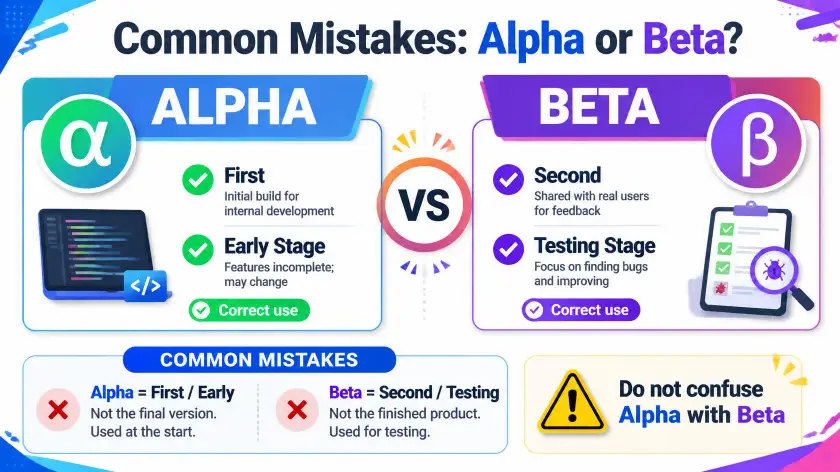
These words are easy to understand when the context is clear, but several mistakes appear often.
Mistake 1: Treating them as exact opposites
Incorrect idea:
“Alpha means good, and beta means bad.”
Better understanding:
They often describe sequence, category, or function. Neither word automatically means good or bad.
Memory tip:
Think first → second, not better → worse.
Mistake 2: Assuming beta always means unfinished
In technology, a beta product is often still being tested. But the word has many other meanings.
For example:
“The stock has a high beta.”
Here, the term relates to financial risk and market movement. It has nothing to do with software testing.
Mistake 3: Using “alpha” only for people
You may hear phrases about an “alpha” person or leader. However, the term is also widely used in science, technology, statistics, and other fields.
Mistake 4: Confusing stage labels
In software development, an alpha release generally comes before a beta release.
A simplified sequence might look like:
Development → Alpha → Beta → Release
Not every company follows exactly the same process, but this is a useful general model.
Everyday Examples
Understanding these words becomes easier when you see them in real situations.
Emails
“The new feature is still in alpha, so please do not share it outside the team.”
Here, the word indicates an early development stage.
Business Writing
“The company is testing a beta version of its new platform.”
This suggests that a later testing version is being evaluated.
News Headlines
“Startup launches beta program for new app.”
The headline tells readers that the product is available for testing.
Blogs
“The tool is currently in beta, so some features may change.”
This gives readers useful information about the product’s development status.
Social Media
“I finally got access to the beta!”
Here, the speaker is talking about an early access testing version.
Academic Writing
“The study examines the relationship between alpha and beta variables.”
In this case, the terms may have specialized meanings defined by the research.
Daily Conversation
“He’s considered the alpha of the group.”
Here, the word is being used informally to suggest leadership or dominance.
How the Meaning Changes by Context
One of the most important lessons is that these words should not be understood in isolation.
In software
Alpha and beta usually describe stages of product testing.
- Alpha: earlier internal testing
- Beta: broader testing before a final release
In finance
Beta measures how strongly an investment tends to move in relation to a broader market benchmark.
For example, a beta above 1 is commonly interpreted as indicating greater sensitivity to market movements, while a beta below 1 indicates lower sensitivity.
In science
Greek letters are frequently used as labels. Their meaning depends on the particular field.
You may encounter alpha and beta when studying physics, chemistry, biology, or medicine.
In statistics and mathematics
Greek letters often represent variables, parameters, coefficients, or other mathematical concepts.
The meaning must be taken from the equation or explanation where the symbol appears.
In social language
“Alpha” can describe someone perceived as dominant, confident, or influential. This is a more informal use and should not automatically be treated as a scientific description of personality.
Google Trends & Modern Usage

People search these terms for many different reasons. Some are trying to understand software releases, while others encounter the words in finance, science, gaming, psychology, or everyday discussions.
Search interest can also be driven by phrases such as:
- alpha vs beta
- alpha and beta meaning
- alpha or beta software
- alpha testing vs beta testing
- beta version meaning
- what does alpha mean
- what does beta mean
- alpha meaning in technology
Exact popularity changes over time and varies by region and topic. Without a specific Google Trends dataset and date range, it would be misleading to give precise search volume figures.
One clear pattern is that technology has made these terms especially familiar to general internet users. People often see “beta” when a company invites users to try a product before its full release.
The terms also remain important in academic and professional fields, where their meanings can be much more specific.
Quick Comparison Table
| Version | Meaning | Correct? | Region | Example |
| Alpha | First, initial, or leading stage | Yes | International | The product is in alpha testing. |
| Beta | Second, later, or testing stage | Yes | International | The app is now in beta. |
| Alpha version | Early development version | Yes | International | Developers tested the alpha version. |
| Beta version | Later testing version | Yes | International | Users received the beta version. |
| Alpha in finance | A measure related to investment performance | Yes | International | The analyst calculated the fund’s alpha. |
| Beta in finance | Sensitivity to market movements | Yes | International | The stock has a beta above 1. |
Key Takeaways
- Alpha is the first letter of the Greek alphabet.
- Beta is the second letter.
- Their basic relationship is first stage versus following stage.
- In software, alpha usually comes before beta.
- Neither term automatically means good or bad.
- Their meanings can change significantly by subject.
- British and American English use the same spellings.
- Always consider the context before interpreting either word.
FAQs
What is the main difference between alpha and beta?
The basic difference is their position in the Greek alphabet. Alpha comes first, while beta comes second. This sequence is often reflected in modern terminology, where alpha describes an earlier or initial stage and beta describes a later stage. However, specialized fields can give each term a completely different technical meaning.
Is alpha better than beta?
Not necessarily. Alpha and beta usually identify stages, categories, or concepts rather than quality levels. In software, an alpha version may be less developed than a beta version because it is normally tested earlier. But the terms do not mean “better” and “worse” in every context.
Does alpha come before beta?
Yes. Alpha is the first letter of the Greek alphabet, and beta is the second. This order is also commonly used when naming stages or categories. For example, software development may use alpha for an earlier testing phase and beta for a later testing phase.
What does beta mean in software?
In software, beta usually refers to a product or feature that is available for testing after an earlier development stage. A beta version may be given to employees, selected users, or the public. Developers use feedback from this stage to identify problems and improve the product before wider release.
What does alpha mean in software?
An alpha version is generally an early development version of software. It may still contain major bugs, incomplete features, or design changes. Alpha testing is often performed internally or by a limited group. The exact process varies between companies, so “alpha” should be treated as a general development label rather than a universal technical standard.
Are alpha and beta different in British and American English?
No significant spelling difference exists. British and American English both use alpha and beta. The terms are standard in both varieties. Differences are more likely to appear in pronunciation, surrounding vocabulary, or the particular field where the words are being used.
What does beta mean in finance?
In finance, beta has a specific meaning. It is commonly used to describe how sensitive an investment is to movements in a broader market benchmark. A higher beta generally indicates greater sensitivity to market movements. This financial meaning is unrelated to beta software testing.
What does alpha mean in finance?
In finance, alpha commonly refers to the amount by which an investment’s performance differs from an appropriate benchmark after considering the relevant comparison. The exact calculation depends on the model being used. This is a technical financial meaning and is different from the everyday idea of being first or dominant.
Can alpha and beta be used for people?
Yes, especially in informal language. Someone may be described as an “alpha” person to suggest leadership, confidence, or dominance. However, this usage can be vague and is not a universal scientific classification of personality. In formal writing, it is better to explain the specific behavior or trait being discussed.
How can I remember the difference?
Use the Greek alphabet as your memory trick: alpha is first and beta is second. If you are talking about software, remember the common sequence alpha → beta → final release. When the words appear in science or finance, check the context because their technical meanings may be different.
Conclusion
The easiest way to understand these terms is to start with their place in the Greek alphabet. Alpha comes first, while beta comes second. That simple order explains why the words are often used for earlier and later stages.
In software, an alpha version is generally an early build, while a beta version is usually tested at a later stage.
In finance, science, mathematics, and other fields, however, the terms can have specialized meanings. Context is therefore more important than simply memorizing a single definition.
There is also no major British American spelling issue. Both forms are standard in English, so your choice should depend mainly on the subject and the audience.
When writing for general readers, give a short explanation if the term could be unclear. That small step makes technical writing much easier to follow.
Remember: alpha comes first, beta follows, but context decides what each term actually means.
Discover More Articles!
Swum or Swam: Common Mistakes and Easy Examples(2026)
Warp or Woof: What’s the Difference?
Kyoto or Tokyo: Which City Should You Visit?

Ethan Parker is an English-language writer known for his interest in words, language, and clear communication. His work focuses on making everyday English easier to understand through simple explanations and practical examples.