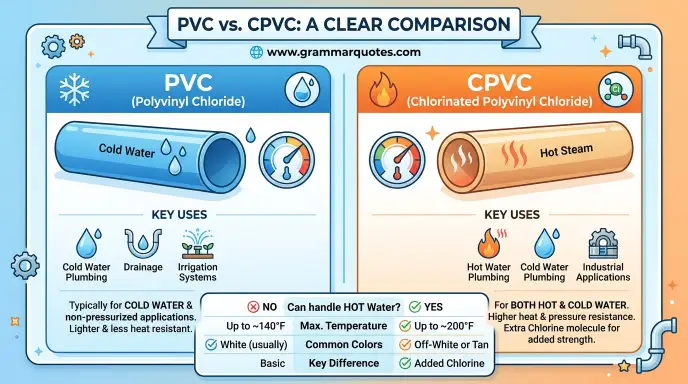
PVC and CPVC are both plastic materials commonly used for pipes and plumbing systems, but they are not exactly the same. PVC stands for polyvinyl chloride, while CPVC stands for chlorinated polyvinyl chloride.
The main difference is that CPVC has undergone an additional chlorination process, which allows it to handle higher temperatures than standard PVC.
Both materials are lightweight, durable, and resistant to corrosion. However, they are designed for somewhat different applications.
PVC is widely used for cold water plumbing, drainage, irrigation, electrical conduit, and other applications. CPVC is often selected for hot and cold water plumbing because it can tolerate higher temperatures.
Choosing between them depends on the type of system, temperature, pressure, local building requirements, and the manufacturer’s specifications. They may look similar, but they should not automatically be treated as interchangeable.
In this guide, you will learn their meanings, key differences, uses, temperature resistance, advantages, limitations, and how to choose the appropriate material for a project.
PVC or CPVC : Quick Answer
PVC and CPVC are both thermoplastic materials used in piping, but CPVC is designed to withstand higher temperatures.
| Feature | PVC | CPVC |
| Full name | Polyvinyl chloride | Chlorinated polyvinyl chloride |
| Temperature capability | Lower | Higher |
| Common use | Cold water, drainage, irrigation | Hot and cold water |
| Corrosion resistance | Good | Good |
| Weight | Lightweight | Lightweight |
| Material relationship | Standard PVC | Chlorinated form of PVC |
The most important point is simple:
PVC is commonly used for lower temperature applications, while CPVC is better suited to higher temperature plumbing.
Definition and Meaning
What Is PVC?
PVC stands for polyvinyl chloride. It is a widely used thermoplastic material found in pipes, fittings, electrical conduits, construction products, and many other applications.
PVC piping is popular because it is:
- Lightweight
- Durable
- Corrosion resistant
- Relatively easy to install
- Widely available
- Suitable for many low temperature applications
PVC is commonly used in drainage, irrigation, wastewater systems, and cold water applications where the specific product is rated for that use.
What Is CPVC?
CPVC stands for chlorinated polyvinyl chloride.
It is produced by adding chlorine to PVC’s polymer structure. This modification changes some of its properties and allows CPVC piping to handle higher temperatures than standard PVC.
CPVC is commonly used for:
- Hot water plumbing
- Cold water plumbing
- Residential plumbing systems
- Commercial plumbing
- Industrial applications
The exact temperature and pressure limits depend on the specific pipe, fitting, standard, and manufacturer.
The Origin of PVC and CPVC
PVC was developed from research into vinyl polymers during the early development of modern plastics. It later became widely used in construction and piping because of its durability and resistance to corrosion.
CPVC was developed by chlorinating PVC to improve its performance at higher temperatures.
This difference in processing is the main reason the two materials have different temperature capabilities.
Main Difference Between PVC and CPVC
The biggest difference is temperature resistance.
PVC is commonly used where temperatures remain relatively low, while CPVC is designed for applications involving higher temperatures.
For example, a PVC pipe may be suitable for a cold water system, while a CPVC pipe may be selected for a residential hot water line if the product is specifically rated for that application.
However, temperature is not the only factor. Pressure, chemical compatibility, pipe size, installation method, and applicable standards also matter.
CPVC vs PVC Temperature Resistance
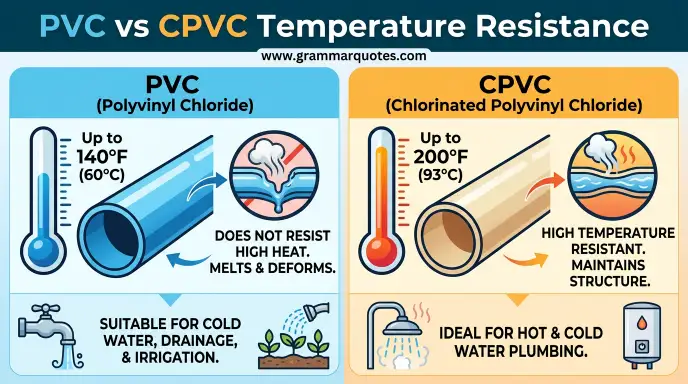
Temperature is one of the most important differences between the materials.
Standard PVC plumbing products generally have lower maximum operating temperatures than CPVC products. CPVC is specifically engineered to perform at higher temperatures.
This is why CPVC is commonly associated with hot water plumbing.
However, there is no single temperature limit that applies to every PVC or CPVC product. Different standards and manufacturers can specify different ratings.
Always check the product’s technical documentation before using either material in a particular system.
PVC for Cold Water
PVC is commonly used in systems carrying water at relatively low temperatures.
Common applications include:
- Cold water lines
- Irrigation
- Swimming pool systems
- Drainage
- Wastewater
- Certain industrial systems
Its suitability depends on the particular product and local requirements.
For a plumbing project, never assume that any PVC product is automatically suitable for drinking water or a particular pressure rating. The pipe and fittings should be specifically approved and rated for the intended application.
CPVC for Hot Water
CPVC is widely used for hot and cold water plumbing because its higher temperature capability makes it suitable for applications where standard PVC may not be appropriate.
It can be found in:
- Residential hot water systems
- Commercial plumbing
- Water distribution
- Industrial piping
- Certain process water systems
As with any piping material, the product’s specifications should be checked before installation.
Can PVC and CPVC Be Used Together?
PVC and CPVC are related materials, but that does not mean they should simply be connected together using ordinary PVC joining methods.
If a system requires a connection between different materials, use a connection method and fitting specifically designed and approved for that purpose.
Do not assume that the same cement or joining procedure is appropriate for every material.
Following manufacturer instructions and applicable plumbing codes is important.
Common Applications
PVC Applications
PVC is commonly found in:
- Drainage systems
- Sewer systems
- Irrigation
- Cold water applications
- Electrical conduit
- Pool piping
- Industrial piping
CPVC Applications
CPVC is commonly found in:
- Hot water plumbing
- Cold water plumbing
- Residential water distribution
- Commercial plumbing
- Industrial piping
- Fire sprinkler systems in applications where approved
The exact application depends on the pipe type, rating, standard, and local regulations.
Which One Is Stronger?
It is not accurate to simply say that one material is always “stronger.”
Performance depends on several factors, including:
- Temperature
- Pressure
- Pipe size
- Wall thickness
- Chemical exposure
- Installation conditions
- Product design
CPVC has an important advantage at higher temperatures, but that does not mean it is automatically the better choice for every application.
PVC can be an excellent option when its properties match the requirements of the system.
PVC or CPVC for Plumbing?
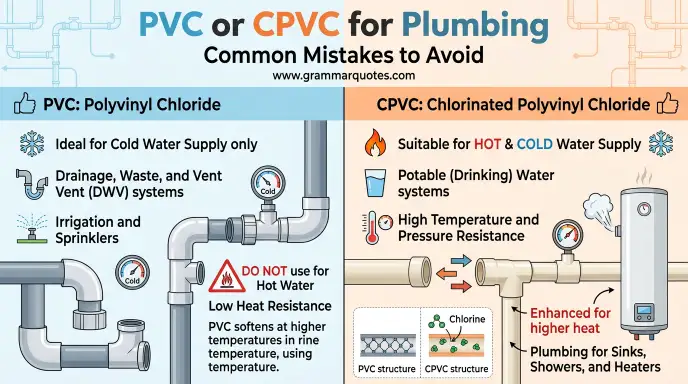
The correct choice depends mainly on the plumbing application.
Choose PVC when:
- The application involves relatively low temperatures.
- Drainage is required.
- Irrigation is involved.
- The specific pipe is rated for the intended water service.
- The system meets applicable local requirements.
Choose CPVC when:
- Hot water is involved.
- Higher operating temperatures are expected.
- The product is approved for the intended plumbing system.
- Its pressure and temperature ratings meet the project requirements.
A professional plumber or engineer can help determine the appropriate material when the application is uncertain.
Advantages of PVC
PVC has several useful characteristics.
Lightweight
PVC pipes are relatively light compared with many traditional piping materials.
Corrosion Resistant
PVC does not rust like metallic piping.
Easy to Handle
Its relatively low weight can make transportation and installation easier.
Versatile
PVC is used in many construction, drainage, irrigation, electrical, and industrial applications.
Cost Effective
Depending on the application and local market, PVC can provide an economical piping solution.
Advantages of CPVC
CPVC offers many of the same general benefits while providing higher temperature capability.
Higher Temperature Capability
This is one of its biggest advantages over standard PVC.
Corrosion Resistance
It does not rust in the same way that metal pipes can.
Lightweight
CPVC is also relatively lightweight and easy to handle.
Suitable for Hot Water
Its temperature performance makes it useful for many hot water plumbing systems.
Common Mistakes
One common mistake is assuming that PVC and CPVC are interchangeable.
They are related materials, but they have different properties and ratings.
Another mistake is choosing a pipe based only on appearance. The two materials can look similar, but their markings and specifications are important.
A third mistake is ignoring temperature and pressure requirements.
For example, selecting a material simply because it is inexpensive without checking if it is rated for hot water can create problems.
CPVC vs PVC in Everyday Examples
Here are some simple examples:
- PVC is commonly used for drainage systems.
- CPVC can be used for hot water plumbing when properly rated.
- PVC is widely used in irrigation systems.
- CPVC can handle higher temperatures than standard PVC.
- Both materials are lightweight.
- Both can resist corrosion.
- PVC and CPVC have different temperature ratings.
- The correct material depends on the application.
- Manufacturer specifications should be checked before installation.
- Local plumbing requirements may determine which product is acceptable.
British English vs American English
There is no major British American spelling difference between PVC and CPVC.
The abbreviations are used internationally:
- PVC = Polyvinyl chloride
- CPVC = Chlorinated polyvinyl chloride
Technical documents may use different product standards depending on the country, but the names themselves remain essentially the same.
PVC or CPVC for Drinking Water?
Both PVC and CPVC products can be manufactured for specific potable water applications, but not every pipe made from these materials is automatically approved for drinking water.
The important question is if the specific product is certified and rated for potable water service.
Always check:
- Product certification
- Manufacturer specifications
- Applicable plumbing codes
- Local regulations
The material name alone is not enough to establish suitability.
CPVC or PVC: Which One Should You Use?
There is no universal winner.
For a lower temperature application such as drainage or irrigation, PVC may be an appropriate choice if the product is properly rated.
For hot water plumbing, CPVC may be more suitable because it is designed to tolerate higher temperatures.
Other factors can also influence the decision, including:
- Cost
- Availability
- Temperature
- Pressure
- Chemical exposure
- Installation requirements
- Local building codes
- Manufacturer recommendations
The best material is the one that meets the technical requirements of the specific system.
CPVC vs PVC : Comparison Table
| Feature | PVC | CPVC |
| Full name | Polyvinyl chloride | Chlorinated polyvinyl chloride |
| Chlorination | No additional chlorination | Chlorinated |
| Temperature resistance | Lower | Higher |
| Cold water use | Common | Common |
| Hot water use | Generally not the standard choice | Common when properly rated |
| Drainage | Common | Less typical |
| Irrigation | Common | Possible depending on product |
| Corrosion resistance | Good | Good |
| Weight | Lightweight | Lightweight |
| Flexibility | Depends on product | Depends on product |
| Best known for | Drainage and lower temperature systems | Hot and cold water plumbing |
CPVC or PVC : Google Trends & Usage
Search interest for PVC and CPVC often depends on construction, plumbing, home improvement, and industrial applications.
PVC generally has broader usage because the material is found in many industries beyond plumbing. CPVC is more closely associated with plumbing systems, particularly applications involving hot water.
Searches may also increase when people are comparing pipe materials for home construction or repairs.
Because product specifications vary, technical searches such as “PVC temperature rating” or “CPVC pressure rating” can be more useful than simply comparing the names.
People Also Ask
1. What is the main difference between PVC and CPVC?
CPVC is a chlorinated form of PVC and is designed to handle higher temperatures.
2. Is CPVC stronger than PVC?
Not in every situation. CPVC has an important advantage in higher temperature applications, but strength depends on the specific product and conditions.
3. Can PVC be used for hot water?
Standard PVC generally has lower temperature limits and is not the usual choice for hot water plumbing. Always follow the product’s rating and applicable code.
4. Can CPVC be used for cold water?
Yes. CPVC products can be used for cold water applications when they are properly rated.
5. Is CPVC more expensive than PVC?
CPVC can cost more than standard PVC, but prices vary by product, size, location, and market conditions.
6. Can PVC and CPVC be connected?
They can sometimes be connected using approved methods and compatible fittings, but they should not simply be joined using an assumed joining method. Follow manufacturer instructions and local requirements.
7. Which is better for plumbing?
It depends on the application. CPVC is commonly chosen for hot water plumbing, while PVC is widely used for drainage and lower temperature applications.
8. Is CPVC safe for drinking water?
Specific CPVC products can be approved for potable water use. Check the product’s certification and local requirements.
9. Why is CPVC used for hot water?
Its chlorinated structure gives it higher temperature capability than standard PVC.
10. Is PVC or CPVC better for cold water?
Both can be suitable for certain cold water applications when the specific product is properly rated.
Frequently Asked Questions
What does PVC stand for?
PVC stands for polyvinyl chloride.
What does CPVC stand for?
CPVC stands for chlorinated polyvinyl chloride.
Why is CPVC more heat resistant?
Additional chlorination changes the polymer structure and improves its performance at higher temperatures.
Can CPVC replace PVC?
Not automatically. The material should be selected based on the system’s temperature, pressure, chemical, code, and installation requirements.
Is PVC cheaper than CPVC?
PVC is often less expensive, but actual costs depend on the product, size, location, fittings, and installation.
Which material lasts longer?
Both can provide long service life when the correct product is used under suitable conditions and installed properly. Longevity depends on the application and environment.
Is PVC suitable for underground pipes?
PVC is widely used underground for various applications, but the specific pipe must be designed and rated for the installation conditions.
Final Comparison
| Question | PVC | CPVC |
| What does it mean? | Polyvinyl chloride | Chlorinated polyvinyl chloride |
| Higher temperature capability? | Lower | Higher |
| Common for drainage? | Yes | Less common |
| Common for hot water? | Generally no | Yes, when properly rated |
| Common for cold water? | Yes, for approved products | Yes |
| Corrosion resistant? | Yes | Yes |
| Lightweight? | Yes | Yes |
| Same material? | No | Modified form of PVC |
| Best choice? | Depends on application | Depends on application |
Conclusion
CPVC and PVC are closely related plastic materials, but they are designed with different performance characteristics. PVC, or polyvinyl chloride, is widely used for drainage, irrigation, electrical conduit, and many lower temperature piping applications. CPVC, or chlorinated polyvinyl chloride, is modified to provide higher temperature capability and is commonly used in hot and cold water plumbing.
The most important difference is temperature performance, but it is not the only factor. Pressure ratings, chemical compatibility, product certification, installation conditions, and local plumbing requirements should also be considered.
For a cold water, drainage, or irrigation application, a properly rated PVC product may be a practical choice. For hot water plumbing, properly rated CPVC is often more suitable.
Instead of asking which material is always better, it is more useful to ask which one is appropriate for the specific application. Checking the manufacturer’s specifications and local requirements is the safest way to make the final choice.
Discover More Articles!
Volume or Volumn: Which Spelling Is Correct?(2026)
Preventative or Preventive: Which One Is Correct?(2026)
Divorce or Annulment: What Is the Difference?

Ethan Parker is an English-language writer known for his interest in words, language, and clear communication. His work focuses on making everyday English easier to understand through simple explanations and practical examples.