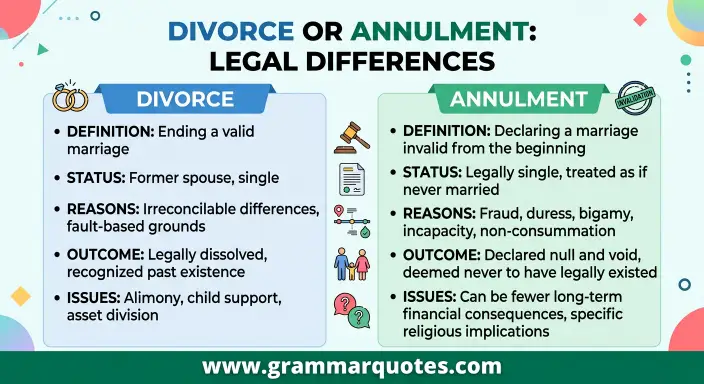
Divorce ends a legally valid marriage, while an annulment treats a marriage as legally invalid or voidable based on specific circumstances. Although both can legally end a marriage, they are different processes with different legal meanings.
This difference can be confusing because people often use the two terms as if they mean the same thing. In everyday conversation, both may be described as ways of ending a marriage. Legally, however, they can have very different requirements and consequences.
A divorce generally recognizes that a valid marriage existed and legally brings that marriage to an end. An annulment, by contrast, is based on the idea that the marriage was invalid or can be declared invalid because of a particular legal reason.
The exact rules vary by country, state, or legal system. Grounds for an annulment can include issues such as fraud, lack of legal capacity, or another circumstance recognized by local law.
This guide explains the meanings, major differences, common grounds, examples, terminology, and frequently asked questions in simple English.
Divorce or Annulment : Quick Answer
A divorce legally ends a valid marriage.
An annulment is a legal process that declares a marriage invalid or voidable under applicable law.
The simplest way to remember the difference is:
- Divorce: A valid marriage existed and is now legally ended.
- Annulment: The law treats the marriage as invalid based on specific circumstances.
For example:
They decided to divorce after several years of marriage.
The court granted an annulment because the marriage met a legal ground for annulment.
The exact effect of an annulment depends on the law where the case is handled.
Definition and Meaning
What Does Divorce Mean?
Divorce is the legal ending of a marriage.
When a court or other legally authorized process grants a divorce, the spouses are no longer married under the law.
A divorce may also address matters such as:
- Property
- Financial support
- Child arrangements
- Parenting responsibilities
- Division of marital assets
The specific rules depend on the jurisdiction.
What Does Annulment Mean?
An annulment is a legal declaration that a marriage is invalid or voidable because of circumstances recognized by law.
Unlike a divorce, it is not simply a legal ending of a marriage that is accepted as valid.
The legal grounds can vary considerably between jurisdictions.
Some legal systems distinguish between marriages that are void from the beginning and those that are voidable and require a legal process to challenge them.
The Main Difference
The key difference is the legal status of the marriage.
With a divorce, the law generally recognizes that a valid marriage existed and then legally ends it.
With an annulment, the legal process concerns if the marriage was invalid or should be treated as invalid under a recognized legal ground.
| Feature | Divorce | Annulment |
| Main purpose | Ends a valid marriage | Declares a marriage invalid or voidable |
| Marriage status | Generally treated as valid | Challenged as legally invalid |
| Common timing | Can happen after a marriage has lasted for years | Often involves circumstances existing when the marriage began |
| Grounds | Vary by jurisdiction | Usually specific legal grounds |
| Children | Legal effects depend on local law | Legal effects depend on local law |
| Property | May be addressed | May also require legal orders |
| Availability | Generally broader | Usually more limited |
How Divorce Works
The divorce process varies by country and state, but it commonly involves a legal application or petition.
Depending on local law, spouses may need to address:
- The legal basis for the divorce
- Property and financial matters
- Child related arrangements
- Required court procedures
- Final legal orders
Some divorces are contested, while others are resolved by agreement.
A court may issue a final order that legally ends the marriage.
How Annulment Works
An annulment generally requires a legally recognized reason showing that the marriage was invalid or should be treated as invalid.
The process can involve evidence about circumstances surrounding the marriage.
For example, a jurisdiction may recognize grounds involving:
- Fraud or misrepresentation
- Lack of legal capacity
- A marriage prohibited by law
- Lack of valid consent
- Other specific circumstances
These grounds are not universal. What qualifies in one jurisdiction may not qualify in another.
Common Grounds for Annulment
There is no single worldwide list of annulment grounds.
Depending on local law, examples may include:
Fraud
In some legal systems, serious deception about an important matter may provide grounds for an annulment.
The exact type of deception that qualifies is determined by law.
Lack of Capacity
A marriage may be challenged when a person legally lacked the capacity to marry.
The rules depend on the circumstances and jurisdiction.
Lack of Valid Consent
If the law determines that valid consent was not given, an annulment may sometimes be available.
Prohibited Marriage
Some marriages are prohibited by law. Examples can include certain marriages involving existing spouses or prohibited family relationships.
The legal treatment differs by jurisdiction.
Is an Annulment the Same as Saying the Marriage Never Happened?
Not necessarily.
This is one of the most common misunderstandings.
People sometimes say that an annulled marriage is treated as if it “never existed.” That can be an oversimplification.
The legal effect of an annulment depends on the applicable law. Courts may still need to address issues involving property, children, financial responsibilities, or other legal matters.
Therefore, an annulment does not simply erase every legal consequence of a relationship.
Divorce vs Annulment After a Long Marriage
A divorce is generally the legal route for ending a valid marriage, including marriages that have lasted for many years.
An annulment is usually based on a specific legal problem connected to the validity of the marriage.
Therefore, the length of the marriage alone does not automatically determine if an annulment is possible.
The facts and the law of the relevant jurisdiction matter.
Divorce or Annulment With Children
Having children does not necessarily prevent an annulment.
However, legal systems generally have rules protecting the interests and legal rights of children.
Issues involving children can include:
- Parenting arrangements
- Child support
- Legal parentage
- Financial responsibilities
- Custody or residence arrangements
The legal consequences can differ between jurisdictions.
Property and Money After an Annulment
An annulment does not necessarily mean that all financial or property matters disappear.
A court may still need to determine issues involving property, debts, financial support, or other obligations.
The exact rules depend on local law and the circumstances of the relationship.
This is why people should not assume that an annulment automatically has fewer legal consequences than a divorce.
Common Mistakes With These Terms
Mistake 1: Thinking They Are Exact Synonyms
Divorce and annulment can both change a person’s marital status, but they have different legal meanings.
Mistake 2: Thinking Any Short Marriage Can Be Annulled
A short marriage does not automatically qualify for annulment.
A specific legal ground is generally required.
Mistake 3: Thinking Annulment Erases Everything
An annulment does not necessarily remove every legal issue connected with the relationship.
Mistake 4: Assuming the Rules Are the Same Everywhere
Marriage and family law differs between jurisdictions.
A rule that applies in one country or state may not apply somewhere else.
Everyday Examples
Example 1: Divorce
After several years of marriage, the couple decided to divorce.
The statement describes the legal ending of a marriage.
Example 2: Annulment
The person applied for an annulment based on a legally recognized problem affecting the validity of the marriage.
Here, the focus is on the legal validity of the marriage.
Example 3: General Conversation
Is divorce different from annulment?
Yes. They have different legal meanings.
Divorce or Annulment in Formal Writing
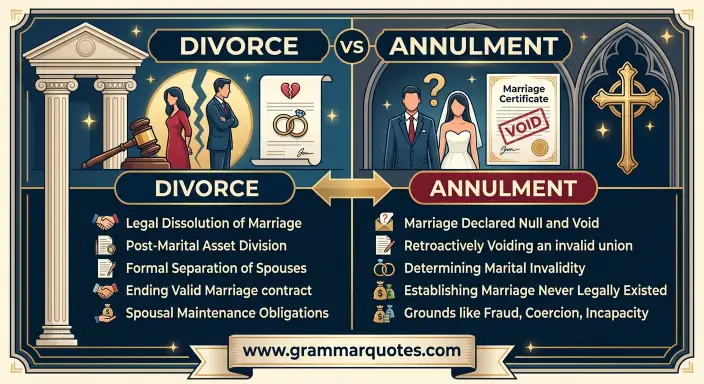
In legal and academic writing, the distinction should be clear.
For example:
Divorce legally terminates a valid marriage.
And:
Annulment concerns the legal validity of a marriage under specific grounds.
Avoid using the two terms interchangeably when discussing legal matters.
If the article, form, or legal document concerns a particular country, use that jurisdiction’s terminology.
British English vs American English
Divorce and annulment are standard terms in both British and American English.
There is no major spelling difference between the two varieties.
| Term | British English | American English |
| Divorce | Divorce | Divorce |
| Annulment | Annulment | Annulment |
| Married | Married | Married |
| Court | Court | Court |
The main differences are more likely to involve legal procedures and terminology rather than spelling.
Which One Should You Use?
The correct term depends on the legal situation.
Use divorce when discussing the legal ending of a valid marriage.
Use annulment when discussing a legal process based on the invalidity or voidability of a marriage.
If you are dealing with an actual legal matter, the rules of the relevant jurisdiction are important. A family law professional or official court information can explain which process applies.
Is Divorce Easier Than Annulment?
There is no universal answer.
Divorce and annulment can have different legal requirements, procedures, evidence rules, costs, and timelines depending on the jurisdiction.
An annulment may require proof of a specific legal ground, while divorce laws may provide broader routes for ending a valid marriage.
The process should therefore be considered according to the law that applies to the case.
Can You Get an Annulment Instead of a Divorce?
Sometimes, yes.
if an annulment is available depends on the legal grounds recognized by the relevant jurisdiction.
If the required grounds do not exist, divorce may be the applicable legal process for ending the marriage.
Google Trends & Usage Data
People commonly search these terms when trying to understand marriage law or the difference between two legal processes.
Common searches include:
- Divorce or annulment
- Annulment vs divorce
- What is an annulment?
- How is annulment different from divorce?
- Can a marriage be annulled?
- Can you get an annulment after years of marriage?
Search interest can vary by country because marriage laws are different across legal systems.
For accurate trend research, the country and date range should be specified because search behavior changes over time.
People Also Ask About Divorce and Annulment
What is the main difference between divorce and annulment?
Divorce legally ends a marriage that is generally recognized as valid, while annulment concerns if the marriage is legally invalid or voidable.
Is annulment better than divorce?
Neither is universally “better.” They are different legal processes with different requirements and consequences.
Can a marriage be annulled after several years?
Possibly, depending on the legal ground and the law of the jurisdiction. The length of the marriage alone does not answer the question.
Does annulment mean the marriage never existed?
Not necessarily. That is a common simplification. The legal consequences depend on the applicable law.
Is annulment only for short marriages?
No. The possibility of annulment depends on legally recognized grounds, not simply the length of the marriage.
Can you get divorced after an annulment is denied?
Depending on local law and the circumstances, divorce may still be available as a separate legal process.
Does an annulment affect children?
The legal effect depends on the jurisdiction. Laws generally address children’s rights separately from the marital status of the adults.
Does annulment cancel property rights?
Not automatically. Property and financial issues may still need to be resolved under applicable law.
Is divorce the same in every country?
No. Divorce laws and procedures vary between countries and sometimes between states or provinces.
What is the legal meaning of annulment?
It generally refers to a legal declaration that a marriage is invalid or voidable under recognized legal grounds.
Frequently Asked Questions
Can you get an annulment without a specific reason?
Usually, an annulment requires a legally recognized ground. The exact requirements vary by jurisdiction.
Does divorce mean the marriage was invalid?
No. Divorce generally recognizes the marriage as valid and legally brings it to an end.
Can an annulled marriage still have legal consequences?
Yes. Depending on local law, issues involving children, property, finances, and other matters may still need to be addressed.
What is a void marriage?
A void marriage is one that the law treats as invalid from the outset because of a legal defect. The exact definition varies by jurisdiction.
What is a voidable marriage?
A voidable marriage is generally treated as legally valid unless and until it is successfully challenged or set aside through the appropriate legal process.
Are divorce and annulment legal terms?
Yes. Both are legal terms, although their exact meanings and procedures depend on the applicable legal system.
Should you choose divorce or annulment yourself?
The appropriate process depends on the facts and the law where the matter is being handled. For an actual case, qualified legal advice can help explain the available options.
Final Comparison
| Point | Divorce | Annulment |
| Meaning | Ends a valid marriage | Challenges the validity of a marriage |
| Main focus | Ending the marital relationship | Legal validity of the marriage |
| Legal grounds | Depend on jurisdiction | Usually specific and limited |
| Long marriage | Commonly possible | Depends on the legal ground |
| Children | May involve child related orders | May still involve child related issues |
| Property | May be divided or addressed | May still require legal resolution |
| Terminology | Widely used | More specific legal term |
Conclusion
Divorce and annulment can both change a person’s legal marital status, but they are not the same process. A divorce generally ends a marriage that the law recognizes as valid. An annulment, on the other hand, concerns a marriage that is legally invalid or can be declared invalid because of a recognized legal ground.
The biggest difference is therefore not simply how long the marriage lasted or how the relationship ended. It is the legal basis for the process.
Rules about annulment and divorce vary significantly between countries and jurisdictions. Grounds, procedures, property rights, financial matters, and issues involving children can all depend on local law.
If you are learning the terms for English or general knowledge, remember the simple distinction: divorce ends a valid marriage, while annulment concerns the validity of the marriage itself. For an actual legal situation, the applicable local law and professional legal advice are more reliable than general definitions.
Discover More Articles!
Trey vs Tray: Meaning, Differences, and Correct Usage Explained
Knives or Knifes: Which Spelling Is Correct?(2026)
Sinus or Allergies: What’s the Difference?(2026)

Ethan Parker is an English-language writer known for his interest in words, language, and clear communication. His work focuses on making everyday English easier to understand through simple explanations and practical examples.