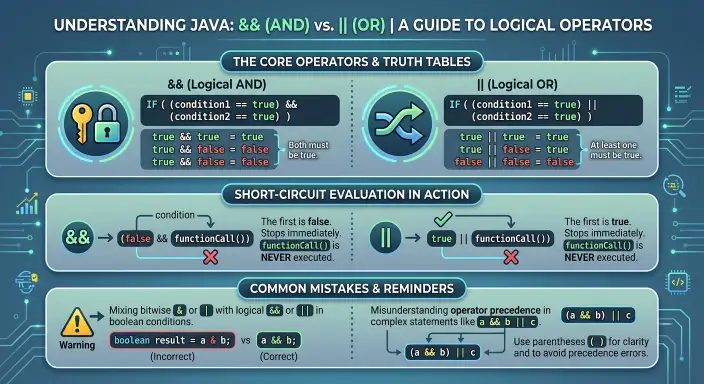
In Java, AND (&&) and OR (||) are logical operators used to combine conditions. AND returns true when both conditions are true, while OR returns true when at least one condition is true.
These operators are important when writing Java programs that make decisions. For example, you might want a program to check if a student has passed two requirements or if a user meets at least one condition.
Although AND and OR look simple, using the wrong operator can change how your program works. Understanding their differences helps you write clearer code and avoid common mistakes.
In this guide, you will learn what AND and OR mean in Java, how they work, when to use each operator, and how to write simple examples. You will also learn about short circuit evaluation and the difference between logical and bitwise operators.
Java AND or OR: Quick Answer
Java uses && for logical AND and || for logical OR.
- AND (&&): Both conditions must be true.
- OR (||): At least one condition must be true.
Example:
int age = 20;
if (age >= 18 && age <= 30) {
System.out.println(“Age is between 18 and 30”);
}
if (age < 18 || age > 60) {
System.out.println(“Age is outside the selected range”);
}
The first condition checks if the age is between 18 and 30. The second checks if the age is below 18 or above 60.
Definition and Meaning
What Does AND Mean in Java?
The logical AND operator (&&) combines two boolean expressions. The result is true only when both expressions are true.
Example:
int age = 20;
boolean hasID = true;
if (age >= 18 && hasID) {
System.out.println(“Access allowed”);
}
The program allows access only if the person is at least 18 and has an ID.
If either condition is false, the complete AND expression is false.
What Does OR Mean in Java?
The logical OR operator (||) combines two boolean expressions. The result is true when at least one expression is true.
Example:
boolean hasTicket = false;
boolean isGuest = true;
if (hasTicket || isGuest) {
System.out.println(“Entry allowed”);
}
The condition is true because isGuest is true, even though hasTicket is false.
If both conditions are false, the complete OR expression is false.
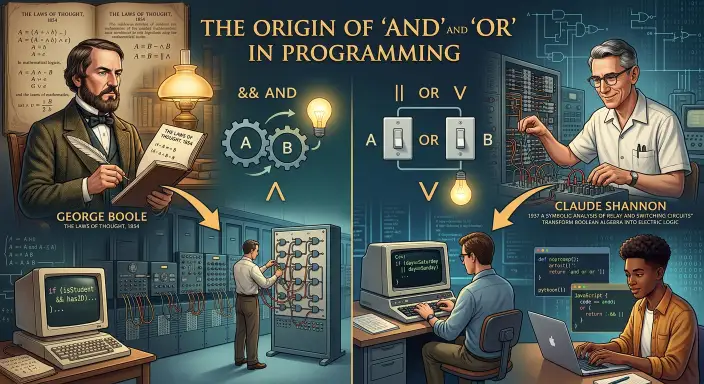
The Origin of AND and OR in Programming
AND in Programming
AND comes from Boolean logic, a system of logic based on true and false values. In Java, && represents logical AND and is commonly used to check if several requirements are satisfied together.
OR in Programming
OR also comes from Boolean logic. Java uses || for logical OR, which allows a condition to succeed when at least one of its alternatives is true.
Both operators help programs make decisions using boolean expressions.
British English vs. American English
AND and OR are programming terms, so their meaning and Java syntax do not change between British and American English.
| Feature | British English | American English | ||||
| Logical AND | && | && | ||||
| Logical OR | ` | ` | ` | ` | ||
| Meaning of AND | Both conditions true | Both conditions true | ||||
| Meaning of OR | At least one condition true | At least one condition true | ||||
| Java syntax | Same | Same |
The operators work the same way regardless of the English variety used in comments or documentation.
Main Differences Between AND and OR in Java
1. When AND Returns True
AND returns true only if both conditions are true.
| Condition A | Condition B | A && B |
| True | True | True |
| True | False | False |
| False | True | False |
| False | False | False |
2. When OR Returns True
OR returns true if either condition or both conditions are true.
| Condition A | Condition B | A || B |
| | | |
| True | True | True |
| True | False | True |
| False | True | True |
| False | False | False |
3. Short Circuit Evaluation
Java’s && and || operators use short circuit evaluation. This means Java may skip checking the second expression when the first expression already determines the result.
With AND, if the first condition is false, the second condition is not evaluated.
With OR, if the first condition is true, the second condition is not evaluated.
Example:
int number = 0;
if (number != 0 && 10 / number > 1) {
System.out.println(“Condition is true”);
}
Because number != 0 is false, Java skips the division. This prevents a division by zero error in the second condition.
4. Logical AND vs. Bitwise AND
Java also has & and | operators. They can perform bitwise operations on integer values. When used with boolean expressions, & and | evaluate both sides rather than using short circuit evaluation.
For normal condition checks, && and || are often the preferred choices.
When Should You Use AND or OR in Java?
When to Use AND (&&)
Use AND when every condition must be true.
Example:
int marks = 75;
if (marks >= 50 && marks <= 100) {
System.out.println(“Valid passing marks”);
}
Both conditions must be true: the marks must be at least 50 and no more than 100.
When to Use OR (||)
Use OR when at least one condition must be true.
Example:
String day = “Saturday”;
if (day.equals(“Saturday”) || day.equals(“Sunday”)) {
System.out.println(“It is the weekend”);
}
The program prints the message if the day is Saturday or Sunday.
When to Use Neither Operator
If you only need to check one condition, you may not need AND or OR.
int age = 19;
if (age >= 18) {
System.out.println(“Adult”);
}
Keeping simple conditions simple makes your code easier to read.
Common Mistakes With AND and OR in Java
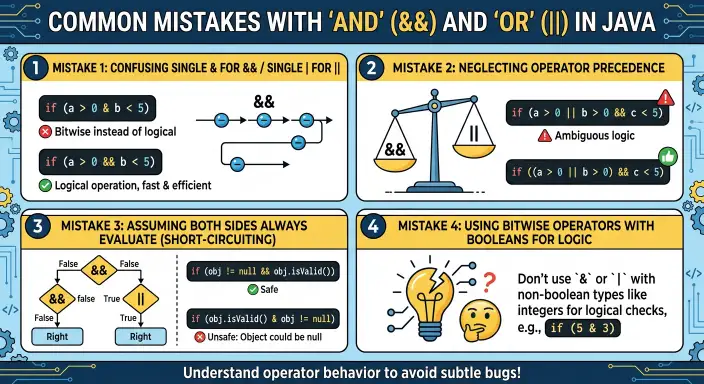
Mistake 1: Using AND When OR Is Needed
Incorrect logic:
if (age < 18 && age > 60) {
System.out.println(“Age requirement met”);
}
A number cannot normally be both below 18 and above 60 at the same time.
If you want to check if someone is under 18 or over 60, use ||.
Mistake 2: Using OR When AND Is Needed
Suppose a person must be at least 18 and have a valid ID.
Using || would allow the condition to succeed when only one requirement is met. Use && when both requirements are necessary.
Mistake 3: Using = Instead of a Comparison
For boolean conditions, write expressions such as age >= 18 rather than trying to assign a value inside the condition.
Mistake 4: Forgetting Parentheses
When conditions become complex, parentheses can make the intended logic clearer.
if ((age >= 18 && hasID) || isAuthorizedGuest) {
System.out.println(“Access allowed”);
}
This means access is allowed when the person is at least 18 and has an ID, or when the person is an authorized guest.
Everyday Examples of AND and OR in Java
Example 1: Student Eligibility
A student must have at least 50 marks and meet the attendance requirement.
if (marks >= 50 && attendance >= 75) {
System.out.println(“Eligible”);
}
Example 2: Weekend Check
A program checks if the day is Saturday or Sunday.
if (day.equals(“Saturday”) || day.equals(“Sunday”)) {
System.out.println(“Weekend”);
}
Example 3: Login Check
A user must enter the correct username and password.
if (usernameCorrect && passwordCorrect) {
System.out.println(“Login successful”);
}
Example 4: Discount Eligibility
if (isStudent || isSeniorCitizen) {
System.out.println(“Discount available”);
}
These examples show how logical operators help Java programs make decisions.
Java AND vs. OR: Comparison Table
| Feature | AND (&&) | OR (||) |
| | | |
| Main purpose | Requires both conditions | Accepts at least one condition |
| Returns true when | Both are true | Either or both are true |
| Both conditions false | False | False |
| Short circuit behavior | Skips second expression if first is false | Skips second expression if first is true |
| Example | age >= 18 && hasID | isStudent || isSenior |
A Simple Trick to Remember the Difference
Remember these two rules:
- AND (&&) = All conditions must be true.
- OR (||) = One or more conditions can be true.
Think of AND as a set of requirements that must all be met. Think of OR as a choice between alternatives.
This simple rule helps you decide which operator to use in most Java if statements.
FAQs About Java AND or OR
1. What is AND in Java?
AND is a logical operator written as &&. It returns true only when both boolean conditions are true.
2. What is OR in Java?
OR is a logical operator written as ||. It returns true when at least one boolean condition is true.
3. What is the difference between && and ||?
&& requires both conditions to be true. || requires only one condition to be true, although both can be true.
4. Can I use AND and OR in the same Java condition?
Yes. You can combine them in one expression. Use parentheses when needed to make the intended logic clear.
5. What is short circuit evaluation in Java?
Short circuit evaluation means Java may skip the second expression when the first expression already determines the result of && or ||.
6. Is & the same as && in Java?
No. && is logical AND with short circuit evaluation. The & operator can perform bitwise AND on integers and evaluates both sides when used with boolean expressions.
7. Is | the same as || in Java?
No. || is logical OR with short circuit evaluation. The | operator can perform bitwise OR and evaluates both boolean expressions when used with booleans.
8. Which operator should beginners use in Java?
Beginners should generally use && for logical AND and || for logical OR when checking conditions in if statements.
9. What happens when both conditions are false?
Both false && false and false || false return false.
10. Why are AND and OR important in Java?
They allow programs to check multiple requirements and make decisions. They are widely used in validation, login systems, eligibility checks, and other conditional logic.
Conclusion
AND and OR are essential logical operators in Java. AND (&&) returns true only when both conditions are true, while OR (||) returns true when at least one condition is true.
These operators help you write conditions for student eligibility, login checks, discounts, and many other programming tasks. Remember that Java uses short circuit evaluation with both operators, so the second expression may not always run.
For beginners, the easiest rule is to use AND when all requirements must be met and OR when at least one alternative is enough. With practice, these operators become a natural part of writing Java programs.
Discover More Articles!
WordPress or Webflow: Which Platform Is Better?
Damned or Dammed: Meaning, Difference, and Examples(2026)
Your vs You’re: Meaning, Differences, and Examples(2026)

Ethan Parker is an English-language writer known for his interest in words, language, and clear communication. His work focuses on making everyday English easier to understand through simple explanations and practical examples.