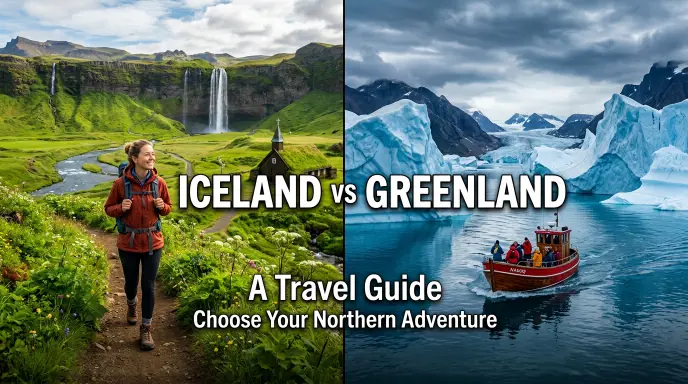
Iceland or Greenland: Wondering which destination is better for travel, nature, and adventure? Discover the key differences in climate, landscapes, glaciers, costs, and experiences to decide which one is right for you.
People often search for “Iceland or Greenland” because they want to know which destination is better for a vacation, which is colder, which has more glaciers, or which offers the best chance to see the Northern Lights.
Some travelers also wonder if Greenland is part of Iceland or if the two places are close to each other.
The short answer is simple: Iceland is generally easier to visit and offers more varied road trip experiences, while Greenland is better for a remote Arctic adventure and huge ice filled landscapes.
This guide compares Iceland and Greenland in simple terms. You will learn about their geography, history, climate, travel options, scenery, costs, and ideal uses. By the end, you should know which destination fits your travel goals best.
Iceland or Greenland Quick Answer
Political Status: Iceland is a fully independent country, while Greenland has its own government and handles many internal matters but remains part of the Kingdom of Denmark.
Geography: Iceland is a relatively small island nation in the North Atlantic, while Greenland is the world’s largest island and is located in the Arctic region, northeast of Canada.
Climate and Landscape: Greenland has a much more Arctic environment, with a huge ice sheet covering most of the island. Iceland has glaciers too, but its landscape also includes volcanoes, lava fields, waterfalls, and geothermal areas.
Population: Greenland has around 56,000 to 57,000 people, and most live along the ice-free coastal areas because much of the interior is covered by ice.
| Feature | Iceland | Greenland |
| Location | North Atlantic | Arctic North Atlantic |
| Political status | Independent country | Autonomous territory of Denmark |
| Capital | Reykjavík | Nuuk |
| Main attraction | Volcanoes, waterfalls, glaciers, hot springs | Ice sheet, glaciers, fjords, Arctic wildlife |
| Tourism | More developed | More remote |
| Road trips | Excellent | Limited |
| Population | Much larger | Much smaller |
| Best for | First time Arctic style trip | Remote Arctic adventure |
The Origin of Iceland or Greenland
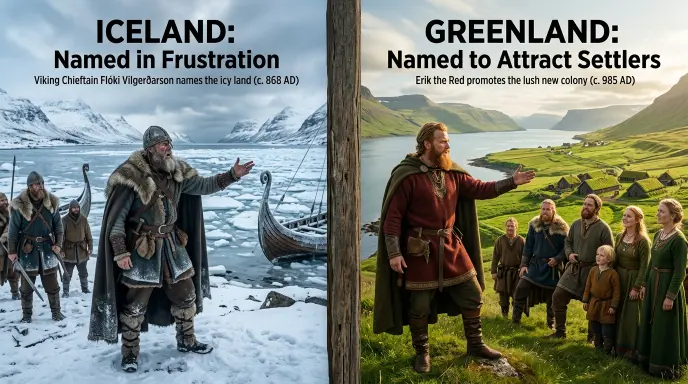
The names Iceland and Greenland have different histories.
The name Iceland is traditionally linked to the Norse explorer Hrafna Flóki Vilgerðarson, who reportedly saw ice filled waters and called the island Iceland. The name became established through Norse settlement.
Greenland has an unusual naming story. According to the Icelandic sagas, Erik the Red gave the land the name Greenland. The name may have been intended to make the new land sound appealing to potential settlers.
Despite their names, neither destination is exactly what the name might suggest.
Iceland has many green areas during the warmer months, but it also contains glaciers and volcanic landscapes. Greenland is covered by a huge ice sheet across much of its landmass, while its coastal areas can become green during summer.
The two names therefore tell only part of the story. Their geography, climate, and landscapes are much more complex.
British English vs American English Spelling
There is no British versus American spelling difference between Iceland and Greenland.
Both British and American English use exactly the same spellings:
- Iceland
- Greenland
The difference people search for is usually not spelling. It is the choice between the two destinations.
| Term | British English | American English | Meaning |
| Iceland | Iceland | Iceland | Independent country |
| Greenland | Greenland | Greenland | Autonomous territory of Denmark |
| Icelandic | Icelandic | Icelandic | Related to Iceland |
| Greenlandic | Greenlandic | Greenlandic | Related to Greenland |
So, if you are writing about either place, there is no spelling change based on if your audience uses British or American English.
Which Spelling Should You Use?
Because Iceland or Greenland is a comparison rather than a spelling question, use the correct name based on the place you mean.
Choose Iceland when talking about:
- Reykjavík
- Volcanoes
- Blue Lagoon
- Waterfalls
- Ring Road
- Icelandic culture
- Icelandic horses
Choose Greenland when talking about:
- Nuuk
- Greenland Ice Sheet
- Ilulissat Icefjord
- Arctic settlements
- Dog sledding
- Greenlandic culture
- Massive glaciers
For global readers, always write the full place name when there could be confusion.
For example:
“Iceland has many volcanic landscapes.”
“Greenland contains one of the world’s largest ice sheets.”
Avoid treating Iceland and Greenland as two names for the same country. They are separate destinations with very different identities.
Common Mistakes with Iceland or Greenland
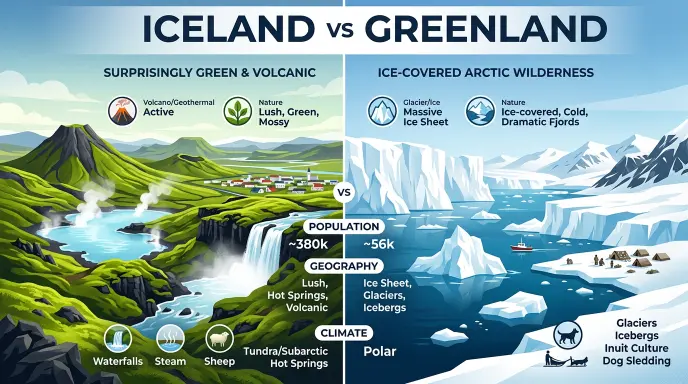
Several mistakes appear when people compare Iceland and Greenland.
Mistake 1: Thinking Greenland is part of Iceland
Incorrect: Greenland is an island belonging to Iceland.
Correct: Greenland is an autonomous territory within the Kingdom of Denmark.
Mistake 2: Assuming Greenland is a country like Iceland
Iceland is an independent sovereign country. Greenland has self government but remains part of the Kingdom of Denmark.
Mistake 3: Thinking Iceland is completely covered in ice
Iceland has glaciers, but much of the country is not covered by ice.
Mistake 4: Thinking Greenland is completely white
Greenland has a massive ice sheet, but its coastal regions have mountains, fjords, rocks, vegetation, and settlements.
Mistake 5: Choosing Greenland because it sounds colder
Greenland is generally more Arctic and colder, but climate varies by location and season. Iceland’s weather can also be cold, windy, and unpredictable.
Mistake 6: Assuming both destinations are equally easy to explore
Iceland has a much stronger road trip infrastructure. Greenland’s communities are widely separated, and travel often involves flights or boats.
Iceland or Greenland in Everyday Examples
The phrase “Iceland or Greenland” commonly appears in travel searches, school assignments, articles, social media posts, and conversations.
In an email
“I’m trying to decide if Iceland or Greenland would be better for our summer trip.”
In a travel article
“Iceland or Greenland? Both offer spectacular Arctic scenery, but the travel experience is very different.”
On social media
“Iceland or Greenland:which destination would you choose for a Northern Lights trip?”
In formal writing
“A comparison of Iceland and Greenland reveals major differences in geography, climate, population, and tourism.”
In a school assignment
“Iceland and Greenland are geographically close but have very different physical environments.”
These examples show that Iceland or Greenland works naturally when someone is comparing the two destinations.
Iceland or Greenland : Google Trends & Usage Data
Search interest for Iceland or Greenland can change based on travel seasons, weather events, Northern Lights interest, and popular tourism trends.
Iceland generally attracts a much larger international tourist market. It is well known for road trips, geothermal pools, waterfalls, volcanoes, and the Northern Lights.
Greenland receives far fewer visitors and is often searched by travelers looking for more remote Arctic experiences.
Search intent also changes depending on the query:
- “Iceland or Greenland for Northern Lights” → travelers comparing aurora experiences
- “Iceland or Greenland colder” → climate comparison
- “Iceland or Greenland bigger” → geography question
- “Iceland or Greenland vacation” → travel planning
- “Iceland or Greenland glaciers” → nature and scenery comparison
The exact popularity of searches can change over time, so search volume data should be checked for the specific country, date range, and keyword being studied.
Iceland or Greenland: Key Differences Compared
| Category | Iceland | Greenland |
| Country status | Independent country | Autonomous territory of Denmark |
| Capital | Reykjavík | Nuuk |
| Landscape | Volcanoes, glaciers, waterfalls, lava fields | Ice sheet, glaciers, fjords, mountains |
| Population | About 400,000 | About 57,000 |
| Tourism | Highly developed | More limited and remote |
| Roads | Many major routes | Roads mainly within settlements |
| Main transport | Cars, buses, flights | Flights, boats, helicopters, local transport |
| Climate | Cool maritime | Arctic/subarctic |
| Wildlife | Whales, puffins, seals | Whales, seals, Arctic wildlife |
| Adventure | Road trips, hiking, geothermal activities | Dog sledding, kayaking, glacier trips |
| Best for | Variety and accessibility | Remote Arctic scenery |
Iceland or Greenland: Which Is Bigger?
Greenland is dramatically larger than Iceland.
Greenland covers roughly 2.16 million square kilometers, while Iceland covers about 103,000 square kilometers.
However, size can be misleading for travelers.
Greenland is enormous, but much of its interior is covered by the Greenland Ice Sheet. Most people live along the coast.
Iceland is far smaller and much easier to explore by road. This makes it more practical for travelers who want to experience many different landscapes during one trip.
Which Is Colder: Iceland or Greenland?
Greenland is generally colder than Iceland.
Iceland benefits from relatively mild ocean currents despite its northern location. Its winters can still be cold, windy, and snowy.
Greenland has a much more Arctic climate. Inland areas can experience extremely low temperatures, while coastal conditions vary by region.
If your goal is a classic Arctic environment, Greenland provides a stronger experience.
If you want northern scenery without the same level of remoteness and extreme conditions, Iceland may be more comfortable.
Iceland or Greenland for the Northern Lights?
Both Iceland and Greenland can offer excellent opportunities to see the Northern Lights.
Iceland is popular because it combines aurora viewing with many other attractions. You can potentially see the lights while visiting waterfalls, glaciers, beaches, and geothermal areas.
Greenland offers a more remote setting with very little light pollution in many locations. This can create an impressive environment for aurora viewing.
Your best choice depends on the overall trip:
- Choose Iceland for Northern Lights plus varied sightseeing.
- Choose Greenland for Northern Lights plus a remote Arctic atmosphere.
Remember that the Northern Lights are a natural phenomenon. No destination can guarantee a sighting.
Iceland or Greenland for a Vacation?
For most first time travelers, Iceland is the easier vacation choice.
Iceland has:
- More accommodation options
- Better developed tourism services
- Extensive road networks
- Many organized tours
- Easy access to major attractions
- Strong infrastructure for independent travelers
Greenland is better suited to travelers who specifically want something more remote.
A Greenland trip can be highly rewarding if you enjoy:
- Icebergs
- Glaciers
- Arctic landscapes
- Small communities
- Adventure travel
- Wildlife
- Remote destinations
Iceland or Greenland: Which One Should You Visit?
The answer depends on what you want from the trip.
Choose Iceland if you want:
- A road trip
- Waterfalls
- Volcanoes
- Hot springs
- Hiking
- More tourist infrastructure
- A wider range of attractions
Choose Greenland if you want:
- Giant icebergs
- Huge glaciers
- Arctic landscapes
- Remote communities
- Dog sledding
- A quieter travel experience
- A more unusual adventure
For a first trip to the region, Iceland is usually the simpler option. For experienced travelers seeking a truly remote Arctic experience, Greenland can be exceptional.
FAQs
1. Is Iceland or Greenland better for tourists?
Iceland is generally better for tourists who want easy transportation, road trips, varied attractions, and developed tourism services. Greenland is better for travelers seeking a remote Arctic experience.
2. Is Greenland colder than Iceland?
Yes, Greenland is generally colder, especially in its inland regions. Iceland has a milder maritime climate.
3. Is Greenland bigger than Iceland?
Yes. Greenland is vastly larger than Iceland in land area.
4. Is Iceland part of Greenland?
No. Iceland and Greenland are separate places.
5. Is Greenland part of Iceland?
No. Greenland is an autonomous territory within the Kingdom of Denmark, while Iceland is an independent country.
6. Which is better for the Northern Lights, Iceland or Greenland?
Both can be excellent. Iceland is easier to combine with other sightseeing, while Greenland can provide a darker and more remote Arctic setting.
7. Should I visit Iceland or Greenland first?
For most travelers, Iceland is the better first choice because it is easier to explore and offers a wider range of attractions and travel options.
Conclusion: Iceland or Greenland?
The choice between Iceland or Greenland depends mainly on the type of adventure you want. Iceland is smaller, easier to explore, and packed with varied attractions such as volcanoes, waterfalls, glaciers, geothermal pools, and scenic roads. It is an excellent choice for travelers who want flexibility and a well developed tourism experience.
Greenland is a completely different type of destination. Its enormous ice sheet, huge icebergs, remote communities, Arctic wildlife, and dramatic fjords make it ideal for travelers looking for something more unusual and secluded.
If you want an easy to plan trip with many attractions, Iceland is usually the better choice. If your priority is remote Arctic scenery and a deeper wilderness experience, Greenland may be the better option.
Most importantly, remember that Iceland and Greenland are not two names for the same place. They have different geography, political status, climates, cultures, and travel experiences. Understanding these differences makes it much easier to choose the right destination.
Discover More Articles!
Keith or Kieth: Which Spelling Is Correct?
Bit or Byte: What’s the Difference and Which One Should You Use?
Buying or Renting: Which Is Better for You?

Ethan Parker is an English-language writer known for his interest in words, language, and clear communication. His work focuses on making everyday English easier to understand through simple explanations and practical examples.