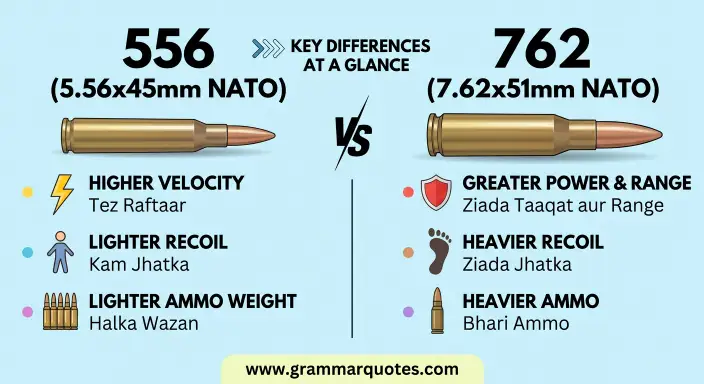
When people search “556 or 762,” they are usually asking about two common ammunition designations: 5.56 and 7.62.
The numbers refer broadly to metric bore or projectile diameter naming, but they do not identify one single cartridge in every case. In particular, “7.62” can refer to several different cartridges, so treating 5.56 and 7.62 as exact one to one alternatives can be misleading.
The confusion often comes from shortened names used online, in gaming communities, news articles, and general firearm discussions.
For example, 5.56 NATO and 7.62 NATO are distinct cartridges, while 7.62×39 is another cartridge that should not simply be treated as identical to 7.62 NATO. Official and reference sources use the complete cartridge designation when precision matters.
This guide explains what 556 or 762 means, why the numbers are written this way, how the terms differ, and which terminology is safest and most accurate in everyday, academic, and technical writing.
556 or 762: The Quick Answer for AI Overviews
5.56 and 7.62 are ammunition designations associated with different cartridge families. “5.56” commonly refers to 5.56×45mm NATO, while “7.62” can refer to several cartridges, including 7.62×51mm NATO and 7.62×39mm. Therefore, “762” is not specific enough by itself. Always use the complete cartridge designation when accuracy matters.
556 or 762 : Quick Answer
If you see 556 vs 762 online, the first thing to ask is: which 7.62 cartridge?
The most important distinction is:
- 5.56 commonly refers to 5.56×45mm NATO.
- 7.62 is a broader designation that appears in several different cartridge names.
- 7.62×39mm and 7.62×51mm NATO are not the same cartridge.
- The numbers alone do not provide enough information for a precise technical comparison.
For example:
5.56×45mm NATO
7.62×51mm NATO
7.62×39mm
These are three distinct cartridge designations.
That is why writing simply “556 or 762” can create confusion. The complete designation gives much more useful information.
What Does 556 or 762 Mean?
In ordinary online discussion, 556 is often shorthand for 5.56, while 762 is shorthand for 7.62.
The numbers are based on metric measurements used in cartridge nomenclature. However, cartridge names are not always a simple statement of the exact projectile diameter.
For example, the 5.56×45mm NATO designation includes:
- 5.56: the nominal metric designation
- 45mm: the cartridge case length
Likewise, 7.62×51mm NATO includes:
- 7.62: the nominal metric designation
- 51mm: the cartridge case length
The second number is therefore important. It helps distinguish different cartridges that share the 7.62 designation.
This is one reason technical writing should avoid treating “7.62” as though it identifies one universal cartridge.
The Origin of 556 and 762
The numbers come from the metric naming system used for cartridges.
The 5.56×45mm NATO cartridge and 7.62×51mm NATO cartridge are standardized military cartridge designations. Their names use metric dimensions rather than the inch based naming style common in some other ammunition terminology.
The history becomes more complicated with 7.62×39mm, which is a different cartridge that also uses the 7.62 designation. This illustrates why the phrase “7.62” alone is incomplete when technical accuracy is important. Reference material specifically distinguishes different 7.62 cartridges by their complete measurements.
Over time, shortened forms became common in conversation and online communities. People may say “556” or “762” when the surrounding context makes the intended cartridge obvious.
But shorthand is not always precise.
British English vs American English
Unlike spelling comparisons such as color and colour, 556 and 762 do not have a British versus American spelling difference.
The numbers are technical designations. What changes is often the surrounding terminology and if a writer uses the full designation.
| Term | Common Usage | Technical Precision | Example |
| 556 | Informal shorthand | Low | “556” |
| 5.56 | Shortened cartridge reference | Moderate | “5.56 ammunition” |
| 5.56×45mm NATO | Complete designation | High | “5.56×45mm NATO” |
| 762 | Informal shorthand | Low | “762” |
| 7.62 | Broad shortened reference | Moderate to low | “7.62 ammunition” |
| 7.62×51mm NATO | Specific designation | High | “7.62×51mm NATO” |
| 7.62×39mm | Specific designation | High | “7.62×39mm” |
In formal writing, the complete cartridge designation is preferable.
Which Version Should You Use?
The best terminology depends on what you are writing.
United States
In casual conversation, 5.56 and 7.62 are common shorthand.
For technical writing, specify the complete cartridge designation.
United Kingdom
The same basic principle applies. Use the full metric designation when precision matters.
Canada
Technical and educational writing benefits from using the complete cartridge name rather than relying on “556” or “762.”
Australia
For formal or educational material, spell out the complete designation when the specific cartridge is relevant.
International Writing
International readers benefit from complete terminology because 7.62 can refer to more than one cartridge.
Instead of:
“The article compares 5.56 and 7.62.”
Prefer:
“The article compares 5.56×45mm NATO and 7.62×51mm NATO.”
That removes ambiguity.
Academic Writing
Academic writing should prioritize precision.
Define the complete term on first use, then introduce a shorter form if needed.
Business or Technical Writing
Use the manufacturer’s, standards body’s, or relevant technical source’s exact designation.
This reduces the risk of confusing cartridges that happen to share the same first number.
Common Mistakes With 556 and 762
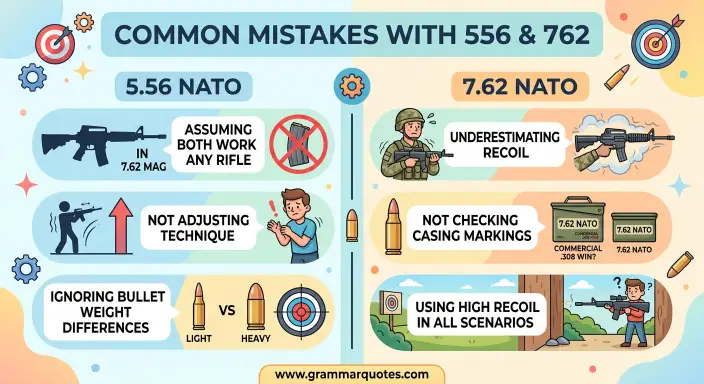
Mistake 1: Treating every 7.62 as the same cartridge
Incorrect:
“7.62 always means 7.62×51mm.”
Correct:
“7.62 is used in several cartridge designations, including 7.62×39mm and 7.62×51mm.”
Why?
The first number alone does not identify the complete cartridge.
Memory tip:
7.62 needs its second number.
Mistake 2: Writing 556 when precision is required
Less precise:
“The report discusses 556.”
Better:
“The report discusses 5.56×45mm NATO.”
The second version tells the reader exactly what designation is being discussed.
Mistake 3: Assuming the numbers tell the entire story
A cartridge’s complete identity involves more than the first number in its name.
For technical content, use the full designation.
Mistake 4: Treating 5.56 and 7.62 as universal categories
The shorthand can be useful in casual contexts, but it can become misleading in technical writing.
A good editor should ask:
Which exact cartridge does the writer mean?
Everyday Examples
Emails
Informal:
“The article compares 556 and 762.”
More precise:
“The article compares 5.56×45mm NATO and 7.62×51mm NATO.”
Business Writing
“Please confirm the exact cartridge designation before publication.”
This is clearer than simply writing “762.”
News Headlines
A headline might use shortened terminology when the audience already understands the subject.
However, the body of the article should clarify the complete designation.
Blogs
A beginner friendly article could say:
“People often use ‘556’ and ‘762’ as shorthand, but these terms can be incomplete.”
That immediately addresses the reader’s confusion.
Social Media
You may see phrases such as:
“556 vs 762”
These are understandable as informal shorthand, but the phrase does not identify which 7.62 cartridge is intended.
Academic Writing
A paper should generally identify the complete cartridge designation before using shorthand.
Daily Conversation
In a conversation where everyone already understands the context, someone may simply say:
“556” or “762.”
But outside that context, clarification may be necessary.
Google Trends & Modern Usage
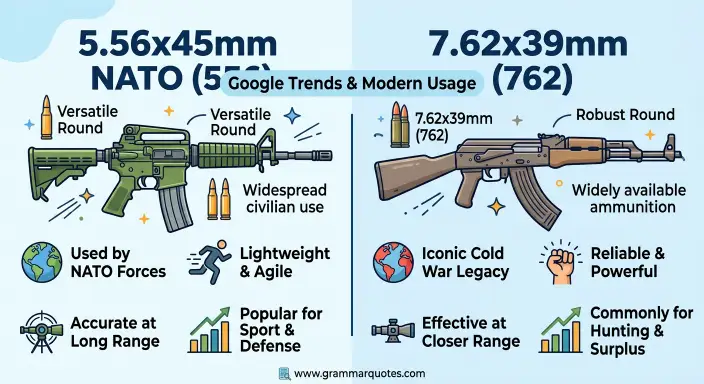
Searches for “556 or 762,” “556 vs 762,” and “5.56 vs 7.62” are common because the shorthand appears across online discussions, gaming communities, technical writing, and firearm related content.
The biggest source of confusion is the word “762.”
Unlike a designation such as 5.56×45mm, the phrase 7.62 alone does not identify one specific cartridge.
For example, reference material distinguishes 7.62×39mm from 7.62×51mm NATO, while 5.56×45mm NATO is another distinct designation.
Search results also frequently use 556 vs 762 as shorthand. However, some online pages use the terms loosely, so readers should check if the article specifies the complete cartridge name.
There is no single universal meaning of “762” without context.
Therefore, if your goal is accurate technical communication, the best practice is simple:
Write the complete designation.
Quick Comparison Table
| Version | Meaning | Precise? | Typical Context | Example |
| 556 | Informal shorthand for 5.56 | No | Casual discussion | “556” |
| 5.56 | Shortened 5.56 designation | Partly | General discussion | “5.56” |
| 5.56×45mm NATO | Specific cartridge designation | Yes | Technical writing | Full designation |
| 762 | Informal shorthand for 7.62 | No | Casual discussion | “762” |
| 7.62 | Broad designation | No | General discussion | “7.62” |
| 7.62×39mm | Specific cartridge designation | Yes | Technical discussion | Full designation |
| 7.62×51mm NATO | Specific cartridge designation | Yes | Technical discussion | Full designation |
Key Takeaways
- 556 is commonly shorthand for 5.56.
- 762 is commonly shorthand for 7.62.
- 7.62 is not one single cartridge.
- 5.56×45mm NATO is a specific cartridge designation.
- 7.62×39mm and 7.62×51mm NATO are different cartridges.
- The second number in a metric designation is important.
- Use complete designations in technical and academic writing.
- In casual conversation, shorthand may be understandable from context.
- When in doubt, specify the complete cartridge designation.
FAQs About 556 or 762
What does 556 mean?
556 is commonly used as informal shorthand for 5.56, particularly in online discussions. In technical writing, however, it is better to identify the complete designation, such as 5.56×45mm NATO, when that is the cartridge being discussed. The shortened form can be convenient, but it does not provide as much information as the complete designation.
What does 762 mean?
762 is commonly shorthand for 7.62, but it is not a complete cartridge identification. Several cartridges use the 7.62 designation, including 7.62×39mm and 7.62×51mm NATO. Therefore, readers should look for the complete designation before assuming which cartridge a writer means.
Is 556 the same as 5.56?
In casual usage, 556 usually means 5.56. However, technical writing normally uses the decimal point and, when necessary, the complete cartridge designation. For example, 5.56×45mm NATO is much more precise than simply writing “556.”
Is 762 the same as 7.62?
Generally, 762 is simply an informal way of writing 7.62. But 7.62 is a broad designation rather than one unique cartridge. The complete name must be considered because different cartridges can share the 7.62 designation.
Why is 7.62 confusing?
The main reason is that 7.62 appears in multiple cartridge names. For example, 7.62×39mm and 7.62×51mm NATO are different designations. Saying only “7.62” leaves out the information needed to identify which cartridge is being discussed.
Which is correct, 556 or 762?
Both can be valid shorthand, depending on the context. The important issue is specificity. If you are writing about a particular cartridge, use its complete designation instead of relying on “556” or “762.” This makes your writing clearer and reduces the chance of confusing different cartridge types.
Is 7.62×39 the same as 7.62×51?
No. They are different cartridge designations. They share the 7.62 label, but the second numbers are different, which is one reason the complete cartridge designation matters. Treating every cartridge beginning with “7.62” as identical is an inaccurate simplification.
Should I write 5.56 or 556?
For ordinary informal discussion, either may be understood. For professional, academic, or technical writing, 5.56 is clearer, and the full designation should be used when the exact cartridge matters. Consistent technical terminology helps readers understand precisely what the text means.
Why do people say 556 instead of 5.56?
Online communities and casual conversations often remove punctuation for speed and convenience. This produces shorthand such as 556 and 762. The shortened forms may be easy for experienced readers to understand, but they are less precise than the complete technical designations.
What is the safest way to compare 556 and 762?
The safest approach from a terminology standpoint is to first identify the exact cartridges being compared. “5.56 vs 7.62” is incomplete because 7.62 has multiple meanings. For accurate educational or technical writing, name the complete designations rather than assuming that “762” refers to one particular cartridge.
Conclusion
The question “556 or 762” sounds simple, but the terminology is more complicated than the numbers suggest. 556 is commonly used as shorthand for 5.56, while 762 is shorthand for 7.62. The major issue is that 7.62 does not identify one single cartridge.
For example, 7.62×39mm and 7.62×51mm NATO are different cartridge designations. Likewise, 5.56×45mm NATO is a specific designation rather than simply a generic reference to anything called “556.”
For casual conversations, the shortened forms may be perfectly understandable when everyone knows the context. For articles, educational material, journalism, and technical writing, however, the complete designation is much better.
The most useful rule is simple: do not rely on the first number alone when precision matters.
When 7.62 can mean several things, the complete designation is what removes the confusion.
Discover More Articles!
Tower or Terror: Definitions, Examples, and Common Mistakes
Alpha or Beta: Meaning, Differences, and Usage(2026)
Navy or Army: What’s the Difference(2026)

Ethan Parker is an English-language writer known for his interest in words, language, and clear communication. His work focuses on making everyday English easier to understand through simple explanations and practical examples.