Have you ever typed a phrase and wondered if you meant tower or something that sounds almost the same? Small spelling differences can change the meaning of a sentence completely.
This is why people often search for terms like these when writing messages, schoolwork, captions, or formal documents.
The confusion usually comes from sound. English has many words that look or sound similar but have very different meanings.
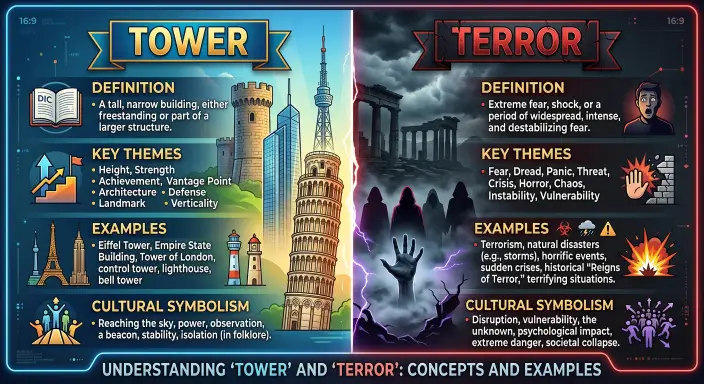
Tower is a real English word, while terror is also a real word, but they describe completely different ideas. One relates to height and buildings; the other describes extreme fear.
Knowing the difference helps you avoid embarrassing spelling mistakes and choose the right word based on context. This guide explains their meanings, origins, pronunciation, common errors, and everyday use. You will also see simple examples that make the difference easy to remember.
Tower or Terror : Quick Answer
Tower and terror are both correct English words, but they have different meanings.
- Tower means a tall structure or something that rises high above its surroundings.
- Terror means extreme fear or great danger that causes fear.
Examples
- The church has a tall tower.
- The movie was filled with terror.
- The castle tower could be seen from miles away.
- The attack caused widespread terror.
So, use tower when talking about height, structures, or something that rises above others. Use terror when talking about intense fear.
The Origin of Tower and Terror
These two words have very different histories.
Tower comes from Old French tor or tour, which was used for a tall building or fortified structure. It is related to Latin turris, meaning a tower.
Over time, the word became established in English as tower. Its meaning has remained closely linked to tall structures.
Terror has a different history. It comes from Old French terreur and Latin terror, meaning great fear or fright. It is related to the Latin verb terrere, meaning “to frighten.”
The spelling difference exists because these words developed from different roots. Although they may seem somewhat similar when spoken quickly, they do not come from the same word family.
Today, their meanings are easy to separate:
Tower → height or structure
Terror → extreme fear
British English vs American English Spelling
There is no major British versus American spelling difference between these two words.
Both varieties of English normally use:
| Meaning | British English | American English |
| Tall structure | Tower | Tower |
| Extreme fear | Terror | Terror |
| Plural of tower | Towers | Towers |
| Plural of terror | Terrors | Terrors |
The main difference is not regional spelling. The important point is meaning.
For example:
- British English: The old tower is open to visitors.
- American English: The old tower is open to visitors.
- British English: The story created a sense of terror.
- American English: The story created a sense of terror.
The spellings stay the same in both forms of English.
Which Spelling Should You Use?
Your choice depends on what you want to say.
Use “tower” for height or buildings
Choose this word when discussing:
- Tall buildings
- Church structures
- Castle structures
- Radio towers
- Watchtowers
- Tall objects
- Something that rises above another thing
Example:
The tower was visible from the highway.
Use “terror” for fear
Choose this word when discussing:
- Extreme fear
- Fright
- Horror
- Dangerous events
- Scary experiences
- A feeling of panic
Example:
The news caused terror among local residents.
For global readers
There is no need to change the spelling for British or American audiences. Both forms use the same words.
The key is to check the meaning and context before choosing one.
Common Mistakes with Tower or Terror
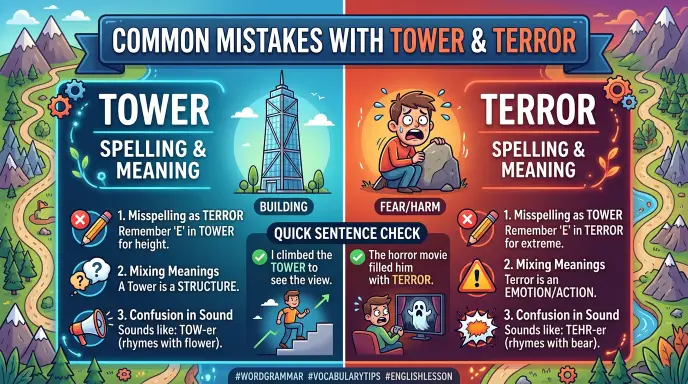
Many mistakes happen because people focus on sound instead of meaning.
Mistake 1: Using “terror” for a building
❌ The church has a tall terror.
✅ The church has a tall tower.
A tall structure is a tower.
Mistake 2: Using “tower” for fear
❌ The event filled people with tower.
✅ The event filled people with terror.
Extreme fear is terror.
Mistake 3: Mixing the words while typing
Because both words contain similar sounds, fast typing can lead to errors.
Before submitting your writing, ask:
Am I talking about something tall, or am I talking about fear?
That simple question can prevent the mistake.
Mistake 4: Assuming similar sounds mean similar meanings
English contains many words that sound somewhat alike but have unrelated meanings. Always look at the sentence rather than choosing a word only because it sounds right.
Terror or Tower in Everyday Examples
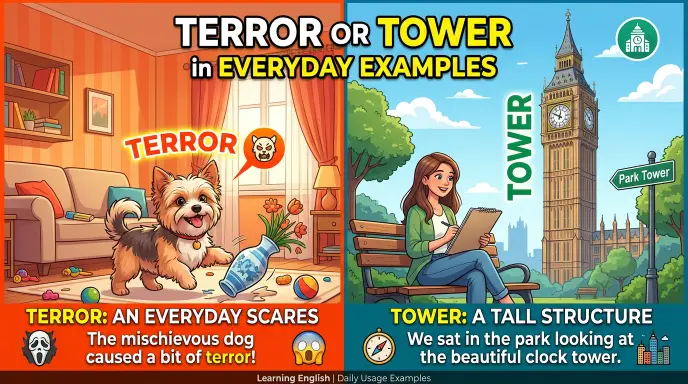
Understanding these words becomes easier when you see them in real situations.
In emails
Tower:
The meeting will take place near the main tower.
Terror:
The incident caused considerable fear among employees.
In news writing
Tower:
Firefighters reached the top of the tower.
Terror:
The incident created a sense of terror in the community.
In social media
Tower:
This tower has an amazing view of the city.
Terror:
That horror movie was pure terror!
In formal writing
Tower:
The historic tower remains an important landmark.
Terror:
The report described the psychological effects of terror.
In school writing
Tower:
The castle had four towers at each corner.
Terror:
The character experienced terror when the storm began.
These examples show why context matters more than pronunciation.
Tower or Terror : Google Trends & Usage Data
Search interest for these words can vary based on context, location, and current events.
Tower is commonly searched in connection with:
- Buildings
- Travel destinations
- Architecture
- Landmarks
- Construction
- Telecommunications
Terror often appears in searches related to:
- Movies
- Horror
- Crime
- History
- News
- Psychology
The two words therefore belong to very different search topics.
Search popularity can also change over time. A major event involving a famous building may increase searches for tower, while news about violence or a popular horror film can increase searches for terror.
For writers, search volume is less important than meaning. If your sentence describes a structure, use the word connected with height. If it describes intense fear, use the word connected with fear.
Terror vs Tower: Simple Comparison
| Feature | Tower | Terror |
| Word type | Noun / Verb | Noun |
| Main meaning | Tall structure or rising above | Extreme fear |
| Related idea | Height | Fear |
| Example | A radio tower | A feeling of terror |
| British spelling | Tower | Terror |
| American spelling | Tower | Terror |
| Plural | Towers | Terrors |
| Common context | Buildings and landmarks | Fear and frightening events |
Easy memory trick
Think:
Tower = Tall
Both are connected with height.
Terror = Terrified
Both are connected with fear.
This makes the difference much easier to remember.
Frequently Asked Questions
Is “tower” a correct English word?
Yes. Tower is a standard English word. It usually refers to a tall structure or something that rises above its surroundings.
Is “terror” a correct English word?
Yes. Terror is a standard English noun meaning extreme fear or intense fright.
Are tower and terror the same word?
No. They have completely different meanings and origins. One is mainly connected with height or structures, while the other describes extreme fear.
Does British English spell these words differently?
No. British and American English normally use tower and terror with the same spelling.
How can I remember the difference?
Use tower for something tall and terror for something frightening. Think “tower = tall” and “terror = terrified.”
Can terror describe a person?
Yes. It can describe a person’s extreme fear.
Example:
She was frozen with terror.
Can tower be used as a verb?
Yes. As a verb, tower can mean to rise high above something.
Example:
The mountains towered over the village.
Conclusion
Choosing the right word becomes simple once you focus on meaning rather than sound. Tower refers mainly to something tall, especially a structure, or something that rises high above its surroundings. Terror, on the other hand, describes extreme fear, fright, or a deeply frightening experience.
These words are not British and American spelling variants. Both forms of English use the same spellings. The real issue is knowing which meaning fits your sentence.
If you are writing about a building, landmark, castle, church, or another tall structure, choose tower. If your sentence describes intense fear, horror, or fright, choose terror.
A quick memory trick can help: tower = tall, while terror = terrified. Once you connect each word with its meaning, the spelling becomes much easier to remember. When in doubt, read the whole sentence and ask what idea you are trying to express.
Discover More Articles!
Or vs Er: Which Suffix Is Correct?(2026)
LP or LLC: Which Business Structure Is Better?
Alpha or Beta: Meaning, Differences, and Usage(2026)

Ethan Parker is an English-language writer known for his interest in words, language, and clear communication. His work focuses on making everyday English easier to understand through simple explanations and practical examples.