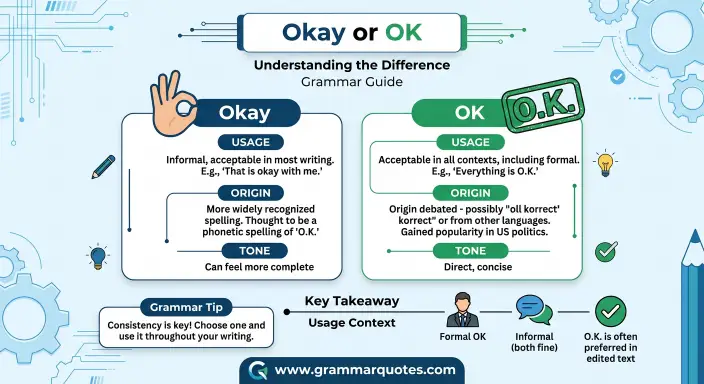
Have you ever wondered if to write “okay” or “OK” in a text message, email, or formal document? Both spellings are correct. They have the same basic meaning, but they can create a slightly different tone depending on the situation.
“Okay” is a common spelling in everyday writing, while “OK” is a shorter form often used in messages, notes, and quick responses. Neither spelling is automatically wrong in formal or informal English. The best choice depends on your audience, writing style, and the rules you follow.
For example, you can write, “Okay, I understand,” or “OK, I understand.” Both sentences are correct.
In this guide, you will learn the difference between okay and OK, what each form means, where the word came from, and when to use each spelling. You will also find simple examples, common mistakes, a comparison table, and answers to frequently asked questions.
By the end, you will know how to choose the right form for emails, school assignments, business communication, and everyday conversations.
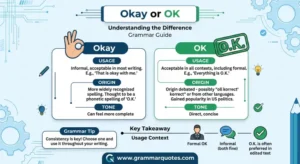
Okay vs OK: Quick Answer
“Okay” and “OK” are both correct spellings of the same word. They can mean acceptable, satisfactory, agreed, or understood.
- Okay: A full spelling commonly used in everyday writing.
- OK: A shorter spelling commonly used in messages, notes, and concise communication.
Examples:
- Okay, I will call you tomorrow.
- OK, I will call you tomorrow.
- Your answer is okay.
- Your answer is OK.
The meaning stays the same in these examples. However, a company’s style guide or a specific publication may prefer one form over the other.
What Does Okay Mean?
Okay is a word used to express agreement, acceptance, understanding, or an acceptable condition. It can function as an adjective, adverb, verb, or conversational response.
Its exact meaning depends on the sentence.
1. Okay as Agreement
Use okay when you agree to a suggestion, request, or plan.
Examples:
- Okay, I will help you with the project.
- She said okay when I asked her to join us.
- Okay, let’s start the meeting.
In these examples, okay shows agreement or willingness.
2. Okay as an Expression of Understanding
Okay can show that you understand what someone has said.
Examples:
- Okay, I understand your point.
- He nodded and said, “Okay.”
- Okay, now I know what to do.
This use is common in conversations, text messages, and emails.
3. Okay as an Adjective
Okay can describe something that is acceptable or satisfactory, even if it is not excellent.
Examples:
- The food was okay, but I expected more.
- Your performance was okay.
- The room looks okay after cleaning.
Here, okay often means that something is good enough, but not necessarily outstanding.
4. Okay as a Verb
Okay can also mean to approve or authorize something. In this use, it is often written as okay, OK, or OK’d, depending on the chosen style.
Examples:
- The manager okayed the request.
- The supervisor OK’d the final design.
- The school must okay the trip before it can happen.
For formal documents, consider using a more precise verb such as approve, authorize, or confirm.
What Does OK Mean?
OK has the same basic meaning as okay. It is a shorter spelling used to express agreement, acceptance, understanding, or a satisfactory condition.
Examples:
- OK, I’ll send the file today.
- Is this time OK for you?
- Everything is OK now.
- The manager said the plan was OK.
OK is especially common in short messages and quick replies because it is brief and easy to recognize.
Is OK an Abbreviation?
OK is often treated as a shortened form or variant of okay. However, its history is more interesting than a simple abbreviation.
The spelling OK became popular in the United States during the nineteenth century. It is now widely recognized in English around the world.
The Origin of Okay and OK
The word OK originated in the United States in the nineteenth century. It became popular in print in 1839 as part of a humorous trend involving playful abbreviations and deliberately altered spellings.
One early explanation connects OK with the phrase “oll korrect,” a humorous misspelling of “all correct.” The spelling appeared in American newspapers and later gained wider recognition.
The word received a major boost during the 1840 US presidential election, when supporters of Martin Van Buren used “OK” in political campaigning. The nickname “Old Kinderhook,” based on Van Buren’s birthplace, helped spread the expression.
Over time, OK became a widely accepted word in English. The longer spelling okay also became established and is now common in everyday writing.
Today, both forms are standard. You do not need to treat one as a spelling mistake.
Okay vs. OK: Main Differences
Although okay and OK mean the same thing, their appearance and typical use can differ.
| Feature | Okay | OK |
| Correct spelling | Yes | Yes |
| Basic meaning | Acceptable, agreed, understood | Acceptable, agreed, understood |
| Length | Four letters | Two letters |
| Everyday writing | Very common | Very common |
| Text messages | Common | Especially concise |
| Formal writing | Acceptable | Acceptable, depending on style |
| Tone | Can feel conversational | Can feel brief or direct |
| Example | “Okay, I agree.” | “OK, I agree.” |
Remember: The difference is mainly spelling and style, not meaning.
Neither version is always more polite. Tone depends on context, punctuation, and the rest of the message.
British English vs. American English
Both okay and OK are used in British and American English. There is no strict rule that says British English must use one form while American English must use the other.
The choice often depends on the writer, publication, or organization.
American English
American English uses both spellings in everyday communication. Newspapers, companies, and academic publishers may follow their own style preferences.
Examples:
- Okay, I’ll meet you at six.
- The proposal is OK.
- Is everything okay?
British English
British English also uses both okay and OK. The longer form is familiar in ordinary prose, while OK is common in informal messages and concise writing.
Examples:
- Okay, I’ll see you tomorrow.
- Your application is OK.
- Are you okay after the journey?
Which Form Should You Choose?
For either variety of English, follow these simple guidelines:
- Use okay when you prefer the full spelling in ordinary prose.
- Use OK when you want a shorter form.
- Follow your school’s, employer’s, or publisher’s style guide when one exists.
- Be consistent within the same document.
Neither British nor American English makes one spelling universally correct and the other incorrect.
When Should You Use Okay?
Use okay when you want a familiar, conversational word that fits naturally into a sentence.
1. In Everyday Writing
Examples:
- Okay, let’s go to the park.
- The movie was okay.
- Everything will be okay.
2. In Emails
Okay works well in friendly or conversational emails.
Examples:
- Okay, I will review the document this afternoon.
- Your suggested meeting time is okay with me.
- Okay, thanks for the update.
For an important business email, a more specific response may sound clearer. For example, “I approve the proposal” communicates more than “Okay.”
3. In School Assignments
You can use okay when discussing language, dialogue, or an acceptable condition. However, in formal academic writing, words such as acceptable, satisfactory, or appropriate may be more precise.
Example:
- The results were acceptable, although further testing is needed.
4. In Friendly Conversations
Okay sounds natural when responding to friends and family.
Examples:
- Okay, see you later!
- Okay, I get it now.
- Is it okay if I borrow your book?
When Should You Use OK?
Use OK when you prefer a concise form or when your organization’s style guide recommends it.
1. In Text Messages
Examples:
- OK, see you soon.
- OK, thanks!
- OK, I’ll be there at 5.
These short responses are common in casual digital communication.
2. In Notes and Quick Replies
Examples:
- Status: OK
- Meeting time: OK
- Payment received: OK
In professional records, use a more precise status such as approved, received, or completed if OK could be unclear.
3. In Informal Workplace Communication
Examples:
- OK, I’ll update the spreadsheet.
- The draft looks OK to me.
- OK, let’s move to the next task.
For official approvals, be clear about what has been approved and by whom.
Common Mistakes With OK and Okay
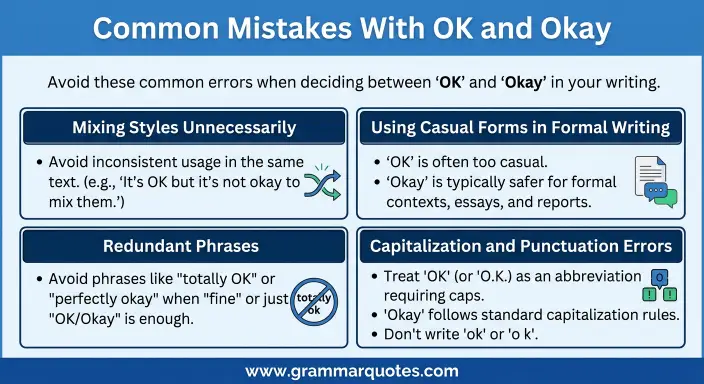
Both spellings are correct, but writers sometimes use them in ways that create confusion.
Mistake 1: Thinking OK Is Always Wrong
Incorrect assumption: “OK is not a real English word.”
Correct understanding: OK is an established and widely accepted spelling.
Example:
- Incorrect assumption: “I must always write okay.”
- Correct: “I can write okay or OK, depending on the style.”
Mistake 2: Thinking Okay Is Only Informal
Okay is common in conversation, but it also appears in ordinary prose and edited writing. Still, a more precise word may be better in formal or technical contexts.
Examples:
- Conversational: The plan is okay.
- More precise: The plan is acceptable.
Mistake 3: Using OK When Approval Needs to Be Clear
A short response such as “OK” can be ambiguous in a professional setting.
Example:
- Unclear: “OK.”
- Clearer: “I approve the revised schedule.”
Tip: Use specific language when the message involves permission, responsibility, or an official decision.
Mistake 4: Changing Spellings Without a Reason
Switching between okay and OK in one document is not automatically wrong, but inconsistent style can look untidy.
Example:
- Less consistent: “The first design is OK. The second design is okay.”
- More consistent: “The first design is okay. The second design is okay.”
Choose a preferred form for the document unless the context calls for a different one.
Mistake 5: Assuming OK Always Sounds Friendly
A one word reply can sometimes sound abrupt, depending on the conversation.
Examples:
- Brief: OK.
- Warmer: Okay, thanks for letting me know!
Neither form is inherently rude. The surrounding message and relationship matter.
Everyday Examples of Okay and OK
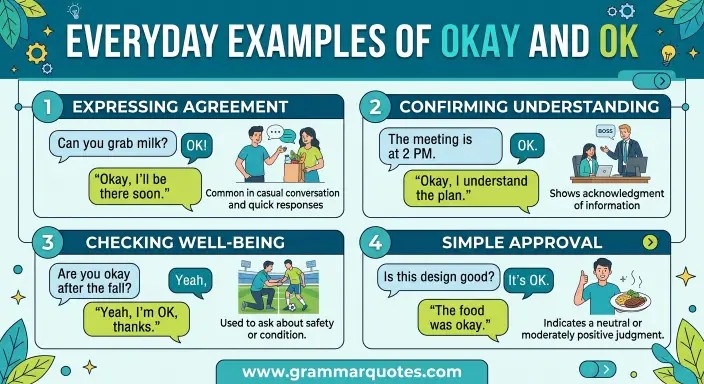
The following examples show how both forms work in common situations.
| Situation | Example With Okay | Example With OK |
| Agreement | Okay, I’ll help you. | OK, I’ll help you. |
| Permission | Is it okay to leave early? | Is it OK to leave early? |
| Health or well being | Are you okay? | Are you OK? |
| Acceptable quality | The food is okay. | The food is OK. |
| Work update | Okay, I’ll finish it today. | OK, I’ll finish it today. |
| Understanding | Okay, I understand. | OK, I understand. |
| Meeting plans | Okay, let’s meet at noon. | OK, let’s meet at noon. |
| Confirmation | Everything is okay. | Everything is OK. |
Key point: In these examples, the meaning stays almost the same. The choice mainly reflects writing preference and context.
Okay or OK in Emails and Business Writing
Both forms can work in emails, but the best option depends on your goal.
Informal Email
When writing to a friend or familiar coworker, either spelling is natural.
Example:
“Okay, I’ll send you the notes tonight.”
Or:
“OK, I’ll send you the notes tonight.”
Formal Email
In a formal email, okay and OK may sound too casual if you are confirming an important decision. A more specific phrase often works better.
Instead of:
“OK, the contract is fine.”
Write:
“I have reviewed the contract and approve the proposed changes.”
Instead of:
“Okay, I got your message.”
Write:
“Thank you for your message. I have received it.”
You do not have to avoid okay or OK in every professional email. The goal is to communicate clearly and use a tone that fits the situation.
Google Trends and Modern Usage
People often search for “okay or OK” because they want to know if one spelling is correct, which form is more formal, or which version to use in an email.
Both spellings remain widely recognizable in modern English. However, a general statement about usage cannot establish which spelling is more popular in every country or year.
Google Trends can help compare search interest for “okay” and “OK” over a selected period and region. Its results measure relative search interest, not the total number of times people write or speak each form.
To explore the comparison, visit Google Trends and enter both terms. Select your country, time range, and search category to see how interest changes.
Writing tip: Do not choose a spelling based only on search popularity. Choose the form that fits your audience and maintain a consistent style.
Quick Comparison Table: Okay vs. OK
| Version | Meaning | Correct? | Typical Use | Example |
| Okay | Acceptable or agreed | Yes | Everyday prose | Okay, I understand. |
| OK | Acceptable or agreed | Yes | Short responses | OK, I understand. |
| O.K. | Same basic meaning | Yes, as a traditional variant | Some styles and older texts | The plan is O.K. |
| Ok | Often understood | Style dependent | Informal digital writing | Ok, see you soon. |
Although “Ok” is common in casual messages, many editors prefer “OK” or “okay.” Follow the relevant style guide if you are writing for school, work, or publication.
The dotted form “O.K.” is also seen, but it is less common in many modern styles.
Key Takeaways
- Okay and OK are both correct.
- They have the same basic meaning.
- Okay is the full spelling, while OK is a shorter form.
- Both spellings are used in British and American English.
- Neither spelling is always more formal or polite.
- A style guide may recommend one form over the other.
- Use precise language for official approvals and important business decisions.
- Keep your spelling consistent within a document.
Frequently Asked Questions
1. Is okay or OK correct?
Both okay and OK are correct spellings. They can express agreement, understanding, acceptance, or a satisfactory condition. The choice usually depends on personal preference, context, or a style guide.
2. Is OK short for okay?
OK is closely associated with okay and is often treated as its shorter form. Historically, OK became established before the longer spelling became common. Today, both forms are accepted in standard English.
3. Is okay more formal than OK?
Not always. Okay may look more natural in ordinary prose, while OK is shorter and often used in quick messages. Formality depends more on the sentence, audience, and purpose than on the spelling alone.
4. Should I write OK or okay in an email?
Both are acceptable in many emails. Use okay for a conversational response or OK for a concise reply. For formal decisions, use specific phrases such as “I approve the request” or “I confirm receipt.”
5. Is “Ok” with a lowercase k correct?
People often use “Ok” in casual digital communication, and readers generally understand it. However, many style guides prefer OK or okay. For polished writing, choose one of those forms and use it consistently.
6. Is okay one word or two words?
Okay is one word. It is not written as “ok ay” or “okey” in standard English. The spelling OK is also written as one unit.
7. Is OK acceptable in academic writing?
It can be acceptable, depending on the academic style guide. However, words such as acceptable, satisfactory, or approved may communicate your meaning more precisely. Always follow your institution’s writing requirements.
8. Do British people write okay or OK?
British English uses both okay and OK. Neither spelling belongs exclusively to British or American English. Individual writers, publishers, and organizations may have different preferences.
9. Is “O.K.” still correct?
Yes, O.K. is a traditional variant. However, many modern publications prefer OK or okay. If you are following a specific style guide, use the form it recommends.
10. Can okay mean average?
Yes. When someone says that a meal, film, or performance was okay, they often mean it was acceptable but not especially good.
Example: “The movie was okay, but I would not watch it again.”
Conclusion
The difference between okay and OK is simple: both spellings are correct and share the same basic meaning. They can express agreement, understanding, acceptance, or something that is satisfactory.
Use okay when you prefer the full spelling in everyday writing. Choose OK when you want a shorter form, especially in quick messages or notes. Both are used in British and American English, so you do not need to treat this as a regional spelling rule.
For school assignments, business emails, and published articles, follow the relevant style guide. If your message concerns an important decision, consider using a more precise expression such as approved, confirmed, or acceptable.
The most important rule is to choose the form that fits your context and use it consistently. Once you understand this simple distinction, you can write okay or OK with confidence.
Discover More Articles!
FXAIX vs VOO: Key Differences, Fees, and Which Is Better?
Prebiotics or Probiotics: What Is the Difference?
Artisan or Agriculturist: What Is the Difference?

Ethan Parker is an English-language writer known for his interest in words, language, and clear communication. His work focuses on making everyday English easier to understand through simple explanations and practical examples.