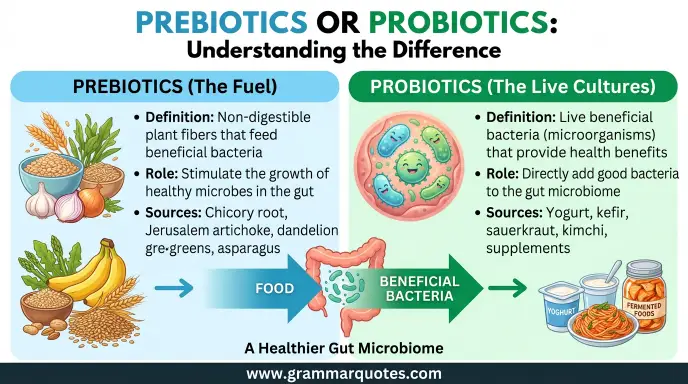
Prebiotics and probiotics both support gut health, but they work in different ways. Prebiotics are substances that feed beneficial gut bacteria, while probiotics are live microorganisms that can provide health benefits when consumed in adequate amounts. Both are found in certain foods and may help support a healthy digestive system.
For example, onions, garlic, bananas, and oats contain prebiotic fibers that beneficial gut bacteria can use as food. Yogurt with live cultures, kefir, and some fermented foods contain probiotics. Although these terms sound similar, they describe two different things.
Understanding the difference can help you make better food choices and learn how your digestive system works.
In this guide, you will discover the meanings of prebiotics and probiotics, their benefits, food sources, common misconceptions, and practical examples. You will also learn how they work together and find answers to frequently asked questions.
Quick Answer: Prebiotics vs. Probiotics
The main difference is that prebiotics feed beneficial gut microorganisms, while probiotics are live microorganisms that may provide health benefits.
| Feature | Prebiotics | Probiotics |
| Meaning | Substances used by beneficial gut microorganisms | Live microorganisms that can provide health benefits |
| Main role | Provide food for certain gut microbes | Add beneficial microbes to the digestive system |
| Common sources | Onions, garlic, oats, beans, bananas | Yogurt with live cultures, kefir, certain fermented foods |
| How they work | Support the growth or activity of certain microbes | May help maintain or restore microbial balance |
| Example | Inulin in certain plant foods | Live bacterial cultures in some yogurts |
Easy way to remember: Prebiotics are food for beneficial microbes. Probiotics are the live microbes themselves.
Definition and Meaning of Prebiotics
Prebiotics are substances, often specific types of dietary fiber, that beneficial microorganisms in the body can use. They help support the growth or activity of certain helpful microbes, particularly in the digestive system.
Many prebiotics pass through the upper digestive tract without being fully digested. When they reach the large intestine, certain gut microorganisms use them as food.
Prebiotics occur naturally in many plant foods. Examples include inulin and fructooligosaccharides (FOS), which are found in some vegetables, fruits, and other plant sources.
Examples of Prebiotics
- Onions: Contain prebiotic fibers, including inulin and FOS.
- Garlic: Provides fibers that certain gut bacteria can use.
- Bananas: Contain fibers and, especially when less ripe, resistant starch.
- Oats: Provide beta glucan and other fibers that support digestive health.
- Beans: Contain fermentable carbohydrates and dietary fiber.
- Asparagus: Contains inulin.
- Chicory root: A well known source of inulin.
What Do Prebiotics Do?
Prebiotics help nourish certain microorganisms in the gut. Their effects depend on the type of prebiotic, the amount consumed, and a person’s digestive system.
Potential benefits include:
- Supporting beneficial gut microorganisms.
- Helping maintain regular bowel movements through dietary fiber.
- Supporting normal digestive function.
- Producing short chain fatty acids when certain fibers are fermented by gut microbes.
Not every type of fiber is classified as a prebiotic. The term generally refers to substances that are selectively used by host microorganisms and provide a health benefit.
Definition and Meaning of Probiotics
Probiotics are live microorganisms that provide a health benefit when administered in adequate amounts. They may include certain bacteria and yeasts.
Some probiotics occur naturally in fermented foods, while others are added to foods or sold as dietary supplements. However, not every fermented food contains live microorganisms when it reaches the consumer. Processing, heating, and storage can affect if live cultures remain.
Different probiotic strains can have different effects. A benefit demonstrated for one strain does not automatically apply to every probiotic product.
Examples of Probiotics
- Yogurt with live cultures: May contain beneficial bacterial cultures.
- Kefir: A fermented milk drink that commonly contains bacteria and yeasts.
- Certain fermented vegetables: May contain live microorganisms if they have not been heat treated after fermentation.
- Some probiotic supplements: Contain identified bacterial strains or beneficial yeasts.
- Certain fermented soy foods: May contain live cultures, depending on how they are produced and processed.
What Do Probiotics Do?
Certain probiotics may help support digestive health. Their effects depend on the specific strain, dose, product, and health concern.
Potential benefits for particular strains and situations may include:
- Helping with some types of diarrhea.
- Supporting digestive function in certain circumstances.
- Helping maintain or restore aspects of the gut microbial community.
- Providing specific benefits that have been demonstrated in clinical research.
Probiotics are not a universal treatment. Their benefits are strain specific, and research findings for one condition should not be applied to every product or person.
Origin of the Words Prebiotics and Probiotics
The words prebiotic and probiotic are formed from elements with Greek origins.
The prefix pre means “before,” while pro can mean “for” or “in favor of.” The element biotic relates to life.
The word probiotic became associated with microorganisms that provide benefits to a host. The term prebiotic later came to describe substances that selectively support beneficial microorganisms.
Although the words are related, they describe different roles in the digestive system.
Prebiotics vs Probiotics: Key Differences
Both prebiotics and probiotics can play a role in gut health, but they are not the same.
| Category | Prebiotics | Probiotics |
| What they are | Substances used by certain gut microbes | Live microorganisms |
| Main purpose | Nourish specific microorganisms | Provide health benefits through specific strains |
| Common examples | Inulin, FOS, certain fibers | Certain Lactobacillus and Bifidobacterium strains |
| Food sources | Garlic, onions, oats, beans | Yogurt with live cultures, kefir |
| Are they alive? | No, they are substances | Yes, by definition |
| Are supplements available? | Yes | Yes |
| Do all types have the same effect? | No | No |
Are Prebiotics and Probiotics the Same Thing?
No. Prebiotics are substances that certain microorganisms can use, while probiotics are live microorganisms that may provide health benefits.
Think of a garden: prebiotics are like nourishment for the plants, while probiotics are like introducing particular living organisms into the environment. This is only an analogy, but it helps explain the difference.
Probiotics vs Prebiotics vs Synbiotics
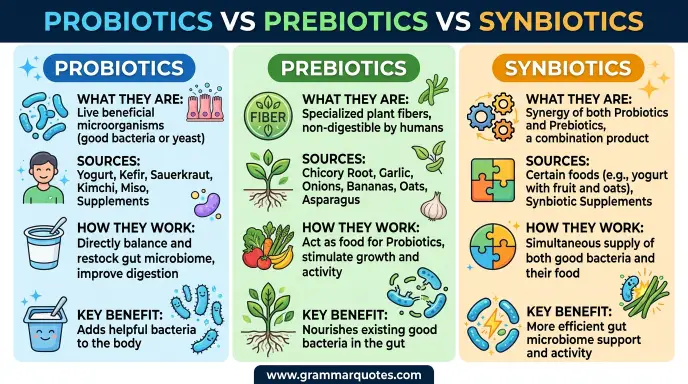
You may also encounter the word synbiotics. It refers to products or combinations that include live microorganisms and substrates used by microorganisms, with the aim of providing a health benefit.
| Term | Meaning | Example |
| Prebiotics | Substances used by beneficial microorganisms | Inulin containing foods |
| Probiotics | Live microorganisms that provide a health benefit | A product with a studied probiotic strain |
| Synbiotics | Combinations of live microorganisms and substrates that work together to provide a health benefit | A product combining a probiotic strain with a suitable prebiotic |
Synbiotics can combine the roles of prebiotics and probiotics, but the ingredients and evidence supporting a product’s benefits still matter.
Foods That Contain Prebiotics and Probiotics
You can find sources of prebiotics and probiotics in different foods. Eating a varied diet can help you obtain different types of fiber and nutrients.
Foods Rich in Prebiotics
Consider including these foods in your meals:
- Onions and garlic.
- Oats and whole grains.
- Beans and lentils.
- Bananas.
- Asparagus.
- Chicory root.
- Some other vegetables and fruits containing fermentable fibers.
These foods provide fiber and other nutrients in addition to prebiotic substances.
Foods That May Contain Probiotics
Some foods contain live cultures or microorganisms associated with fermentation:
- Yogurt labeled with live cultures.
- Kefir.
- Certain fermented vegetables.
- Some traditionally fermented soy foods.
- Other fermented products that retain live microorganisms.
Check product labels when live cultures are important to you. Pasteurization or heat treatment after fermentation can kill live microorganisms.
Can One Food Provide Both?
Some foods can contain both live microorganisms and substances that support gut microbes, depending on their ingredients and preparation. However, a fermented food is not automatically a proven probiotic, and a food containing fiber is not automatically a proven prebiotic.
The specific microorganisms, ingredients, and evidence for health benefits determine how a food or product should be described.
How to Choose Between Prebiotics and Probiotics
The right choice depends on your dietary needs and your reason for considering them. Neither is automatically better than the other.
Choose Prebiotic Rich Foods for More Dietary Fiber
If you want to increase your fiber intake, consider foods such as oats, beans, lentils, onions, and fruits.
Increase fiber gradually and drink enough fluids. A sudden increase in fermentable fiber may cause gas, bloating, or discomfort in some people.
Consider Probiotics for Specific Purposes
If you are considering a probiotic supplement for a particular digestive concern, look for evidence about the exact strain and condition rather than relying only on broad marketing claims.
A healthcare professional can help you decide if a specific product is appropriate, especially if you have a medical condition or a weakened immune system.
Do You Need Both?
Many people can support digestive health through a varied diet containing vegetables, fruits, legumes, whole grains, and other nutritious foods. A probiotic supplement is not necessary for everyone.
If you are considering both prebiotics and probiotics, remember that their effects depend on the products, amounts, and individual circumstances. More is not always better.
Common Myths About Prebiotics and Probiotics
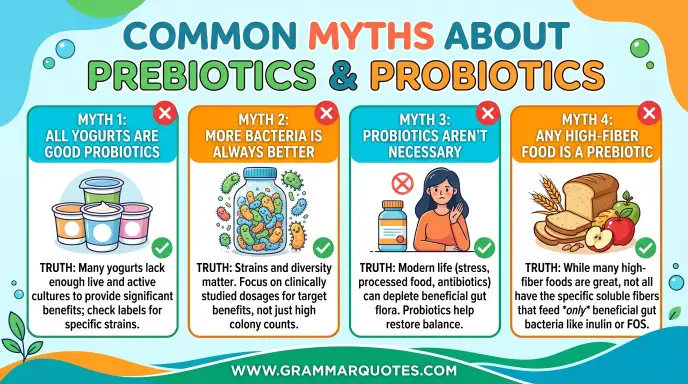
Myth 1: All Bacteria Are Harmful
Fact: Many microorganisms live naturally in and on the human body. Some are beneficial, some can cause illness, and others have effects that depend on the circumstances.
Myth 2: Every Fermented Food Is a Probiotic
Fact: Fermentation does not automatically make a food a proven probiotic. Some fermented foods are heat treated or do not contain microorganisms with demonstrated health benefits.
Myth 3: Prebiotics and Probiotics Work in Exactly the Same Way
Fact: Prebiotics provide substances that certain microbes can use. Probiotics are live microorganisms that may provide health benefits.
Myth 4: Probiotic Supplements Are Always Better Than Food
Fact: Supplements are not automatically superior to foods. Their value depends on the strain, product quality, intended use, and available evidence.
Myth 5: Everyone Needs a Probiotic Supplement
Fact: Many people do not need probiotic supplements. if one is useful depends on individual circumstances and the health concern being addressed.
Everyday Examples of Prebiotics and Probiotics
Here are simple examples to help you understand how the two terms are used.
Prebiotics in Sentences
- Oats contain fibers that can support beneficial gut microorganisms.
- Garlic provides prebiotic compounds.
- Beans are a useful source of dietary fiber.
- Bananas contain fibers that gut microbes can use.
- She added onions to her meal to increase its variety of plant fibers.
- Prebiotic fibers can be fermented by certain gut bacteria.
- Lentils provide fiber and other important nutrients.
- A varied diet can include several sources of prebiotic substances.
- Some prebiotic supplements contain inulin.
- He learned that prebiotics and probiotics have different roles.
Probiotics in Sentences
- Some yogurts contain live probiotic cultures.
- Kefir is a fermented drink that may contain live microorganisms.
- She checked the yogurt label for live cultures.
- Certain probiotic strains have been studied for specific digestive concerns.
- The supplement lists the probiotic strains in its formula.
- Not every probiotic product has the same benefits.
- Some fermented foods contain live microorganisms.
- The doctor explained that probiotic effects depend on the strain.
- Probiotics are live microorganisms that may provide health benefits.
- He compared food sources of probiotics with supplements.
People Also Ask About Prebiotics and Probiotics
1. What is the main difference between prebiotics and probiotics?
Prebiotics are substances used by certain beneficial microorganisms, while probiotics are live microorganisms that can provide health benefits.
2. Which is better, prebiotics or probiotics?
Neither is universally better. Prebiotics and probiotics have different roles, and the best choice depends on your diet and health needs.
3. Can you take prebiotics and probiotics together?
They can be used together. Some products combine both, but if a combination is helpful depends on its ingredients and the intended health benefit.
4. What foods contain prebiotics?
Common sources include onions, garlic, oats, beans, lentils, bananas, and certain other fruits and vegetables.
5. What foods contain probiotics?
Yogurt with live cultures, kefir, and some fermented vegetables may contain live microorganisms. Processing and storage can affect if those organisms remain alive.
6. Do prebiotics help with digestion?
Certain prebiotics can support gut microorganisms, and dietary fibers can help with bowel regularity. However, effects vary, and some fermentable fibers may cause gas or bloating.
7. Do probiotics improve gut health?
Some probiotic strains provide specific digestive health benefits, but effects vary by strain and condition. Not every probiotic product has been shown to be effective.
8. Are bananas prebiotic or probiotic?
Bananas are not probiotics because they are not live microorganisms. They contain fibers and resistant starch, particularly when less ripe, that can be used by certain gut microbes.
9. Is yogurt a prebiotic or a probiotic?
Yogurt containing live cultures may provide probiotics. if it also provides prebiotic substances depends on its ingredients and composition.
10. Do I need prebiotic or probiotic supplements?
Not necessarily. Many people can obtain fiber from a varied diet, and probiotic supplements are not needed by everyone. Ask a healthcare professional for advice if you have a specific medical concern.
Conclusion
Prebiotics and probiotics both relate to gut health, but they serve different purposes. Prebiotics are substances that certain beneficial microorganisms use as food, while probiotics are live microorganisms that may provide health benefits.
Prebiotic sources include oats, beans, onions, garlic, and bananas. Probiotic sources may include yogurt with live cultures, kefir, and certain fermented foods. However, not every fermented food is a proven probiotic, and not every product provides the same benefits.
You do not necessarily need supplements to support digestive health. A varied diet rich in plant foods can provide fiber and many essential nutrients. If you are considering probiotics for a particular health problem, focus on evidence for the specific strain and consult a healthcare professional when appropriate.
Understanding the difference between prebiotics and probiotics can help you make informed choices without assuming that one is always better than the other.
Discover More Articles!
Aldi or Lidl: What Is the Difference?
Drove or Driven: What Is the Difference?(2026)
Southpaw or Orthodox: What Is the Difference?(2026)

Ethan Parker is an English-language writer known for his interest in words, language, and clear communication. His work focuses on making everyday English easier to understand through simple explanations and practical examples.