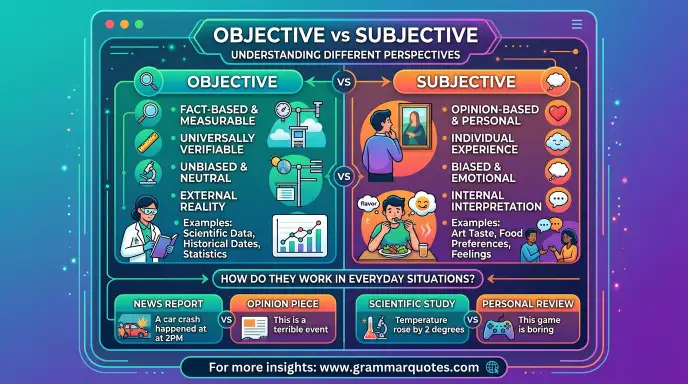
When people compare objective vs subjective, the main question is simple: does a statement rely on facts that can be checked, or does it express a person’s thoughts, feelings, or opinions? Objective information is based on facts and evidence, while subjective information is influenced by personal views, feelings, or experiences.
The difference matters in everyday conversations, school assignments, news writing, reviews, research, and business communication. For example, “The book has 300 pages” is objective because the number can be verified. “This is the best book ever written” is subjective because it expresses an opinion.
Knowing when to use objective or subjective language can make your writing clearer and more trustworthy. It can also help you identify opinions when reading articles, advertisements, reviews, and social media posts.
In this guide, you will learn the meaning of both terms, their differences, common mistakes, regional usage, and practical examples. You will also learn a simple memory trick that makes the distinction easy to remember.
Objective vs Subjective: Quick Answer
Objective means based on facts, evidence, or information that can be checked independently. Subjective means based on personal opinions, feelings, preferences, or experiences.
For example:
- Objective: The exam lasted two hours.
- Subjective: The exam was difficult.
- Objective: The restaurant opened at 10 a.m.
- Subjective: The restaurant has the best food in town.
A useful rule is: objective = fact based; subjective = opinion based.
What Does Objective vs Subjective Mean?
The words objective and subjective describe two different ways of presenting information.
What Does Objective Mean?
Objective describes information that is not based mainly on personal feelings or opinions. It can usually be supported by facts, measurements, records, evidence, or observations that other people can check.
For example:
The company was founded in 2015.
If the founding date is documented, this is an objective statement.
Other examples include:
- Water freezes at 0°C under standard atmospheric pressure.
- The meeting starts at 9 a.m.
- The report contains 25 pages.
- The store has three branches.
Objective writing is common in academic work, scientific reports, news reporting, instructions, and formal documents.
What Does Subjective Mean?
Subjective describes information influenced by personal feelings, opinions, preferences, or experiences.
For example:
This restaurant serves the best pizza in the city.
That statement cannot be proved in the same way as a restaurant’s opening time. Someone else may strongly disagree.
Other subjective statements include:
- This movie is boring.
- The blue design looks better.
- Mathematics is enjoyable.
- That was the most exciting match of the season.
Subjective language is not automatically wrong. It simply reflects a person’s viewpoint.
The Origin of Objective vs Subjective
The two words have different histories but are closely connected in modern English.
Objective comes through Latin roots connected with the idea of an object or something presented to the mind. Subjective is connected with the idea of a subject, particularly the individual experiencing or thinking about something.
Over time, these terms developed important meanings in philosophy, science, psychology, and general English.
Today, the distinction is often simplified:
- Objective: focused on facts, evidence, and observable information.
- Subjective: focused on personal thoughts, feelings, and viewpoints.
The terms can have more specialized meanings in philosophy and academic fields, but the fact versus opinion distinction is the most useful meaning for everyday writing.
British English vs American English
There is no major British American spelling difference between objective and subjective. Both forms are spelled the same in standard British and American English.
| British English | American English | Example |
| objective | objective | The report should remain objective. |
| subjective | subjective | The review contains subjective opinions. |
| objectively | objectively | The issue should be examined objectively. |
| subjectively | subjectively | People may judge the experience subjectively. |
The main difference is therefore not regional spelling. It is how the words are used in context.
Both British and American writers use objective and subjective in academic, professional, journalistic, and everyday communication.
Which Version Should You Use?
You do not normally choose between objective and subjective based on your country. Instead, choose the word based on what you are trying to communicate.
United States
Use objective when presenting verifiable information and subjective when discussing personal opinions or interpretations.
United Kingdom
The same basic distinction applies. Both terms are standard in British English.
Canada
Canadian English also uses both words in the same general way.
Australia
Australian English follows the same distinction between factual and opinion based information.
International Writing
For international readers, use the words clearly and explain the difference when necessary. They are widely understood in formal English.
Academic Writing
Academic writing often aims to be objective. However, some academic subjects involve interpretation, so subjective viewpoints may also be discussed when properly identified and supported.
Business Writing
Business reports should usually separate measurable facts from personal judgments.
For example:
Objective: Sales increased by 12% during the first quarter.
Subjective: The new campaign was highly successful.
The first statement presents a measurable result. The second requires a clear definition of what “successful” means.
Common Mistakes
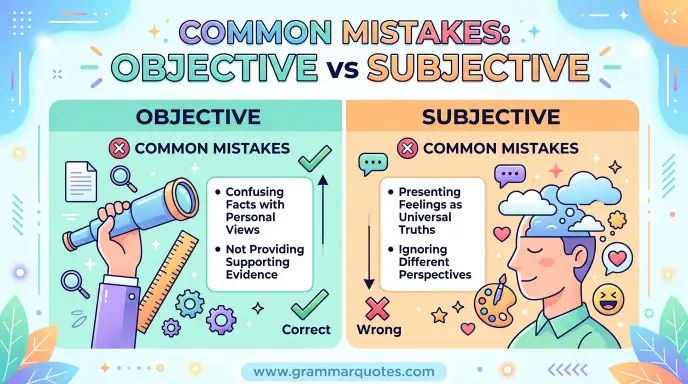
Mistake 1: Treating Every Opinion as a Fact
Incorrect:
This is objectively the best phone.
Better:
This is my favorite phone.
Or:
This phone received the highest rating in our comparison.
The first version presents a personal judgment as if it were universally provable.
Mistake 2: Thinking Subjective Means Incorrect
A subjective statement can be perfectly reasonable.
Example:
I think the movie is entertaining.
This is subjective because it describes a personal opinion. It is not necessarily false.
Mistake 3: Using “Objectively” to Make an Opinion Sound True
Incorrect:
Objectively, this is the most beautiful design.
Beauty is usually a matter of personal judgment, so calling it “objective” does not make it an objective fact.
Better:
In my opinion, this is the most beautiful design.
Mistake 4: Confusing Evidence With Interpretation
Consider this:
The article received 10,000 views.
That is an objective measurement if the figure can be verified.
But:
The article was extremely successful.
That is an interpretation. It may be based on the number of views, but “successful” requires judgment or context.
Memory Tip
Remember:
Objective = Object = something you can examine or verify.
Subjective = Subject = the person experiencing or judging something.
This is a helpful shortcut, although the words have broader meanings in specialized fields.
Everyday Examples
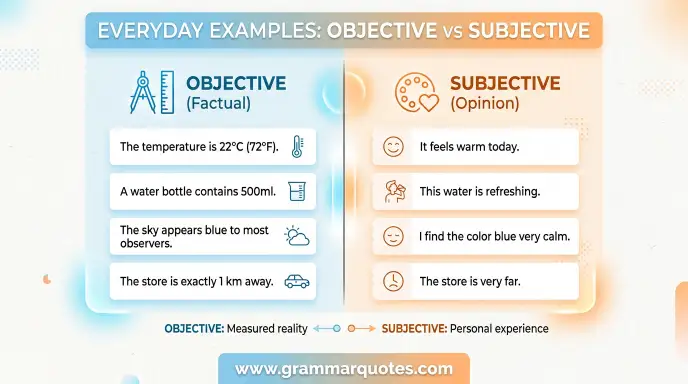
The objective subjective difference appears in almost every type of communication.
Emails
Objective:
The meeting is scheduled for Monday at 10 a.m.
Subjective:
I think Monday’s meeting will be useful.
Business Writing
Objective:
Customer complaints decreased by 15% this month.
Subjective:
The new customer service system is much better.
News Headlines
A headline reporting a documented event is generally objective:
City Council Approves New Transport Plan
A headline using strong judgment can be more subjective:
City Council Finally Approves a Much Needed Transport Plan
The phrase “much needed” expresses an evaluation.
Blogs
Blog writing often combines both.
Objective:
The laptop has 16 GB of RAM.
Subjective:
I found the laptop fast and easy to use.
Social Media
Social media posts commonly contain subjective statements:
This is the best restaurant ever!
That is an opinion, not a measurable fact.
Academic Writing
Objective:
The study included 200 participants.
Subjective or interpretive:
The findings appear particularly important for younger participants.
The second statement involves interpretation and should be supported by evidence.
Daily Conversation
Objective:
The bus arrived at 8:15.
Subjective:
The bus ride was too long.
Both statements can occur in the same conversation.
Google Trends & Modern Usage
People often search objective vs subjective because the two words are frequently used together in education, journalism, essays, workplace communication, reviews, and online discussions.
Search interest around this phrase generally reflects a common language question: How can I tell if something is a fact or an opinion?
The terms are especially useful when discussing:
- Objective vs subjective writing
- Objective vs subjective information
- Objective vs subjective statements
- Objective vs subjective opinions
- Objective vs subjective questions
- Objective vs subjective observations
- Objective vs subjective language
Modern digital content has also made the distinction more important. Reviews, advertisements, social media posts, blogs, and online comments often mix facts with opinions.
A useful reading habit is to ask:
Can I verify this statement independently, or does it mainly describe someone’s judgment or experience?
That question will not solve every case, but it is a strong starting point.
Exact regional search volume or Google Trends figures should be checked directly in Google Trends because search interest changes over time.
Quick Comparison Table
| Version | Meaning | Correct? | Typical Use | Example |
| Objective | Based on facts or evidence | Yes | Reports, research, facts | The building is 20 meters tall. |
| Subjective | Based on personal opinion or feeling | Yes | Reviews, opinions, experiences | The building looks beautiful. |
| Objectively | In a fact based or impartial way | Yes | Formal discussion | The data should be examined objectively. |
| Subjectively | From a personal viewpoint | Yes | Personal interpretation | Subjectively, I prefer the older design. |
Key Takeaways
- Objective information is based on facts, evidence, or verifiable observations.
- Subjective information is influenced by personal feelings, opinions, or experiences.
- Objective statements can usually be checked independently.
- Subjective statements can be valid opinions even when they cannot be proven as facts.
- Do not use “objectively” simply to make an opinion sound more authoritative.
- Academic and business writing often separates facts from personal judgments.
- Both British and American English use objective and subjective with the same spelling.
- A simple memory tip is objective = fact based, subjective = opinion based.
FAQs
What is the difference between objective and subjective?
Objective information is based on facts, evidence, or information that can be independently verified. Subjective information is based on personal feelings, opinions, preferences, or experiences. For example, “The book has 200 pages” is objective, while “The book is fascinating” is subjective because it expresses a personal judgment.
Is objective fact or opinion?
Objective information is generally associated with facts rather than personal opinions. An objective statement should be supported by evidence or information that others can independently check. For example, “The store opens at 9 a.m.” is objective if its opening hours can be verified.
Is subjective always an opinion?
Subjective information often involves opinions, feelings, preferences, or personal experiences. However, subjective does not simply mean “wrong.” A statement such as “I enjoyed the movie” is subjective because it describes a personal reaction, and that reaction can be genuine even though another person may feel differently.
What is an example of an objective statement?
“The company was founded in 2018” is an example of an objective statement if reliable records confirm the date. Other examples include “The meeting begins at 2 p.m.” and “The report contains 15 pages.” These statements provide information that can be checked rather than relying mainly on personal judgment.
What is an example of a subjective statement?
“This is the most enjoyable movie of the year” is subjective because it expresses a personal evaluation. Another person may strongly disagree. Statements about beauty, taste, enjoyment, comfort, or personal preference are often subjective because they depend on an individual’s experience or judgment.
Can something be both objective and subjective?
A topic can contain both objective and subjective elements. For example, a restaurant may have an objective rating, price, and opening time. if its food tastes excellent is subjective. Good writing separates measurable facts from personal opinions instead of treating them as the same type of information.
Is objective writing better than subjective writing?
Neither is automatically better. The best choice depends on the purpose. Objective writing is useful for reports, research, instructions, and factual explanations. Subjective writing is useful for reviews, personal essays, opinions, and experiences. The key is to make it clear when you are presenting evidence and when you are giving an opinion.
How do I remember objective vs subjective?
Use the simple memory rule: objective = facts and evidence; subjective = personal views and feelings. You can also connect “subjective” with the person, or subject, who is experiencing something. If a statement mainly depends on someone’s personal judgment, it is likely subjective.
Are objective and subjective spelled differently in British English?
No. Objective and subjective have the same spelling in standard British and American English. The distinction is about meaning, not regional spelling. Both forms are commonly used in education, academic writing, business communication, journalism, and everyday English.
What does objective vs subjective mean in writing?
In writing, objective language focuses on information that can be supported by evidence or verified. Subjective language reflects opinions, emotions, interpretations, or personal experiences. Strong writers understand the difference and use each type appropriately instead of presenting an opinion as an established fact.
Conclusion
Understanding objective vs subjective makes both writing and reading easier. The core difference is straightforward: objective information focuses on facts, evidence, and information that can be independently checked, while subjective information reflects personal opinions, feelings, preferences, or experiences.
For example, “The course lasts six weeks” is objective when the duration can be verified. “The course is excellent” is subjective because it expresses an evaluation.
Neither type of statement is automatically good or bad. The important thing is to use the right type for the situation and make the difference clear to your reader. Academic reports, research papers, news stories, and business documents often require careful separation of facts from opinions. Reviews, personal essays, blogs, and conversations may naturally contain more subjective language.
When you are unsure, ask yourself one simple question: Can this statement be checked independently, or does it mainly depend on someone’s personal judgment?
Remember: objective is about verifiable information, while subjective is about personal perspective.
Discover More Articles!
Dig or Die: Meaning, Usage & Examples(2026)
Absents or Absence: Meaning, Difference & Examples(2026)
Unbalanced or Imbalanced: Meaning, Differences & Examples

Ethan Parker is an English-language writer known for his interest in words, language, and clear communication. His work focuses on making everyday English easier to understand through simple explanations and practical examples.