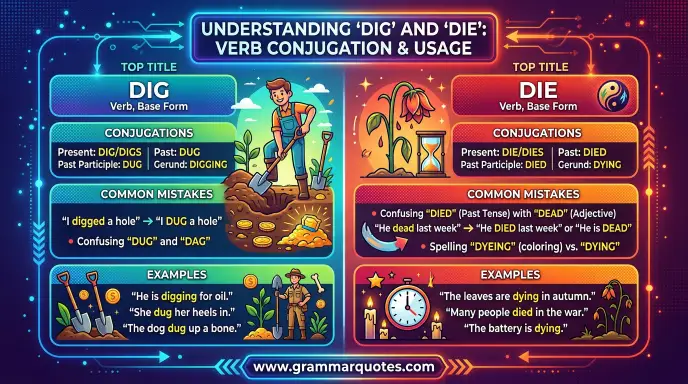
The phrase Dig or Die sounds short and dramatic, but its meaning depends on the context in which it is used. In its literal sense, it can suggest that someone must keep digging or face failure, while in a figurative sense, it can describe a strong determination to continue working toward a goal.
People may search for Dig or Die because they have seen the phrase in a game title, a slogan, a conversation, or online content and want to understand what it means. The wording can also be confusing because dig has several meanings in English. It can mean making a hole in the ground, understanding something, or even liking something in informal speech.
In this guide, we will explain the meaning of Dig or Die, its possible interpretations, grammatical use, everyday examples, and the contexts where the phrase sounds natural. We will also look at its modern usage and answer common questions people ask about this expression.
Dig or Die : Quick Answer
Dig or Die combines the verb dig with or die.
The phrase can have a literal or figurative meaning.
Literal meaning
Dig or die.
This could mean that digging is necessary for survival in a fictional or extreme situation.
Figurative meaning
It can suggest:
Keep working or face failure.
For example:
We have to dig deep and find a solution. It’s dig or die now.
Here, the phrase creates a dramatic sense of urgency.
Important point
Dig or Die is not one of the most common fixed idioms in everyday English. Its meaning is strongly influenced by context.
What Does Dig or Die Mean?
To understand Dig or Die, it helps to look at each word separately.
What Does “Dig” Mean?
The most basic meaning of dig is to make a hole or move earth using your hands, a tool, or a machine.
They dig a hole in the garden.
But dig has other meanings.
It can also mean to search for information:
I need to dig into the records.
In informal English, dig can also mean to like or understand something:
I really dig this song.
Because the word has several meanings, the meaning of Dig or Die depends on the surrounding context.
What Does “Die” Mean?
Die is a verb that refers to the end of life. It can also be used more loosely in expressions to create a strong sense of urgency or exaggeration.
For example:
We need to finish this today or we’re in serious trouble.
When die appears in a phrase like Dig or Die, it creates a strong contrast between continuing and facing a serious consequence.
Is Dig or Die an Idiom?
Not usually in the same way as common idioms such as break the ice or hit the nail on the head.
Dig or Die is better understood as a context based phrase. It can be used creatively to express determination, urgency, or a difficult choice.
The Origin of Dig or Die
There is no single well established historical origin that should be assigned to Dig or Die as a fixed English idiom.
The two words are ordinary English words with long histories.
Dig has Germanic roots and has been used in English for centuries in connection with breaking or turning over earth. Die is also an old Germanic word with a long history in English.
The structure “X or die” is also a broader English pattern. Speakers and writers can use it to create a dramatic either or statement.
For example:
Win or die.
Fight or die.
Adapt or die.
These expressions can be literal in fictional contexts or figurative in ordinary speech.
Therefore, it is safer to explain Dig or Die based on its actual context rather than claiming that it originated from one specific historical event or saying.
British English vs American English
There is no significant British American spelling difference in Dig or Die.
Both varieties use:
- dig
- or
- die
| Feature | British English | American English | Example |
| Dig | dig | dig | They dig a hole. |
| Die | die | die | Plants can die without water. |
| Phrase | Dig or Die | Dig or Die | The phrase sounds dramatic. |
The main difference is likely to be context and style, not spelling.
In both British and American English, the phrase may sound dramatic or informal depending on how it is used.
In formal writing
A writer may choose a clearer expression instead:
We must continue working until we find a solution.
Instead of:
It’s dig or die.
The second version is more dramatic and conversational.
Which Version Should You Use?
There is no British or American spelling choice to make here. Dig or Die is spelled the same way in standard English.
United States
Use it when a dramatic or informal tone is appropriate.
United Kingdom
The same spelling and basic interpretation apply.
Canada
Canadian English also uses the same spelling.
Australia
Australian English follows the same spelling.
International writing
If your readers may not know the phrase, explain its meaning through the surrounding sentence.
Academic writing
Avoid using Dig or Die as if it were a standard academic term unless you are discussing a specific title, quotation, or source.
A clearer alternative might be:
We must continue our efforts despite the challenges.
Business writing
It can work as a creative slogan, but it may sound too dramatic in a formal report.
For professional communication, consider:
We need to keep working until we find a solution.
Common Mistakes with Dig or Die
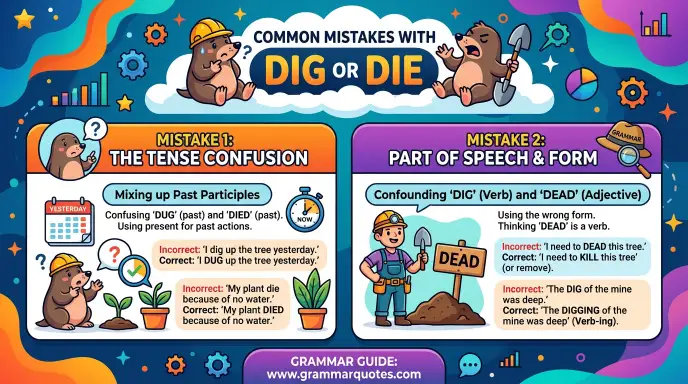
Mistake 1: Treating it as a fixed idiom
❌ Dig or Die always means physical digging.
✅ The meaning of Dig or Die depends on its context.
Why?
Dig can have literal and figurative meanings.
Memory tip: Always check what dig means in the sentence.
Mistake 2: Confusing “dig” and “dug”
❌ They dug or die.
If you are using the phrase as a slogan or command, the standard form is:
✅ Dig or Die.
Dig is the base form used in a command or slogan.
Mistake 3: Using it in a formal sentence without context
❌ The research project is dig or die.
This sounds unclear.
Better:
✅ The research team must continue investigating until it finds an answer.
Mistake 4: Assuming “die” is always literal
The word die can create dramatic emphasis without literally referring to death.
For example:
It’s now or never.
Similarly, creative expressions can use strong language to show urgency.
Always consider the context before interpreting the phrase literally.
Dig or Die in Everyday Examples

Emails
A dramatic or informal email might say:
We need to keep searching for the missing information. It’s dig or die at this point.
For professional writing, a clearer version would be:
We need to continue searching until we find the information.
Business Writing
The company adopted a “dig or die” attitude toward solving the problem.
Here, the phrase suggests strong determination.
News Headlines
A headline could use Dig or Die as a dramatic phrase, especially when discussing survival, construction, exploration, or competition.
Blogs
Starting a new business can sometimes feel like dig or die.
Here, it means continuing to work despite difficult circumstances.
Social Media
Exam tomorrow. Time to dig or die. 😅
This would usually be understood as humorous exaggeration rather than a literal statement.
Academic Writing
Academic writers would normally avoid the phrase unless it is relevant to a specific source, title, or quotation.
A clearer alternative is:
Researchers must continue investigating the problem despite limited evidence.
Daily Conversation
We have one hour left. Dig or die!
In casual conversation, this can be used dramatically or jokingly to mean:
Keep working or we will fail.
Dig or Die : Google Trends & Usage Data
People who search for Dig or Die may have encountered the phrase in very different contexts. Some may be looking for its English meaning, while others may be searching for a specific title or piece of media.
Because search interest can change over time and across countries, exact popularity numbers should not be stated without current, reliable data.
The phrase is also easy to search because it has a distinctive structure. Users may want to know:
- What does Dig or Die mean?
- Is Dig or Die an idiom?
- Is Dig or Die a phrase?
- What does dig mean in this expression?
- Is Dig or Die used literally or figuratively?
Modern usage is likely to be more common in creative, gaming, entertainment, slogan, and informal contexts than in formal academic English.
The key point is that Dig or Die does not have one universal interpretation. Context determines the intended meaning.
Quick Comparison Table
| Version | Meaning | Correct? | Typical context | Example |
| Dig or Die | Continue digging or face a serious consequence | ✅ | Literal/creative | Dig or die! |
| dig | Make a hole or search deeply | ✅ | General English | Dig into the soil. |
| dig deep | Make a strong effort | ✅ | Figurative | We need to dig deep for answers. |
| dug | Past tense of dig | ✅ | Past events | They dug a hole yesterday. |
| dig or died | Past tense variation | ⚠️ | Context dependent | The phrase may need rewriting. |
Key Takeaways
- Dig or Die is grammatically understandable English.
- It can have a literal or figurative meaning.
- Dig can mean physically excavating or searching deeply.
- Die creates a strong sense of consequence or urgency.
- The phrase is not normally treated as a common fixed idiom.
- British and American English use the same spelling.
- Context is essential for understanding the phrase.
- Formal writing often benefits from a clearer, less dramatic alternative.
FAQs
What does Dig or Die mean?
Dig or Die generally suggests that someone must keep digging or continue making an effort despite a serious consequence. It can be literal, such as digging for survival, or figurative, meaning that someone must keep working until they succeed. The exact meaning depends on where and how the phrase is used.
Is Dig or Die an idiom?
Not usually. Dig or Die is better viewed as a creative or context dependent phrase rather than a common fixed English idiom. It follows a pattern often used in dramatic expressions, where two choices are presented with a strong consequence. Its meaning can therefore change depending on the situation.
Is Dig or Die grammatically correct?
Yes, Dig or Die can be grammatically correct, especially as a command, slogan, or dramatic phrase. The base verb dig works naturally in commands. However, if the phrase sounds natural depends on the context. In formal writing, a more direct sentence may communicate the idea more clearly.
What does “dig” mean in Dig or Die?
The meaning of dig depends on context. Literally, it means to make a hole or move soil. Figuratively, it can mean to investigate deeply or make a strong effort. In Dig or Die, the intended meaning should be determined from the surrounding text rather than assuming that physical digging is always involved.
Is Dig or Die a common phrase?
It is understandable English, but it is not as common as many established idioms. It may appear more often in creative writing, slogans, entertainment, gaming, or informal speech. If you use it for a general audience, adding context can help readers understand exactly what you mean.
What is another way to say Dig or Die?
The best alternative depends on the intended meaning. If you mean determination, you could say “keep going or fail.” If you mean investigation, you could say “keep searching until we find the answer.” For formal writing, direct language is usually clearer than a dramatic phrase such as Dig or Die.
Can Dig or Die be used in formal writing?
It can be used when the phrase is relevant to a title, quotation, slogan, or creative discussion. However, it may sound dramatic in formal academic or business writing. In those settings, a direct statement such as “We must continue our efforts” is often clearer and more professional.
Does Dig or Die literally mean death?
Not necessarily. The phrase can use die figuratively to create urgency or dramatic effect. In casual speech, similar expressions often exaggerate the consequences of failure. However, in a literal story or survival context, the words could have a more direct meaning. Context determines the interpretation.
What is the difference between Dig or Die and Dig Deep?
Dig or Die presents a dramatic choice or consequence, while dig deep is a common expression meaning to make a strong effort or search deeply. For example, “We need to dig deep for answers” means we need to investigate carefully or work hard to find a solution.
Conclusion
Dig or Die is a short but flexible phrase whose meaning depends heavily on context. At its most literal, it can describe a situation where digging is necessary and failure has a serious consequence. In figurative use, it can express determination, urgency, or the feeling that there is no easy alternative.
It is important not to treat Dig or Die as a standard idiom with one fixed definition. The word dig has several meanings in English, including physically making a hole and investigating something deeply. The word die can also be literal or used for dramatic emphasis.
British and American English use the same spelling, so there is no regional spelling issue to solve. The bigger question is if the phrase fits the tone of your writing.
For casual, creative, humorous, or dramatic contexts, Dig or Die can be effective. For academic and professional writing, a direct explanation is often better.
The easiest rule to remember is this: understand the context first, because “Dig or Die” can mean more than one thing.
Discover More Articles!
i.e. vs e.g.: Meaning, Difference, and Correct Usage
Else’s or Elses: Common Mistakes and Examples(2026)
Perfume or Parfum: What’s the Difference?(2026)

Ethan Parker is an English-language writer known for his interest in words, language, and clear communication. His work focuses on making everyday English easier to understand through simple explanations and practical examples.