Confused about Absents or Absence? Learn which word is correct, what each word means, and how they are used in English. This guide explains why “absence” is usually the correct choice, when “absents” can be used, and gives clear examples to help you avoid common grammar mistakes.
This difference matters because the two words cannot normally be swapped. For example, we say “Her absence was noticed,” but “He absents himself from the meeting” has a different grammatical structure. The confusion often comes from the shared root and similar spelling.
In this guide, you will learn the meaning of absents or absence, how each word works in a sentence, their origins, British and American usage, common mistakes, practical examples, and easy ways to remember which form to use.
Absents or Absence: Quick Answer
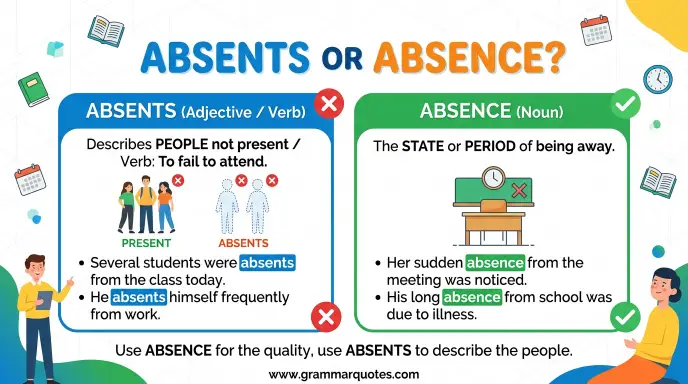
Absence is a noun that means the state of not being present or the lack of something. Absents is a verb form of absent, normally used with a reflexive pronoun, as in “She absents herself from class.”
- Absence: His absence was noticed.
- Absents: He absents himself from the discussion.
- Absent: Maria was absent from school.
Easy rule: Use absence when you are naming the situation. Use absents when someone actively stays away, usually in the formal construction “absents himself/herself/themselves.”
Absents or Absence : Quick Answer
| Word | Part of speech | Main meaning | Example |
| absence | Noun | The state of not being present | Her absence was obvious. |
| absent | Adjective | Not present | She was absent from class. |
| absents | Verb | Stays away or removes oneself | He absents himself from meetings. |
The most important distinction is noun vs. verb.
Use absence when:
- You are talking about someone not being present.
- You are talking about something that does not exist or is missing.
- You need a noun after words such as his, her, their, the, or an.
Examples:
His absence from the meeting was unexpected.
The absence of evidence made the claim difficult to prove.
Use absents when:
- The subject is he, she, or it.
- You are using absent as a verb.
- The sentence normally uses a reflexive pronoun.
Example:
He absents himself from important meetings.
This verb construction is relatively formal. In everyday English, “He stays away from important meetings” or “He is often absent from important meetings” may sound more natural.
What Does Absents or Absence Mean?
Meaning of Absence
Absence is a noun. It refers to the fact that someone or something is not present where expected. It can also mean that something does not exist or is lacking.
For example:
The teacher noticed his absence.
Here, absence refers to the fact that he was not there.
It can also describe a lack of something:
The absence of clear evidence caused concern.
In this sentence, absence means that clear evidence was lacking. Cambridge also lists both meanings: not being present and not existing.
Meaning of Absents
Absents comes from the verb absent.
The verb means to stay away or withdraw oneself from a place. Cambridge gives examples of the verb in constructions such as “absent yourself from” a place.
For example:
He absents himself from the weekly meeting.
The subject, he, is doing the action.
Because this form is formal, you are more likely to encounter it in formal writing than in casual conversation.
The Origin of Absents or Absence
The words absent and absence share a Latin origin. Absence entered English through Old French from Latin absentia, related to absens, the present participle of Latin abesse, meaning to be away or absent.
The Latin verb can be understood through:
- ab = away or from
- esse = to be
So the basic idea behind the word is connected with being away. The English adjective absent appeared in the late 14th century, while the noun absence also dates from the late 14th century.
The verb absent also developed in English, with the sense of withdrawing or staying away.
British English vs American English
There is no major spelling difference between British and American English for absent, absents, or absence.
| British English | American English | Example |
| absence | absence | Her absence was noticed. |
| absent | absent | He was absent from school. |
| absents | absents | He absents himself from the meeting. |
The pronunciation may vary slightly between speakers and regions, but the spelling and core meanings remain the same. Cambridge lists both UK and US pronunciations for absence and absent.
Regional differences
The important difference is not spelling. It is style and frequency.
In both British and American English, absence is common and natural:
Her absence was unexpected.
The verb absent is more formal:
He absented himself from the meeting.
For everyday communication, many speakers prefer:
He did not attend the meeting.
So the choice often depends more on formality and sentence structure than on region.
Which Version Should You Use?
United States
Use absence when you need a noun:
His absence from work was noted.
Use absent when describing someone:
He was absent from work.
Use absents himself only when the formal verb construction fits the context.
United Kingdom
The same basic rules apply.
Her absence was noticed.
She was absent from class.
She absented herself from the discussion.
Canada
Standard Canadian English follows the same distinction.
For most general writing, absence and absent are the safest choices.
Australia
Australian English also uses the same grammatical distinction.
Choose the word based on its role in the sentence, not its regional spelling.
International writing
For ESL learners and international audiences, simple constructions are usually best:
He was absent from class.
This is clearer than:
He absented himself from class.
Academic writing
Absence is especially common in academic writing:
The absence of reliable data limits the study.
Business writing
Use clear, direct language:
Sarah’s absence from today’s meeting was noted.
This is usually more natural than using the formal verb absents.
Common Mistakes
Mistake 1: Using “absents” as a noun
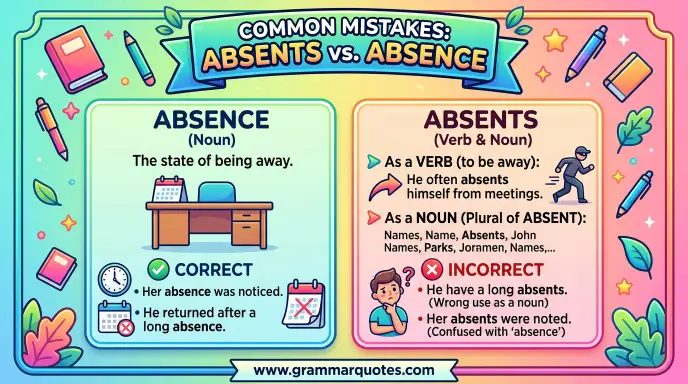
❌ His absents caused problems.
✅ His absences caused problems.
Why?
The plural noun is absences, not absents.
Memory tip:
One situation = absence. More than one = absences.
Mistake 2: Using “absence” after “was”
❌ He was absence from school.
✅ He was absent from school.
Why?
After was in this structure, you need the adjective absent, not the noun absence.
Mistake 3: Forgetting the reflexive pronoun
❌ He absents from the meeting.
✅ He absents himself from the meeting.
The verb absent normally takes a reflexive construction when it means that someone deliberately stays away.
Mistake 4: Using “absence” when you mean “absent”
❌ She is absence today.
✅ She is absent today.
Think of it this way:
Person = absent
State or situation = absence
Everyday Examples
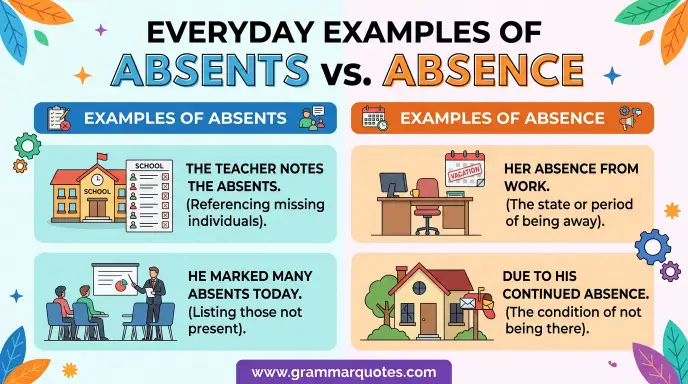
Emails
Please let us know about your absence in advance.
I will be absent from tomorrow’s meeting.
Business Writing
The manager’s absence affected the schedule.
His absence from the meeting was recorded.
News Headlines
Minister’s Absence Raises Questions
Blogs
The absence of clear instructions can confuse new users.
Social Media
Sorry for my absence. I’ve been busy with exams.
Academic Writing
The absence of sufficient evidence limits the conclusion.
Daily Conversation
Why were you absent yesterday?
I noticed your absence at the event.
Google Trends & Modern Usage
People searching for absents or absence are often trying to solve a grammar or word choice problem. They may also be unsure if they should use absent, absence, absents, or absences.
There is no reliable basis here for claiming a specific search volume number or trend percentage, so exact statistics should not be invented.
From normal modern English usage, absence is a common noun, while absent is commonly used as an adjective. The verb absent exists but is more formal, especially in the construction “absent himself/herself/themselves.” Cambridge confirms the adjective, noun, and verb uses.
A useful related term is absentee, meaning someone who is absent, while absenteeism refers to the practice or situation of being absent, especially from work or school.
Quick Comparison Table
| Version | Meaning | Correct? | Typical use | Example |
| absence | State of not being present | ✅ | Noun | His absence was noticed. |
| absent | Not present | ✅ | Adjective | He was absent today. |
| absents | Stays away | ✅ | Verb | He absents himself from meetings. |
| absences | More than one absence | ✅ | Plural noun | Several absences were recorded. |
| absentee | Person who is absent | ✅ | Noun | The absentee missed the meeting. |
| absenteeism | Habit or pattern of being absent | ✅ | Noun | Absenteeism affects productivity. |
Key Takeaways
- Absence is a noun.
- Absent is commonly an adjective.
- Absents is a third person singular verb form.
- Absents is normally used with a reflexive pronoun, such as himself or herself.
- Use absence for the state or fact of not being present.
- Use absent to describe someone who is not present.
- Absences is the plural of absence.
- British and American English use the same spellings.
- Absents himself is formal and less common in everyday conversation.
- When in doubt, absence or absent will usually be the more natural choice.
FAQs
What is the difference between absents and absence?
Absence is a noun meaning the state of not being present or the lack of something. Absents is a verb form of absent, usually appearing in the formal construction “he absents himself.” For example, “Her absence was noticed” uses a noun, while “He absents himself from meetings” uses a verb.
Is “absents” a correct English word?
Yes. Absents is grammatically correct as the third person singular form of the verb absent. It is generally used in formal constructions such as “She absents herself from the discussion.” In casual English, speakers usually prefer phrases such as “She stays away” or “She does not attend.”
Is “absence” a noun or a verb?
Absence is a noun. It names the state or fact of not being present, or the lack of something. For example, “His absence was surprising” uses absence as a noun. It can also describe a lack, as in “the absence of evidence.”
What is the adjective form of absence?
The adjective is absent. For example, “John was absent from class.” The adjective describes someone or something that is not present. Cambridge also lists absent as an adjective meaning not present and, in another sense, not existing.
What is the plural of absence?
The plural of absence is absences. For example, “The school recorded several absences this month.” Do not use absents as the plural of absence. The word absents has a different grammatical role because it is a verb form.
Can I say “he absents from school”?
Usually, no. The standard formal construction is “he absents himself from school” when the meaning is that he deliberately stays away. However, in ordinary English, “he is absent from school” or “he does not attend school” is more natural.
Is “absence” the opposite of “presence”?
Yes. Absence describes not being present, while presence describes being present. For example, “The student’s absence was noticed” contrasts naturally with “The student’s presence was important.” Both words have long established English usage.
Which is correct: “in my absence” or “in my absent”?
“In my absence” is correct. Absence is the noun needed after the possessive my. For example: “Please contact Sarah in my absence.” The phrase means that something happens while you are not present.
Is “absent” more common than “absents”?
In everyday English, absent is much more useful because it commonly works as an adjective: “She is absent today.” Absents is a specialized verb form and is usually found in formal writing, particularly in the construction “absents himself/herself/themselves.”
What is the easiest way to remember absence vs absent?
Use this simple rule: absence = the situation; absent = the person or thing’s condition. For example, “His absence was noticed” and “He was absent.” If you see was/is/are, absent will often be the right choice in this context.
Conclusion
The difference between absents or absence becomes much easier when you focus on grammar. Absence is a noun. It describes the state or fact of not being present, or the lack of something.
Absent is commonly an adjective that describes someone or something that is not present. Absents is a verb form and is normally used in a formal reflexive construction, such as “He absents himself from the meeting.”
For most everyday, academic, and business writing, absence and absent are the forms you will use most often. If you are writing naturally for a general audience, do not choose absents simply because it looks like a plural form. It has a completely different grammatical function.
The best approach is to identify the role of the word before choosing it.
Memorable rule: Think “absence” for the situation, “absent” for the condition, and “absents” for the formal action of staying away.
Discover More Articles!
i.e. vs e.g.: Meaning, Difference, and Correct Usage
Else’s or Elses: Common Mistakes and Examples(2026)
Perfume or Parfum: What’s the Difference?(2026)

Ethan Parker is an English-language writer known for his interest in words, language, and clear communication. His work focuses on making everyday English easier to understand through simple explanations and practical examples.