i.e. vs e.g. is one of the most common punctuation and writing questions in English. The two abbreviations look similar, but they do not mean the same thing. Using the wrong one can make a sentence confusing, especially in academic writing, business emails, blogs, and professional documents.
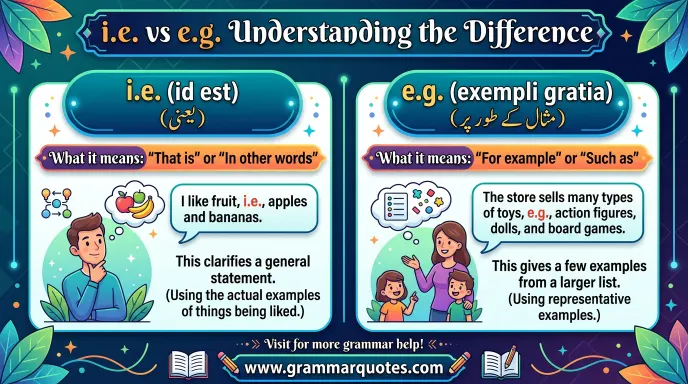
i.e. means “that is” or “in other words,” while e.g. means “for example.” In simple terms, use i.e. when you want to clarify exactly what you mean. Use e.g. when you want to provide one or more examples.
The confusion comes partly from their Latin origins. i.e. comes from id est, meaning “that is,” while e.g. comes from exempli gratia, meaning “for example.” Their similar appearance makes them easy to mix up.
In this guide, you will learn the difference between i.e. and e.g., how to use each abbreviation correctly, common mistakes, punctuation rules, regional style differences, and practical examples. By the end, choosing between them should be simple.
i.e. vs e.g. : Quick Answer
The easiest way to understand the difference is:
- i.e. = that is / in other words
- e.g. = for example
Example with i.e.
She lives in the capital city, i.e., Islamabad.
Here, Islamabad identifies exactly which city is meant.
Example with e.g.
You can visit many Pakistani cities, e.g., Lahore, Islamabad, or Karachi.
Here, the cities are examples. They are not necessarily the complete list.
Simple memory trick
Remember:
i.e. → “in other words”
e.g. → “example given”
If you are clarifying, use i.e.
If you are giving examples, use e.g.
What Does i.e. Mean?
i.e. is an abbreviation of the Latin phrase id est, which means “that is.”
In modern English writing, it is used to clarify, define, or restate something more precisely.
Example
He works remotely, i.e., he does not work from an office.
The second part explains exactly what “works remotely” means in this context.
Another example:
The meeting is on the weekend, i.e., Saturday.
Here, the writer is identifying the specific day being discussed.
When should you use i.e.?
Use i.e. when you want to:
- clarify an idea
- define something
- restate something
- make a statement more specific
- explain exactly what you mean
Think of i.e. as a signal that says:
“Let me explain exactly what I mean.”
What Does e.g. Mean?
e.g. is an abbreviation of the Latin phrase exempli gratia, which means “for example.”
Use it when you want to give one or more examples of something.
Example
I enjoy outdoor activities, e.g., hiking and cycling.
Hiking and cycling are examples of outdoor activities. They do not represent every possible outdoor activity.
Another example:
You can learn a programming language, e.g., Python or C++.
Python and C++ are examples. Other programming languages could also fit the sentence.
When should you use e.g.?
Use e.g. when you want to:
- provide examples
- illustrate an idea
- show possible options
- give representative items
- make a general statement easier to understand
Think of e.g. as saying:
“Here is an example.”
The Origin of i.e. vs e.g.
Both i.e. and e.g. come from Latin.
i.e.
i.e. comes from the Latin phrase id est, which literally means “that is.”
English writers use it as a short way to introduce a clarification or precise restatement.
e.g.
e.g. comes from the Latin phrase exempli gratia, which means “for the sake of an example” or simply “for example.”
Both abbreviations became established in English writing because Latin was historically important in education, law, science, and scholarship.
Today, writers generally use them as standard English abbreviations rather than thinking about their Latin origins.
British English vs American English
The basic meanings of i.e. and e.g. are the same in British and American English.
| Abbreviation | British English | American English | Example |
| i.e. | That is / in other words | That is / in other words | He is a minor, i.e., under 18. |
| e.g. | For example | For example | Try a fruit, e.g., an apple. |
| i.e. | Clarification | Clarification | Choose one day, i.e., Monday. |
| e.g. | Example | Example | Visit a city, e.g., London. |
The main differences tend to involve punctuation and style guide preferences, not meaning.
Some style guides recommend periods because these are traditional abbreviations. Others may use slightly different punctuation conventions.
For formal writing, follow the style guide required by your school, university, employer, or publication.
Which Version Should You Use?
Choosing between i.e. and e.g. depends on what you are trying to communicate.
United States
Both abbreviations are widely understood. In formal writing, use i.e. for clarification and e.g. for examples.
United Kingdom
The same basic rule applies. i.e. means “that is,” while e.g. means “for example.”
Canada
Canadian English generally follows the same distinction.
Australia
Australian English also uses both abbreviations with the same core meanings.
International Writing
For an international audience, consider writing the full phrases “that is” and “for example” if there is any risk of confusion.
For example:
Several programming languages, for example, Python and Java, are widely used.
This can be clearer for English learners.
Academic Writing
Always check your institution’s style requirements.
In some academic contexts, writing the words “that is” or “for example” may be preferred over abbreviations.
Business Writing
Both abbreviations can be useful, but clarity should come first.
Instead of:
We need a professional qualification, i.e., a degree or equivalent.
You could write:
We need a professional qualification, that is, a degree or equivalent.
Choose the form that best fits your audience.
Common Mistakes
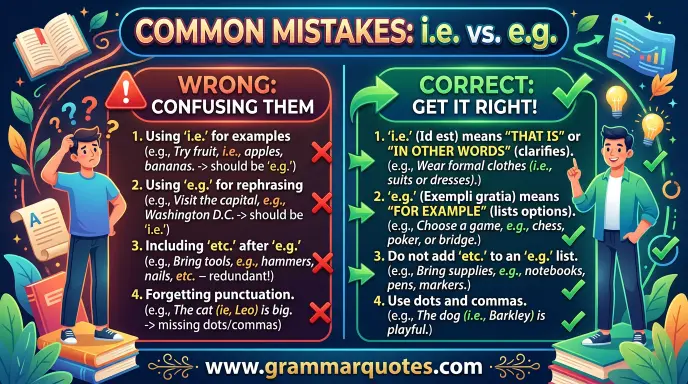
Mistake 1: Using e.g. when you mean “that is”
Incorrect:
My favorite sport is a team sport, e.g., football.
If you mean football is the exact sport you are referring to, e.g. may not be appropriate.
Better:
My favorite sport is football, i.e., the sport I play most often.
The exact meaning depends on context.
Memory tip: If the second part explains exactly what you mean, think i.e.
Mistake 2: Using i.e. before examples
Incorrect:
You can eat many fruits, i.e., apples, bananas, and oranges.
If apples, bananas, and oranges are only examples and other fruits are also possible, use e.g.
Correct:
You can eat many fruits, e.g., apples, bananas, and oranges.
Mistake 3: Thinking i.e. means “for example”
This is one of the most common errors.
i.e. does not mean “for example.”
It introduces a clarification or precise explanation.
Mistake 4: Thinking e.g. gives a complete list
e.g. introduces examples, not necessarily every possible option.
Bring school supplies, e.g., pens, notebooks, and pencils.
This does not mean those are the only supplies you can bring.
Mistake 5: Confusing the Latin phrases
You do not need to memorize the Latin phrases to use the abbreviations correctly.
The practical rule is enough:
i.e. = that is
e.g. = for example
Everyday Examples
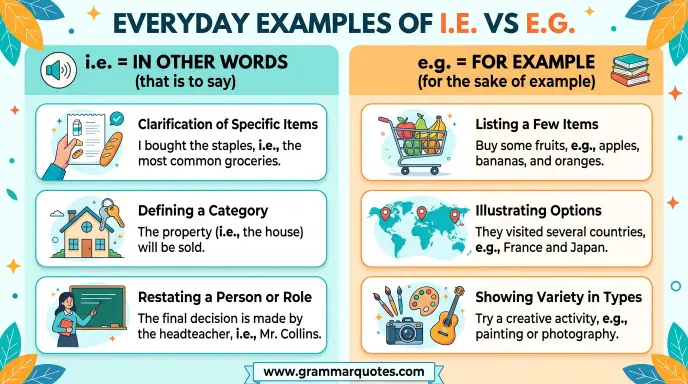
Emails
i.e. example:
Please submit the final document by Friday, i.e., September 11.
e.g. example:
Please bring identification, e.g., a student card or other approved ID.
Business Writing
We need a digital marketing specialist, i.e., someone with experience in and online campaigns.
We use several tools, e.g., Google Analytics and Search Console.
News Headlines
News writing may use abbreviations depending on the publication’s style.
Several major cities, e.g., London and Manchester, reported increased activity.
Blogs
You can improve your writing in several ways, e.g., by reading more and practicing regularly.
Social Media
Informal social media writing often avoids i.e. and e.g. because the full phrases are easier for general readers.
Instead of:
Try healthy snacks, e.g., fruit.
You could simply write:
Try healthy snacks, for example, fruit.
Academic Writing
The study focused on one age group, i.e., students aged 18 to 21.
Or:
Several programming languages, e.g., Java, Python, and C++, were considered.
Daily Conversation
People rarely say “i.e.” and “e.g.” aloud in ordinary conversation. They are mainly useful in written communication.
In speech, people usually say:
- “that is”
- “in other words”
- “for example”
i.e. vs e.g. Punctuation
Punctuation can vary by style guide, but a common form is to place a comma after the abbreviation when it introduces a phrase.
Common style
The course covers several subjects, e.g., mathematics and computer science.
He is a minor, i.e., he is under 18.
You may also see punctuation handled differently in some style systems.
The important point is to be consistent and follow the style guide you are using.
Should i.e. and e.g. be italicized?
Usually, they do not need special formatting in ordinary English writing.
Should there be periods?
The traditional forms are:
- i.e.
- e.g.
Some modern style guides may use different conventions. Always follow the requirements of the publication or institution.
Google Trends & Modern Usage
The search query “i.e. vs e.g.” is driven by a common writing problem: both abbreviations look similar, but their functions are different.
The question is especially relevant to:
- students
- ESL learners
- bloggers
- writers
- editors
- business professionals
- academic writers
Modern digital writing has also increased the need for quick explanations. People often search for the difference when editing essays, emails, articles, reports, or professional documents.
Exact Google Trends numbers depend on the selected country and time period. Without checking a specific Google Trends dataset, it would be inappropriate to claim exact search volume or popularity figures.
A broader usage pattern is clear: i.e. tends to appear when writers clarify a statement, while e.g. commonly appears when writers introduce examples.
Quick Comparison Table
| Version | Meaning | Correct? | Main Use | Example |
| i.e. | That is | ✅ | Clarification | He is a minor, i.e., under 18. |
| e.g. | For example | ✅ | Examples | Try a sport, e.g., football. |
| i.e. | For example | ❌ | Not its function | ❌ Try a sport, i.e., football. |
| e.g. | That is | ❌ | Not its function | ❌ He is a minor, e.g., under 18. |
Key Takeaways
- i.e. means “that is.”
- e.g. means “for example.”
- Use i.e. to clarify or restate something.
- Use e.g. to provide examples.
- i.e. usually introduces a more exact explanation.
- e.g. normally introduces examples that are not necessarily complete.
- Both abbreviations come from Latin.
- British and American English use the same basic distinction.
- When writing for a broad audience, spelling out “that is” or “for example” can improve clarity.
FAQs
What is the difference between i.e. and e.g.?
i.e. means “that is” and introduces a clarification or more precise statement. e.g. means “for example” and introduces one or more examples. A simple test is to replace the abbreviation with the phrase you mean. If “that is” works, use i.e. If “for example” works, use e.g.
What does i.e. stand for?
i.e. comes from the Latin phrase id est, meaning “that is.” In English writing, it is used to clarify, define, or restate something more precisely. For example: “The office closes early, i.e., at 3 p.m.” The second part specifies exactly what the writer means.
What does e.g. stand for?
e.g. comes from the Latin phrase exempli gratia, meaning “for example.” It is used to introduce one or more examples of a larger category. For example, “Bring a writing tool, e.g., a pen or pencil.” The examples do not necessarily form a complete list.
Is i.e. or e.g. used for examples?
Use e.g. for examples. It means “for example.” Use i.e. when you want to explain exactly what you mean. For instance, “Bring fruit, e.g., apples and oranges” gives examples, while “The meeting is on Monday, i.e., the first day of the workweek” provides clarification.
Is it i.e. or e.g. in academic writing?
Both can be used in academic writing, but the correct choice depends on the meaning. Use i.e. for clarification and e.g. for examples. However, universities and academic publishers may have their own style rules. Always check the required style guide before submitting formal academic work.
Are i.e. and e.g. interchangeable?
No. They have different functions. i.e. means “that is,” while e.g. means “for example.” Replacing one with the other can change the meaning of a sentence. If you are clarifying an exact meaning, use i.e. If you are giving representative examples, use e.g.
Is i.e. formal English?
Yes. i.e. is an established abbreviation used in formal and informal written English. However, some publications prefer writers to spell out “that is” because it may be clearer for general readers. In formal documents, follow the style requirements of the organization or publication.
Is e.g. formal English?
Yes. e.g. is a standard English abbreviation and is commonly found in academic, professional, technical, and general writing. However, it is not always the clearest choice for every audience. In simple public facing content, “for example” may be easier to understand.
Should I use a comma after i.e. and e.g.?
A common writing style uses a comma after the abbreviation when it introduces the following phrase: “e.g., apples and oranges” and “i.e., the final version.” However, punctuation rules vary between style guides. Follow the style guide required for your work and use one convention consistently.
How can I easily remember i.e. vs e.g.?
Use the memory trick “i.e. = in other words” and “e.g. = example given.” When you are explaining exactly what you mean, choose i.e. When you are giving examples, choose e.g. This simple distinction works in most everyday writing situations.
Conclusion
The difference between i.e. vs e.g. is simple once you focus on their purpose. i.e. means “that is” and is used to clarify or make a statement more precise. e.g. means “for example” and is used to provide examples of a broader idea.
The most important rule is not to memorize complicated Latin terminology. Instead, ask yourself what the sentence is doing. If you are saying “in other words”, use i.e. If you are saying “for example”, use e.g.
For students, writers, bloggers, and professionals, this small distinction can make writing much clearer. When writing for a general audience, you can also replace these abbreviations with their full meanings when that feels more natural.
Remember the simplest rule: i.e. explains, while e.g. exemplifies. Once you understand that difference, you can use both abbreviations confidently in academic, business, and everyday writing.
Discover More Articles!
Receive or Recieve: Which Spelling Is Correct?
Occurred or Occured: Which Is Correct?
556 or 762: What’s the Difference?

Ethan Parker is an English-language writer known for his interest in words, language, and clear communication. His work focuses on making everyday English easier to understand through simple explanations and practical examples.