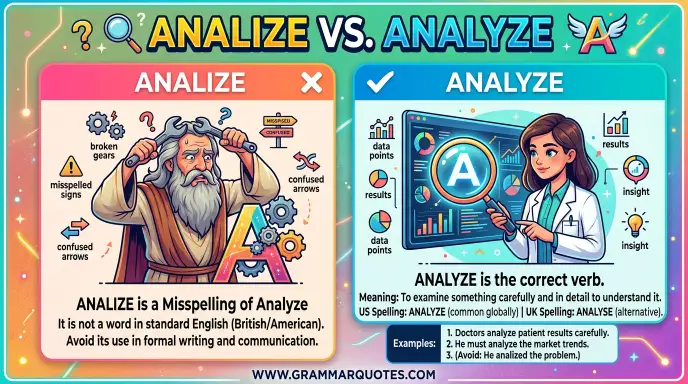
Analyze is the correct standard spelling in American English, while analyse is the British English spelling. Analize is generally considered a misspelling.
This spelling difference can be confusing because the word sounds the same in different varieties of English.
If you are writing an essay, email, report, article, or professional document, choosing the right form matters. The main issue is not the meaning but the spelling convention you are following.
American English normally uses analyze, with a z, while British English uses analyse, with an s. The form analize is not the standard spelling in either variety.
Understanding this small difference can help you avoid spelling mistakes and make your writing look more polished. It is especially useful for students, bloggers, writers, and anyone who regularly switches between American and British English.
Analyze and Analize: Quick Answer
The correct spelling is analyze when using American English.
Analize is generally incorrect.
Examples:
- Correct: We need to analyze the results.
- Incorrect: We need to analize the results.
There is also another correct form:
- British English: analyse
- American English: analyze
So, the choice depends on the English style you are following.
| Spelling | Correct? | English variety |
| Analyze | Yes | American English |
| Analyse | Yes | British English |
| Analize | No | Generally a misspelling |
Definition and Meaning
Analyze means to examine something carefully in order to understand its parts, meaning, structure, or results.
For example:
Scientists analyze data to find patterns.
The word can describe many types of careful examination. You can analyze a sentence, problem, report, business result, experiment, article, or situation.
The British form analyse has exactly the same meaning. The difference is simply the spelling convention.
Simple Meaning
Analyze means:
- Examine carefully
- Study something in detail
- Break information into parts
- Look at facts to understand something better
Examples
- The teacher asked students to analyze the poem.
- We should analyze the data before making a decision.
- The company will analyze customer feedback.
- She likes to analyze complex problems.
The Origin of Analyze and Analyse
The word comes from the Greek analyein, meaning to break up or loosen. It entered English through French and Latin related forms.
Over time, English developed different spelling conventions in Britain and America.
British English commonly retained the yse ending in words such as:
- analyse
- paralyse
- catalyse
American English generally adopted yze spellings:
- analyze
- paralyze
- catalyze
This is why analyze and analyse have the same meaning but different spellings.
The form analize does not follow the standard spelling pattern used by either major English variety.
British English vs American English
The important difference is between analyze and analyse, not between analyze and analize.
| Meaning | American English | British English |
| Examine carefully | analyze | analyse |
| Examination | analysis | analysis |
| Person who examines | analyst | analyst |
| Related adjective | analytical | analytical |
Notice that analysis is spelled the same in both varieties.
More Examples
American English:
The researchers will analyze the results.
British English:
The researchers will analyse the results.
Both sentences are correct. The only difference is the regional spelling.
Why Is “Analize” Incorrect?
A common reason people write analize is pronunciation.
The ending of analyze sounds like a “z” sound, so some writers naturally spell it with ize.
However, the standard American spelling is analyze, with yze, while the British spelling is analyse, with yse.
So remember:
analyze → American English
analyse → British English
analize → generally incorrect
This is a spelling issue, not a difference in pronunciation or meaning.
Which Spelling Should You Use?
Choose the spelling based on the English style required for your audience.
Use “Analyze” for American English
Use analyze if you are following American English.
It is common in:
- American schools
- US based websites
- American businesses
- US academic writing
- American software and technical documentation
Example:
The software can analyze large amounts of data.
Use “Analyse” for British English
Use analyse when following British English.
It is common in:
- UK academic writing
- British publications
- UK schools
- British government writing
- Many Commonwealth English contexts
Example:
The researchers will analyse the new information.
Avoid “Analize”
Unless you are referring to a specific proper name, brand, or unusual title, analize should be avoided in standard English writing.
Common Mistakes
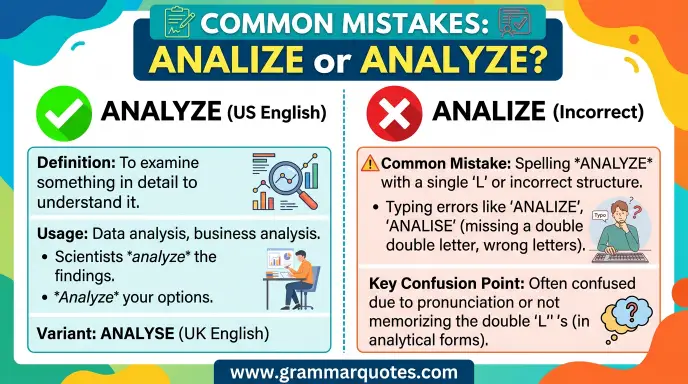
1. Writing “analize” because of pronunciation
Incorrect:
We need to analize the report.
Correct:
We need to analyze the report.
2. Mixing English styles
A writer may use American spelling in one paragraph and British spelling in another.
For example:
The team will analyze the data and analyse the results.
This is not necessarily grammatically wrong, but consistent spelling is usually better in formal writing.
3. Confusing “analysis” with “analyze”
These words are related but have different grammatical roles.
Analyze is a verb:
We will analyze the information.
Analysis is a noun:
The analysis was detailed.
4. Assuming ” ize” is always wrong
The issue is more specific than simply choosing s or z.
American English uses analyze, while British English uses analyse. The spelling analize is not the standard form.
Analyze in Everyday Examples

In Academic Writing
Students must analyze the evidence before reaching a conclusion.
In Business
The company will analyze its sales data.
In Science
Scientists analyze samples in the laboratory.
In Technology
The program can analyze user behavior.
In Everyday Conversation
Let’s analyze what happened yesterday.
In an Email
Could you analyze the attached report and share your feedback?
These examples show that the verb is widely used whenever someone needs to examine information carefully.
Analysis or Analyze : Side by Side Comparison
| Feature | Analyze | Analyse | Analize |
| Standard spelling | Yes | Yes | No |
| American English | Yes | Usually no | No |
| British English | Usually no | Yes | No |
| Meaning | Examine carefully | Examine carefully | Same intended meaning, but misspelled |
| Pronunciation | Same | Same | Usually intended to be the same |
| Formal writing | Correct | Correct | Avoid |
Analyze vs Analysis
These two words are often confused because they come from the same word family.
Analyze is an action.
We need to analyze the data.
Analysis is the examination or its result.
The analysis took several hours.
Other related words include:
- Analyst – a person who analyzes something
- Analytical – involving careful examination
- Analyzed – past tense
- Analyzing – present participle
Spelling Examples
- analyze
- analyzes
- analyzed
- analyzing
- analysis
- analyst
- analytical
Google Trends and Usage
Search interest for spelling questions often comes from students, writers, editors, and people checking if a word uses yse or yze.
The important usage pattern is regional. Analyze is strongly associated with American English, while analyse is associated with British English and related spelling traditions.
Search results can vary by country, platform, and time, so exact Google Trends numbers should not be treated as universal measures of language correctness.
For practical writing, the safest approach is to identify your target audience and use one English variety consistently.
People Also Ask
Is “analize” a correct spelling?
No. Analize is generally considered a misspelling. The standard forms are analyze and analyse.
Is “analyze” American or British?
Analyze is the standard American English spelling.
Is “analyse” British English?
Yes. Analyse is the standard British English spelling.
Do analyze and analyse mean the same thing?
Yes. They have the same meaning and pronunciation. The difference is mainly regional spelling.
Why does American English use “analyze”?
American English commonly uses the yze spelling in this word.
Why does British English use “analyse”?
British English traditionally uses the yse spelling.
Is analyze with an S or Z?
The American form is spelled with a z: analyze.
What is the noun of analyze?
The noun is analysis.
What is the past tense of analyze?
The past tense is analyzed in American English. British English normally uses analysed.
Is analize a spelling mistake?
In standard English, yes. If you mean the verb meaning “to examine carefully,” use analyze or analyse depending on your English variety.
Frequently Confused Forms
| Word | Correct? | Use |
| Analyze | Yes | American English |
| Analyse | Yes | British English |
| Analize | No | Generally a misspelling |
| Analysis | Yes | Noun |
| Analyst | Yes | Person who examines information |
| Analytical | Yes | Related adjective |
Final Takeaway
When writing in American English, use analyze. When writing in British English, use analyse. The spelling analize is generally not accepted as the standard form.
The easiest way to remember the difference is to connect analyze with American English and analyse with British English. Both words have the same meaning, pronunciation, and grammatical function. Only the spelling convention changes.
If you are writing for an international audience, consistency matters more than choosing one variety at random. Pick the English style required by your school, employer, publication, or target readers and keep that style throughout your writing.
Also remember that analysis is the noun in both varieties. So you might analyze information and then write an analysis of your findings.
Once you understand this small spelling difference, it becomes much easier to avoid the common mistake of writing analize.
Discover More Articles!
Broche or Brooch: Which Spelling Is Correct?(2026)
Paster or Pastor: Which Spelling Is Correct?
Trouper or Trooper: What Is the Difference?(2026)

Ethan Parker is an English-language writer known for his interest in words, language, and clear communication. His work focuses on making everyday English easier to understand through simple explanations and practical examples.