UTI or period symptoms can sometimes feel similar, especially when you have lower abdominal discomfort, pelvic pressure, or changes in urination. However, a urinary tract infection (UTI) and a menstrual period are different conditions with different causes.
A UTI happens when bacteria enter and infect part of the urinary system, such as the bladder. Common symptoms include burning or pain when urinating, needing to urinate often, and feeling an urgent need to pee.
A period is the monthly shedding of the uterine lining. Menstruation can cause cramps, lower abdominal pain, backache, tiredness, and changes in mood or appetite. Some people also experience changes in bowel habits around their period.
The confusion usually happens because both can cause discomfort around the lower abdomen or pelvis. The timing of symptoms and the specific symptoms you notice can provide useful clues.
Understanding the differences can help you describe what you are experiencing more clearly and know when medical advice may be appropriate.
UTI or Period : Quick Answer
A UTI mainly affects the urinary system, while a period is part of the menstrual cycle.
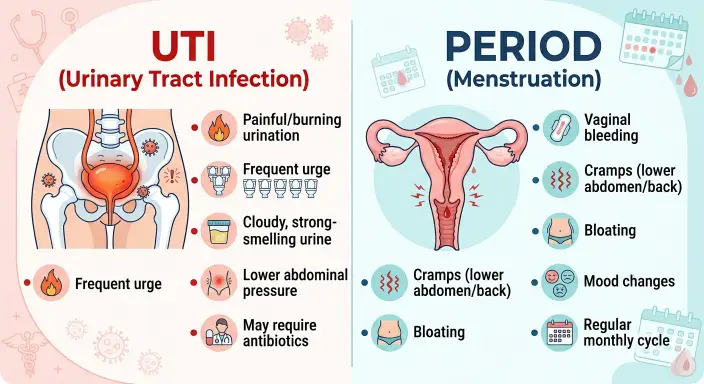
A UTI commonly causes urinary symptoms such as:
- Burning or pain while urinating
- Frequent urination
- A strong or sudden urge to urinate
- Passing only small amounts of urine
- Pressure or discomfort in the lower abdomen
- Cloudy, bloody, or unusually strong smelling urine in some cases
Period symptoms commonly include:
- Menstrual bleeding
- Cramps
- Lower abdominal discomfort
- Lower backache
- Bloating
- Tiredness
- Mood changes
The most useful distinction is often where the symptoms are coming from. Burning during urination and urinary urgency are much more suggestive of a UTI, while menstrual bleeding and cramps that follow the person’s usual cycle are more consistent with a period.
Definition and Meaning
What Is a UTI?
UTI stands for urinary tract infection. It is an infection affecting part of the urinary system.
The urinary tract includes the:
- Kidneys
- Ureters
- Bladder
- Urethra
Most UTIs involve the lower urinary tract, especially the bladder and urethra.
A bladder infection is also called cystitis. Symptoms often include painful urination, frequent urination, and an urgent need to urinate.
What Is a Period?
A period, or menstruation, is the monthly bleeding that occurs when pregnancy has not occurred and the uterine lining is shed.
Menstrual symptoms vary from person to person. Some people have mild cramps, while others experience stronger discomfort, fatigue, headaches, or other symptoms.
The Origin of the Terms
The abbreviation UTI comes from the medical phrase urinary tract infection.
The word urinary relates to urine and the urinary system. “Tract” refers to the connected organs and passages through which urine travels.
The word period comes from a Greek word meaning a cycle or circuit. In everyday English, “period” can have several meanings, but in this context it refers to menstruation.
UTI vs Period: Main Differences
The easiest way to compare them is to look at the type and location of symptoms.
| Symptom | UTI | Period |
| Burning while urinating | Common | Not typical |
| Frequent urination | Common | Not typical |
| Urgent need to urinate | Common | Not typical |
| Menstrual bleeding | No | Common |
| Abdominal cramps | Possible | Common |
| Pelvic discomfort | Possible | Common |
| Lower back pain | Possible | Possible |
| Bloating | Not typical | Common for some people |
| Nausea | Possible | Possible |
| Blood in urine | Can occur | Not the same as menstrual blood |
| Symptoms linked to menstrual cycle | No | Yes |
| Fever | Can occur with a more serious infection | Not a normal period symptom |
How Do You Know If It Could Be a UTI?
Certain symptoms are more strongly associated with urinary infections.
1. Burning When You Pee
A burning or painful sensation during urination is a common UTI symptom.
If urinating suddenly becomes uncomfortable, especially together with urgency or frequency, a urinary infection may be one possible explanation.
2. Needing to Pee Frequently
A UTI can make you feel as though you need to urinate repeatedly, even when only a small amount comes out.
3. Sudden Urgency
You may feel a strong need to urinate that is difficult to postpone.
4. Lower Abdominal Pressure
Some people with bladder infections experience pressure or discomfort in the lower abdomen.
5. Changes in Urine
Urine may sometimes appear cloudy, contain blood, or have an unusual smell. These changes are not enough by themselves to diagnose a UTI, but they can occur with urinary infections.
How Do You Know If It Could Be Your Period?
Menstrual symptoms tend to follow a person’s menstrual cycle.
Common signs include:
- Vaginal bleeding
- Cramps
- Lower abdominal discomfort
- Backache
- Bloating
- Breast tenderness
- Fatigue
- Headache
- Mood changes
Period cramps happen because the uterus contracts as it sheds its lining.
The intensity and combination of symptoms can vary from one menstrual cycle to another.
Can a UTI Feel Like Period Cramps?
Yes. A bladder infection can sometimes cause discomfort or pressure in the lower abdomen, which may feel similar to the location of menstrual cramps.
However, the other symptoms are important.
If lower abdominal discomfort occurs together with burning urination, urinary urgency, or frequent urination, a UTI becomes more worth considering.
If the discomfort appears around the expected menstrual period and occurs with menstrual bleeding or typical cramps, it may be related to menstruation.
These symptoms can overlap, so symptoms alone cannot always provide a definite diagnosis.
Can You Have a UTI During Your Period?
Yes. Having a period does not prevent someone from developing a UTI.
This can make the situation confusing because menstrual bleeding may make it harder to notice changes in urine.
If you have strong urinary symptoms during your period, such as burning when urinating, unusual urgency, or frequent urination, it is worth discussing them with a healthcare professional.
Blood in Urine vs Period Blood
This is one of the most confusing parts.
Menstrual blood comes from the reproductive system. Blood that is actually present in urine comes from the urinary tract.
During menstruation, blood can mix with urine externally and make it difficult to tell where the blood originated.
If you are unsure if blood is coming from your urine or from menstrual bleeding, a healthcare professional can help determine the cause.
Do not assume that visible blood is automatically part of your period, especially if it appears outside your normal menstrual bleeding or is accompanied by urinary symptoms.
British English vs American English
There is no major spelling difference between British and American English for these terms.
| British English | American English |
| UTI | UTI |
| urinary tract infection | urinary tract infection |
| period | period |
| menstruation | menstruation |
| urination | urination |
| bladder | bladder |
The spelling is generally the same in both varieties of English.
Which Term Should You Use?
Use UTI when you are discussing a urinary tract infection.
Use period when referring to menstruation.
In formal or medical writing, urinary tract infection is clearer than simply saying “UTI” if your audience may not know the abbreviation.
For example:
- “I think I might have a UTI.”
- “The doctor tested me for a urinary tract infection.”
- “My period started yesterday.”
- “I usually get cramps before my period.”
If you are writing for a general audience, it is often helpful to write urinary tract infection (UTI) the first time and then use UTI afterward.
Common Mistakes
Mistake 1: Assuming all lower abdominal pain is period pain
Lower abdominal discomfort has many possible causes. Menstrual cramps are one possibility, but urinary infections and other conditions can also cause discomfort.
Mistake 2: Ignoring burning urination
Burning while urinating is not a typical period symptom and can be an important clue toward a urinary problem.
Mistake 3: Assuming blood always means a UTI
Blood may have different causes. During menstruation, it can be especially difficult to determine if blood is coming from the urinary or reproductive tract.
Mistake 4: Thinking a UTI always causes severe pain
UTI symptoms can vary. Some people mainly notice urinary frequency, urgency, or burning.
Mistake 5: Self diagnosing from one symptom
One symptom rarely provides the whole answer. Looking at the complete pattern and, when appropriate, getting medical testing is more reliable.
Everyday Examples
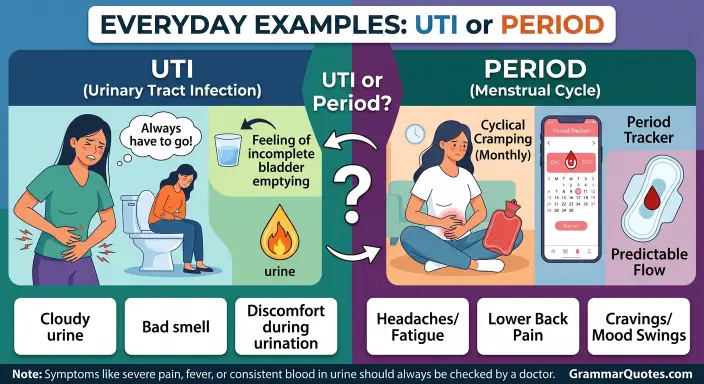
Talking About a UTI
- “It burns when I pee.”
- “I have to use the bathroom much more often.”
- “I feel pressure in my lower abdomen.”
- “I think I may have a urinary infection.”
Talking About a Period
- “My period started this morning.”
- “I usually get cramps before my period.”
- “My period is a few days late.”
- “I have lower back pain during my period.”
In a Medical Setting
- “I have burning when I urinate and feel like I need to go frequently.”
- “My symptoms started around the time of my period.”
- “I am not sure if the blood is menstrual or coming from my urine.”
Clear descriptions can help a healthcare professional understand the symptoms more easily.
When Could It Be More Likely to Be a UTI?
A UTI may be more likely when several urinary symptoms occur together, especially:
- Burning during urination
- Frequent urination
- Urinary urgency
- Lower abdominal pressure
- Changes in urine
A healthcare professional may use symptoms, medical history, and urine testing to determine if an infection is present.
When Could It Be More Likely to Be a Period?
Menstruation may be more likely when:
- Bleeding occurs around the expected time of the cycle
- Cramps follow a familiar pattern
- Symptoms improve as the period ends
- There are typical menstrual symptoms such as bloating or fatigue
- There are no unusual urinary symptoms
However, menstrual cycles can naturally vary, so a change from your usual pattern may deserve attention.
When Should You Seek Medical Advice?
Medical advice is especially important if urinary symptoms are severe, persistent, or getting worse.
A UTI can sometimes spread from the bladder to the kidneys. Warning signs can include:
- Fever or chills
- Pain in the back or side
- Nausea or vomiting
- Feeling significantly unwell
These symptoms can indicate a more serious infection and should receive prompt medical attention.
You should also seek medical advice for unusually heavy menstrual bleeding, severe or unusual pelvic pain, fainting, or symptoms that are significantly different from your normal menstrual pattern.
Treatment and Relief
Treatment depends on the cause.
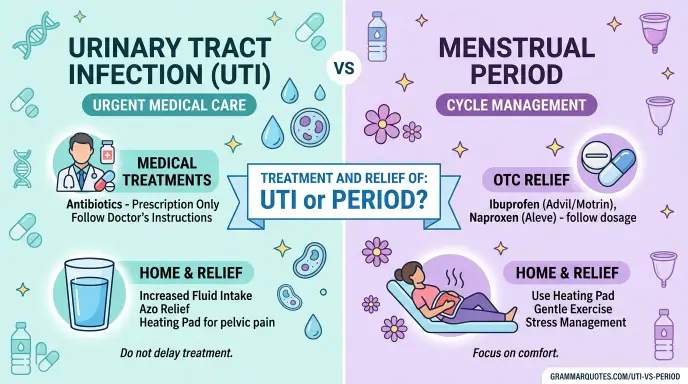
A confirmed bacterial UTI may require antibiotics prescribed by a healthcare professional. It is important to take antibiotics only as directed and not use leftover antibiotics without medical advice.
For ordinary period cramps, some people find relief from heat, rest, gentle activity, and appropriate over the counter pain medicine when it is safe for them to use.
The right approach depends on the person’s age, symptoms, medical history, and possible cause. Avoid assuming that treatment for one condition will treat the other.
UTI or Period : Google Trends & Usage Data
Searches comparing urinary symptoms with menstrual symptoms are common because both can involve lower abdominal or pelvic discomfort.
The search intent behind this topic is usually informational. People may be trying to understand if symptoms such as cramps, pressure, frequent urination, or bleeding are related to their menstrual cycle or a urinary problem.
Search interest can change depending on season, health awareness, and current online discussions. Exact Google Trends numbers also change over time, so fixed search volume figures should not be treated as permanent data.
For , related searches may include:
- UTI symptoms
- period cramps
- UTI during period
- burning when peeing
- bladder infection symptoms
- period pain
- UTI or menstrual cramps
- blood in urine during period
Side by Side Comparison
| Feature | UTI | Period |
| Affects | Urinary system | Reproductive system |
| Main cause | Usually bacterial infection | Normal menstrual cycle |
| Burning urination | Common | Not typical |
| Urinary urgency | Common | Not typical |
| Frequent urination | Common | Not typical |
| Menstrual bleeding | No | Yes |
| Cramps | Possible | Common |
| Lower abdominal discomfort | Possible | Common |
| Back pain | Possible | Possible |
| Fever | Possible with infection | Not a normal symptom |
| Cycle related | No | Yes |
| Urine changes | Can occur | Not caused by menstruation itself |
People Also Ask
1. How can I tell if I have a UTI or period cramps?
Burning urination, frequent urination, and urgency suggest a urinary problem, while cycle related cramps and menstrual bleeding are more typical of a period.
2. Can a UTI feel like menstrual cramps?
Yes. Bladder discomfort can sometimes feel similar to lower abdominal or pelvic cramps.
3. Can you get a UTI while on your period?
Yes. Menstruation does not prevent a person from developing a UTI.
4. Does a UTI cause period like pain?
A UTI can cause lower abdominal pressure or discomfort that may feel similar to menstrual pain.
5. Can period cramps cause burning when you pee?
Burning during urination is not a typical menstrual symptom. If it occurs, a urinary problem or another cause should be considered.
6. Can a UTI make you bleed?
A urinary infection can sometimes cause blood in the urine. However, menstrual bleeding can also appear during the same time, making the source difficult to identify.
7. Is frequent urination a period symptom?
Some people notice changes in urination around menstruation, but frequent or urgent urination with burning can be more suggestive of a urinary problem.
8. Does a UTI make your period late?
A UTI itself is not generally considered a direct cause of a late period. Many factors can affect menstrual timing.
9. Can you have a UTI without burning when you pee?
Yes. Symptoms vary, and not everyone experiences every typical symptom.
10. When should I see a doctor for UTI like symptoms?
Seek medical advice if symptoms persist, become severe, or occur with fever, chills, back or side pain, vomiting, or feeling very unwell.
Conclusion
UTIs and periods can sometimes cause symptoms in a similar area, which makes them easy to confuse. The key difference is that a UTI affects the urinary system, while a period is a normal part of the menstrual cycle.
Burning when urinating, frequent urination, and a strong urge to pee are common clues associated with a UTI. Menstrual bleeding, familiar cramps, bloating, fatigue, and symptoms that follow a person’s usual cycle are more consistent with menstruation.
Blood can be particularly confusing during a period because menstrual blood may mix with urine externally. If you are unsure where blood is coming from, especially when urinary symptoms are present, medical evaluation can help clarify the situation.
No single symptom can diagnose a UTI or explain every type of pelvic discomfort. Persistent, severe, or unusual symptoms deserve appropriate medical attention. Fever, chills, back or side pain, vomiting, or feeling very unwell with urinary symptoms can require prompt care because they may indicate a more serious infection.
Understanding the difference can help you describe your symptoms accurately and seek the right type of care when necessary.
Discover More Articles!
Broche or Brooch: Which Spelling Is Correct?(2026)
Meak or Meek: Which Spelling Is Correct?(2026)
Impostor or Imposter: Which Spelling Is Correct?(2026)

Ethan Parker is an English-language writer known for his interest in words, language, and clear communication. His work focuses on making everyday English easier to understand through simple explanations and practical examples.