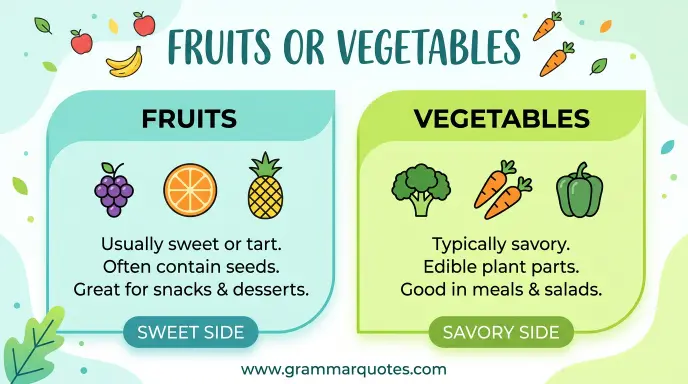
Fruits develop from the flowering part of a plant and usually contain seeds, while vegetables are other edible plant parts such as roots, stems, leaves, and bulbs.
The difference seems simple, but some foods make the question surprisingly confusing. Tomatoes, cucumbers, pumpkins, and peppers are common examples that people often debate.
The confusion happens because botanical and culinary definitions are not always the same. Botanically, a fruit develops from a flower and usually contains seeds. In cooking, however, people often call foods vegetables based on how they taste and how they are prepared.
Understanding the difference between fruits or vegetables is useful for students, gardeners, cooks, and anyone who wants to describe food correctly. It also explains why some foods that seem like vegetables are technically fruits.
In this guide, we will explain the meaning of both terms, explore their origins, compare their characteristics, discuss common mistakes, and give simple everyday examples.
Fruits or Vegetables : Quick Answer
A fruit is a plant structure that develops from a flower, usually after fertilization, and often contains seeds. A vegetable is a broader culinary term for edible parts of plants, including roots, stems, leaves, bulbs, and sometimes immature fruits.
Simple examples
Fruits:
- Apple
- Mango
- Orange
- Strawberry
- Tomato
- Cucumber
- Pumpkin
- Pepper
Vegetables:
- Carrot
- Potato
- Spinach
- Lettuce
- Onion
- Celery
- Broccoli
- Cauliflower
The important point is that some foods can be culinarily treated as vegetables but botanically classified as fruits.
For example, a tomato is botanically a fruit because it develops from the flower of the tomato plant and contains seeds. In cooking, it is commonly used as a vegetable.
Fruits and Vegetables : Definition and Meaning
What Is a Fruit?
A fruit is the mature structure that develops from the ovary of a flowering plant. Its main biological role is connected with protecting and helping disperse seeds.
Common fruits include:
- Apples
- Bananas
- Peaches
- Grapes
- Oranges
- Tomatoes
- Cucumbers
- Peppers
Not every fruit is sweet. Some botanical fruits, such as tomatoes and cucumbers, are commonly used in savory dishes.
What Is a Vegetable?
Vegetable is mainly a culinary term rather than one strict botanical category.
It can refer to different edible parts of plants, including:
- Roots — carrots and radishes
- Leaves — spinach and lettuce
- Stems — celery
- Bulbs — onions
- Flowers — cauliflower and broccoli
- Tubers — potatoes
This is why the categories can overlap when science and everyday cooking use different definitions.
The Origin of Fruits and Vegetables
Humans have cultivated and eaten plants for thousands of years. As agriculture developed, people learned to grow plants for their edible roots, leaves, seeds, fruits, and other parts.
The words fruit and vegetable have different linguistic histories. Fruit comes through Old French from Latin fructus, meaning enjoyment, produce, or yield. Vegetable comes from Latin roots related to growth and later developed into a term for edible plant matter.
Over time, vegetable became strongly associated with foods prepared in savory dishes, while fruit became associated with naturally sweet or tart foods.
This culinary tradition explains many of today’s common classifications.
What Is the Botanical Difference Between Fruits and Vegetables?
The botanical distinction is based mainly on which part of the plant the food develops from.
A botanical fruit develops from the ovary of a flower. It may contain one or many seeds.
Examples include:
- Tomato
- Cucumber
- Squash
- Pumpkin
- Pepper
- Eggplant
Vegetable parts can come from other parts of the plant.
| Plant Part | Examples |
| Root | Carrot, beet |
| Leaf | Lettuce, spinach |
| Stem | Celery |
| Bulb | Onion |
| Flower | Broccoli, cauliflower |
| Tuber | Potato |
This botanical definition is why a tomato can be a fruit even though most people use it like a vegetable.
Is a Tomato a Fruit or Vegetable?
Botanically, a tomato is a fruit. Culinary wise, it is commonly treated as a vegetable.
This is one of the most famous examples of the difference between scientific and culinary classifications.
The same general idea applies to foods such as:
- Cucumbers
- Peppers
- Pumpkins
- Squashes
- Eggplants
They develop from the flowering part of the plant, making them botanical fruits.
Is a cucumber a fruit or a vegetable?
A cucumber is botanically a fruit, but it is commonly considered a vegetable in cooking.
Its mild flavor and common use in salads and savory dishes explain its culinary classification.
Is a Pumpkin a Fruit or Vegetable?
A pumpkin is botanically a fruit because it develops from the flower of the pumpkin plant and contains seeds.
In cooking, however, pumpkin may be used in both sweet and savory foods.
This makes pumpkin another good example of how botanical and culinary categories can differ.
Fruits or Vegetables: Taste Does Not Decide the Category
Many people assume that sweet foods are fruits and savory foods are vegetables.
That is a useful cooking rule, but it is not a scientific rule.
For example:
- Tomato → botanically fruit
- Cucumber → botanically fruit
- Pepper → botanically fruit
- Pumpkin → botanically fruit
At the same time, some fruits are not particularly sweet.
The biological classification depends on the plant structure, not simply on taste.
Fruits or Vegetables in Everyday Examples
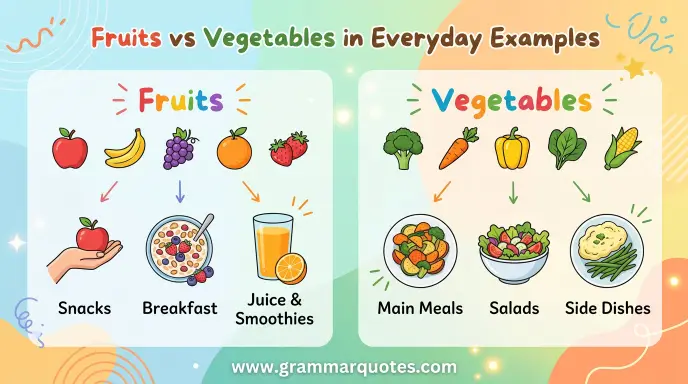
Here are some natural examples:
Fruit:
- I bought some fresh fruit from the market.
- Mangoes are my favorite fruit.
- We added berries to breakfast.
- The apple is a common fruit.
Vegetable:
- We need more vegetables for dinner.
- She chopped the carrots and onions.
- Spinach is a leafy vegetable.
- Potatoes are commonly used as vegetables in cooking.
Mixed classification:
- Is a tomato a fruit or a vegetable?
- Botanically, a cucumber is a fruit.
- A pumpkin is technically a fruit.
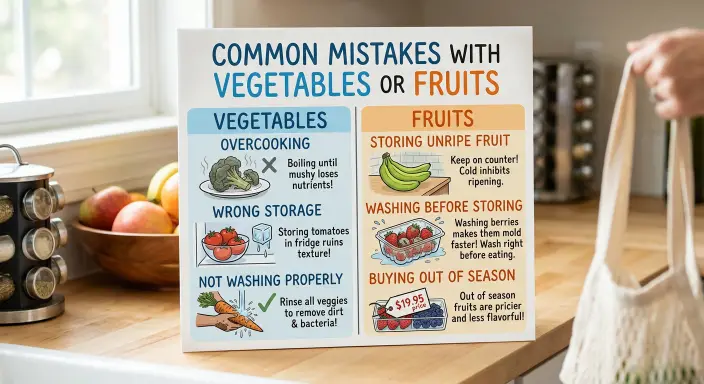
Common Mistakes with Vegetables or Fruits
Mistake 1: Thinking Every Sweet Food Is a Fruit
Taste does not determine botanical classification.
A botanical fruit is defined by how it develops from a flower, not simply by sweetness.
Mistake 2: Thinking Tomatoes Are Scientifically Vegetables
Tomatoes are botanically fruits.
They are called vegetables mainly because of their culinary use.
Mistake 3: Thinking “Vegetable” Is a Strict Botanical Category
The word vegetable is mainly used in cooking and everyday language. It can describe many different edible parts of plants.
Mistake 4: Assuming Seeds Are the Only Test
Seeds can be a useful clue, but the botanical definition is more specific: a fruit develops from the ovary of a flower.
Mistake 5: Thinking Culinary and Botanical Definitions Must Match
They do not always match.
A food can be a botanical fruit and a culinary vegetable at the same time.
Fruits or Vegetables : British English vs American English
There is no major spelling difference between fruit and vegetable in British and American English.
| Word | British English | American English |
| Fruit | Fruit | Fruit |
| Fruits | Fruits | Fruits |
| Vegetable | Vegetable | Vegetable |
| Vegetables | Vegetables | Vegetables |
| Tomato | Tomato | Tomato |
| Cucumber | Cucumber | Cucumber |
The main difference is not spelling. The interesting difference comes from how people classify certain foods in cooking versus science.
Which Should You Use: Fruit or Vegetable?
Use fruit when you are referring to the botanical category or to foods commonly recognized as fruits.
Use vegetable when you are talking about edible plant parts commonly prepared as savory foods.
If you are discussing a food like a tomato, the most accurate answer depends on the context.
Scientific context:
“A tomato is a botanical fruit.”
Culinary context:
“A tomato is commonly used as a vegetable.”
Both statements can be correct because they use different classification systems.
Fruits or Vegetables : Comparison Table
| Feature | Fruits | Vegetables |
| Botanical category | More specific | Broad culinary category |
| Usually develops from flower ovary | Yes | Usually no |
| Often contains seeds | Often | Usually not |
| Can be sweet | Often | Less commonly |
| Can be savory | Yes | Yes |
| Common examples | Apple, mango, orange | Carrot, spinach, onion |
| Examples that cause confusion | Tomato, cucumber, pumpkin | Potato, broccoli, lettuce |
Vegetables or Fruits : Google Trends and Usage Data
Search interest for fruits and vegetables changes based on season, health interests, recipes, education, and food trends.
People may search for these terms when looking for:
- Healthy food ideas
- Nutrition information
- School assignments
- Gardening advice
- Cooking recipes
- Food classification
- Plant science
Specific search interest can also vary by country and season. For example, searches for particular fruits may increase when those fruits are in season, while vegetable related searches can rise around diet and recipe trends.
Because Google Trends data changes over time, exact popularity should be checked for a specific country and date range rather than assuming one category is always searched more.
People Also Ask Questions
1. What is the main difference between fruits and vegetables?
Botanically, fruits develop from the ovary of a flower, while vegetables can refer to other edible plant parts and are mainly a culinary category.
2. Is a tomato a fruit or a vegetable?
A tomato is botanically a fruit but is commonly treated as a vegetable in cooking.
3. Is a cucumber a fruit or vegetable?
A cucumber is botanically a fruit because it develops from a flower and contains seeds. It is commonly used as a vegetable.
4. Is a potato a fruit or vegetable?
A potato is a vegetable in culinary use and is botanically a tuber, not a fruit.
5. Is a carrot a fruit or vegetable?
A carrot is a vegetable. More specifically, it is an edible root.
6. Is a pumpkin a fruit or vegetable?
A pumpkin is botanically a fruit because it develops from the flowering part of the plant.
7. Why is tomato called a vegetable?
Tomatoes are commonly called vegetables because they are usually prepared and eaten in savory dishes.
8. Are fruits healthier than vegetables?
Neither category is automatically healthier. Different fruits and vegetables provide different nutrients, and a varied diet can include both.
9. Are peppers fruits or vegetables?
Peppers are botanically fruits because they develop from the flower of the plant. They are commonly treated as vegetables in cooking.
10. Is broccoli a fruit or vegetable?
Broccoli is a vegetable. The part commonly eaten is made up mainly of flower buds and stems.
Frequently Asked Questions
Are fruits and vegetables the same?
No. They are different categories, although some foods can be classified differently depending on whether you use a botanical or culinary definition.
What is the easiest way to identify a fruit?
In botanical terms, a fruit develops from the ovary of a flowering plant, usually after the flower is fertilized.
Why are tomatoes called vegetables?
They are commonly treated as vegetables because of their savory flavor and how they are used in cooking.
Is corn a fruit or vegetable?
Corn is a cereal grain botanically, while individual corn kernels are the fruits of the plant in botanical terms. In cooking, sweet corn is commonly treated as a vegetable.
Is an avocado a fruit or vegetable?
An avocado is botanically a fruit because it develops from the ovary of a flower and contains a seed.
Are strawberries true fruits?
Botanically, strawberries are considered accessory fruits because the fleshy part does not develop only from the ovary. The small structures on the surface are the actual fruits.
Can one food be both a fruit and a vegetable?
Yes, depending on the classification system. A tomato is a botanical fruit but is commonly treated as a vegetable in culinary settings.
Fruits or Vegetables : Final Comparison
| Food | Botanical Classification | Common Culinary Classification |
| Apple | Fruit | Fruit |
| Mango | Fruit | Fruit |
| Tomato | Fruit | Vegetable |
| Cucumber | Fruit | Vegetable |
| Pumpkin | Fruit | Vegetable |
| Pepper | Fruit | Vegetable |
| Carrot | Root | Vegetable |
| Potato | Tuber | Vegetable |
| Spinach | Leaf | Vegetable |
| Broccoli | Flower/stem | Vegetable |
| Onion | Bulb | Vegetable |
| Celery | Stem | Vegetable |
Conclusion
The difference between fruits or vegetables becomes much clearer when you understand that science and cooking use different classification systems.
Botanically, a fruit develops from the ovary of a flowering plant and usually contains seeds. A vegetable is a broader culinary term that can describe edible roots, leaves, stems, bulbs, flowers, and other plant parts.
This explains why tomatoes, cucumbers, pumpkins, peppers, and eggplants can cause confusion. Botanically, they are fruits, but people commonly use them as vegetables in salads, sauces, soups, and other savory dishes.
The simplest rule is to remember that botanical classification is based on plant structure, while culinary classification is based largely on how food is used and prepared.
So, if someone asks whether a tomato is a fruit or vegetable, the most complete answer is: it is a fruit botanically and a vegetable in common culinary use.
Discover More Articles!
Dig or Die: Meaning, Usage & Examples(2026)
Absents or Absence: Meaning, Difference & Examples(2026)
Unbalanced or Imbalanced: Meaning, Differences & Examples

Ethan Parker is an English-language writer known for his interest in words, language, and clear communication. His work focuses on making everyday English easier to understand through simple explanations and practical examples.