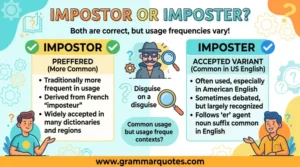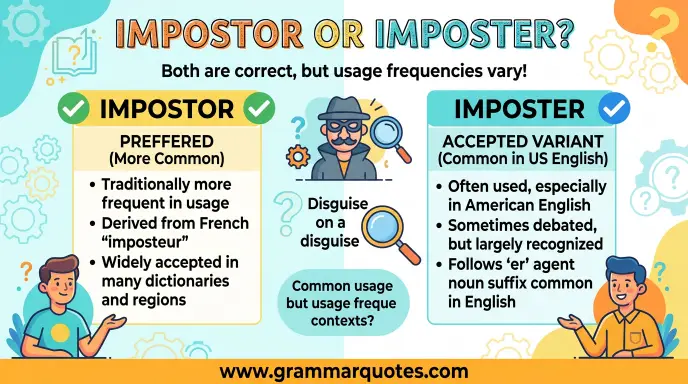
Impostor and imposter are both correct English spellings. They have the same meaning and are used to describe someone who pretends to be another person, often to gain an advantage or deceive others. The main difference is spelling preference, not meaning.
If you have ever wondered if to write impostor or imposter, you are not alone. The two forms look almost identical, and both appear in dictionaries, books, news articles, and everyday writing. This can make it difficult to know which one is the right choice.
The traditional spelling is impostor, which comes from the Latin based form of the word. However, imposter has become widely used in modern English because the ending er is familiar in many English words.
Both spellings are accepted, but their frequency can vary by region, publication, and writing style. In most situations, you can safely use either one.
This guide explains the difference between impostor and imposter, their origin, British and American usage, common mistakes, examples, and how to choose the best form for your writing.
Impostor or Imposter : Quick Answer
Impostor and imposter are both correct.
They have the same meaning:
A person who pretends to be someone else in order to deceive people or gain an advantage.
Examples
- The police discovered that he was an impostor.
- The police discovered that he was an imposter.
Both sentences are correct.
The main difference is spelling preference.
| Spelling | Correct? | Meaning |
| Impostor | Yes | A person who pretends to be someone else |
| Imposter | Yes | A person who pretends to be someone else |
If you are following a particular dictionary, newspaper, or style guide, use the spelling preferred by that source.
Definition and Meaning
An impostor/imposter is someone who falsely presents themselves as another person.
For example:
The man claimed to be a doctor, but he was an impostor.
The word can also describe someone who pretends to have a position, identity, skill, or status that they do not actually have.
The two spellings have the same definition.
The Origin of Impostor and Imposter
The word impostor comes from Latin imponere, meaning to impose or place upon. It passed through French and other European languages before entering English.
The Latin related form influenced the spelling impostor.
The spelling imposter developed as an English spelling variant. The ending er is very common in English nouns describing people who perform an action.
For example:
- teach → teacher
- write → writer
- sing → singer
- act → actor
Because English speakers often expect words referring to people to end in er, imposter became a natural spelling.
Why Are There Two Spellings?
English contains many words with more than one accepted spelling. This can happen because of:
- Historical spelling changes
- Different language influences
- Regional preferences
- Pronunciation patterns
- Simplification of older spellings
- Dictionary and editorial preferences
Impostor preserves the traditional form, while imposter follows a spelling pattern that feels more natural to many English speakers.
British English vs American English Spelling
Both impostor and imposter are used in British and American English.
There is no strict rule saying that one spelling belongs only to Britain and the other only to the United States.
However, usage can vary between dictionaries, publishers, and individual writers.
| Feature | British English | American English |
| Impostor | Correct | Correct |
| Imposter | Correct | Correct |
| Meaning | Same | Same |
| Pronunciation | Generally the same | Generally the same |
| Regional restriction | None | None |
| Formal writing | Both acceptable | Both acceptable |
Some style guides or publications may prefer impostor, while others commonly use imposter.
The important point is that neither spelling should automatically be treated as a mistake.
Which Spelling Should You Use?
Since both forms are correct, your choice can depend on your audience and writing style.
For American English
Both impostor and imposter are acceptable. Choose the form used by your preferred dictionary or style guide.
For British English
Both forms are also accepted. Impostor may be seen frequently in traditional or formal writing, while imposter is also widely understood.
For International English
If you want to follow the more traditional spelling, choose impostor.
If your website or publication already uses imposter, there is no need to change every occurrence simply because impostor also exists.
For Writing
Search engines generally understand both forms and their shared meaning. The best approach is to use the target keyword naturally while explaining that both spellings are correct.
For a comparison article targeting “impostor or imposter,” use both forms naturally rather than repeating one excessively.
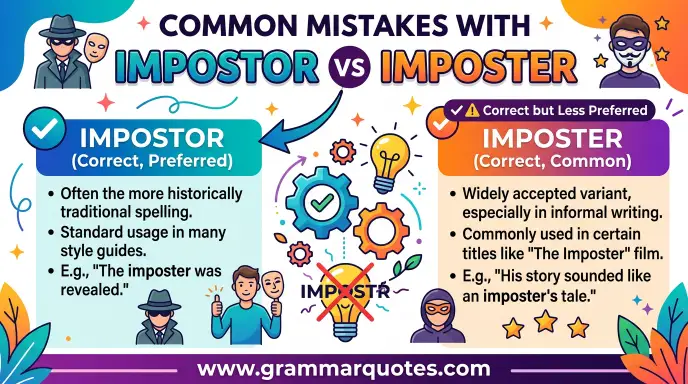
Common Mistakes with Impostor or Imposter
1. Thinking One Spelling Is Always Wrong
A common mistake is to assume that imposter is incorrect because impostor looks more traditional.
Both are accepted English spellings.
2. Changing the Meaning
There is no major difference in meaning.
Impostor and imposter both describe someone who pretends to be someone else or falsely claims an identity or position.
3. Confusing Impostor With Imposture
These words are related but different.
Impostor/imposter is a person.
Imposture is the act or practice of pretending to be someone else.
Example:
The impostor was arrested.
His imposture was eventually discovered.
4. Using Both Spellings Randomly
Although both forms are correct, consistency is useful in professional writing.
For example, if you choose impostor in an article, continue using that spelling unless there is a specific reason to use the alternative.
5. Confusing It With “Imposter Syndrome”
The term impostor syndrome is commonly spelled with impostor, although imposter syndrome is also widely seen.
It refers to persistent feelings of self doubt despite evidence of one’s abilities or achievements.
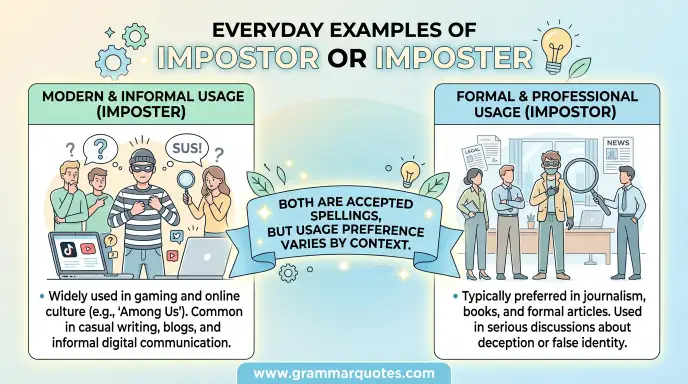
Imposter or Impostor in Everyday Examples
In News Writing
The company discovered that the man was an impostor.
Both spellings can work here.
In an Email
We believe the person contacting our customers may be an imposter.
This is an acceptable informal or professional use.
In a Story
The hero soon realized that the stranger was an impostor.
In Social Media
That account is an imposter pretending to be the real creator.
In Formal Writing
The investigation revealed that the individual was an impostor.
Both impostor and imposter are grammatically correct.
Impostor vs Imposter Comparison Table
| Feature | Impostor | Imposter |
| Correct spelling | Yes | Yes |
| Meaning | Person who pretends to be someone else | Same |
| Origin | Traditional form | English variant |
| British English | Used | Used |
| American English | Used | Used |
| Pronunciation | Generally the same | Generally the same |
| Formal writing | Acceptable | Acceptable |
| Informal writing | Acceptable | Acceptable |
| Plural | impostors | imposters |
The biggest takeaway is simple:
There is no difference in meaning.
Impostor or Imposter in “Impostor Syndrome”
One of the most common places people see this word is the phrase impostor syndrome.
You may also see:
imposter syndrome
Both spellings appear in published English.
The phrase describes a pattern of self doubt in which a person may feel that their success is undeserved or that others will discover they are not as capable as they appear.
For example:
She experienced impostor syndrome after starting her new job.
When writing about the concept, choose one spelling and use it consistently.
Is Impostor More Correct Than Imposter?
No. Impostor is not automatically more correct than imposter.
Both spellings are recognized in standard English.
Some dictionaries and style guides may prefer one form, but that does not make the other universally wrong.
If you want to follow a particular publication’s style, check its preferred dictionary or style guide.
For general writing, either form is acceptable.
Is Imposter More Common Than Impostor?
Usage varies by source, region, and context.
Both forms are common enough to be familiar to English speakers. Impostor is the traditional spelling, while imposter has become a widely accepted alternative.
Rather than focusing only on which form is more common, consider the style of the publication or audience you are writing for.
Impostor or Imposter : Google Trends & Usage Data
People searching “impostor or imposter” usually want to know if one spelling is correct or if the two forms have different meanings.
Related searches include:
- impostor or imposter
- imposter vs impostor
- impostor meaning
- imposter meaning
- is impostor correct
- is imposter correct
- impostor syndrome or imposter syndrome
- how to spell impostor
- how to spell imposter
Search interest can change over time and by country. Exact Google Trends figures should be checked for a specific date range and location before publishing numerical claims.
The continued appearance of both spellings in dictionaries and published writing explains why people often search for this comparison.
Impostor or Imposter: Which One Is Better for ?
For an article targeting “impostor or imposter,” both spellings should appear naturally.
Use:
- Impostor or Imposter
- Impostor vs Imposter
- Impostor meaning
- Imposter meaning
- Impostor syndrome
- Imposter syndrome
Do not repeatedly insert the exact keyword into every paragraph. Search engines can understand related terms and variations.
The article should answer the reader’s main question quickly:
Both impostor and imposter are correct.
Then explain the history, usage, and context.
FAQs About Impostor or Imposter
Is impostor or imposter correct?
Both are correct. They have the same meaning and can both describe someone who pretends to be another person.
What is the difference between impostor and imposter?
There is no major difference in meaning. The difference is mainly spelling. Impostor is the traditional form, while imposter is a widely accepted variant.
Is imposter a real word?
Yes. Imposter is an accepted English spelling and is used in dictionaries and published writing.
Is impostor more correct than imposter?
No. Both spellings are correct. Some publications may prefer impostor, but imposter is also standard.
Which spelling is used in impostor syndrome?
You will commonly see impostor syndrome, but imposter syndrome is also used. Both spellings appear in English.
Do British people say impostor or imposter?
British English uses both spellings. Neither is exclusively British.
Do Americans spell it impostor or imposter?
American English also uses both. The choice may depend on the dictionary, publisher, or writer’s preference.
What is the plural of impostor?
The plural of impostor is impostors. The plural of imposter is imposters.
Conclusion
When deciding between impostor or imposter, you do not need to worry about choosing a completely wrong spelling. Both forms are correct and have the same meaning. They describe a person who pretends to be someone else or falsely claims an identity, position, or ability.
Impostor is the traditional spelling and remains widely used. Imposter is an accepted variant that has become common in modern English. Neither spelling has an exclusive claim to British or American English.
Your best choice depends on consistency and the style of the publication you are writing for. If a company, newspaper, school, or website has a preferred dictionary or style guide, follow it. Otherwise, either form is acceptable.
The same choice applies to phrases such as impostor syndrome and imposter syndrome, where both spellings can be found. The most important rule is to understand the meaning and use your chosen spelling consistently.
In short, impostor = imposter in meaning. The difference is simply a matter of spelling preference and usage.
Discover More Articles!
Favourites or Favorites: Which Spelling Is Correct?
Keeped or Kept: Common Grammar Mistake Explained(2026)
Target or Walmart: What Is the Difference?(2026)

Ethan Parker is an English-language writer known for his interest in words, language, and clear communication. His work focuses on making everyday English easier to understand through simple explanations and practical examples.