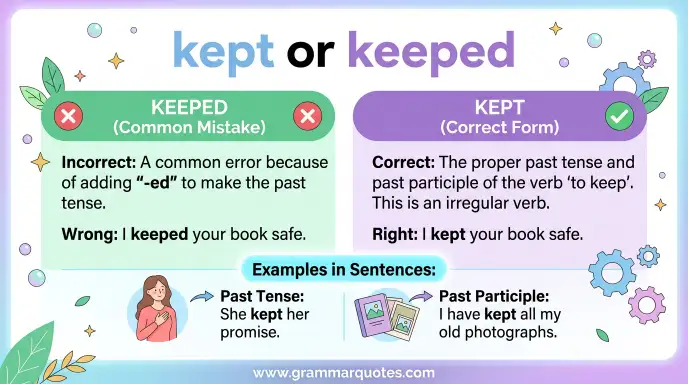
“Kept” is the correct past tense and past participle of “keep,” while “keeped” is not standard English. If you want to describe something that happened in the past, use kept, not keeped.
For example, you should say, “I kept the book,” not “I keeped the book.” The confusion happens because many English verbs form their past tense by adding ed, such as “walk” → “walked” and “clean” → “cleaned.” However, keep is an irregular verb, so its past form does not follow this regular pattern.
Understanding keeped or kept is useful for English learners, students, writers, and anyone who wants to avoid common grammar mistakes. Once you know that “keep” changes to “kept” in the past, the rule becomes easy to remember.
This guide explains the meaning and correct use of keep and kept, common mistakes, sentence examples, and simple ways to remember which form to use.
Keeped or Kept : Quick Answer
Kept is correct. Keeped is incorrect in standard English.
The verb keep has these main forms:
| Verb Form | Correct Word | Example |
| Base form | keep | I keep my notes here. |
| Present | keep/keeps | She keeps her room clean. |
| Past | kept | I kept the letter. |
| Past participle | kept | I have kept the letter. |
| ing form | keeping | He is keeping the secret. |
Correct Examples
- I kept your book.
- She kept the money safe.
- We kept our promise.
- He kept the door open.
- They kept working until late.
Incorrect Examples
- I keeped your book. ❌
- She keeped the money safe. ❌
- We keeped our promise. ❌
The correct form is always kept when you need the past tense of “keep.”
Definition and Meaning of Keep
Keep is a verb that can mean to have, hold, retain, store, continue, or maintain something.
Examples:
- Please keep this book.
- I keep my documents in a folder.
- Keep the door closed.
- She keeps her phone with her.
The exact meaning depends on the context.
Definition and Meaning of Kept
Kept is the past tense and past participle of “keep.”
It describes an action or situation connected with the past.
Examples:
- I kept the receipt.
- She kept her promise.
- They kept the room clean.
- He has kept the documents safely.
So:
Keep → Kept
Not:
Keep → Keeped
Why Is “Keeped” Incorrect?
“Keeped” looks logical because many regular English verbs form their past tense by adding ed.
For example:
- walk → walked
- play → played
- clean → cleaned
- open → opened
However, English also contains many irregular verbs. These verbs do not form their past tense by simply adding ed.
For example:
- go → went
- see → saw
- take → took
- write → wrote
- keep → kept
Therefore, you cannot create the past tense of “keep” by adding ed.
The Origin of Kept and Keep
The verb keep has very old Germanic roots. It developed through earlier forms of English and related Germanic languages.
Like many common English verbs, “keep” has retained an irregular past form over centuries. The modern form kept is therefore not created by adding “ ed” to “keep.”
This is why English learners need to memorize keep → kept as an irregular verb pair.
The same pattern appears in many everyday verbs:
| Present | Past |
| keep | kept |
| sleep | slept |
| feel | felt |
| leave | left |
| lose | lost |
| meet | met |
Keep vs Kept: The Main Grammar Difference
The main difference is time and grammatical form.
Keep
Use keep for the base form and present tense situations.
Examples:
I keep my keys in my bag.
Please keep the door closed.
They keep their promises.
Kept
Use kept for the past tense or as a past participle.
Examples:
I kept my keys in my bag yesterday.
She kept the letter.
They have kept their promises.
Simple Rule
Present or base form → keep
Past → kept
Past participle → kept
Keeped or Kept in Past Tense
If you are talking about something that happened in the past, use kept.
Examples
- I kept the old photo.
- He kept his promise.
- She kept the secret.
- We kept the receipt.
- They kept the door open.
Do not add ed to “keep.”
❌ I keeped the photo.
✅ I kept the photo.
Keeped or Kept in Present Perfect
Kept is also used after helping verbs such as has, have, and had.
Examples:
- I have kept the receipt.
- She has kept her promise.
- They have kept the information private.
- We had kept the documents safely.
So the past participle is also kept, not “keeped.”
Is “I Have Keeped” Correct?
No.
❌ I have keeped the book.
✅ I have kept the book.
After “have,” use the past participle kept.
Common Mistakes With Keeped or Kept
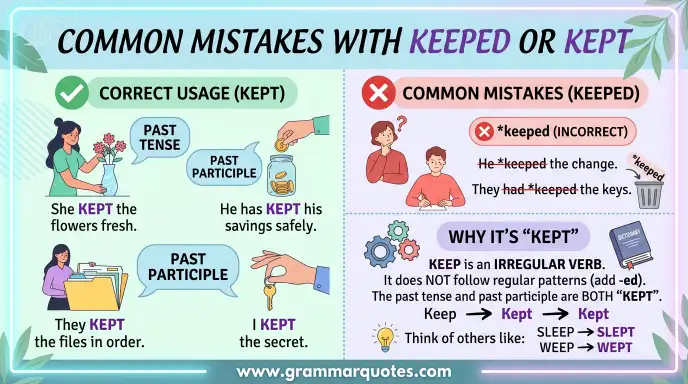
Mistake 1: Adding ed
❌ He keeped the money.
✅ He kept the money.
The verb “keep” is irregular.
Mistake 2: Using “Keep” for a Completed Past Action
❌ Yesterday, I keep the letter.
✅ Yesterday, I kept the letter.
Because “yesterday” refers to the past, the correct form is kept.
Mistake 3: Using “Keeped” After Have
❌ She has keeped her promise.
✅ She has kept her promise.
Mistake 4: Confusing Keep and Kept
Compare:
I keep my passport in a safe place.
Present/general situation.
I kept my passport in a safe place yesterday.
Past situation.
Keeped or Kept in Everyday Examples
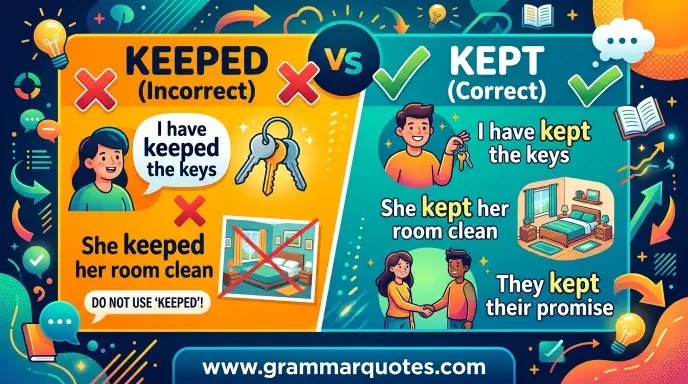
Here are some natural examples you can use in everyday English.
At School
I kept my notes in my backpack.
At Home
She kept the keys on the table.
At Work
He kept the documents in a folder.
In Conversation
I kept thinking about your advice.
In Writing
The company kept its promise.
With “Have”
I have kept all the important emails.
British English vs American English
There is no difference between British and American English when it comes to the past tense of keep.
Both use:
keep → kept
Examples:
- British English: I kept the receipt.
- American English: I kept the receipt.
“Keeped” is not the standard past form in either variety.
So if you are writing for a British, American, Canadian, Australian, or international audience, kept is the correct choice.
Which Word Should You Use: Keeped or Kept?
Use kept whenever you need the past tense or past participle of keep.
Use keep for the base form and many present tense situations.
Quick Examples
Present:
I keep my phone with me.
Past:
I kept my phone with me yesterday.
Present perfect:
I have kept my phone with me all day.
Remember:
Keep → Kept → Kept
This is the easiest pattern to memorize.
How to Remember Keeped or Kept
A useful trick is to connect keep with another irregular verb that has a similar pattern.
For example:
- sleep → slept
- keep → kept
Both words contain a similar eep sound in their base form and change to an ept ending in the past.
You can remember:
Sleep → Slept
Keep → Kept
This can help you avoid accidentally saying “keeped.”
Keeped or Kept: Comparison Table
| Feature | Keep | Kept | Keeped |
| Standard English | Yes | Yes | No |
| Base form | Yes | No | No |
| Past tense | No | Yes | No |
| Past participle | No | Yes | No |
| Present example | I keep it. | — | — |
| Past example | — | I kept it. | ❌ I keeped it. |
| Correct form | ✓ | ✓ | ✗ |
Keeped or Kept : Google Trends & Usage
The search phrase “keeped or kept” reflects a common grammar question among English learners. People often search for the correct form because “keeped” appears to follow the regular ed pattern.
However, English irregular verbs do not always follow predictable rules. Kept is the established standard form of the past tense and past participle of “keep.”
Search popularity can vary by country and time. Exact Google Trends figures should be checked for a specific location and date range rather than assuming a fixed search volume.
People Also Ask Questions About Keeped or Kept
1. Is “keeped” a correct word?
No. Kept is the standard past tense and past participle of “keep.”
2. Is it “keeped” or “kept”?
Kept is correct.
3. What is the past tense of keep?
The past tense of keep is kept.
4. What is the past participle of keep?
The past participle of keep is also kept.
5. Can I say “I keeped it”?
No. Say “I kept it.”
6. Why is keeped not correct?
Because “keep” is an irregular verb and changes to kept in the past.
7. Is “kept” present or past tense?
Kept is the past tense and past participle of “keep.”
8. Is “I have kept” correct?
Yes. “I have kept” is grammatically correct.
9. What is the correct form of keep in the past?
The correct form is kept.
10. What is the difference between keep and kept?
Keep is the base/present form, while kept is the past tense and past participle.
Frequently Asked Questions
Is keeped ever correct in English?
Not in standard modern English. Kept is the correct form.
Is “kept” an irregular verb?
Yes. “Keep” is an irregular verb because its past form is kept, rather than “keeped.”
What are all three forms of keep?
The three main forms are:
Keep : Kept : Kept
Is “kept” always past tense?
“Kept” can function as both the simple past form and the past participle.
For example:
I kept the book.
Simple past.
I have kept the book.
Past participle.
Why do people say “keeped”?
It is usually a grammar mistake caused by applying the regular ed rule to an irregular verb.
Final Comparison: Keeped or Kept
The correct word is kept, not keeped. “Keep” is an irregular English verb, so its past tense does not follow the common rule of simply adding ed.
Use keep when you need the base or present form:
I keep my books here.
Use kept when talking about the past:
I kept my books there yesterday.
Use kept as the past participle after words such as “have,” “has,” and “had”:
I have kept my books safely.
The easiest pattern to remember is:
Keep → Kept → Kept
Once you memorize this irregular verb, you will know immediately that “keeped” is not the standard form.
Conclusion
The keeped or kept question has a simple answer: kept is correct, while keeped is incorrect in standard English. The verb “keep” is irregular, which means it does not form its past tense by simply adding ed.
Use keep for the base and present form, and use kept for both the past tense and past participle. For example, “I keep my notes here” describes a present or general situation, while “I kept my notes there” describes something in the past. Similarly, “I have kept my notes” uses kept as a past participle.
A simple way to remember the rule is keep → kept → kept. You can also connect it with the similar pattern sleep → slept.
Whenever you are unsure if to write keeped or kept, choose kept for a past action. This small grammar rule can help make your schoolwork, emails, conversations, and other English writing more accurate.
Discover More Articles!
Parfum or Toilette: What Is the Difference?(2026)
May vs Might: When to Use May and Might(2026)
Coat or Jacket: Style, Fit, and Usage Compared(2026)

Ethan Parker is an English-language writer known for his interest in words, language, and clear communication. His work focuses on making everyday English easier to understand through simple explanations and practical examples.